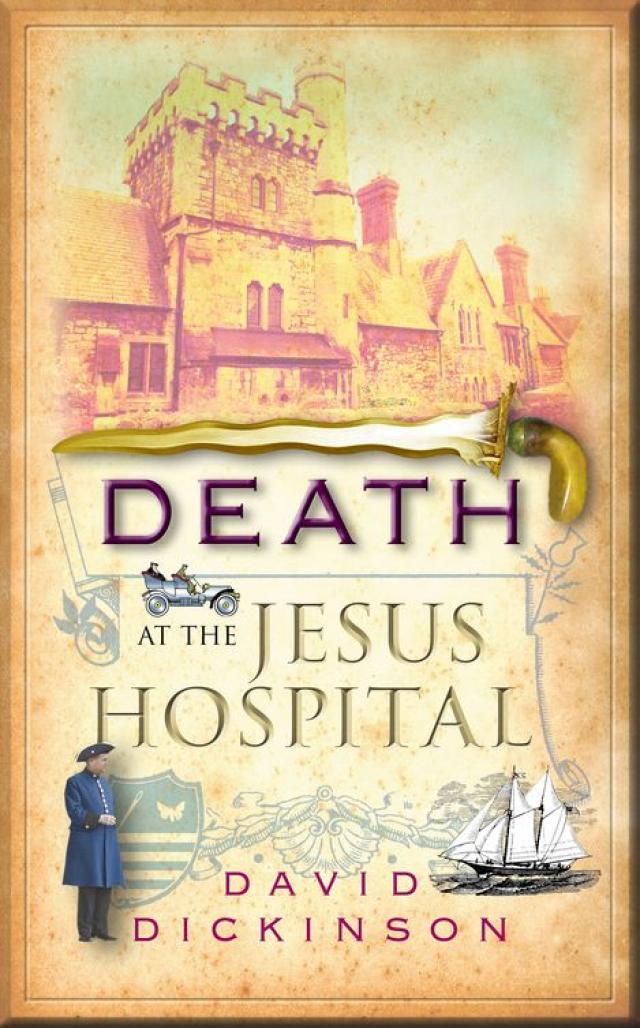
Death at the jesus hospi.., p.21
Death at the Jesus Hospital lfp-11,
p.21


‘Don’t worry about that, Mrs Lewis,’ said the sergeant. ‘We’re engaged on a murder investigation here, nothing to do with taxes.’
‘Thank goodness for that,’ said Mrs Lewis. ‘Now where was I?’
‘You were talking about your meeting with Mr Gill.’
‘Ah, yes. I think we grew close when we were working on the arrangements for the Harvest Festival. It was as if love was blossoming among the fruit and vegetables dotted around the church. After that Roderick used to come to my house after we had a few drinks in the Farmers’ Arms together. Roderick would drink Guinness and I would have a glass of port — Horace introduced me to port years ago — and things progressed from there.’
‘When did you become engaged, Mrs Lewis?’
‘I’ll always remember that, Sergeant. It was after the midnight carol service on Christmas Eve. We were sitting together near the front. I remember thinking that Roderick was coming close to me during “Oh Come all ye Faithful”. Then he came even closer when we were singing “Hark the Herald Angels Sing”. And then, would you believe this, Sergeant, he actually held my hand while we were singing “Silent Night”! Discreetly, of course, not so people could see. I wondered if he was going to propose while we were in church, in “It Came Upon the Midnight Clear” perhaps, but he waited till we were home again.’
The sergeant wanted to ask if the school bursar stayed the night on these romantic evenings, but he thought it better not.
‘Have you told your children about this?’
A small cloud seemed to pass across Mrs Lewis’s features. ‘Well, I did, actually. I think it’s fair to say that neither William nor Montague ever understood Roderick. They never liked him. It was so unfair. Roderick tried so hard.’
‘Did you have rows about it, Mrs Lewis? Sorry, but we have to ask questions like these.’
‘I expect somebody has been telling stories out of school at the Farmers’ Arms. Quite why these snooping people have to listen in to private conversations I’ll never know. Yes, there was a row.’ For the first time in the conversation Mrs Lewis seemed to have lost the power of speech.
‘Was the row about money? About who you were going to leave the shares to?’
‘My goodness, they were listening carefully, weren’t they! Yes, it was. What you must understand is that Horace left the two boys very well off. Each of them has as many shares in the business as I have, if not more. Neither of them has to work at all. So I can’t see why they were so cross when I said I was going to leave my shares to Roderick after we were married and I made a new will.’
‘But you didn’t. Get married, I mean, did you, Mrs Lewis? You didn’t have much time between the engagement and the murder.’
‘No,’ said Mrs Lewis sadly, ‘we didn’t. Such a pity as I’d seen a very beautiful hat over in Norwich. I was so looking forward to getting married in that hat.’
‘And tell me, pray, the will you already had in place, the one that was valid when Mr Gill was killed, where did that leave the money?’
‘That went to the two boys, all of it. I hadn’t even met Roderick when I made that will.’
‘I’ve nearly finished, Mrs Lewis, just one last thing, if I may. Could you just give me the address or addresses for the boys? I don’t think they live locally, do they?’
‘Montague lives at fourteen North Road in Highgate near the school, and William lives at thirty-four Noel Road in Islington. Such pretty houses they have. Now then, will you take a glass of Madeira before you go, Sergeant? A small sherry? I usually have a little tipple about this time!’
The sergeant declined. As he made his way back to the station he wondered if Mrs Lewis realized the import of what she had told him. She had just pointed out that her two sons, singly or together, had very powerful motives for murder.
Powerscourt discovered to his great delight that M. Olivier Brouzet, director general of the French secret service, was not at his elegant headquarters in the Place des Vosges in Paris. He was in London, conferring with his English counterparts. He met Powerscourt in a charming room, hung with Gobelin tapestries, in the French Embassy.
‘Thank you for your note, how pleasant to meet you again, Lord Powerscourt.’ Olivier Brouzet was still slim and dapper with a charming smile. ‘You mention you have been having trouble with secrecy in your secret service? Is that so, Lord Powerscourt?’
Powerscourt explained about the murder at the Jesus Hospital and the two further murders at places connected with the Silkworkers Company. He mentioned the strange marks on the dead men’s chests. He told Brouzet about meeting Colonel Arbuthnot outside the almshouse and his great reluctance to give any details of his interest in the victim and the manner of his death. And he passed on his latest intelligence about the highly suspicious trip to Hamburg and the meeting in London that infuriated Abel Meredith. He complained about the secrecy in the organization he had served.
‘Maybe you should make allowances, my friend. This secret organization of yours is very young. Perhaps they do not yet know how to behave.’
‘Colonel Arbuthnot hinted that Meredith might have been turned into a double agent by the Germans. Do you think that is possible?’
‘Anything is possible in this secret world, my friend. This Meredith would seem to have been used as a courier, but then the colonel more or less admitted that, did he not, when he said his service sometimes used the Silkworkers as messengers. It’s quite smart, I think. Maybe we should infiltrate our winegrowers’ fraternities and use them to take messages to and from Germany under cover of friendly visits to the vineyards of Hock and Moselle. In the world of espionage, Lord Powerscourt, if you look at things very closely for a long time you may end up entertaining the most fantastical notions. You can think you are going mad, and some of us do. It becomes like a repeating image in a hall of mirrors. The man is a double agent, no, he is a triple agent, you can go on for ever. Certainly the British have turned quite a lot of people in recent times. Betraying your country is often preferable to four years in some ghastly English prison where the inmates will beat you up all the time for being a German spy. Patriotism flourishes in the most unlikely places.’
‘What would you advise, Monsieur Brouzet? Should I take this spying business seriously or not?’
‘That is a difficult question, my friend. Part of the difference between our two countries on espionage-related matters is that of geography. You have the waters of the North Sea between you and the Kaiser. For us, he is, literally, next door. That is why I think these matters are taken more seriously in France than in Britain. Let me ask you a question. From what you have told me, you think these mysterious marks hold the key to the crimes, the fact that all three corpses have been defaced in the same way. Is that right?’
‘It is,’ said Powerscourt, wondering where this French logic might be taking him.
‘Well, my friend, it seems unlikely to me that all three dead men were involved with the secret service and acting as couriers to Germany and back. I do not believe the Germans would come all this way to kill all three of them. I think that’s very unlikely. So I think you should not close your mind to the possibilities of espionage in this case, but I do not think it should be at the forefront of your mind either. I tell you what I will do. Quite soon I have a meeting with the superior officer of this Colonel Arbuthnot. I shall ask him about events at the almshouse. I shall tell him that we had an agent holidaying at your Elysian Fields Hotel who heard about the murder inquiry and reported back to us. I shall, of course, let you know what he says.’
Inspector Fletcher had never interviewed a professional mistress before, if that was what she was. He wasn’t quite sure if she had committed any crimes. The young lady had blonde hair and bright blue eyes and went straight on to the attack as if she were a professional boxer.
‘Hey,’ she said, ‘are you in charge round here? That man of yours, Constable whatever his name is, he seems to have lost the power of speech.’
‘I am the senior investigating officer, looking into a case of murder. Fletcher is my name. I’m an Inspector.’
‘Good for you. Well done. Nobody’s mentioned murder round here to me. Everybody’s still alive in this hotel as far as I know. Some of them may be bloody old but they’re not dead yet. Not quite. My name’s Francesca, by the way, my friends call me Frankie. I don’t know nothing about this murder, wherever it was. Why can’t I go home? You’ve got no cause to hold on to me. I’ve got work to do.’
‘I’m sure you do. What kind of work do you do, Miss Francesca?’
‘I’m a masseuse. And I do occasional escort work sometimes. If the money’s right. Do you need a massage, Inspector? You look pretty tense to me.’
‘I’m fine, thank you,’ said the Inspector. ‘I wonder if you could tell me about your relationship with one of the directors here, Sir Peregrine Fishborne.’
‘What’s it got to do with you, my relationship as you call it, with old Fishcake? None of your bloody business.’
‘There you’re wrong. The murder we are investigating took place at an almshouse not far from here. Sir Peregrine was here at the hotel the night of the murder. We think you may have been with him. The date of which we speak is January twenty-second.’
‘I may have been with him that night,’ Francesca said, ‘and I may not. I can’t be expected to remember exactly where I was all the time. I still don’t think it’s any of your business.’
‘Did you come down with Sir Peregrine in his car? Or did you make your own way here? It was a Saturday. The hotel people remember you being here. In the Baron Haussmann Suite.’
‘What if I was?’
‘Could I ask you what you were doing with Sir Peregrine so late at night?’
‘You may. He needed a massage. He often sends for me here when he needs a massage. He’s got a terrible back, old Fishcake, just terrible.’
‘I see,’ said the Inspector. ‘And does the treatment involve you staying the night?’
‘You’re the nosey one, aren’t you? Course it does. Sometimes the treatment doesn’t work first time round. You have to do it again. “Frankie,” old man Fishcake would say to me, “despite your best efforts, I’m afraid it hasn’t taken. One more time if you please.” And usually he needs it again in the morning. Help him through the day, that sort of thing. What’s he done anyway, my client? You’re not suspecting him of the murder, are you?’ With that Francesca began to laugh. ‘All the time he’s lying there, scarcely able to move, you think he’s off up at the almshouse killing somebody? Don’t be ridiculous!’
‘Can you remember, Miss Francesca, if Sir Peregrine required further treatment in the morning? Can you remember what time he left the hotel?’
‘There is one thing you can say about old Fishcake, he’s very regular in his habits. He always wants it in the morning, the treatment, I mean. Never known him not to. He usually left very early in the morning after I’d seen to him. Seven o’clock? Eight o’clock? Sometimes earlier, sometimes later. His back was so bad one day recently I had to stay till ten o’clock.’
‘Has this masseuse duty been going on for long, Miss Francesca?’
‘Long enough, Inspector. There are times when a girl might like to be pummelling something younger, if you follow me, but I can’t complain. I’ve been seeing to him for about six months, I should say.’
‘How does he get in touch with you, Miss Francesca?’
‘You’re getting very cheeky, young man. I shall answer this question and then no more. He’s lent me a flat so I can treat him there when he needs me to. Just off the Strand. And he’s installed one of those telephone things so he can call when he needs me. That’s your lot, sunny Jim. I’m off.’
The constable and the Inspector made their way back to the station.
‘Do you know, sir, I’m not feeling too good,’ said the constable.
‘I’m sorry to hear that,’ said Inspector Fletcher. ‘What seems to be the trouble?’
‘It’s my back, sir. I seem to have twisted something. I think I need a massage.’
14
Inspector Grime of the Norfolk Constabulary hated London. He had hated it ever since his father took him there as a treat when he was seven years old. Master Grime had been accidentally separated from his father in a huge shop in Oxford Street and it had taken four very frightening hours before they were reunited. He disliked the noise, the clamour of streets too full of cars and carriages and carts and humans. He disliked the crowds rushing around on missions he did not understand. He disliked Londoners. He thought they were slick, superficial, devious and would rob you of your last farthing if they had a chance.
Now, stuck in a cab at eleven o’clock in the morning between Liverpool Street Station and Noel Road in Islington, home of William Lewis, son of the merry widow in Fakenham, he cursed the traffic that was making him late for his interview, arranged by telephone the afternoon before. Damn London, said the Inspector. At least I’ll be out of here this evening after I’ve seen the other Lewis up in Highgate.
William Lewis ushered him into an upstairs drawing room that looked out on to a garden and the Regent’s Park Canal. ‘You’ve come a long way to see me, Inspector, it must be important. Would you like some coffee?’
‘Thank you, but no,’ said the Inspector. ‘I’m sorry to have to ask you personal questions, but this is a murder inquiry. I wonder if you could tell me about how your mother coped after your father died. In a general way, if you see what I mean.’
‘Have you met my mother, Inspector?’
‘I’m afraid I haven’t had that pleasure yet, Mr Lewis. My sergeant went to talk to her and reported back.’
‘Pity, that,’ said William Lewis. ‘Things might have been easier if you had. Let me try to answer your question, Inspector. My mother is a creature of fancy. My father once referred to her as being blessed with an iron whim. She gets ideas into her head. And unlike a lot of women who are content to leave the idea where it is, she acts on them. Not all the time, just most of the time. My brother and I — he’s the elder, by the way — tried to persuade her to stay where she was after our father passed away. The house was more than adequate for her needs. I’m not saying she had a lot of friends, but she knew a lot of people round there. But no, that wouldn’t do. Sell the house, move to Fakenham — why Fakenham, for God’s sake? She was going slightly mad.’
‘When you refer to her going slightly mad, sir, what do you mean? Was she behaving out of character?’
‘I think you could say she was behaving entirely in character, that was the trouble. Who in their right mind would want to get involved with an ageing bounty hunter who stalked his victims over the flower rotas and the Harvest Festival at the local church?’
‘I hope you won’t mind my asking, sir, but did you meet Mr Gill the bursar? What did you think of him?’
William Lewis snorted. ‘He was awful. Creepy, sucking up to my mother all the time, calling her darling and my love and all that sort of stuff. You could tell a mile off that he was only interested in the money.’
‘So what did you and your brother do about it?’
‘We tried, Inspector, we tried. God knows we tried to talk some sense into her. What did she think she was doing, marrying this useless specimen of humanity? And if she did have to marry him, why did she have to leave him all her money? What would Father have thought of it?’
Inspector Grime had a sudden vision of Horace Lewis, obsessed with the sale of his undergarments, supposedly up a ladder in the stockroom with a very pretty girl beside him.
‘We can get the exact figures from the solicitors, Mr Lewis, but I wonder if you could tell us exactly how much money we’re talking about here. In the shares and the property?’
William Lewis looked out of the window. A barge was making slow passage towards the long tunnel at the top end of Noel Road. ‘You may find this hard to believe, Inspector, but I don’t know. Truly I don’t. I could never keep up with the numbers at school. My brother Montague looks after all that. I know I have enough to live comfortably off the shares.’
‘Could I ask you to tell me how you felt about Mr Gill, sir? Did you dislike him? Did you hate him?’
William Lewis wasn’t going to own up to hatred. ‘Dislike would do it, Inspector,’ he said. ‘Extreme dislike, maybe.’
‘Did you kill Roderick Gill, Mr Lewis?’
‘I did not.’
‘Could you tell me where you were on the afternoon and evening of January twenty-second?’
‘Of course. In the afternoon I went for a walk, as I usually do, Inspector. I spent the evening with my brother. We played chess.’
‘Who won?’
‘I did, Inspector. It was quite a long game. In the end I captured his queen with a fork and that was the end of my brother. On the chessboard, I mean.’
Forty minutes later Inspector Grime was in the small library at 14 North Road, Highgate, home of the mathematically minded Montague Lewis, elder son of Mrs Maud Lewis of Fakenham. The conversation followed remarkably similar lines to the earlier interview in Noel Road. Montague Lewis, like his brother, thought his mother had gone slightly mad. He could see no reason why she wanted to marry this wretched bounty hunter. The Inspector noted that they used exactly the same word to describe Roderick Gill. It could have been collusion before he arrived, or it could have been the way they had talked about him for months.
‘How would you describe your feelings towards Roderick Gill, sir? Dislike? Loathing? Hatred?’
‘I don’t think I’d go as far as that, Inspector,’ said Montague Lewis. ‘I despised him, that’s the best way to put it, I think. I despised him for creeping round my mother the way he did, I despised him for insisting they get married as soon as possible.’
‘Did you kill him?’
‘I did not.’
‘Could you tell me your whereabouts on the afternoon and evening of January the twenty-second?’