The mycroft holmes caseb.., p.24
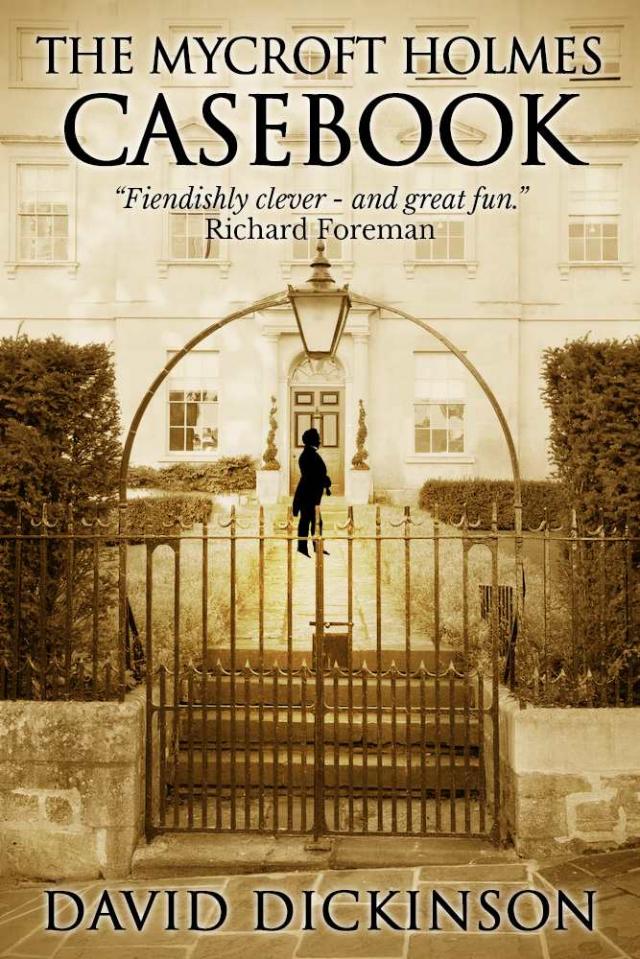
The Mycroft Holmes Casebook,
p.24


“Lestrade, that’s the fellow’s name. Inspector G Lestrade. Do you know by any chance what the G stands for, Mr Holmes?”
Only now, leaning forward for a closer look at his guest, did Valentine Delaney realise that Mycroft was fast asleep and looked like he had been fast asleep for some time.
Tobias did not have any double doors in his quarters. He did not have a balcony either, or even a living room. His room was up with the servants in the attics on the top two floors of the hotel. There was a small bedroom with a single bed and a tiny cupboard for his clothes. A mean window looked out, not on to the sea front and the Channel, but onto the rear quarters of the hotel next door. Shaky fire escapes that had once been black festooned the sides of the building. Right at the bottom was a great container filled with the rubbish from the hotel. Looking out at the feral cats and the seagulls swooping low to search for new booty, Tobias thought about the cases he had known with Mycroft and the ones he had read about by Dr Watson concerning Mycroft’s brother. Always, he told himself, as the seagull chorus turned from a chamber ensemble to a full orchestra with the arrival of a fresh consignment of refuse from the kitchens, there was a key to the mystery, a phrase, a look, a forgotten piece of history, a clue that the Holmeses spotted long before anybody else. Tobias knew that the medicines, the rows of bottles and phials in Mycroft’s bathroom, were probably keeping him alive. But he very much doubted whether they were making him better. What was the answer? What was the secret? As he closed his window and climbed into his small bed, Tobias’s brain was working at the speed that had won him the first place of his year in the Mathematics Tripos at Cambridge several years before.
Very early the next morning word went out to the leading jewel and diamond merchants in London’s Hatton Garden, to their equivalents Holbein and Neeskens in the world’s diamond capital, Antwerp, to Fassbender and Rauch in Vienna, to Yusupoff, Yusupoff and Yusupoff in St Petersburg, and to Goldsmith, Goldfarb and Himmelstein, dealers in precious jewels in New York City. The message was the same. ‘White Pearls of the Romanovs have vanished in Brighton, England. Please report any interest, or scintilla of interest, to Inspector Lestrade, Scotland Yard, London.’
There was a sharp knock on the door of Mycroft’s suite just before nine o’clock. The visitor did not wait for a reply.
“Mycroft, Mycroft, you know my methods! Never send a letter when a telegram will do. Never send a telegram when you can make a personal appearance. How good to see you up and dressed at a time like this! I rather feared you might still be abed like the tramps in the doorways I passed on my way from the station.”
Sherlock Holmes was dressed in a dark suit with a long frock coat and a white shirt. He carried a fierce looking stick in his left hand, as if highwaymen and footpads might beset a man on the Brighton seafront. Mycroft, wearing a double breasted grey suit with a Diogenes Club tie, nodded wearily and ushered him to a small dining table by the window.
“Breakfast should be here any minute, Sherlock,” he said, with the air of a man who might just have completed a marathon race, “I’m sure Tobias here can order another helping.”
“Capital, capital!” cried the younger Holmes five minutes later, attacking a plate of eggs, bacon, sausage and tomato with great vigour, “an early start gives a man a good appetite. Did I tell you that I missed a golden opportunity to make a fortune last week?”
Mycroft, picking at a lightly boiled egg, shook his head.
“Watson put me onto it, but you know my views about correspondence. Too boring to read, most of it. So I didn’t open his letter until it was too late.”
Sherlock Holmes leant forward and helped himself to another couple of sausages. “You remember the case, years ago now it must be, of Silver Blaze, the missing racehorse named after his white forehead? How his trainer was murdered and the horse apparently vanished only to reappear at the very last minute in time to win the Wessex Cup at Tavistock Races? Well, Watson is something a dark horse himself when it comes to the turf and he maintains a close, if well hidden, interest in current form. He wrote to tell me that Silver Blaze, after his triumphs on the flat, had been put out to stud, and one of his progeny, Flower of Silver, by Silver Blaze out of Dartmouth Flower, was making his first appearance at this year’s Wessex Cup. Apparently he shares the same streak of white on his forehead as his forebear, but very few racing fans were prepared to invest in a horse on his very first outing. Watson put twenty pounds on at fifteen to one and suggested I did the same. The horse, of course, won by eight lengths and is the toast of Devonshire. Watson is the toast of his bank manager with three hundred pounds to his name. I missed my chance. Never mind.”
Sherlock Holmes sprang from his chair and flung one set of double doors open. He strode rapidly onto the balcony and peered about him in all directions.
“Policemen, my dear Mycroft, policemen everywhere. I did not think Brighton contained so many officers. And the newspapers tell me that more are expected from London later today. Have you formed an opinion on this singular case, brother? Have you kept yourself informed?”
Mycroft stared sadly at the carpet. “The hotel manager came to tell me about it yesterday evening, but I’m afraid I fell asleep.”
“Never mind,” said Sherlock Holmes, “such women as this Duchess of Alcester are very dangerous. They are a peril to the rest of society. The good Watson was not putting words into my mouth when he reported my comments on a similar specimen, Lady Frances Carfax, and she nearly ended up being buried alive:
‘One of the most dangerous classes in the world is the drifting and friendless woman. She is the most harmless and often the most useful of mortals, but she is the inevitable inciter of crime in others. She is helpless. She is migratory. She has sufficient means to take her from country to country and from hotel to hotel. She is lost, as often as not, in a maze of pensions and boarding houses. She is a stray chicken in a world of foxes. When she is gobbled up she is hardly missed. I much fear that some evil has come to the Lady Frances Carfax’.”
“You must have set eyes on the Alcester woman, Tobias,” Mycroft said, “what did you think of her?”
“She wasn’t wearing the pearls when I saw her,” Tobias replied, “but she did have some enormous cameo round her neck.”
“Did she indeed,” cried Sherlock, striding out to the balcony and back, his hands clasped tight together behind his back, “do you suppose that she had a fixed plan, a rota if you like, for wearing the baubles? Cameo on Monday, pearls on Tuesday, diamonds on Wednesday, that sort of thing? Great God, you don’t suppose the thieves got the wrong day, do you? They thought they were going to pinch the great emerald of the Nizam of Hyderabad and got the Romanov Pearls instead?”
“You don’t think that would imply a fixity of purpose not always found in the female of the species?” Tobias ventured, thinking of his mother and her three sisters together, “I mean, she might make the plan but would she stick to it?”
“Well done, Tobias, well done indeed! You are coming along very well, I must say. I fear you may be right. Now then, Mycroft, I’m sure those damned doctors say you need exercise. They’re always saying you need something you haven’t got or don’t want. A quick stroll up the pier? Morning greetings to the seagulls and the fishermen? What do you say?”
“I’m afraid Tobias normally takes me out to the balcony in my chair at this time. I fear the pier would be too much for me.”
“Very well,” said Sherlock Holmes, darting to the wheel chair and pushing it out to the furthest end of the balcony. “But you must walk this far, Mycroft, it will do you good. Tobias, will you be so kind as to accompany me to the far limit of the West Pier beyond the bandstand? Maybe I shall meet a fortune teller. I have always placed high hopes in that profession. Far more reliable than the bishops, in my opinion.”
Mycroft Holmes picked up his walking stick and made his way slowly out to his wheelchair on the balcony. It was a beautiful spring morning. The sky was blue, flecked with groups of brilliant white clouds. The sea was a darker blue with a couple of coastal steamers far out in the channel, puffing tiny dots of smoke into the air. Closer in a couple of fishing boats were clawing their way along the coast towards Rottingdean. But Mycroft felt the same colour as his suit. His cloth was grey, his mood was grey, his heart was grey. He thought he would go on feeling grey till the end of his days.
He spotted his two companions striding out along the pier. He would have known his brother’s walk anywhere. Tobias seemed quite small and insignificant beside him. But if Mycroft had been looking through a pair of field glasses or a telescope, he would have noticed something rather surprising. The person doing most of the talking, gesticulating fiercely from time to time with his left hand, was not the great consulting detective, but his own assistant, young Tobias.
“Sea air, sea air, how refreshing it is!” cried Sherlock Holmes on his return. “I must get back. Hundreds, if not thousands, of my bees will have perished while I have been away. I am sad to see you laid so low, brother. I fear your chances of regaining the Baker Street Cup must have gone for ever.”
The Baker Street Cup was a real silver cup given to the winner of the annual series of Test Matches at chess the brothers played every year. Some were played in the conventional manner, others as chess without boards. The title had gone the previous year to Sherlock by four matches to three, with the decider played at a long lunch with no board at Simpsons in the Strand. Now the younger brother was claiming the title in perpetuity.
“I don’t mind, Sherlock,” said Mycroft sadly, “I don’t really care about chess anymore.”
“How I hate illness,” said Sherlock Holmes as he and Tobias walked down the grand staircase to say goodbye, “how I hate seeing people who are ill. Let me know how it goes, won’t you? The Alcester case might revive him, you never know.”
With that he shook Tobias by the hand just outside the front door and turned left along King’s Road en route to West Street and Queen’s Road where the railway waited to take him back to his bees.
Inspector Lestrade arrived shortly after lunch wearing a fine new suit, slightly marred by a stain upon the lapel and devalued altogether by a brand new boater, purchased, Tobias surmised, at Victoria Station in honour of the trip to the seaside. In his wake came Inspector Bramble of the Brighton constabulary, a barrel shaped man with a large moustache and a diffident manner. In deference to his high regard for all Holmes brothers, irrespective of health, Lestrade insisted that all conferences be held in Mycroft’s rooms with Mycroft and Tobias in attendance. Also present was hotel manager Valentine Delaney, clad in a light grey suit purchased in Rome with a red rose in his buttonhole. Tobias wondered if he doubled as the hotel gigolo in his spare time.
“I hope you are making good progress here, Mr Holmes, in these splendid rooms,” Lestrade began. “Carrie, the wife, swears by Brighton as a place of recuperation after it cured her grandfather of the gout many years ago. Do you have any questions for the moment?”
Mycroft shook his head sadly. Tobias had watched him picking at an excellent chicken salad at lunchtime. Even a strawberry trifle, a speciality of one of the junior chefs, had been totally neglected.
“I’m sure you will have some wisdom for us later on,” said Lestrade cheerfully, “if I could begin with you, Mr Delaney, there are a number of points of interest about your hotel I should like to ask you about. Perhaps you could just give us the general background?”
Delaney purred slightly, as if he were a very expensive motor car preparing to move off. “Of course, Inspector, of course. Founded in the eighteen sixties. Still owned by the same family, who also own Browns Hotel in London and the Meurice in Paris.”
Even the mention of one of the gastronomic capitals of Europe failed to make an impact on the invalid. Tobias made a private bet with himself that his employer would be fast asleep by three o’clock.
“The Majestic,” Delaney carried on, “has been upgraded and improved with the passing years. It still has two hundred and one rooms with five suites available. There are six major reception rooms looking out over the sea and a billiards room. We were the first hotel in the county to install electric light and the first to install a lift. We have higher rates of re-occupancy, people coming back to us year after year, than any other hotel in England.”
“Mycroft raised this with me the other day,” said Tobias politely, “he wondered if it had to do with the staff recruitment policy. Everybody visible, he said, waiters, chambermaids and so on, seems to be aged between sixteen and twenty five and very physically attractive. Mycroft thought it must be deliberate.”
Valentine Delaney laughed. “What it is to have the brain of a Holmes in our midst,” he cried, with just a hint of annoyance. “Mycroft is right, of course. I myself and a much younger man from the accounts department interview all the young ladies, and our housekeeper and one of the chambermaids interview all the young men. You will see, if you look closely,” Delaney coughed a little at this point, “that we have a lot of middle aged bachelors and aging widowers among our guests. The same is true on the distaff side. We have not, of course, asked them why they return over and over again, but people have been known to confirm that Albert with the blond hair is still waiting at table, that sort of thing. I may say that two of our young people employed in front of house have made very advantageous marriages in recent years. We offer them a special discount rate for the wedding and reception, of course. Happy families by the sea.”
“Was the Duchess of Alcester a regular visitor?” Lestrade cut in.
“She was, as a matter of fact. This was her fourth year in succession.”
“And was there a particular young man on display who caught her fancy? A Lothario of the Lanes you have here in Brighton? The seducer on the seafront?”
“I do not know,” Delaney shook his head. But some of his own putative gigolo connection must have returned. “But which of us can tell the secrets of a lady’s heart?”
“Quite so, Delaney, quite so,” said Lestrade testily. “Did she always stay at the same time of year?”
“It was always in April or May, I believe. After her stay here she usually went to take the waters in Marienbad or some other Continental spa.”
“In other words,” Inspector Bramble had a very deep voice like a basso profundo, “any thief with half a brain could have worked when she would be here with her jewellery collection and made their plans accordingly?”
“That would certainly appear to be the case,” Valentine Delaney was crossing one elegant trouser leg over the other, “but the reality is slightly different. Every time the Duchess comes I plead with her to put the valuables in our safe, or entrust them to the police. She has always refused. Theft of such valuables from a hotel of quality like ours is not good for the reputation on which we depend for our clients and our custom. We have contingency plans. The Duchess was encouraged to eat in the seclusion of the Fitzherbert Suite rather than in the main body of our dining room so that if she were to be robbed, at least it would not be in front of a couple of hundred people. We have rehearsals in the event of a theft as you saw with two of my people going to guard the doors once the lights went out. We have a direct line to the nearest police station, which is why so many officers arrived so quickly. Unfortunately, our efforts have not been successful. The necklace is still missing.”
“And what about the black-out?” Lestrade was back in the hunt. Tobias remembered Dr Watson telling him that Lestrade’s nickname among the criminal fraternity was The Holloway Ferret and he certainly had a remarkable similarity to one of those small animals as he pursued the hotel owner back to his lair.
“I wondered when you were going to come to that. There have been two black outs like that since Easter. The hotel engineers can find nothing wrong with the various mechanisms. They insist the incidents are man-made. After the last one I had them establish a connection with the Bristol next door which would cut in almost immediately if our own supply went down. I believe this thwarted the thieves in their plans and prevented their getaway.”
“But it means,” boomed Inspector Bramble, “don’t you see, it means that there is yet another criminal, apart from the one or two in the Fitzherbert Suite? We could be dealing with a gang of three or even four, rather than two.”
A low moaning sound began to spread across the room from the deep sofa where Mycroft Holmes had been listening, or not, to the proceedings. The Government Auditor had fallen asleep. It was a quarter to three. Tobias hid a grin behind a mild fit of coughing.
“Damn,” said Lestrade, “there were one or two questions I wished to raise with him, even in his weakened state. Talking of gangs, by the way, gentlemen, I checked with the records department of Scotland Yard before I came down here. There are three known jewel thieves they believe could have carried out this job. Nobby ‘The Safe’ Symonds from Bethnal Green, Light fingered Lionel from Lewisham and Diamond Jack from up Arsenal way. I took the liberty of taking a look in your visitor’s book while I waited for the good Inspector here and a John Joseph Smith, one of the favourite noms de plume of Diamond Jack, stayed here for four days at the beginning of this month. Brought his wife too, cheeky blighter.”
Inspector Bramble whistled. Mycroft began to snore rather loudly. Tobias shook his head in despair.
“Gentlemen,” said Delaney, shaking out his trousers as he rose to his feet, “I feel we should leave. Perhaps we could meet here again at six o’clock this evening when our friend will be rested and may be able to give us some assistance.”
A messenger boy came in with a letter as the others were leaving. It was addressed to Herr Mycroft Holmes in a Gothic Germanic script. Tobias was deeply suspicious of this missive but felt he should wait until Mycroft was awake. Tobias was to tell Lestrade later that if his master had known what was inside he would have stayed asleep.
The message was quite short, as Tobias read it out later at Mycroft’s instructions. There was no address at the top, only the legend The Fatherland in large capitals. It came from one of Mycroft’s most fearsome opponents, the criminal mastermind from Germany usually referred just as the Count.