Bullets for the bridegro.., p.1
Bullets for the Bridegroom,
p.1
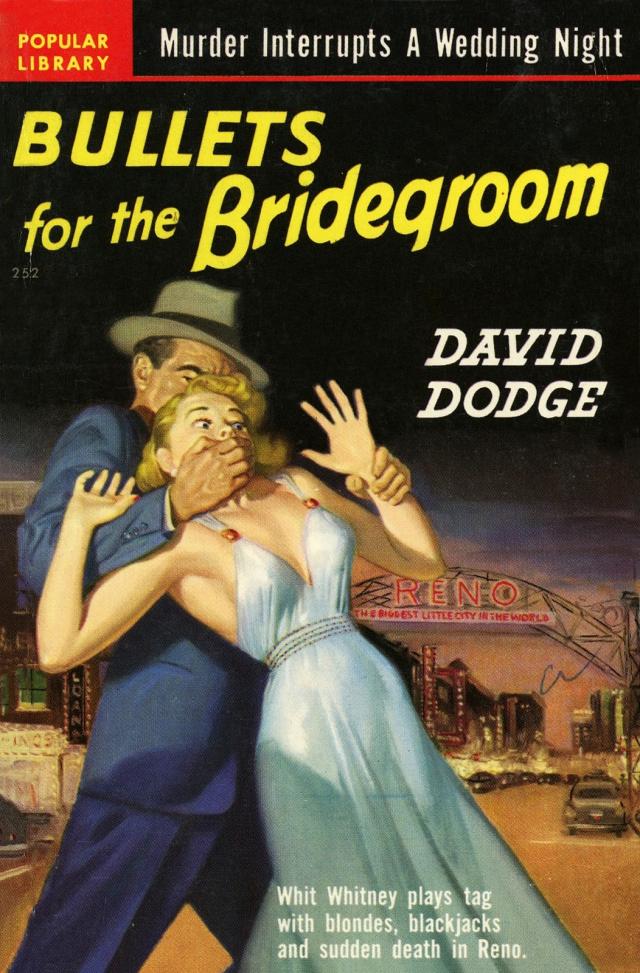


Quiet, peaceful honeymoon? not on your life, unless bouncing baby-faced blondes, disguised G-men, espionage, night-clubs, and finally murder are quiet and peaceful. James Whitney and Kitty found themselves involved in the efforts of the F.B.I. to track down a secret wireless station when they went to Reno to get married; first there was the odd behavior and odder friends of ‘Pop’ who was to marry them, second the leech-like attachment of Jess Caldwell and his friend Gladys, and third, the mysterious behavior of Casey, Whit’s old friend. All this led Whit to get Swede, a tough cop, to help him solve a mystery which ends in a large-scale gunfight and the final defeat of the enemy agent.
DAVID DODGE
Bullets for the Bridegroom
Copyright © 1944 by David Dodge
This book is a work of fiction. Names, characters, places, and incidents either are the products of the author’s imagination or are used fictitiously, and any resemblance to actual events or persons, living or dead, is entirely coincidental.
Table of Contents
Chapter 1
Chapter 2
Chapter 3
Chapter 4
Chapter 5
Chapter 6
Chapter 7
Chapter 8
Chapter 9
Chapter 10
Chapter 11
Chapter 12
Chapter 13
Chapter 14
Chapter 15
Chapter 16
Chapter 17
Chapter 18
Chapter 19
Chapter 20
Chapter 21
Chapter 22
Chapter 23
Chapter 24
Chapter 25
About David Dodge
Bibliography
Bullets for the Bridegroom
This is for Elvadee
CHAPTER 1
THERE were four men in a dark little room. One of them had been shot several times in the chest and was about to die.
The room was bare except for a rickety table, a couple of chairs to match, and a number of heavy packing cases. The dying man lay sprawled on his back across a couple of the packing cases, and blood bubbled in the back of his throat as he breathed. The other men stood by silently, waiting.
The smallest of the three men who watched the unconscious body on the packing cases had a face like a weasel. One of the others was stocky, heavy-set and middle-aged, with greying hair and very pale blue eyes. The third was younger, of average height, average weight, average coloring, average looks. He and the heavy-set man could have been a couple of plumbers or a pair of mechanics from the nearest garage. Both wore overalls, and their hands were grimy with grease and dirt.
The dying man, except for the blood that soaked his shirt and colored the saliva at the corner of his mouth, was just another chubby man with a bald spot. His clothes were more expensive than most, but that was all that distinguished him, although he had more stamina than most chubby men with bald spots. He was dying hard.
Weasel-face said, “He’s sure taking his time about it.”
“He’s going.” The heavy-set man did not shift his eyes from the face of the man on the packing cases. “He’s lost too much blood to pull out of it. We won’t get anything from him.”
Weasel-face said, “Maybe he’s got something in his pockets.”
“I searched him once.”
Weasel-face said nothing for a while. After a moment he suggested hopefully, “Maybe he’d wake up if you stuck a pin under his fingernail or something.”
The third man looked at weasel-face sharply, frowning. But the heavy-set man shook his head, as if he had considered the idea and discarded it. “He’s too far gone. If you hadn’t been so free with that gun of yours, we could have made him talk.”
“Well, what was I going to do – let him get away?”
“One shot would have been enough.”
“I didn’t know I hit him with the first shot. Anyway, he had a gun. Suppose—”
The heavy-set man turned his pale eyes towards weasel-face. Weasel-face shut up. The heavy-set man said, “Never mind explaining again. It’s too late to do anything about it now. Next time you get ready to shoot somebody, remember what I told you.”
Weasel-face muttered, “I was just trying to stop him.”
“His eyes are open,” the third man said suddenly.
The man on the packing cases had come to the end of the road. For a short moment before he died, the fog lifted and he saw the three faces above him. They watched his eyes come into focus. He looked directly at the heavy-set man, and one corner of his mouth twitched up in what might have been a spasm of pain and might have been an attempt at a derisive grin. Then the bubbling stopped in his throat, his eyes closed, and he was dead.
“That’s that,” the third man said. “We don’t know any more than we did an hour ago.”
“He knows a lot less.” Weasel-face nodded at the body, “if he’d got away, we’d have had something to worry about.”
“We’ve got plenty to worry about,” the heavy-set man said. “If he was after us, he wasn’t doing the job by himself, and they’re not going to stop looking because we kill one of them. All you did was complicate things.”
“Jesus, he saw you guys working, didn’t he?” weasel-face said plaintively. “I had to stop him, didn’t I? I don’t see why you have to act like I should have let him get away. You told me to stop anyone that came prowling around, and I did. Now I’m dumb because I plugged him.”
“You’re dumb because you’re dumb,” the heavy-set man answered. “You try to think with your gun. You could have brought him in without killing him, and I’d have made him talk. Then we would have known whether he was looking for us or whether he just stumbled in here by accident.”
“You don’t know that he would have talked.”
The heavy-set man turned his head. “Don’t I?”
Weasel-face looked away from the pale eyes. There was no real doubt in his mind. Even when he had his hand on the gun in his pocket, the heavy-set man could scare hell out of him just by looking at him.
The third man said, “What do we do now?”
“Go on where we left off. I don’t think he was anyone we have to worry about; it’s too soon for them to have trailed us here. And even if he was looking for us, he didn’t know he was going to find us or he wouldn’t have come alone. They haven’t located us yet.”
“Yet.” The third man repeated it. “You sound as if you’re pretty sure they’re after us. As far as I can see, there isn’t any real reason to think they even know we’re operating.”
The heavy-set man said, “Of course they know we’re operating. It’s their business to know. He may have been one of them or he may not, but they’ll find us sooner or later. It’s up to us to know about it before they get ready to close in, that’s all.” The heavy-set man bent over the body on the packing cases and began to strip off its clothes. As he removed each garment, he went systematically through the pockets, felt the lining, and examined seams for signs of re-sewing. He found nothing that interested him.
The third man watched the search thoughtfully. He said, “Someone will be looking for him, whoever he was. He’s been around Reno for a month, and every time I saw him he was spending money. There’ll be a lot of people interested in what happened to him. Maybe we ought to move along.”
“No one will be able to find anything.” The heavy-set man did not look up from his work. “We’re as safe here for a couple of weeks as we’d be anywhere, if we’re careful.”
“The trouble with that is, we’re not safe anywhere.”
“That’s right. Did you think you were going on a picnic when you got into this?”
The other man did not answer. The heavy-set man looked at him for a moment and went back to his job.
After the body of the dead man had been stripped, the heavy-set man went to a corner of the room and came back with a gunny sack, which he threw over his shoulder. Before he bent to pick up the body, he had one or two more words to say to weasel-face.
“You aren’t being paid for your brains, so I don’t expect you to have any. But try to remember that whether this man was searching for us or whether he wasn’t, somebody else is. A lot of people are. They’re twice as harmless to look at as anyone you ever saw and five times as smart, and they don’t wear tin badges on their chests to advertise themselves. The only way to beat them is to find out who they are before they find out who you are. That means I want the next visitor alive and in good shape, so he can talk. Do you get it?”
Weasel-face muttered something under his breath. The heavy-set man said, “I didn’t hear you.”
“I said O.K.”
The heavy-set man bent over the packing cases and hauled the limp body to a sitting position. With the help of the others, he got the body up and across his back, and lumbered towards the door with his burden. Blood soaked the gunny sack on his shoulder.
“Come along,” he said. “It’s dark enough to get rid of this.” The third man said, “Are we going to work anymore today?”
“We’ll clean up the traces. Then I want to get back to the old place and pack the rest of the stuff. We’ll move it tonight.” The two men followed him from the room.
CHAPTER 2
THE CHUBBY MAN with the bald spot had been dead five days.
At four o’clock on the morning of the sixth day, James Whitney drove his car around the last of the winding curves that led down from Donner Pass and stepped
on the gas as the road straightened out in front of him. He was travelling faster than he should, in view of the condition of his re-caps, but it was late and he wanted to get to Reno. He knew a man there who would perform a matrimonial welding job on him and the beautiful creature who sat beside him, and he wanted the job done before the beautiful creature had too much time to think seriously about what she was getting. She had a keen sense of values, in addition to her good looks.
The bride-to-be put her nose over the collar of her fur coat and looked around.
“Where are we, Whit?”
“I don’t know. We ought to be nearly there, unless they’ve moved the town.”
“What time is it?”
“Four o’clock.”
The bride-to-be yawned. “How did you talk me into this?”
“Into what?”
“Driving to Reno in the middle of the night on five minutes’ notice, with a borrowed gas ration book, a trousseau in one suitcase, and not even enough to drink to make it seem sensible.”
“We decided we didn’t want to wait for a California license. Either you had more drinks than you think or your memory is failing.”
“My memory is good enough to remember that you proposed to me a year and a half ago, and it turned out to be a proposition instead of a proposal. You waited eighteen months before your conscience began to bother you. Why all the fuss now?”
Whit shrugged. “You know how it is.”
“I don’t know how it is, and I’m curious. What happened?”
“My God, Kitty. I just want to marry you, that’s all. You ask the silliest questions.”
Kitty said, “I keep on asking them, too. Something happened, and I want to know about it. What was it?”
Whit did not speak while a quarter of a mile of highway rolled by under the tires. Kitty waited. He said abruptly, “I’d have to tell you sooner or later, I guess. I’m going to be drafted.”
It took a moment for it to soak in. When it did, Kitty sat up straight, and anger made her voice shake. “Draft dodging is certainly a romantic reason for marriage. You can turn around and drive back to San Francisco, as far as I’m concerned. The wedding is off.”
Whit reached over to pat the nearest bulge in the fur coat. “Take it easy, honey. Whether I’m married or not doesn’t mean anything to the draft board. You’ve got too much money to be a dependent, and it wouldn’t make any difference, anyway. Getting drafted is my own idea. I wanted to sew you up tight before I go down to the draft board and turn myself in. You’re too good-looking to leave lying around loose while I’m in an army camp.”
Kitty said, “You’re not volunteering.”
“No. I’m getting drafted.”
“But you were deferred.”
“I’m going to be undeferred.”
Kitty stared at him. He gloomily explained.
“There isn’t anything less essential to a war than an income-tax consultant, unless it’s a piano player in a cat-house. I should have known there was something funny about my deferment when I hadn’t asked for it, but I was making a lot of money and I wanted to keep the business going. So I just figured I was pretty important after all and let things ride. Then today – yesterday – I was talking with a client and he spilled the beans. He’s Mr. Big on the draft board, and I’ve been fighting a fifty-thousand dollar tax case for him that’s going to drag on for another year or so. The son of a bitch had me deferred.”
“So you’re mad at him,” Kitty said.
Whit looked at her in surprise. “I told him to take his tax case and jump into the bay with it. What would you expect me to do – tip my hat and say thank you kindly, mister?”
Kitty shook her head. “You’re weird. What did he say?”
“He said if I felt that way, he’d see to it that I was in uniform in a couple of days. Then I said that’s the way I felt and I’d see to it myself. Then I kicked his pants and threw him out. But I figured I could be spared from the army long enough to take a honeymoon, so I wrote the draft board a letter, told them I’d be available in a week, and here we are. If you still feel like it.”
He sounded unhappy.
Kitty slid across the seat, lifted his arm from the wheel, and draped it around her neck. She said softly in his ear, “I could be persuaded.”
Whit persuaded her, giving it up just in time to drag the car back on the road by main strength. When they were once again on an even keel, he said, “I should have told you before, but I didn’t want to spoil your honeymoon. I’m afraid it’s going to be kind of short.”
“A week is better than nothing. I wouldn’t have liked it if you had gone away without marrying me.”
“Not me. I got no faith in you. Anyway, it’ll be a nice peaceful week. I’m going to stop worrying about income taxes for the first time in ten years. Nothing but rest and relaxation for seven whole days.”
“I won’t like the eighth day,” Kitty said.
“Neither will I. Keep your mind off it until it gets here.”
The next signpost they passed marked a wide place in the road called Verdi, and Whit knew where he was. The town was ten or eleven miles from Reno. They should be there by four-thirty.
“You’ll be a bride in less than an hour,” he said. “How does it feel?”
“It thrills me,” Kitty said, yawning. “You don’t expect to find anyone to marry us at this time of night, do you?”
“Sure. I’ve got connections with a man named Pop Foster, He’s a justice of the peace.”
Kitty thought it over. “How did you develop connections with a justice of the peace? You told me you’d never been married.”
“I lied,” Whit said. “I’ve been married eleven times. Pop gives me wholesale rates.”
Kitty sniffed.
Whit said, “He and my old man used to be in business together, years ago, before Pop got to be a J.P. I don’t know what kind of justice he hands out, but he can marry us as well as the next man. And he’s a nice guy.”
“He must be, if you expect him to marry us tonight. Anyone who came around knocking on my door at this hour of the morning would get the hose turned on him.”
“People are used to it in Reno. It’s illegal to sleep.”
Reno was living up to Whit’s promise when they arrived. All the gambling joints were open, and even at that late hour there were enough suckers out to make business good for those on the right side of the tables. Whit, for the first time in several trips to Reno, did not immediately join the suckers. He found an all-night drug store where he could get directions. Kitty waited in the car.
Whit returned in a few minutes with his directions written on a piece of scratch paper, and a package that could only contain a quart bottle of something. He turned the car around and headed back in the direction from which they had come.
Kitty said, “Now what?”
“Pop’s moved since I was here last. He’s living out at that village we passed coming in – Verdi. A gallon and a half of gas gone to hell, just like that.”
“What’s the bottle for?”
“A little bribe. I know Pop won’t take anything for marrying us, but he’s never been known to refuse a drink.”
It was five o’clock before they reached Verdi. Whit’s scratch-paper map took them away from the highway and left them high and dry on a back road where any of several houses could have been the one they were looking for. They finally found the right place by examining mail boxes along the road with a flashlight until they came to one with the name Foster on it. The house belonging to the mail box was set back some distance from the road in a neat yard surrounded by white pickets. They found a gate and started up the graveled path.
At the first sound of their feet on the gravel, a dog began to bark from the rear of the house. It was an unusually dirty bark, and it said clearly that the dog wouldn’t waste his breath making noise if he could only get at them. They heard a chain rattle as the dog lunged at it, howling.
Kitty clutched at Whit’s arm. “He sounds mean. I hope he’s tied tightly.”
“So do I. With the meat situation what it is, I wouldn’t want—”
Whit stopped, blinking.
A flood of light had come on, surrounding the house. Not only was the wide porch ahead of them lighted, but the entire yard inside the picket fence was illuminated brightly by unshaded light globes hanging from wires which radiated from the house to the surrounding trees. One light burned almost directly over their heads. Behind the house the dog kept up his howling, jumping at the chain.