Thank you for your servi.., p.1
Thank You for Your Service,
p.1


ALSO BY DAVID FINKEL
The Good Soldiers
Copyright © 2013 David Finkel
Foreword copyright © 2013 Lieutenant-General Roméo Dallaire
Introduction copyright © 2013 Carol Off
All rights reserved. The use of any part of this publication, reproduced, transmitted in any form or by any means electronic, mechanical, photocopying, recording or otherwise, or stored in a retrieval system without the prior written consent of the publisher—or in the case of photocopying or other reprographic copying, license from the Canadian Copyright Licensing Agency—is an infringement of the copyright law.
Photograph on this page courtesy of the U.S. Army. Photograph on this page by Sascha DeNinno, courtesy of Sascha DeNinno. Photographs on this page courtesy of the Junction City, Kansas, Police Department. Photograph on this page by Shawnee Lynn Hoffman, courtesy of Shawnee Lynn Hoffman. All other photographs courtesy of the author.
Chapter 4 first appeared, in slightly different form, in The New Yorker.
Excerpt from The Iliad by Homer, translation by Richard Lattimore. Copyright 1951 and 2011 by University of Chicago Press. Used with permission. All rights reserved.
Bond Street Books and colophon are registered trademarks of Random House of Canada Limited
Library and Archives Canada Cataloguing in Publication
Finkel, David, 1955-, author
Thank you for your service / David Finkel.
eISBN: 978-0-385-68097-4
1. Soldiers–United States–Biography. 2. Post-traumatic stress disorder–Patients–Biography. 3. Iraq War, 2003-2011–Veterans–United States–Biography. 4. United States. Army–Military life–History–21st century. I. Title.
DS79.764.U6F57 2013 956.7044′3 C2013-902643-6
C2013-903028-X
Jacket design by Darren Haggar
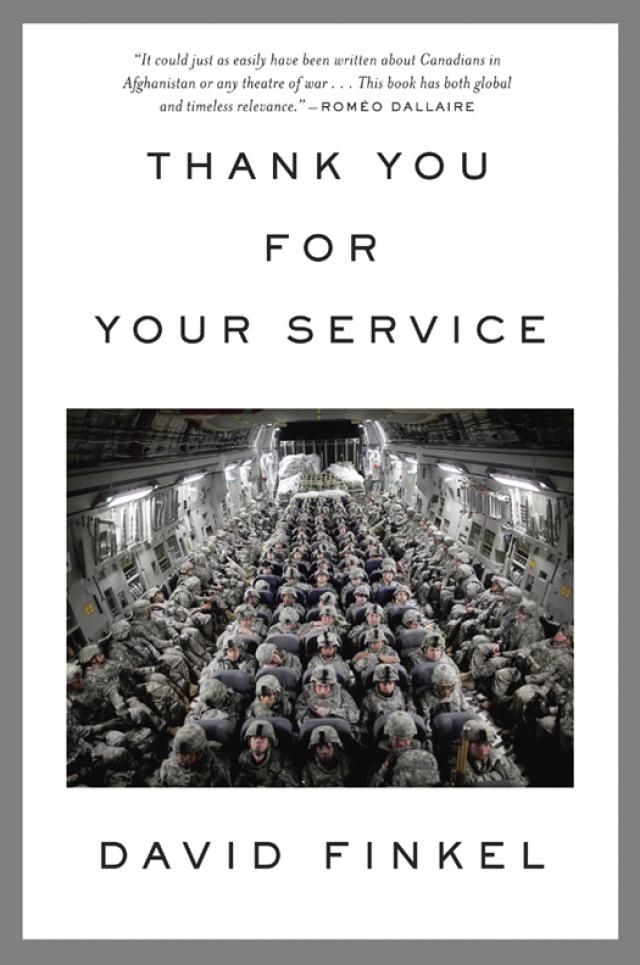
Jacket photograph by Damon Winter /The New York Times / Redux
Published in Canada by Bond Street Books, a division of Random House of Canada Limited, a Penguin Random House Company
www.randomhouse.ca
v3.1
For Phyllis Beekman,
who taught me about damage and recovery
To Elizabeth Helen Hill
for saying okay
Contents
Cover
Other Books by This Author
Title Page
Copyright
Dedication
Foreword
Introduction
Prologue
Chapter 1
Chapter 2
Chapter 3
Chapter 4
Chapter 5
Chapter 6
Chapter 7
Chapter 8
Chapter 9
Chapter 10
Chapter 11
Chapter 12
Chapter 13
Chapter 14
Chapter 15
Chapter 16
A Note On Sources and Methods
Acknowledgments
A Note About the Author
FOREWORD
by Lieutenant-General Roméo Dallaire
War is persistent and universal, and so too is the terrible physical and psychological price paid by the men and women who fight it, and their families. David Finkel has demonstrated an exceptional ability to identify and describe the psychological consequences of modern warfare.
Although Thank You for Your Service, like Finkel’s earlier book, The Good Soldiers, focuses on men from a U.S. Army infantry battalion that served in Baghdad, it could just as easily have been written about Canadians in Afghanistan, or any theatre of war, for that matter. This book has both global and timeless relevance. In the eloquence of the soldier-speak captured by Finkel, “… all wars are the same, only the landscape changes.”
Finkel shows us, from an intimate vantage point, the damage done to soldiers, their families and those that command them, and he clarifies how, in military culture, the very concept of a mental injury carries a great deal of stigma. This book is both difficult to read and rewarding. It calls up the full range of emotions: tears at the plight of a young family struggling with the baggage of war, anger at the shortage of therapeutic help for the injured and their resulting overreliance on medication, and even occasionally laughter at the unique humour soldiers use to mask their emotions.
Finkel does find some signs of hope. He depicts the unflagging courage and determination of the injured, and the strong desire on the part of a number of senior generals to overcome the mental health challenges of modern warfare. Most encouragingly, he sees signs of success in some of the many programs that now exist for the returning injured. And their predecessors from earlier wars? As Finkel writes, “Most of them came home from their wars to no help at all.”
INTRODUCTION
by Carol Off
A different person came home.” That’s a lament I’ve heard so many times. A husband or wife, a son or a daughter went off as a soldier to Afghanistan or Bosnia or Rwanda but never really returned. Oh, they came back physically—they even looked the same after the tour in Medak or Sarajevo or Kandahar—but they were fundamentally altered. And never in a good way.
How is it possible? How can decades of a person’s development become rewired in a matter of six months or a year? A relatively happy and well adjusted man or woman comes back from a military mission morose and withdrawn. A solid, loving father and husband becomes a monster, capable of abuse and violence. A dependable, mood-steady warrior returns sullen and paranoid, and soon after hangs himself or smashes his car into a brick wall. What happened “over there” to change everything?
Thank You for Your Service is a journey into the lives of those who returned to the United States from war in Iraq but could no longer fit into the space that they had occupied before deployment. The men of U.S. 2-16 Infantry Battalion who David Finkel follows so intimately are angry, disengaged and frightened of themselves and others. Wives do not recognize these men, and eventually the women run out of patience and love, or they are forced to flee the violence and chaos that now surrounds the man they married. Then there are the soldiers who simply give up trying to make sense of it all and take their own lives, leaving partners, parents and children bewildered.
The majority of post-deployment soldiers in the United States and Canada do not report the psychological problems described as Post-Traumatic Stress Disorder (PTSD) or, in military language, Operational Stress Injuries. But no country’s defence department is really keeping an adequate score. One Canadian military analysis claims that 13 per cent of our troops suffered from mental and emotional problems within five years of returning from Afghanistan. But that doesn’t begin to tell the story. Soldiers are reluctant to disclose their mental health issues, fearing reprisal or mockery, and governments are loath to gather full statistics out of a concern for the costs of compensation.
Many stress injuries are explained as the obvious consequences of extreme violence. Soldiers get bashed around when their armoured carriers are ambushed and, if the men and women inside survive, their brains are often bruised. They sustain concussions in everything from combat to car accidents. They also see colleagues blown up, and then must overcome their fear in order to return to duty the next day. Given the ordeals, it is surprising that there aren’t more stress injuries. But the Canadian experience with PTSD poses more troubling and complex questions about the origins of these injuries. Why do so many soldiers suffer PTSD when they return from so-called peacekeeping missions?
Throughout the 1990s, an unprecedented number of Canadian Forces personnel headed off to United Nations—sponsored missions, principally in Africa and the former Yugoslavia. Many soldiers came back severely traumatized. Canadians were led to believe that these missions were benign and friendly and included no combat role, but the troops who took part in the operations discovered that there was often no peace to keep. They were under orders to maintain the UN mandate of “neutrality” in the midst of ethnic cleansing and genocide. Some Canadian units disobeyed the higher command in order to intervene, notably in Croatia and Rwanda. Here was their dilemma: How can a soldier, well armed and well trained, simply observe while women are raped, children murdered and whole families driven from burned and looted homes?
These acts of mutiny, as some soldiers called them, were rarely documented or reported, with one extraordinary exception: the 1993–94 United Nations Assistance Mission for Rwanda (UNAMIR), led by Canada’s General Roméo Dallaire. His poorly equipped force attempted to stop the genocide, and Dallaire tried to assist the media in reporting the inadequacy of his UN mission. But Dallaire’s full disclosure did not end with the war in Rwanda.
No other person in Canada, or perhaps anywhere, has done as much as General Dallaire to reveal the psychological effects of conflict on soldiers. He volunteered the deepest, darkest secrets of his postwar trauma and warned the Canadian government that it faced an epidemic of Operational Stress Injuries from these allegedly benign peacekeeping missions.
In the early 1990s, the crippling disease was already taking its toll. In just one rotation through Croatia so many Canadian soldiers suffered illnesses that, in 1999, the Department of National Defence launched a Board of Inquiry to determine if the men and women had been exposed to some environmental toxin. Soldiers suffered skin rashes and hair loss; some had impaired eyesight or impotency; many developed cancer. But, digging deeper, the inquiry discovered that the soldiers suffered depression; their marriages had failed; their careers h
ad crumbled; and an unknown number had taken their own lives. The board’s conclusion: they suffered from the curious and underestimated condition of Post-Traumatic Stress Disorder.
Canada has long been in denial about the extent of PTSD in the ranks. Military doctors and advocates for the troops have been able to shame the government into giving more assistance to veterans, but many working soldiers struggle to hold on to their jobs as they return to lives into which they no longer fit. And there is pathetically little known about the emotional and psychological condition of the thousands of reservists who supplemented these missions.
Like the professionals in David Finkel’s account, Canadian mental health workers hoping to understand PTSD often look to the experiences of the Vietnam War. That was perhaps the first conflict in which doctors began to diagnose and document the range of debilitating pathologies that were once simply written off as “shell shock.” Yes, there are long-term effects of concussions sustained in combat, and damage sustained from fearing for one’s life each day. But those who study the nuances of PTSD identify a distinct set of common emotions—guilt, feelings of powerlessness and futility—that become exponentially more potent under extreme duress. Soldiers carry an overwhelming sense of responsibility for the lives of others, not just their colleagues but also the civilians they are supposed to protect and the civilians they end up killing because they can’t distinguish them from the enemy. In addition, there is a sense of impotence, as Canadian troops discovered in peacekeeping, when they have the means but not the mandate to protect innocent people. And, finally, there is the despair that comes from being involved in a mission that you—or, worse, your society—might regard as wrong or futile.
War—and its often carefully disguised sister, peacekeeping—is an encounter with evil. Those who are exposed to it see the worst of what humans are capable of, and they learn what they themselves are capable of, all in the most extreme circumstances. It changes you forever. And it is almost impossible for families to understand what afflicts these returning troops.
The same soldier didn’t come back from Iraq or Afghanistan. Nor did he return from the World Wars, from Vietnam, Bosnia, Rwanda … or Troy. In Homer’s Iliad, the warrior Achilles despairs:
Fate is the same for the man who holds back, the same if he fights hard. We are all held in a single honour, the brave with the weaklings. A man dies still if he has done nothing, as one who has done much.
Over the years, soldiers have shared with me some of their fear and pain, but I don’t know of any account that is as intimate and searing as Thank You for Your Service. As devastating as the stories are, there is a thread of hope here: Finkel shows what it takes to bring a soldier back from the brink. It’s a long and painful process, and only some of the wiring is restored. And, in dollars-and-cents terms, it’s also very expensive.
Perhaps when the psychological effects of military missions are finally tabulated, the crass price tag will force governments to confront the real cost of a mission, and that might discourage them—rightly or wrongly—from intervening. Through the stories of the wounded but still dedicated warriors in these pages, David Finkel poses the question that has endured over all the ages of war: Is it worth it?
Carol Off has been a host of CBC Radio’s As It Happens since 2006. She was previously a documentary reporter for The National. Her books on the Canadian military include The Lion, the Fox, and the Eagle (2000) and The Ghosts of Medak Pocket: The Story of Canada’s Secret War (2005).
PROLOGUE
You could see it in his nervous eyes. You could see it in his shaking hands. You could see it in the three prescription bottles in his room: one to steady his galloping heart rate, one to reduce his anxiety, one to minimize his nightmares. You could see it in the screensaver on his laptop—a nuclear fireball and the words FUCK IRAQ—and in the private journal he had been keeping since he arrived.
His first entry, on February 22:
Not much going on today. I turned my laundry in, and we’re getting our TAT boxes. We got mortared last night at 2:30 a.m., none close. We’re at FOB Rustamiyah, Iraq. It’s pretty nice, got a good chow hall and facilities. Still got a bunch of dumb shit to do though. Well, that’s about it for today.
His last entry, on October 18:
I’ve lost all hope. I feel the end is near for me, very, very near. Darkness is all I see anymore.
So he was finished. Down to his final hours, he was packed, weaponless, under escort, and waiting for the helicopter that would take him away to a wife who had just told him on the phone: “I’m scared of what you might do.”
“You know I’d never hurt you,” he’d said, and he’d hung up, wandered around the FOB, gotten a haircut, and come back to his room, where he now said, “But what if she’s right? What if I snap someday?”
It was a thought that made him feel sick. Just as every thought now made him feel sick. “You spend a thousand days, it gets to the point where it’s Groundhog Day. Every day is over and over. The heat. The smell. The language. There’s nothing sweet about it. It’s all sour,” he said. He remembered the initial invasion, when it wasn’t that way. “I mean it was a front seat to the greatest movie I’ve ever seen in my life.” He remembered the fire fights of his second deployment. “I loved it. Anytime I get shot at in a firefight, it’s the sexiest feeling there is.” He remembered how this deployment began to feel bad early on. “I’d get in the Humvee and be driving down the road and I would feel my heart pulsing up in my throat.” That was the start of it, he said, and then Emory happened, and then Crow happened, and then he was in a succession of explosions, and then a bullet was skimming across his thighs, and then Doster happened, and then he was waking up thinking, “Holy shit, I’m still here, it’s misery, it’s hell,” which became, “Are they going to kill me today?” which became, “I’ll take care of it myself,” which became, “Why do that? I’ll go out killing as many of them as I can, until they kill me.
Adam Schumann on his last day of war
“I didn’t give a fuck,” he said. “I wanted it to happen. Bottom line—I wanted it over as soon as possible, whether they did it or I did it.”
The amazing thing was that no one knew. Here was all this stuff going on, pounding heart, panicked breathing, sweating palms, electric eyes, and no one regarded him as anything but the great soldier he’d always been, the one who never complained, who hoisted bleeding soldiers onto his back, who’d suddenly begun insisting on being in the right front seat of the lead Humvee on every mission, not because he wanted to be dead but because that’s what selfless leaders would do.
He was the great soldier who one day walked to the aid station and went through the door marked COMBAT STRESS and asked for help and now was on his way home.
Now he was remembering what the psychologist had told him: “With your stature, maybe you’ve opened the door for a lot of guys to come in.”
“That made me feel really good,” he said. And yet he had felt so awful the previous day when he told one of his team leaders to round up everyone in his squad.
“What’d we do now?”
“You didn’t do anything,” he said. “Just get them together.”
They came into his room, and he shut the door and told them he was leaving the following day. He said the hard part: that it was a mental health evacuation. He said to them, “I don’t even know what I’m going through. I know that I don’t feel right.”
“Well, how long?” one of his soldiers said, breaking the silence.
“I don’t know,” he said. “There’s a possibility I won’t be coming back.”
They had rallied around him then, shaking his hand, grabbing his arm, patting his back, and saying whatever nineteen- and twenty-year-olds could think of to say.
“Take care of yourself,” one of them said.
“Drink a beer for me,” another said.
He had never felt so guilt-ridden in his life.
Early this morning, they had driven away on a mission, leaving him behind, and after they’d disappeared, he had no idea what to do. He stood there for a while alone. Eventually he walked back to his room. He turned up his air conditioner to high. When he got cold enough to shiver, he put on warmer clothes and stayed under the vents. He packed his medication. He stacked some packages of beef jerky and mac ’n’ cheese and smoked oysters, which he wouldn’t be able to take with him, for the soldiers he was leaving behind and wrote a note that said “Enjoy.”