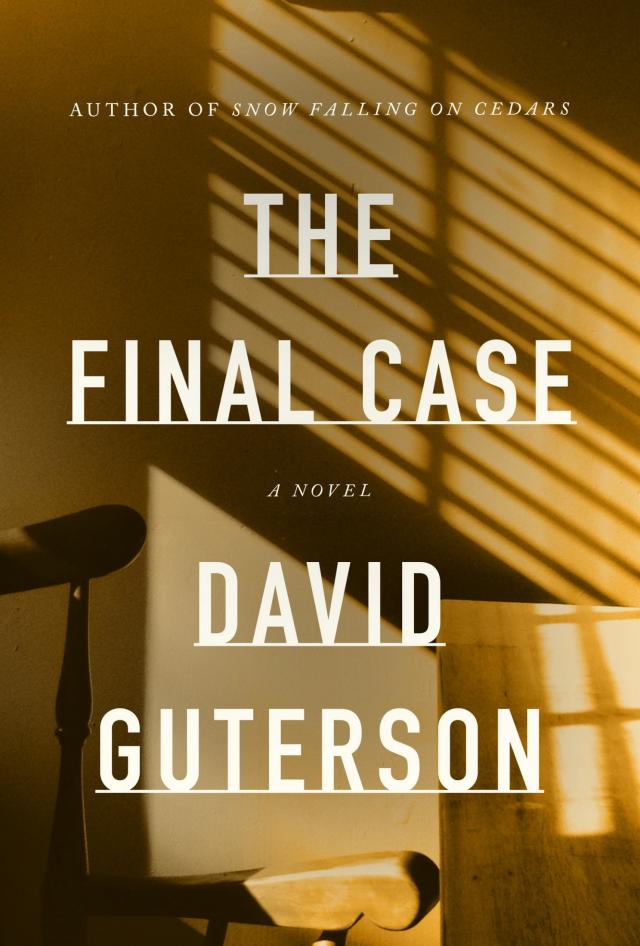
The final case, p.4
The Final Case,
p.4


The next time I drove my father to Skagit County—at his request, made sheepishly—it was for Delvin and Betsy Harvey’s arraignment on charges of homicide by abuse. Almost no one had come to witness this formality—in fact, besides me, there were only three, bunched together in a corner opposite mine.
The arraignment began. Betsy Harvey shuffled through a side door, dressed in a turquoise sweater and orange scrubs, shackled at the ankles and waist, handcuffed and accompanied by two deputies. Her straw-colored eyebrows were sparse, and her shoulders sloped steeply. She was waiflike and bony and, despite her intensity, looked like she might blow away in a wind.
My father and Betsy Harvey approached the bench. It was difficult to hear what anyone was saying. For maybe three minutes, there was murmuring and hobnobbing between my father, the judge, and the prosecutor, while the stenographer sat with a very straight back, keyboarding with a light, silent flutter. Then they were done, and a deputy freed Betsy Harvey of a handcuff so she could sign her bail agreement. Her first order of business with her liberated hand was to curl strands of hair behind one ear and press against her raw nostrils where they flared. Then she signed, the cuff went back on, and, in summary fashion, wedged between deputies, she was trundled through a door that, on thudding shut, echoed. It was at this point, in the lull before Delvin Harvey appeared, that I turned toward the other people in the gallery, and realized that I must be looking at one of the Harvey children, sitting between what had to be his grandparents. His face looked so thoroughly crushed that its features, mottled pink, had retracted.
The side door opened, and Delvin Harvey entered, handcuffed to a chain wrapped twice around his waist and dressed in faded red prison togs. Short of stature and broadly built, he had a meaty lower lip, a recessed chin, and a deeply retreating hairline. The thin tuft of hair that remained between his temples had been combed sideways. Delvin Harvey held his chest in an inflated rictus. He looked like someone determined to give pause by puffing up, staying mum, and leaving behind a question mark.
One of his cuffs came off. Left-handed, he signed his bail agreement. The cuff went back on, and he turned toward the gallery. He noted me in my corner, and then the three people in theirs. He nodded at them—or, rather, dropped his chin—before, like Betsy Harvey, he was trundled out a side door.
The proceedings were over. The judge got up and left, followed by the bailiff. The stenographer gathered up her things and left, too. Each of the ostensible grandparents put an arm around the ostensible Harvey boy and escorted him toward the exit. My father, in his raincoat, briefcase in hand, came to my corner. “They wanted to set bail at a quarter-million,” he said. “I asked for personal recognizance. In the end, we got hit with a hundred fifty thousand, so now I have to go see a bondsman.”
He went to do that. I waited in Barton’s, a used-book store with creaky floorboards on Mount Vernon’s main street. Barton’s has a section on local history, and when my father was done at the bail-bond office, he found me there, reading while perched on a windowsill. “How’s your book?” he asked.
I showed him An Illustrated History of Skagit and Snohomish Counties, which is a compilation of news articles, county records, anecdotes, miscellany, and photographs assembled in 1906. I told him that its author had begun by assailing the Spanish, Russian, Portuguese, and French explorers who’d sailed off the shores of Skagit County as impeded by shortcomings consistent with their nationalities, before moving on to English explorers, about whom he felt better. I read for my father a pertinent sentence: “Anglo-Saxon energy, thoroughness, and zeal, from James Cook on, would come to characterize operations on the shores of the Pacific Northwest.”
My father said, “If I remember correctly, James Cook was killed in Hawaii. Clubbed to death, or something along those lines.”
I told my father that, from what I’d read so far, An Illustrated History of Skagit and Snohomish Counties was long on murders. Three happened near the Skagit River in the winter of 1869, a time when potatoes were legal tender there. A John Barker, I told my father, had his throat slashed and his store robbed. A mob quickly formed, two “Indians” were hanged, and then someone noticed that Quinby Clark, an Anglo-Saxon, had produced thirty dollars to buy a “squaw” shortly after Barker died. My father took the book and read for himself. “Listen to this,” he said. “ ‘Subsequent investigation of the store showed plainly that the robbery and murder had been committed by a white man, for things which Indians would have taken were left, and those which a white man would have taken were gone.’ ”
He looked at me over the tops of his reading glasses. “Interesting detective work,” he said.
I got us onto the freeway. Things went smoothly for a while, but then, a few miles north of Seattle, an accident halted traffic. My father passed the time with documents in his lap, turning pages and underscoring passages with his pen. “How is it,” he asked, without looking up, “that you have time to cart me around like this? Don’t you have work to do?”
I lied. I said I did have work to do but that, fortunately, the circumstances of my life left time both to do it and to cart him around. “Maybe,” said my father, “but, still, I’m an albatross around your neck. Which isn’t my point, though. My point is, what about work? I know there are people who say, ‘On your deathbed you’re not going to wish you’d worked more, you’re going to wish you’d gone to Zanzibar to watch the sun set. And loved your loved ones more. Those are the two. Do things, love people more.’ Well, I’m not going to argue about Zanzibar, but, as for loving people, that doesn’t have to be mutually exclusive with work, does it? Couldn’t they happen at the same time?”
* * *
—
Which brings me to Alison, to whom I’m married. I met her twenty-eight years ago at the University of British Columbia’s Museum of Anthropology, where I’d gone for its archives, and for its Xwi7xwa Library, in service to the pretense, enacted for myself, that I knew what I was doing as a researcher. At the time, I thought I wanted to assay a fictionalized account of the exploits of Franz Boas, who at twenty-five sailed from Germany to Baffin Island for the purpose of nearly freezing to death in the course of anthropological fieldwork, and then, maybe in need of more duress, pursued an ethnographic project, amid virulent rains, in the Pacific Northwest. As it turned out, the Boas Collections and the Boas Papers were housed at the headquarters of the American Philosophical Society in Philadelphia; however, I was able to ferret out, at this Museum of Anthropology southwest of Vancouver, some copies of letters Boas wrote, which I tracked down with private vindication, and with eager élan, and copied a page at a time against the screen of a loud machine, then stapled and read on a bench in the museum’s foyer, occasionally laughing because Boas, at twenty-eight, was the sort of correspondent who wrote, “I hope I shall find another good Tsimshian to replace Mathew, whom I can not curse enough.” Alison and I met because I laughed at “Today was my worst day since I have been here. I learned practically nothing as I had to spend the entire day running about in search of new people.” “What’s so funny?” she asked me—a woman in a raincoat who had just straightened up after holding her hair aside to drink from a low-arcing fountain. The raincoat was rain-beaded. Her hair was wet. I apologized for laughing out loud. Her answer: raised eyebrows. Later, I went to look at bentwood cedar boxes; she came around a corner and stood ten yards from me, nothing, not even glances exchanged, me with my hands behind my back reading about the splitting of boards and the adzing of planks, rigorously keeping my eyes forward. I felt then like a cipher, an apparently aloof guy in a sweater that had dried out in the museum but that still hung rain-limp—a study in detachment, but privately jangled, as if a very loud alarm had gone off.
Certain things are said to happen “without warning”—a tree topples on a windless day, a heart stops, a sinkhole opens between your house and your neighbor’s, all things devoid of premonition, of an inkling. Anyway, in the great hall of the museum, the totem poles shuddered. The bentwood boxes moved. I turned. The masks in a nearby glass case changed expressions. A man who had been looking at them looked at me now, with penetrating quizzicality. In fact, the dozen or so people in the museum—we all looked at one another as if among us, somewhere, was the answer to a question not formulated yet but in need of an immediate answer. We were like bobblehead dolls, frozen in place but loose-necked, or like foosball figurines in a game just heating up. I realized then that I had trembling carte blanche to meet the eyes of the “What’s so funny?” woman, who had her hands on her head and her arms bent like wings and was looking back at me as if there was no answer not only to the question at hand but to any question worthy of being one. During this limbo of mutual appraisal, the floor began to thrum as if a tank were passing under us. Then it began to pulse and roll. The totem poles seemed in danger of toppling were it not for guy wires that, on second thought, might snap. The cedar baskets lined up in cases leaned like fallen dominoes, a canoe lurched across the floor, a bear reared in my direction, the posts and beams, the concrete and glass, the fifty-foot ceiling, the bowls, cradles, coffins, hats: all of it was seized by a din of threatening seriousness, as if the Strong Man Who Holds Up the World were stomping on the ground with ever greater fury, or the dancer who’d accidentally kicked the drum and thereby gained an earthquake foot were enraged.
Then it stopped, and no one got out a phone and began to text or call, because this was before that.
I turned again toward the “What’s so funny?” woman, who still had her hands on her head in the manner sometimes seen in grainy military prisoner-taking footage but that in her case suggested humor. She looked toward the ceiling. She looked at me again. “I think we should leave,” she said, pointing overhead at totem-pole guy wires that were twanging as if electrified.
We fled. It had stopped raining, and the sort of light you might associate with magnanimous divinity filtered through the clouds. With no earthquake, I would have felt like a liaison was in progress, but with one, there was room for ambiguity. I lagged a half step behind the “What’s so funny?” woman in deference to that as we put a gap between us and the museum, which looked, from where we turned for a summation, undeniably sturdy. I had a car, but it was subterranean, where I had paid to lodge it in what had become, while we were in the museum, a no-go zone, as announced by a line of orange plastic cones and a ticket-booth cashier sitting on a curb by a newly opened concrete crack. Alison’s car was down there, too.
Behind the museum was a reflecting pool. Its water looked suspiciously mobile, shimmeringly suggestive of aftershocks so subtle they registered only as liquid impressions—although, at that point, everything, the merest footfall, suggested aftershocks, which as tactile mirages or felt hallucinations are equal in force to shocks that nudge the Richter Scale. We stood listening with our feet. Now that we were here, and there was nothing to be done, Alison sank in for me. And what I noticed was that, in peering across the pool, over the crest of a rise, she went up on her toes and didn’t come down or waver for an impressive duration, which made me wonder, was she now, or had she been, a dancer, as this looked en pointe, or close to it anyway, in a relaxed sense, so relaxed that she had her hands in her raincoat pockets, although one did emerge briefly when she needed it to push aside some dangling, still-damp chestnut-brown tendrils of hair obstructing her view, and let’s face it, does it take more than that? She said, “So what do you do?” I answered that I was “between jobs,” but that not long ago—this was true, given a generous construing of “not long ago”—I’d worked for a company that poured concrete creatively: counters, sink tops, hearths, stairs, terraces; meanwhile, I’d become interested in Franz Boas and was thinking of writing a book about him, or, rather, doing research for one. Before Alison could respond to this, there was an actual aftershock, no doubt about it, aggressively roiling the reflecting pool and, like a frisson, producing, in me at least, giddy pleasure, since it was mild, I was outside, there was nothing tall nearby, and the world, as it shook, was alive like I was, though at the time I formulated no simile relating the dawning lover to the world, or to an earthquake, those were, or are, posterior formulations on the part of an author who at the moment has nowhere to hide. And when it was over, though the pool hadn’t settled yet, Alison said, “That was a good one.” Then we went for a walk along Tower Beach, in the hope that, when we returned, the orange cones would no longer be lined up in front of the parking-garage gate, and where spume, or froth, sparkling and billowing, had been thrown out of the Georgia Strait onto low tide’s sloping shingle, along with the wreckage of polished red madrones lofted against cobbled groynes meant to thwart the work of an ocean threatening to undermine, undercut, and finally end the work of the University of British Columbia on the cliff above, where Alison had studied Global Resource Systems. An hour later, the cones were still there, so we walked across Marine Drive to a pub Alison knew about and, with other survivors—actually no one died in that quake—ate poutine.
Early this morning—I had my nose against her neck, my arm across her belly, and the edge of my hand against the small of her waist—Alison twitched as she slept. First her shoulder leapt, then her thigh, then her hip, and then, as it seemed to me, she ran softly in place, all of which made me feel like a voyeur, but also lonely, because Alison was warm and her throat moist and she smelled of coconut oil in the solitude of night’s end, and I was already thinking that before long she would get up and go off to her current job as the assistant director of an international campaign devoted to the preservation of boreal forests, and thinking also that Alison’s current wander through disassociated images, fragments of event and encounter, fluid and morphing exchange, surfeits of emotion, fleeting confabulations of voice, character, and place, paranormal hauntings, and other irreducible perplexities of mind were all unavailable to me and always would be, so that I wanted to wake her and urge her toward me in the hope that a companionable convergence marked by mingled respiration, poignant and freighted by mortality as it might be, would nevertheless help us outrun the sun, which wanted to rise again, as always, and also, selfishly, I hoped our coupling, if it were to happen, might blot out my singularity, which I have always found burdensome, but such is the vanity of the one who lies awake feeling desire mingling with the reluctant recognition that, in the cold, he must first and foremost be humbled by his body, rise, and stand over the toilet. And as for the poutine, I had to tell Alison that I had never tried it before, because the idea of French fries and cheese curds in gravy had always seemed offensive to me, but why not; our recent seismic event had opened a poutine door, and so we stuck our forks into the contents of a heaped plate and I gave her my honest opinion, which was that, however you looked at it, the best thing about poutine was that its curds squeaked.
I’m a little ashamed of the fact that all of this fooling around with words means that Alison ceases to exist and is replaced, as far as posterity is concerned, if there is to be a posterity (we have no children); a time is coming when no one living will have lived when Alison lived; she will, for a generation to a generation and a half, be sporadically reconstituted via photos, letters, potentially some hard drives, whatever remnants of her are retrievable from clouds, and for who knows how long by references to her in this book and maybe others to come, so that what remains is inference, distortion, short shrift, and other forms of once removal, forever incommensurate and insufficient, a false record, a substitute, a life lost not to silence but to reinvention, to selection and omission, a disguise instead of gross anonymity but equaling the same: utter loss, nothing, the woman I kissed for the first time with poutine breath rendered invisible by writerly choice, by a scribbler choosing traits and events, deciding which tics, proclivities, etc., will have relative endurance in the public record and by that means ensuring that no one will know, for example, that Alison has a drawer so full of old sweaters that the wool rises in relief when she works it open; that, as a schoolgirl in saddle shoes arriving home at 3:40 p.m. with a three-ring binder clutched to her chest, she sometimes spied a cigar stub on a ledge by her front door and knew because of it that her grandfather was leaning on his cane inside; that she’d seen a moose charge a clothesline hung with bath towels in Saskatchewan; that, when disconsolate, she sometimes stands with her head down, drawing with a pencil; that her husband is enamored of the winter coats she wears, or has worn, and says so on those occasions when she dons, for the first time, a replacement for a beloved predecessor (something that happens at intervals of years); that she makes envelopes out of advertising circulars while talking on the phone; that her right foot turns out more than the left by a slight degree when she descends a slope; that frequently in autumn she goes about with bits of leaf in her hair; that when she emerges from her scalding showers the skin beneath her clavicles is rouge, or ruby; that on many mornings her first words are “What time is it?”; that she listens to a solar-powered wind-up radio while weeding; that her shoe soles wear out mid-foot and on their outside edges; and that she prefers glass to plastic for refrigerator storage. That these things might appear here distorted and employed essentially for artistic effect I’m not going to call a tragedy, but it’s close.
The day after the arraignment of Betsy and Delvin Harvey, Alison and I took a pruning class. We have a tree in our yard called Acer × freemanii that our guesswork and ignorance had stressed to the point where we vacillated over keeping it; goaded by naturally occurring steroids, it kept thrusting up double and triple leaders and shooting out laterals as if the sun threatened to flame out tomorrow. A master of rabid, overnight fecundity, it so summarily defeated our efforts to beat it back that we’d begun to wonder if it felt animosity toward us. We also had a Camperdown elm that was supposed to grow in the shape of an umbrella but that looked like a man’s beard, and some Himalayan birches that had nearly succumbed to bronze birch borer and were in need of triage. Problem after problem, but the pruning workshop we’d signed up for was led by a horticulturalist who more than knew the ropes when it came to the trees at hand. It was held on a day of odd, rare, and even punishing fall sunshine in an atrium of the University of Washington’s horticulture building, so, when it was over, Alison and I walked on campus. We wanted to see a Camperdown elm our pruning instructor had referred to as nicely shaped. We found it in a side yard near the Art Building. It had a lofty and symmetrical umbrella, and it resembled topiary. Nearby, we sat on a bench for a while. The campus was landscaped to a veritable T. Everything imperfect had either been removed or bore signs of active, well-considered renovation. The parklike setting, anodyne to a fault, featured flowering cherries and London plane trees. Alison and I watched students pass—people of an age our children might have been if we’d had children, so that we felt them as a vaguely wistful absence—and then we walked to Wallingford, where we noticed a theater marquee advertising a movie we hadn’t meant to see but weren’t averse to. It seemed worth a try, so we went in, bought tickets, and sat down.