Baf 00 voyage to arctu.., p.1
BAF 00 - Voyage to Arcturus,
p.1


17-07-2024
Rework of an earlier conversion
Wandering alone on Tormance, the one inhabited planet of the star Arcturus, the hero of this remarkable story cries, “I must make up my mind that this is a strange journey, and that the strangest things will happen in it.”
And the strangest things do indeed happen in a book that is at once an engrossing fantasy and a profound metaphysical fable.
Maskull is transported to the Arcturan planet where a series of mysterious adventures causes him to undergo countless physical transformations. The people he meets— some frightening, some spiritually beautiful —are like none on earth, and their behavior is like that of no mortal Maskull has ever known. Gradually Maskull becomes aware that his journey is the journey of a human soul caught in a death struggle between good and evil.
As a story, its violence and color are enthralling: on a deeper level, it takes
us to new worlds of moral experience. And it makes all the symbolic novels of
the past ten years look soft.
—The Spectator
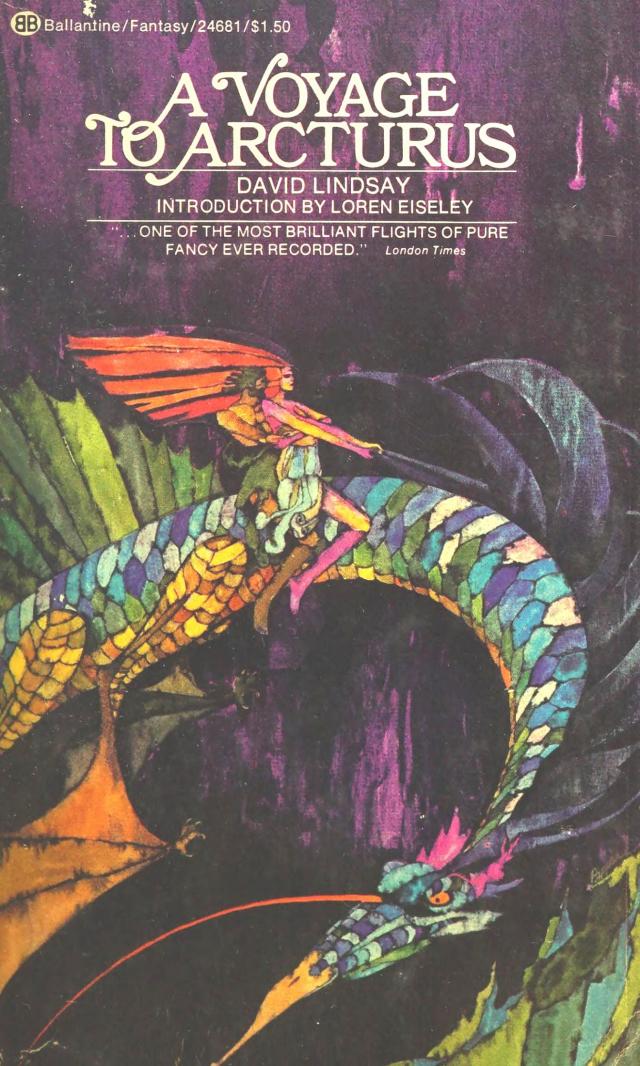
A VOYAGE TO
ARCTURUS
David Lindsay
Introduction by
Loren Eiseley
BALLANTINE BOOKS • NEW YORK
Copyright © 1963 by The Macmillan Company
All rights reserved.
Library of Congress Catalog Card Number: 63-15669
SBN 345-24681-0-150
This edition published by arrangement with
The MacMillan Company
First U.S. Printing: November, 1968
Fourth Printing: December, 1974
First Canadian Printing: November, 1968
Printed in the United States of America
Cover art by Bob Pepper
BALLANTTNE BOOKS
A Division of Random House, Inc.
201 East 50th Street, New York, N.Y. 10022
Contents
INTRODUCTION BY LOREN EISELEY
1 - THE SEANCE
2 - IN THE STREET
3 - STARKNESS
4 - THE VOICE
5 - THE NIGHT OF DEPARTURE
6 - JOIWIND
7 - PANAWE
8 - THE LUSION PLAIN
9 - OCEAXE
10 - TYDOMIN
11 - ON DISSCOURN
12 - SPADEVIL
13 - THE WOMBFLASHFOREST
14 - POLECRAB
15 - SWALONE’S ISLAND
16 - LEEHALLFAE
17 - CORPANG
18 - HAUNTE
19 - SULLENBODE
20 - BAREY
21 - MUSPEL
INTRODUCTION
BY LOREN EISELEY
A Voyage to Arcturus is, in reality, a long earth journey. So interpreted it is a tale of travels that few among us possess the imagination, the courage, or the ever-present symbolism to sustain. The book is an amalgam of strange philosophies clothed in weird exterior forms that have taken shape in a fantastically gifted if somewhat elusive mind. As one of his Arcturian characters remarks of a haunting and formidable music which it is the aim of the hero to investigate: “The man that can play the instrument … would be able to conjure up the most astonishing forms, which are not phantasms, but realities.”
David Lindsay, the author of A Voyage to Arcturus, comes very close to being such a musician. In spite of a prose which is occasionally rude and awkward, in spite of characters which appear and vanish before, in some instances, we can quite grasp their significance, in spite of a plethora of overdramatic names like Maskull and Night-spore, Lindsay has produced a book which it is difficult if not impossible to lay down once one has entered the observatory tower where the journey starts and glimpsed the dread blue sun which revolves by far-off Tormance.
David Lindsay died young. One must be tolerant, therefore, if his message—even his unearthly music—is rasped from a not quite perfected instrument or if his compositions seem too complex for our ears. The importance of this young forgotten writer lies in the fact that his book has refused to die and that it has occupied the libraries of bibliophiles and received the devoted attention of such gifted men as Frank Lloyd Wright. The book, to hold such attention, must contain some message from the world of Nightspore, from the soul beyond death. The message is cryptic, admittedly. If, however, one reads, not lightly, but again and yet again, one is conscious of an always shifting point of view which is a true part of the fragmented world we occupy. The messages derived from the fragments cannot be the message from the whole. Even Maskull, the seeker, collapses before the labyrinthine thought which permeates Lindsay’s conclusion. To it I will return, but first I wish to establish the reality of this Arcturian landscape and equate it with the things on earth. I do so for one purpose only: that we do not mistake Arc-turus, in this day of easy science fiction, for a superficial tale of odd beings with odd organs on a planet remote from our own. This is not a common story of adventure. Rather, it is a story of the most dangerous journey in the world, the journey into the self and beyond the self. Let me illustrate.
A few days ago on a West Indian island I walked at low tide through the wet sand and coral which afforded the background of half a dozen living worlds. I thought, as I waded through this weird and glimmering domain of life, of a remark that the philosopher George Santayana had made long ago. “Prodigious complexity,” he had observed, “is something to which nature is not averse, like a human artist, but on the contrary is positively prone.” A jellyfish, ninety-five per cent water yet somehow alive, pumped past me, stoutly working its little translucent umbrella—although it could neither hear nor see its way and was about to be dashed into oblivion upon the shore. Down in the weeds, his appropriated shell festooned with all manner of concealing bric-a-brac, lurked a hermit crab. Something unidentifiable with mottled green tentacles grasped at my sandals. In another spot a slippery proboscis just protruding from the sand descended faster than I could uncover it. Farther along a great tiger-colored slug whose pseudo-eyes gave it the expression of a formidable fish, grazed amidst the bottom plants. Once a bright blue butterfly object hovered in the water and, as I tried to grasp it, vanished with a total magical directness that was inexpressibly startling. I disturbed a delicate pale-blue shrimp hiding in the mouth of an anemone with stinging nettles. I encountered a sidling crab concealed behind claws which had been modeled to fit over his entire face like a medieval helmet; he could only momentarily be persuaded to drop this enormous guard. Just his eyes were alive, twiddling like small twin periscopes above his armor. It became obvious as I studied him that he was engaged in some effort at total disinvolvement with the world.
Now if I had chosen to walk through these tide pools with the mind and thirsty imagination of a David Lindsay I believe it would have been possible, even without the twin suns of Branchspell and Alppain, to have observed the whims of the country of Matterplay, and if I had been able, like Lindsay, to humanize and make articulate this fantastic and diverse array, its voices would have been equally dissembling in expressing their interpretations of the universe. The double-sexed would have spoken their views of life, as would the blind from the deep caves of the coral. The multiple-personed Portuguese man-of-war might have had a philosophy, or the starfish some radial pure delight unknown to creatures of mere bilateral symmetry.
In a similar and equally bewildered fashion Maskull, who is really a kind of symbolic Everyman, journeys through the wilds of the Arcturian planet Tormance, seeking from its strange inhabitants the meaning of the universe, some word of its creator. He follows a mysterious drum beat, which, toward the end of the story, we come to suspect is the exteriorized music of his own beating heart.
He encounters beings who speak of their god as of this nature: “He faces Nothingness in all directions. He has no back and no sides, but is all face; and this face is his shape. It must necessarily be so, for nothing else can exist between him and nothingness…. He draws his inspirations from it; in no other way could he feel himself….” Each man, continues the speaker, is a miniature of this same god.
But God, before the end, is seen or hunted in many shifting guises. Is he Crystal-man, or Shaping, who seems at first benign but whose subjects in the instant of death all break into a hideous grin as though taken with some final repulsive joke?
There is a Bergsonian glimpse of life as some kind of ineffable streaming radiance, an elan vital caught and trapped and diversified in matter and forever seeking escape from it. There is the beautiful moment toward the end in which the dying Maskull recognizes he has set himself against the infinite, that he is nothing and that the final extirpation of his will has left him free. Yet it is characteristic of Lindsay’s work that we are not permitted to rest upon this note. Maskull, who had glimpsed the life around him in so many shapes—even, with concentrated gaze, seen a living body dissolved until it was only a dance of blood corpuscles through invisible arteries, a ghostly starlike fountain hidden beneath a grotesque exterior shell—Maskull in his spiritual shape of Nightspore had still a last dread journey into that tower of death before whose entrance he protests in vain to the ferryman: “I have forgotten everything.”
Some moments later when he emerges hopeless from the tower to re-enter life again, we are not sure whether his decision is foredoomed and inescapable or an act of free will. We know only that amidst the stench and diversions of matter a tremendous spiritual struggle is in progress. Yet haunting our ears also throughout the book is the utterance of Maskull’s mysteri
ous supernatural companion: “The music was not playing for you, my friend.”
Or, again, there is Nightspore’s protest over the body of Maskull: “Why was all this necessary?” If, as readers, we expect from David Lindsay a clear answer to this age-old question we shall be disappointed. Instead, if we are perceptive, we shall have climbed with Nightspore that last grim tower in the night and returned with some kind of unearthly knowledge which it is not in our power to communicate adequately. In the end one arises from this book not as from an idle tale, but from a spiritual catharsis the more surprising because it will have been transmitted, like the music of the drum that Maskull followed, dimly and from far away. David Lindsay was perhaps too honest to record one voice alone among the many conflicting voices that represent the living world. It is both his strength and his weakness that certain of the questions asked on Tormance, as well as the responses to them, are locked in that Delphic ambiguity which torments our daily lives. The intellectual contribution of A Voyage to Arc-turus lies in its author’s willingness to ask such questions in a highly original and vivid manner and to pursue them to the inevitable, if ennobling, end.
1
THE SEANCE
On a march evening, at eight o’clock, Backhouse, the medium - a fast-rising star in the psychic world - was ushered into the study at Prolands, the Hampstead residence of Montague Faull. The room was illuminated only by the light of a blazing fire. The host, eying him with indolent curiosity, got up, and the usual conventional greetings were exchanged. Having indicated an easy chair before the fire to his guest, the South American merchant sank back again into his own. The electric light was switched on. Faull’s prominent, clear-cut features, metallic-looking skin, and general air of bored impassiveness, did not seem greatly to impress the medium, who was accustomed to regard men from a special angle. Backhouse, on the contrary, was a novelty to the merchant. As he tranquilly studied him through half closed lids and the smoke of a cigar, he wondered how this little, thickset person with the pointed beard contrived to remain so fresh and sane in appearance, in view of the morbid nature of his occupation.
“Do you smoke?” drawled Faull, by way of starting the conversation. “No? Then will you take a drink?”
“Not at present, I thank you.”
A pause.
“Everything is satisfactory? The materialisation will take place?”
“I see no reason to doubt it.”
“That’s good, for I would not like my guests to be disappointed. I have your check written out in my pocket.”
“Afterward will do quite well.”
“Nine o’clock was the time specified, I believe?”
“I fancy so.”
The conversation continued to flag. Faull sprawled in his chair, and remained apathetic.
“Would you care to hear what arrangements I have made?”
“I am unaware that any are necessary, beyond chairs for your guests.”
“I mean the decoration of the seance room, the music, and so forth.”
Backhouse stared at his host. “But this is not a theatrical performance.”
“That’s correct. Perhaps I ought to explain… There will be ladies present, and ladies, you know, are aesthetically inclined.”
“In that case I have no objection. I only hope they will enjoy the performance to the end.”
He spoke rather dryly.
“Well, that’s all right, then,” said Faull. Flicking his cigar into the fire, he got up and helped himself to whisky.
“Will you come and see the room?”
“Thank you, no. I prefer to have nothing to do with it till the time arrives.”
“Then let’s go to see my sister, Mrs. Jameson, who is in the drawing room. She sometimes does me the kindness to act as my hostess, as I am unmarried.”
“I will be delighted,” said Backhouse coldly.
They found the lady alone, sitting by the open pianoforte in a pensive attitude. She had been playing Scriabin and was overcome. The medium took in her small, tight, patrician features and porcelain-like hands, and wondered how Faull came by such a sister. She received him bravely, with just a shade of quiet emotion. He was used to such receptions at the hands of the sex, and knew well how to respond to them.
“What amazes me,” she half whispered, after ten minutes of graceful, hollow conversation, “is, if you must know it, not so much the manifestation itself - though that will surely be wonderful - as your assurance that it will take place. Tell me the grounds of your confidence.”
“I dream with open eyes,” he answered, looking around at the door, “and others see my dreams. That is all.”
“But that’s beautiful,” responded Mrs. Jameson. She smiled rather absently, for the first guest had just entered.
It was Kent-Smith, the ex-magistrate, celebrated for his shrewd judicial humour, which, however, he had the good sense not to attempt to carry into private life. Although well on the wrong side of seventy, his eyes were still disconcertingly bright. With the selective skill of an old man, he immediately settled himself in the most comfortable of many comfortable chairs.
“So we are to see wonders tonight?”
“Fresh material for your autobiography,” remarked Faull.
“Ah, you should not have mentioned my unfortunate book. An old public servant is merely amusing himself in his retirement, Mr. Backhouse. You have no cause for alarm - I have studied in the school of discretion.”
“I am not alarmed. There can be no possible objection to your publishing whatever you please.”
“You are most kind,” said the old man, with a cunning smile.
” Trent is not coming tonight,” remarked Mrs. Jameson, throwing a curious little glance at her brother.
“I never thought he would. It’s not in his line.”
“Mrs. Trent, you must understand,” she went on, addressing the ex-magistrate, “has placed us all under a debt of gratitude. She has decorated the old lounge hall upstairs most beautifully, and has secured the services of the sweetest little orchestra.”
“But this is Roman magnificence.”
“Backhouse thinks the spirits should be treated with more deference,” laughed Faull.
“Surely, Mr. Backhouse - a poetic environment…”
“Pardon me. I am a simple man, and always prefer to reduce things to elemental simplicity. I raise no opposition, but I express my opinion. Nature is one thing, and art is another.”
“And I am not sure that I don’t agree with you,” said the ex-magistrate. “An occasion like this ought to be simple, to guard against the possibility of deception - if you will forgive my bluntness, Mr. Backhouse.”
“We shall sit in full light,” replied Backhouse, “and every opportunity will be given to all to inspect the room. I shall also ask you to submit me to a personal examination.”
A rather embarrassed silence followed. It was broken by the arrival of two more guests, who entered together. These were Prior, the prosperous City coffee importer, and Lang, the stockjobber, well known in his own circle as an amateur prestidigitator. Backhouse was slightly acquainted with the latter. Prior, perfuming the room with the faint odour of wine and tobacco smoke, tried to introduce an atmosphere of joviality into the proceedings. Finding that no one seconded his efforts, however, he shortly subsided and fell to examining the water colours on the walls. Lang, tall, thin, and growing bald, said little, but stared at Backhouse a good deal.