The mx book of new sherl.., p.1
The MX Book of New Sherlock Holmes Stories - Part XXXIII,
p.1
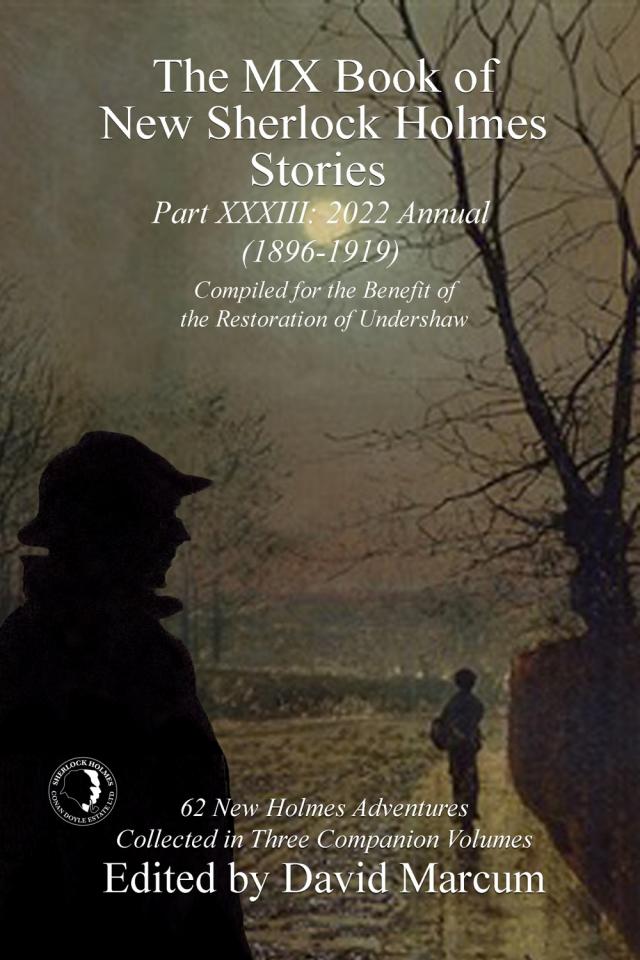


The MX Book of New Sherlock Holmes Stories - Part XXXII
David Marcum
Published in 2022 by
MX Publishing
www.mxpublishing.co.uk
Digital edition converted and distributed by
Andrews UK Limited
www.andrewsuk.com
Copyright © 2022 David Marcum
The right of David Marcum to be identified as the author of this work has been asserted in accordance with the Copyright, Designs and Patents Act 1988.
All rights reserved. No reproduction, copy or transmission of this publication may be made without express prior written permission. No paragraph of this publication may be reproduced, copied or transmitted except with express prior written permission or in accordance with the provisions of the Copyright Act 1956 (as amended). Any person who commits any unauthorised act in relation to this publication may be liable to criminal prosecution and civil claims for damage.
All characters appearing in this work are fictitious. Any resemblance to real persons, living or dead, is purely coincidental.
David Marcum can be reached at:
thepapersofsherlockholmes@gmail.com
* * *
Cover design by Brian Belanger
www.belangerbooks.com
and
www.redbubble.com/people/zhahadun
* * *
Internal Illustrations by Sidney Paget
Dedicated to these friends of the MX Anthologies who recently crossed over the Reichenbach:
Carole Nelson Douglas
Greg Hatcher
Carl Heifetz
William “Bill” Lawler
Mark Levy
R.I.P.
Editor’s Foreword: “We can but try.”
by David Marcum
Some approach the Sherlockian Canon, that small batch of just five-dozen original Holmes adventures, as if that number – Only sixty stories! – is unalterable. They’re quite firm: Verily, verily, the Canon shall be sixty stories – No more, no less! But then the exceptions creep in…
Sixty may be absolute – No more, no less! – but then there’s The Apocrypha, that extra-Canonical material that maybe ought to be included too. “How Watson Learned the Trick” and “The Field Bazaar”, though not full-length adventures, are important slices-of-life from the famed Baker Street sitting room. And if one accepts those, then there are the Canonical plays – all by way of the First Literary Agent: The Crown Diamond and The Speckled Band. Then onward to the lesser-known (and most confusing) play Angels of Darkness. And don’t forget the two stories which clearly feature Holmes in an off-stage setting, “The Man with the Watches” and “The Lost Special”. So already the pure Sixty-story Barrier has been breached.
And then there are those absolute purists who make other exceptions. “Sixty adventures – No more, no less!” they cry, prepared to defend that idea to the death. But then, a moment later, they follow with, “Well, except for these two or three pastiches written by a friend of mine, or by the person whose attention I’m seeking or whose celebrity favor I want to curry with my praise.” Thus, their conviction of The Immaculacy of The Canonical Sixty is already cracked and compromised.
Along the same lines, some insist that The Canon be insulated from the bigger picture, keeping Holmes’s world a cozy little place solely defined by only what is found recorded in the “official” sixty tales. If it isn’t recorded there, they insist, then it didn’t happen. But there’s a loophole for that: The Canon mentions over one-hundred-forty “Untold Cases” in addition to the Told Sixty, and the details of these are often so vague that they are very much open to infinite interpretation. It’s a bold concept, and too much for some to assimilate: Holmes and Watson are doing things off-stage that we don’t get to witness in the Canonical Sixty.
I haven’t done the math, but it would be a good project for someone to make a solid estimate of just how much time accrues in just the events of The Canon that we actually see recorded and presented. For instance, the bulk of “The Five Orange Pips” – around 82% – consists of just an hour or so in the Baker Street sitting room on a late September 1887 night, either hearing the client’s story, or discussing it after he leaves to go be murdered. The rest occurs in a short breakfast scene the next day, followed by another concluding conversation that evening.
It would be interesting if someone were to calculate the amount of time that is actually recorded in The Canon – either passing from the beginning of a case to the end, or simply what’s shown “on screen”, against how much total time that passes within the forty years between Holmes’s first recorded Canonical case, “The Gloria Scott” (in Summer 1874) and the last, “His Last Bow” (in August 1914). I’m certain that it would be stunning for some just how much unrecorded time there is, wherein Holmes and Watson live all those other parts of their lives beyond the lens of the pure Canon that so many defend.
And in that recorded time, there are historical events occurring all around them. Many don’t want to acknowledge those either. They like the idea that Holmes and Watson interact with anonymous folk like Jabez Wilson or Hall Pycroft, or others that no one has never heard of before or since. They don’t want to hear about Holmes actually functioning in The World. But he does. In some of those Canonical Untold Cases, there are references to Holmes’s interactions with historical figures, so it isn’t a total impossibility, even for the Defenders of the Sixty, that he had contact with others. Holmes assisted the Pope (Leo XIII, whose Papacy ran from 1878 to 1903) in two Untold Cases, that of the Vatican Cameos, and also the death of Cardinal Tosca. He assisted the Royal Family of Scandinavia (as mentioned in “The Noble Bachelor” and “The Final Problem”). He was hired by the King of Bohemia (although such title was rather flimsily moribund by the late 1880’s), and he assisted the British Prime Minister (whose name was changed for security’s sake.)
So when Canonical purists dislike those post-Canonical stories wherein Holmes is involved with recognizable historical figures, they really don’t have a Canonical leg to stand upon. The door for this was thrown open with the publication of Nicholas Meyer’s Game-changing 1974 work, The Seven-Per-Cent Solution, wherein Holmes and Watson meet Sigmund Freud. Before that, in Canonical adventures which had been prepared for publication in The Strand, Watson and the First Literary Agent had pointedly changed names to protect identities. But not so in the document that Meyer uncovered. And when it was understood that Watsonian manuscripts could be published without the need to cross the First Literary Agent’s desk, such editorial protections were no longer honored – or necessary.
The list of historical figures that Holmes and Watson have encountered who appear under their own names in latter-day post-Canonical adventures is staggering, and many show up multiple times: The Queen of England and the Prince of Wales (and later the King). Gladstone and Disraeli and Lord Salisbury (and other Prime Ministers). Actors like Ellen Terry, Henry Irving, Lillie Langtry, and Basil Rathbone. Writers such as Bram Stoker, Henry James, Charles Dickens, H.P. Lovecraft, H.G. Wells, and F. Scott Fitzgerald. Inspector Abberline and Montague Druitt. The Dalai Lama and Henry Ward Beecher. Dr. Joseph Bell and Dr. Cream and Dr. Joseph Lister and Dr. Crippen. Both of my grandfathers, William Marcum and Ray Rathbone. Bismarck and Kaiser Wilhelm and Winston Churchill. Theodore Roosevelt and Franklin Roosevelt. J. Edgar Hoover and Adolf Hitler.
The list is overwhelming – although the School and Holmes website has made a good start at cataloging various figures encountered by our heroes in post-Canonical adventures. Here’s the link for the letter “A” – Dive in, and like Jabez Wilson in “The Red-Headed League”, you can progress through that letter, and “with diligence [you] might get on to the B’s before very long.…”
https://www.schoolandholmes.com/charactersa.html
Many who try to limit Holmes to the Canonical Sixty are unwittingly limiting what makes him the greatest detective. If we only accept what’s presented in The Canon, then we find that a good many of Holmes’s cases are small affairs indeed, giving the impression that Holmes is a very skilled but very small-time problem solver. Of course, he loved the problem for the problem’s sake, no matter its size or seriousness, and to him it didn’t matter if a client was a pawn-broker or a king, a stockbroker or a banker or baronet. Yet many of the recorded Canonical cases are rather insignificant in the great scheme of things. If not for being memorialized in The Canon, for example, no one would have ever known or cared about the existence of Jabez Wilson or Hall Pycroft.
Holmes was involved with so many people over the course of his career, and his reputation grew and grew through the decades. Therefore, it’s certain that even though a sizeable percentage of his clients were those who lived small lives, there were also just as many who lived big lives. And if Holmes was interacting with these historical figures, then he was interacting with history as well.
Many Canonical limiters don’t want that. They want Holmes to be a shabby small-timer who mopes around the sitting room in brown studies, getting in the dumps at times and not opening his mouth for days on end, until he’s consulted by an otherwise unimportant figure who has a curious vexation – five orange pips, for instance, or a blue jewel in a bonny goose conta
iner. Granted, there are the occasional cases of greater importance – stolen naval treaties and that irksome Napoleon of Crime – but many stories presented in The Canon are much smaller in scale. Yet just because that’s what’s on the “accepted” Canonical stage doesn’t mean that it’s the whole story.
In 1989, one of my few heroes, Billy Joel, released “We Didn’t Start the Fire”, a nearly-five-minute long song detailing the events from 1949 (the year of his birth) to 1989. He wrote it after speaking to a twenty-one-year old who told him that things were much rougher in 1989 than it had been when Joel was in his twenties. Joel responded by pointing out all of the historical events – some quite grim, like the Korean War – which occurred in those bygone days, all just as rough as what the young man was facing in the present. The chorus states, “We didn’t start the fire – It was always burning since the world’s been turning. We didn’t start the fire, No, we didn’t light it, but we tried to fight it.” The implication of this is that these historical challenges have always been with us, but that one can meet them as they appear and do one’s best to succeed.
And this, believe it or not, is rather like Sherlock Holmes’s own creed.
In both “The Problem of Thor Bridge” and “The Creeping Man”, Holmes makes a statement that’s easy to slide over too quickly, but which, in fact, is something well-worth remembering:
“We can but try.”
In context, Holmes first makes the statement in “Thor Bridge” when explaining that he has a theory, but it might be wrong:
[Y]ou have seen me miss my mark before, Watson. I have an instinct for such things, and yet it has sometimes played me false. It seemed a certainty when first it flashed across my mind in the cell at Winchester, but one drawback of an active mind is that one can always conceive alternative explanations which would make our scent a false one. And yet – and yet – Well, Watson, we can but try.
“Thor Bridge” was first published in February and March 1927. The next Canonical tale to be published was “The Creeping Man”, a full year later (in March 1928, just a little over a year before Watson’s passing). In that, Holmes is suggesting that he and Watson bluff their way into seeing an antagonist, to which Watson replies:
“We can but try.”
“Excellent, Watson! Compound of the Busy Bee and Excelsior. We can but try – the motto of the firm.”
The motto of the firm indeed! Even though this statement only appeared in the fifty-fifth and fifty-sixty published Canonical adventures, it was certainly Holmes’s philosophy long before that. It served him well as he carried out his investigations, and also as he lived his life – for besides encountering many historical figures, Holmes encountered a great deal of challenging history as well.
Holmes was born in 1854. Watson’s birth was two years earlier. We can look at the world around us now and bemoan all that is legitimately wrong – and it truly is wrong in so many ways! – but the challenges people faced in those days, while different, were also quite grim indeed. Disease and genocide – different forms then and now, but still the same human suffering under different guises. Wars and starvation on all levels – they had it, and we have it. Societal unfairness, foul corruption, and evil injustice and from top to bottom, with the haves always greedily clutching at theirs while the have-nots scramble – some surviving and others not.
Google, that amazing tool undoubtedly brought back from the future to this time by some as-yet unborn time-traveling Prometheus, provides an instantaneous way to find out this or that fact. It is truly an amazing thing. A quick check shows that between 1854 and 1900, there were nearly three-hundred wars around the world! Eight of those were in the year of Holmes’s birth. And while that seems like a long time ago, and they might have been small compared to the World Wars and possible Nuclear Wars and Cold Wars that we’ve been conditioned to in our lifetimes, they were very real and devastating and disruptive and deadly for those who were involved. Lives were ruined or lost.
During that same period, there were several dozen pandemics and endemics and plagues – fevers and cholera, influenza and bubonic plague, malaria and smallpox.
The world was a dangerous place. It is a dangerous place. It always has been. It isn’t just bad now. This – the history we’re living in right now – is just a different kind of bad.
We didn’t start the fire. It was always burning since the world’s been turning.
But we can be strong and face it.
Like Sherlock Holmes…
We can but try.
* * *
I had the idea for The MX Book of New Sherlock Holmes Stories in early 2015 as a way to have more stories about the True Canonical Holmes – a hero, and not a modernized broken sociopathic murderer who had stolen Holmes’s name, a version that was insidiously creeping into the world’s perceptions of him. The idea for volumes of stories about the True Holmes was more popular than I could have ever imagined, as so many people still need Heroic Holmes. My 2015 hope for possibly a dozen or so new stories grew and grew over that year to become the first MX three-volume set with over sixty new adventures – the largest Holmes anthology collection of its kind ever produced. (We’ve since regularly surpassed that.)
It quickly became obvious that both authors and readers wanted more, so the series was established as an ongoing venture. From nearly the beginning, it was decided to direct the royalties from the books to a school for special needs children that was located at Undershaw, one of Sir Arthur Conan Doyle’s former homes in Hindhead, England. The school was originally called Stepping Stones, but it has since been renamed to match the building where it resides, Undershaw. As of this writing, this series, by way of the incredible contributions from over 200 authors and the amazing support of countless fans around the world, has produced nearly 700 new traditional Holmes adventures and has raised nearly $100,000 for the school. That’s nearly One-Hundred-Thousand Dollars! That number will almost certainly be exceeded by mid-2022. (And I’m told that even more important than the money has been the spread awareness of the school around the world and its valuable work.)
When COVID-19 came upon us in early 2020, I was worried about this series, and how everyone’s suddenly upside-down lives might be affected in terms of contributing new Sherlock Holmes stories. While some people found it more difficult to write when conditions became unfavorable, most rose to the challenge, and the books continued as before, with multiple volumes of high-quality traditional Holmes adventures. There were six volumes in 2020, and six more in 2021. Now as I write this, the world watches as a vile Beast has invaded Ukraine, and still the contributors have done an amazing job, and I continue to receive stories for the next set of books, However Improbable… planned for Fall 2022.
I cannot express my admiration and gratefulness enough for those who have provided stories under ongoing challenging conditions.
Each and every contributor who has added to this series with stories, poems, forewords, and artwork are the finest kind of people, and they are heroes of the first order, and should all be incredibly proud of what we’ve accomplished. And as conditions still prove to be challenging…
We can but try.
* * *
“Of course, I could only stammer out my thanks.”
– The unhappy John Hector McFarlane, “The Norwood Builder”
As always when one of these sets is finished, I want to first thank with all my heart my incredible, patient, brilliant, kind, and beautiful wife of nearly thirty-four years, Rebecca – every day I’m luckier than the day before! – and our amazing, funny, brilliant, creative, and wonderful son, and my friend, Dan. I love you both, and you are everything to me!
* * *
In late 2020, I was fortunate to obtain my dream job, working as a municipal civil engineer for the city whose specific infrastructure had inspired me to go back to school in my thirties to be an engineer. It’s the best job I’ve ever had with an amazing group of people – and the learning curve has been amazing in its own way as well. I knew the engineering, but learning things from the municipal side is a new challenge. On top of that was family time – most important – and also the various Sherlockian efforts that I’ve pursued.