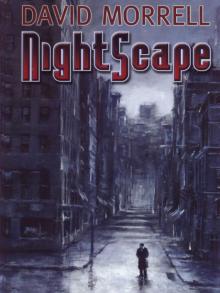
Nightscape 2004, p.22
Nightscape (2004),
p.22


Romero needed all his discipline and training not to react, his mind reeling as he remembered. Luke Parsons? Christ, this was the man he'd spoken to the night his son had been killed and his life had fallen apart. To distract himself from his memories, he had come to this market, only to find someone who reminded him of what he was desperately trying to forget.
"And this is my brother Mark."
"...Hello."
"Say, are you feeling all right?"
"Why? What do you-"
"You turned pale all of a sudden."
"It's nothing. I just haven't been eating well lately."
"Then you ought to try this." Luke Parsons pointed toward a small bottle filled with brown liquid.
Romero narrowed his eyes. "What is it?"
"Home-grown echinacea. If you've got a virus, this'll take care of you. Boosts your immune system."
"Thanks but-"
"When you feel how dramatically it picks you up - "
"You make it sound like drugs."
"God's drug. Nothing false. If it doesn't improve your well-being, we'll give you a refund."
"There you are," Romero's sergeant said. "I've been looking all over for you." He noticed the bottle in Romero's hand. "What's that?"
"Something called home-grown..." The word eluded him.
"Echinacea," Luke Parsons said.
"Sure," the sergeant's wife said. "I use it when we get colds. Boosts the immune system. Works like a charm. Lord, these tomatoes look wonderful."
As she started buying, Luke told Romero, "When your appetite's off, it can mean your body needs to be detoxified. These cabbage, broccoli, and cauliflower are good for that. Completely organic. No chemicals of any kind ever went near them. And you might try this." He handed Romero a small bottle of white liquid.
"Milk thistle," the sergeant's wife said, glancing at the bottle while selecting green peppers. "Cleans out the liver."
"Where on earth did you learn about this stuff?" the sergeant asked.
"Rosa down the street got interested in herbal remedies," she explained later as the three of them crossed the train tracks, carrying sacks of vegetables. "Hey, this is Santa Fe, the world's capital of alternate medicines and New Age religions. If you can't beat 'em, join 'em."
"Yeah, those crystals around their necks. They're New Agers for sure," Romero said. "Did you notice their belts were made of hemp. No leather. Nothing from animals."
"No fried chicken and take-out burgers for those guys." The sergeant gave Romero a pointed look. "They're as healthy as can be."
"All right, okay, I get it."
"Just make sure you eat your greens."
The odd part was that he actually did start feeling better. Physically, at least. His emotions were still as bleak as midnight, but as one of the self-help books he'd read advised, "One way to heal yourself is from the body to the soul." The echinacea (ten drops in a glass of water, the typed directions said) tasted bitter. The milk thistle tasted worse. The salads didn't fill him up. He still craved a pepperoni pizza. But he had to admit, the vegetables at the Farmers' Market were as good as any he'd come across. No surprise. The only vegetables he'd eaten before came from a supermarket, where they'd sat for God knew how long, and that didn't count all the time they'd been in a truck on the way to the store. They'd probably been picked before they were ready so they wouldn't ripen until they reached the supermarket, and then there was the issue of how many pesticides and herbicides they'd been doused with. He remembered a radio call-in show that had talked about poisons in food. The program had dealt with similar problems in the environment and -
Romero shivered.
The program had been the one he'd listened to in his car the night he'd been waiting for the shoes to drop and his son had been killed.
Screw it. If I'm going to feel this bad, I'm going to eat what I want.
It took him only fifteen minutes to drive in from El Dorado and get a big take-out order of ribs, fries, cole slaw, and plenty of barbecue sauce. He never ate in restaurants anymore. Too many people knew him. He couldn't muster the energy for small talk. Another fifteen minutes, and he was back at home, watching a lawyer show, drinking beer, gnawing on ribs.
He was sick before the ten o'clock news.
"I swear, I'm keeping to my diet. Hey, don't look at me like that. I admit I had a couple of relapses, but I learned my lesson. I've never eaten more wholesome food in my life."
"Fifteen pounds. That health club I joined really sweats the weight off."
"Hi, Mark."
The tall thin sandy-haired young man behind the vegetables looked puzzled at him.
"What's wrong?" Romero asked. "I've been coming to this market every Saturday for the past six weeks. You don't recognize me by now?"
"You've confused me with my brother." The man had blue eyes, a hint of their color in the crystal around his neck. Jeans, a white tee-shirt, a glowing tan, and the thin-faced, high-cheekboned esthetic look of a saint.
"Well, I know you're not Luke. I'm sure I'd recognize him."
"My name is John." His tone was formal.
"Pleased to meet you. I'm Gabe Romero. Nobody told me there were three brothers."
"Actually-"
"Wait a minute. Let me guess. If there's a Mark, Luke, and John, there's got to be a Matthew, right? I bet there are four of you."
John's lips parted slightly, as if he wasn't accustomed to smiling. "Very good."
"No big deal. It's my business to deduce things," Romero joked.
"Oh? And what business is - " John straightened, his blue eyes as cold as a star, watching Luke come through the crowd. "You were told not to leave the stand."
"I'm sorry. I had to go to the bathroom."
"You should have gone before we started out."
"I did. But I can't help it if-"
"That's right. You can't help me if you're not here. We're almost out of squash. Bring another basket."
"I'm really sorry. It won't happen again."
Luke glanced self-consciously at Romero, then back at his brother, and went to get the squash.
"Are you planning to buy something?" John asked.
You don't exactly win friends and influence people, do you? Romero thought. "Yeah, I'll take a couple of those squash. I guess with the early frost that's predicted, these'll be the last of the tomatoes and peppers, huh?"
John simply looked at him.
"I'd better stock up," Romero said.
He'd hoped that the passage of time would ease his numbness, but each season only reminded him. Christmas, New Year's, then Easter, and too soon after that, the middle of May. Oddly, he'd never associated his son's death with the scene of the accident on the Interstate. Always the emotional connection was with that section of road by the Baptist church at the top of the hill on Old Pecos Trail. He readily admitted that it was masochism that made him drive by there so often as the anniversary of the death approached. He was so preoccupied that for a moment he was convinced that he'd willed himself into reliving the sequence, that he was hallucinating as he crested the hill and for the first time in almost a year saw a pair of shoes on the road.
Rust-colored, ankle-high hiking boots. They so surprised him that he slowed down and stared. The close look made him notice something so alarming that he slammed on his brakes, barely registering the squeal of tires behind him as the car that followed almost hit the cruiser. Trembling, he got out, crouched, stared even more closely at the hiking boots, and rushed toward his two-way radio.
The shoes had feet in them.
As an approaching police car wailed and officers motioned for traffic to go past on the shoulder of the road, Romero stood with his sergeant, the police chief, and the medical examiner, watching the lab crew do its work. His cruiser remained where he'd stopped it next to the shoes. A waist-high screen had been put up.
" I'll know more when we get the evidence to the lab," the medical examiner said, "but judging from the straight clean lines, I think something like a power saw was used to sever the feet from the legs."
Romero bit his lower lip.
"Anything else you can tell us right away?" the police chief asked.
"There isn't any blood on the pavement, which means that the blood on the shoes and the stumps of the feet was dry before they were dropped here. The discoloration of the tissue suggests that at least twenty-four hours passed between the crime and the disposal."
"Anybody notice anything else?"
"The size of the shoes," Romero said.
They looked at him.
"Mine are tens. These look to be sevens or eights. My guess is, the victim was female."
The same police officers who'd left the pile of old shoes in front of Romero's locker now praised his instincts. Although he had long since discarded the various shoes that he'd collected, no one blamed him. After all, so much time had gone by, who could have predicted the shoes would be important? Still, he remembered what kind they'd been, just as he remembered that he'd started noticing them almost exactly a year ago, around the fifteenth of May.
But there was no guarantee that the person who'd dropped the shoes a year ago was the person who'd left the severed feet. All the investigating team could do was deal with the little evidence they had. As Romero anticipated, the medical examiner eventually determined that the victim had indeed been a woman. Was the person responsible a tourist, someone who came back to Santa Fe each May? If so, would that person have committed similar crimes somewhere else? Inquiries to the FBI revealed that over the years numerous murders by amputation had been committed throughout the U.S., but none matched the profile that the team was dealing with. What about missing persons reports? Those in New Mexico were eliminated, but as the search spread, it became clear that so many thousands of people disappeared in the U.S. each month that the investigation team would need more staff than it could ever hope to have.
Meanwhile, Romero was part of the team staking out that area of Old Pecos Trail. Each night, he used a night-vision telescope to watch from the roof of the Baptist church. After all, if the killer stayed to his pattern, other shoes would be dropped, and perhaps-God help us, Romero thought-they too would contain severed feet. If he saw anything suspicious, all he needed to do was focus on the car's license plate and then use his two-way radio to alert police cars hidden along Old Pecos Trail. But night after night, there was nothing to report.
A week later, a current model red Saturn with New Hampshire plates was found abandoned in an arroyo southeast of Albuquerque. The car was registered to a thirty-year-old woman named Susan Crowell, who had set out with her fiance on a cross-country car tour three weeks earlier. Neither she nor her fiance had contacted their friends and relatives in the past eight days.
May became June, then July. The Fourth of July pancake breakfast in the historic Plaza was its usual success. Three weeks later, Spanish Market occupied the same space, local Hispanic artisans displaying their paintings, icons, and woodwork. Tourist attendance was down, the sensationalist publicity about the severed feet having discouraged some visitors from coming. But a month after that, the similar but larger Indian Market occurred, and memories were evidently short, for now the usual thirty thousand tourists thronged the Plaza to admire Native American jewelry and pottery.
Romero was on duty for all of these events, making sure everything proceeded in an orderly fashion. Still, no matter the tasks assigned to him, his mind was always back on Old Pecos Trail. Some nights, he couldn't stay away. He drove over to East Lupita, watched the passing headlights on Old Pecos Trail, and brooded. He didn't expect anything to happen, not as fall approached, but being there made him feel on top of things, helped focus his thoughts, and in an odd way gave him a sense of being close to his son. Sometimes, the presence of the church across the street made him pray.
One night, a familiar pickup truck filled with moss rocks drove by. Romero remembered it from the night his son had been killed and from so many summer Saturdays when he'd watched baskets of vegetables being carried from it to a stand at the Farmers' Market. He had never stopped associating it with the shoes. Granted, at the time he'd been certain he'd stopped the wrong vehicle. He didn't have a reason to take the huge step of suspecting that Luke Parsons had anything to do with the murders of Susan Crowell and her fiance. Nonetheless, he'd told the investigation team about that night the previous year, and they'd checked Luke out as thoroughly as possible. He and his three brothers lived with their father on a farm in the Rio Grande gorge north of Dillon. They were hard workers, kept to themselves, and stayed out of trouble.
Seeing the truck pass, Romero didn't have a reason to make it stop, but that didn't mean he couldn't follow it. He pulled onto Old Pecos Drive and kept the truck's taillights in view as it headed into town. It turned right at the state capitol building and proceeded along Paseo de Peralta until on the other side of town it steered into an Allsup's gas station.
Romero chose a pump near the pickup truck, got out of his Jeep, and pretended to be surprised by the man next to him.
"Luke, it's Gabe Romero. How are you?"
Then he was surprised, realizing his mistake. This wasn't Luke.
"John ?
I didn't recognize you." The tall, thin, sandy-haired, somber-eyed young man assessed him. He lowered his eyes to the holstered pistol on Romero's hip. Romero had never worn it to the Farmers' Market. "I didn't realize you were a police officer."
"Does it matter?"
"Only that it's reassuring to know my vegetables are safe when you're around." John's stern features took the humor out of the joke.
"Or your moss rocks." Romero pointed toward the back of the truck. "Been selling them over on that country road by the Interstate? That's usually Luke's job."
"Well, he has other things to do."
"Yeah, now that I think of it, I haven't seen him at the market lately."
"Excuse me. It's been a long day. It's a long drive back."
"You bet. I didn't mean to keep you."
Luke wasn't at the Farmers' Market the next Saturday or the final one the week after that.
Late October. There'd been a killing frost the night before, and in the morning, there was snow in the mountains. Since the Farmers' Market was closed for the year and Romero had his Saturday free, he thought, Why don't I take a little drive?
The sunlight was cold, crisp, and clear as Romero headed north along Highway 285. He crested the hill near the modernistic Sante Fe Opera house and descended from the juniper-and-pinon-dotted slopes of town into a multicolored desert, its draws and mesas stretching dramatically away toward white-capped mountains on each side. No wonder Hollywood made so many westerns here, he thought. He passed the Camel Rock Indian casino and the Cities of Gold Indian casino, reaching what had once been another eternal construction project, the huge interchange that led west to Los Alamos.
But instead of heading toward the atomic city, he continued north, passing through Espanola, and now the landscape changed again, the hills on each side coming closer, the narrow highway passing between the ridges of the Rio Grande gorge. WATCH OUT FOR FALLING ROCK, a sign said. Yeah, I intend to watch out, he thought. On his left, partially screened by leafless trees, was the legendary Rio Grande, narrow, taking its time in the fall, gliding around curves, bubbling over boulders. On the far side of the river was Embudo Station, an old stagecoach stop the historic buildings of which had been converted into a microbrewery and a restaurant.
He passed it, heading farther north, and now the gorge began to widen. Farms and vineyards appeared on both sides of the road, where silt from melting during the Ice Age had made the soil rich. He stopped in Dillon, took care that his handgun was concealed by his zipped-up windbreaker, and asked at the general store if anybody knew where he could find the Parsons farm.
Fifteen minutes later, he had the directions he wanted. But instead of going directly to the farm, he drove to a scenic view outside town and waited for a state police car to pull up beside him. During the morning's drive, he'd used his cellular phone to contact the state police barracks farther north in Taos. After explaining who he was, he'd persuaded the dispatcher to send a cruiser down to meet him.
"I don't anticipate trouble," Romero told the burly trooper as they stood outside their cars and watched the Rio Grande flow through a chasm beneath them. "But you never know."
"So what do you want me to do?"
"Just park at the side of the highway. Make sure I come back out of the farm."
"Your department didn't send you up here?"
"Self-initiative. I've got a hunch."
The trooper looked doubtful. "How long are you going to be in there?"