A temporary life, p.25
A Temporary Life,
p.25


‘Oh, they’re still being very much talked about,’ he says.
‘The bigger the better.’
‘That’s what I think in a thing like this.’
He stands up briefly behind the desk; I let the door swing to.
The glare of coloured lights comes from Kendal’s room.
I cross over to the door and step inside.
Mathews is working at one of the benches with a soldering iron; Kendal himself, a mask on his face, is welding a sheet of metal across the room.
As the glare from the torch subsides he looks across.
He lifts up the mask, smiling, puts down the apparatus and comes over to the bench.
‘I hear you had dinner with Wilcox recently,’ I tell him.
‘Two nights ago, old man.’ He rubs his hands. ‘I expand my work in here, he expands whatever he has to expand out there, and never the twain of us shall disagree.’
‘Did you offer to clear his room?’ I say.
‘That was part of the arrangement, you understand. Some of it in any case,’ he says, ‘has come in useful.’
I can see the ’cello with its partly dismembered body standing in the corner; the skeleton, an anatomy torso, and the remains of what appears to have been the Apollo Belvedere are scattered across a bench.
‘Mathews and myself are doing a sort of assembly of the more enigmatic pieces in the Wilcox collection. We thought of calling it “Skipperania”, a hitherto unknown cultural syndrome characterized by an aversion to all known forms of artistic expression in favour of a collection of one’s own excreta, usually displayed in one’s place of work in forms that aren’t, at first sight, at least, immediately recognizable.’
Mathews looks across.
‘How’s your eye?’
‘All right.’
‘Need any stitches?’
‘One or two.’
He goes back to his soldering iron.
‘Has Wilcox spoken to you yet?’ I say.
He shakes his head.
‘Whenever he does,’ I tell him, ‘let me know.’
He doesn’t look up. I go over to the door.
‘If you’d like to make your own contribution,’ Kendal says, ‘you’re very welcome. The whole conception, you see, is essentially a communal gesture. Not the prerogative of one particular man.’
‘I’ve made my gesture already,’ I tell him.
‘I’ve even kept one of the bottles,’ Kendal says. ‘Vintage 1912,’ he adds.
I go out to the hall.
Pollard is mounting up the steps, consulting a newspaper; a cigarette he’s smoking, as he hears my steps, he hastily puts out.
‘It’s you, old man.’ He folds the paper. ‘I’ve just been given a tip,’ he says, ‘by this friend of Hendricks. I don’t know whether you know him.’ He twirls his hand above his head. ‘A large moustache. Bright red. Says he rode Agamemnon in the National in, what was it now; one of those immediate post-war years.’
‘1946.’
‘That’s right.’
He stabs the paper.
‘Fancy a gamble, then, old man?’
‘Had all I want for the present,’ I say.
‘I know what you mean, old man.’ He taps his nose. ‘Had dinner, you know, the other night. Boiled fish plus a rendering of “Hail, Thou Wandering Spirit” by the Skipper’s better half.’
He goes on up the steps.
From Kendal’s room comes the whirring of electric motors, the flashing of coloured lights.
I push open the glass doors and go down to the street; I glance up at the black, tall-windowed building, at the sign above the door, ‘Municipal College of Fine Arts and Crafts’, then, with my collar up, my hands thrust in my pockets, set off down the road towards the town.
A boot, perhaps thirty feet high, stands in the centre of the yard. Where the eyelets might have been there are coloured lights; the lace itself is a coloured rope: the heel, it seems, is made of glass: the figures moving past are divided into two, the smoothness of the heel itself reflecting the legs and feet, the curve of the boot above the upper half of arms and heads.
The whole structure, it appears, has begun to shake; the black texture around the lace and the ankle begins to glow.
A rocket streaks across the college roof, exploding against the evening sky; a low humming emerges from the boot itself; white smoke emerges from an opening at the front; it drifts across the yard in a bulbous cloud, changing colour above the upturned heads: a tongue lolls out, a brilliant red. The lights, too, around the eyelets have begun to twinkle; the lolling tongue at the front begins to shake; a tune emerges, muffled, from the interior of the boot itself.
Yvonne, red-cheeked, watches now with widening eyes; her head’s turned up, shrouded in a scarf: she holds the edge of the scarf between her teeth, her lips drawn back: she begins to smile.
The whole boot, as if antagonized, begins to sway; the upper half, as if impelled by an invisible foot, contracts, expands; the one bulbous half, beginning to vibrate, bursts finally with a roar of rockets. The edges of the boot begin to crumble: the lace itself is a coil of flame; smoke drifts up in clouds from around the eyelets.
Wilcox, transfixed, is gazing up at the glittering edifice with his wife on one side and Hendricks on the other; Pollard, his hat on the back of his head, is standing with his wife and a crowd of children, too numerous to count, in the open door of the modelling shed; a shower of sparks cascades across the yard: the crowd have screamed. Kendal crouches on the steps at the back of the college: he manipulates a series of knobs and levers on a board before him, his face lit up, gleaming, as he gazes at the boot itself: the thirty foot edifice begins to crumble.
The neck of the boot falls in; the crowd draws back. Yvonne herself has caught my arm; a cloud of smoke and flames obscures the college: standing at the gate are Rebecca, Mathews and Elizabeth. Mathews, seeing Kendal, has crossed over to the steps; a crowd presses in from the road outside. Sparks drift off across the roofs.
The large salmon-coloured car is parked against the kerb.
Elizabeth, bare-headed, her hands in the pockets of her coat, has looked across.
Yvonne is laughing; she glances back towards the yard.
Elizabeth doesn’t stir; Rebecca, her back to the car, is gazing over to where Mathews, on the steps, is talking now to Kendal.
I go across. Her face, vaguely, has caught the light reflected from the yard.
‘A farewell visit,’ she says. ‘I thought you’d left.’
‘I have.’
‘Come back for the celebration.’
Her face is thinner, hard, the hair pushed over now entirely to one side.
‘I heard about the chauffeur.’
‘He died,’ she says.
‘That’s what I heard.’
‘Neville was driving. The poor bastard, I’m afraid, was sitting beside him. The other way around,’ she says, ‘and it mightn’t have been so bad.’
She looks over to Yvonne.
‘Is that your wife?’
‘Would you like to meet her?’
She shakes her head.
‘Is she out of hospital yet?’
‘For a couple of days.’
‘She looks quite well.’
Yvonne, suddenly aware of my absence, has glanced across.
The boot has vanished. An anonymous mound of burning debris now occupies the centre of the yard.
‘We’re leaving in a couple of weeks. I suppose,’ she says, ‘I should say good-bye.’
She reaches up; she kisses my cheek.
Abstracted, half-smiling, she glances back towards the yard.
‘Is Neville still here?’
‘He’ll keep popping back, I suppose, for the next two years.’
‘Is Rebecca staying?’
‘She’ll be coming with me. We’ll be living in London for a while. She’ll probably, if she wants to, go to a college there.’
She turns away, slowly, towards the yard.
‘Give my love to the flat,’ she says.
Not only are there the drifts of coal dust which have fallen off the lorries, the refuse, the bits of paper, the droppings from the horses, the twigs and leaves and lumps of clay from the heath itself, but these hardened packs of ice which have accumulated beneath the wheels of the passing traffic. I loosen them with the shovel, sweep up the rest of the refuse, and drop the whole load in the metal bin; having swept one side of the road, I wheel the bin over to the other side and start sweeping up the debris there.
A car passes down the road, from the direction of the village. It slows as it draws abreast of the bin and, a little lower down, pulls over to the side.
A man gets out in a trilby hat; he stamps his feet, turns up his collar, and comes back up the road, blowing in his hands.
‘Your name Freestone?’
He has bright red cheeks; thin veins run in patterns across his nose: it too is red, the eyes above dark brown. The whites show up as a dullish pink.
‘That’s’ right.’
‘Used to fight: what was it, now?’ He glances at my jacket with Urban District Council printed in luminous letters across the back. ‘Light-heavy.’
‘That’s right.’
‘You were pointed out to me,’ he says, ‘the other day.’
He looks at the brush, the shovel, at the dustbin on its metal trolley, then stamps his feet against the cold.
‘Fallen on hard times.’
‘I believe in the principle that you should pay people,’ I tell him, ‘not to work. Then the ones who do work would do it for purely equitable reasons. I believe in a society built upon that principle,’ I add.
He shakes his head. ‘You’d find a lot of loafers, then. There’ll be nobody in the factories. Nor down the mines. Nor anywhere, if it comes to that.’
‘I think you’d be surprised.’
‘At what?’
‘The sort of society that that principle might produce,’ I say.
‘I could get you a job, if you like.’ He gestures at the shovel. ‘Better than this.’
‘I don’t know of any job,’ I tell him, ‘better than this. This is a job I’ve chosen,’ I go on, ‘of my own volition.’
‘A man like you?’ He stamps one foot and then the other.
‘Think about it,’ I tell him, ‘when you get back home.’
‘I’ve thought about it already, lad.’
He tries to laugh.
‘Then think a little harder. If you had a job like this,’ I tell him, ‘you’d find you had the time.’
‘You married, then, or just looking to yourself?’ he says.
‘I’m married,’ I tell him.
‘Euphoria,’ he says. ‘You’ll find it pass.’
‘I’m too old for euphoria,’ I tell him.
‘Aye, well,’ he says. ‘I’d better get on.’
‘It’ll not wait for you,’ I say. ‘I can tell you that.’
‘What won’t wait?’
‘Your kind of time.’
He goes back to the car.
He gets inside.
It moves off slowly down the road, quickening then, appreciably, as it nears the town.
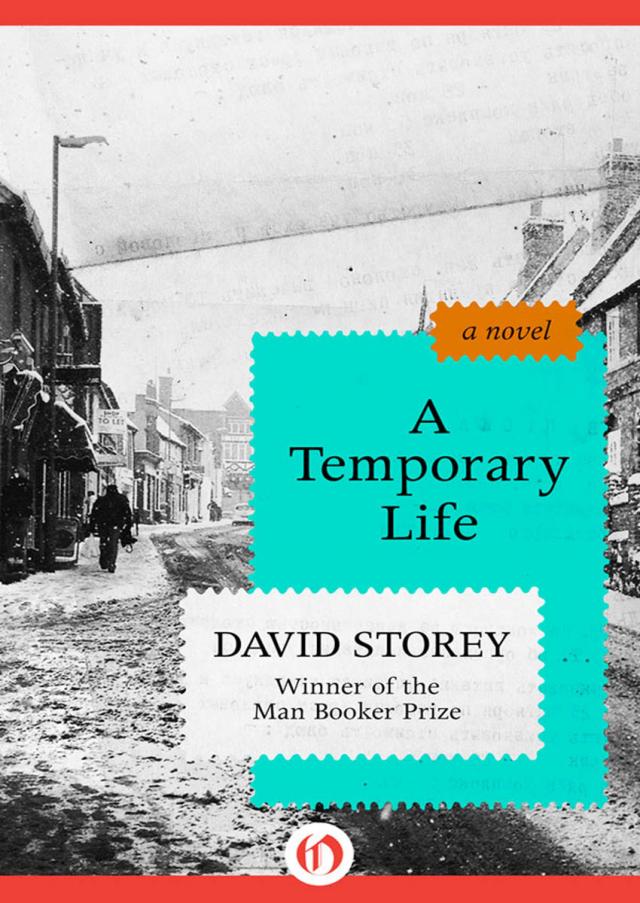
The snow drifts down.
Across the valley, like a ligament of rock, stand the buildings of the town, black, crested white, the cathedral spire thrust up like a fissure into the greyness overhead.
I pick up the shovel and start again.
About the Author
David Storey was born in 1933 in Yorkshire, England, and studied at the Slade School of Fine Art. His novels have won many prizes, including the Macmillan Fiction Award, the Somerset Maugham Award, the Geoffrey Faber Memorial Prize, and the Man Booker Prize. He is also the author of fifteen plays and is a fellow of University College London. Storey lives in London with his wife and four children.
All rights reserved, including without limitation the right to reproduce this ebook or any portion thereof in any form or by any means, whether electronic or mechanical, now known or hereinafter invented, without the express written permission of the publisher.
This is a work of fiction. Names, characters, places, events, and incidents either are the product of the author’s imagination or are used fictitiously. Any resemblance to actual persons, living or dead, businesses, companies, events, or locales is entirely coincidental.
Copyright © 1973 by David Storey
Cover design by Mauricio Díaz
ISBN: 978-1-5040-1512-7
This edition published in 2015 by Open Road Integrated Media, Inc.
345 Hudson Street
New York, NY 10014
www.openroadmedia.com
EARLY BIRD BOOKS
FRESH EBOOK DEALS, DELIVERED DAILY
BE THE FIRST TO KNOW—
NEW DEALS HATCH EVERY DAY!
EBOOKS BY DAVID STOREY
FROM OPEN ROAD MEDIA
Available wherever ebooks are sold
Open Road Integrated Media is a digital publisher and multimedia content company. Open Road creates connections between authors and their audiences by marketing its ebooks through a new proprietary online platform, which uses premium video content and social media.
Videos, Archival Documents, and New Releases
Sign up for the Open Road Media newsletter and get news delivered straight to your inbox.
Sign up now at
www.openroadmedia.com/newsletters
FIND OUT MORE AT
WWW.OPENROADMEDIA.COM
FOLLOW US:
@openroadmedia and
Facebook.com/OpenRoadMedia
David Storey, A Temporary Life