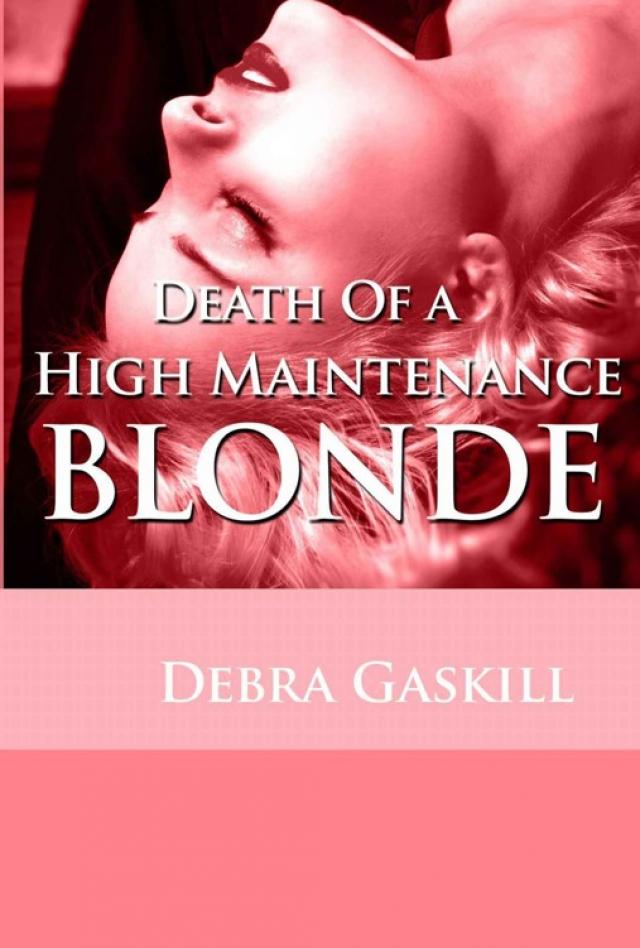
Death of a high maintena.., p.18
Death of A High Maintenance Blonde (Jubilant Falls Series Book 5),
p.18


Chapter 29 Leland
My head was throbbing Thursday morning when I lifted my face from the pillow. The red lights of the bedside digital clock told me it was nearly noon. My clothes lay in a sloppy pile on the foot of the bed. When had I taken them off?
God, how much did I drink? I sat up, swung my bare feet over the side of the bed, and slipped into my boxers. I stood unsteadily, rubbing my face roughly with my hands, hoping to wipe away the fog in my head and the dried saliva from my cheeks and beard.
Does it matter? The answer came back quickly. You’re still an alcoholic.
My mouth tasted like the bottom of an abandoned birdcage as I staggered the few steps from my bed into the bathroom. The vodka bottle was upended in the sink and the cold, white hearts of a few ice cubes floated with the glass I’d taken from the bar in the ice bucket. I leaned my forehead against the mirror’s cold surface, trying to assuage the pounding in my skull.
Five years of sobriety down the goddamn toilet. Five years of hard work keeping my life on track and I fuck it up again. First Noah, then Bitch Goddess and now Charisma—once again I’m the one-stop source for pain, disaster and hurt.
I wet my toothbrush and squeezed a shaky trail of toothpaste along the bristles. Closing my eyes to escape the pain in my head, I began brushing my teeth.
“Don’t beat yourself up too badly. You at least called me.”
I jumped, dropping my toothbrush alongside the empty vodka bottle. It was Steve, the AA meeting leader, leaning on my bathroom doorframe.
“How long have you been here?” I asked.
“All night.” He turned to point at the armchair in the corner. “I slept there.”
Shaking my head, I picked up the vodka bottle and sat it upright on the bathroom counter. Running water over my toothbrush again, I returned to brushing my teeth, but didn’t say anything.
“You really hadn’t drank that much by the time I got here. You can get right back into the program and start all over again, no problem. As long as you’re here in Jubilant Falls, we’re all here to help you.”
“Mmm.” I jerked my chin up in acknowledgement and spit into the sink. I put my toothbrush back in my mouth and kept brushing.
“Don’t beat yourself up too badly. You only had maybe two, three drinks. You called, and I came right over.”
I spit into the sink again, this time vehemently.
“Help me? Help me?” I said. “If it hadn’t been for one of the idiots in your group, I wouldn’t have just sent five years of sobriety down the toilet.” I wanted to take the empty vodka bottle and sling it at his head.
“Excuse me?” Steve’s supportive, rah-rah tone ended.
“After I told my story, that goddamn fat bastard of a police chief went straight to the woman I talked about and told her he knew who she was. Because of his goddamn big mouth, she’s packed up and left town.”
Steve hung his head.
“I had spent a year researching, trying to find her and others just like her—I’m not even talking about falling for her—all it took was one idiot running his mouth to ruin it all.”
“Oh my God. I’m so sorry…”
“I’m sure you are, but it doesn’t fix a damned thing.” I stepped over to the shower, my voice rising over the water. As steam filled the bathroom, I reached for the empty bottle and, holding it like the Louisville Slugger I wished it were, stepped into the doorway. “I would suggest you get the hell out of here before I decide to sling this goddamn thing at your head.”
Steve’s eyes got large and he scrambled backwards, fumbling his way toward the door. It slammed behind him as he left, running down the hallway.
I tossed the vodka bottle into the bathroom trashcan and stepped into the shower.
The water cascading over my face chased away the fog in my brain. If Charisma was gone, there was no need for me to remain here either. But before I could leave, I had one more stop to make.
Chapter 30 Charisma
“You sure you want to do this?” Addison looked at me with concern. “You’re under no obligation. I mean, I’d love to have the story for selfish reasons, but don’t do it because I asked you.”
“I owe you, Addison. You gave me a second chance, even though I lied to you. You and these folks in the newsroom gave me the chance to start again.”
“You’re still leaving, though.”
Again, I nodded. “You deserve the truth, but nobody else deserves a piece of me. I’m going to write the story for you and then I’m out of here. I don’t even know where I’m going. I just know I’m gone.”
“Did you want to tell the rest of the staff before the story runs?”
“No. I can’t. They’re good folks and everything, but I’m… I’m just not up to it.”
“OK.”
I returned to my desk and sat down in front of my computer, sighing as I did so.
It had been a long, long road. No one knew my story because I was ashamed of so much, responsible for so much and as a result of one single day’s events, I’d paid so much.
Now, it was time to tell it, not because I wanted to but because I needed to protect myself with a story that wasn’t spun or slanted or playing to anyone’s agenda.
I laid my fingers across my computer keyboard like a pianist beginning to pick out the notes of some personal, tragic sonata and, slowly, began to write down the events that changed my life.
*****
Jean Paul’s fingers walked up my arm to my shoulder, followed by his lips. We were in bed, in our dingy room at a cheap hotel inside the Green Zone, where US military officials corralled journalists, both foreign and domestic, when they came to Baghdad.
The rooms were basic at best, with tacky furniture and blackout curtains designed to catch breaking window glass should a missile strike close to the building. US troops called the area The Emerald City, a reflection of how the order and security within its walls seemed like part of Oz, not the ugly chaos outside in the real Baghdad.
“Go away. I’m trying to work,” I said, running my fingers through his curly black hair and kissing his lips. I smiled at him as I gently pushed him away.
The electricity was currently working and I knew, before the next of several daily blackouts plunged the city into darkness, I needed to get some work done. I was on my laptop, trying to transcribe some of my interview notes from a mother I’d interviewed on the scarcity of food and medicine and the anticipated chaos once US troops left.
Pulling the thin, worn hotel blanket up to his sculpted abs, Jean Paul settled back into his side of the bed, sighing melodramatically.
“C'est notre deuxième anniversaire. Ma mère veut savoir quand nous allons donner ses petits-enfants,” he said. Our conversations were an odd mix of French and English. “It’s our second anniversary. My mother wants to know when we're going to give her grandchildren.”
“Your mother can wait until we quit living out of suitcases.”
“When will that be?” he asked.
The lights flickered uncertainly and I quickly hit ‘save’ on the keyboard to preserve my work.
“Everyone I’ve talked to says the country will disintegrate into chaos after the US leaves,” I said, focusing once more on my notes. “I’ve got to get that impression across—I think this woman I interviewed today will really convey that: the lack of medical supplies, the food shortages, the feeling of no future for anyone who stays here. Everyone I’ve interviewed said to expect sectarian violence, especially now that Saddam is dead. The conflict between Sunni and Shiite Muslims is expected to explode.”
“You didn’t answer my question.”
I waved my hand dismissively toward his side of the bed and kept typing.
“Charisma, please. Can we forget about work for one night and talk?” Jean Paul asked.
“Give me a minute and let me finish. I’ve got to get this done. Did you talk to Lt. Faulkner today?”
Second Lt. Reese Faulkner was the Army press liaison we worked with. Just out of college, this was his first tour in Iraq. He was bright, young and made sure we had plenty of the patriotic stories that the brass clamored for, but seldom put me in contact with real Iraqis who lived with the real results of the invasion. The current story lines always involved Iraqi troops and how, following US training, they would take over.
“When they stand up, we’ll stand down,” was Lt. Faulkner’s mantra and he repeated it often.
“I want to talk to my wife right now, not some kid.”
“Just a few more minutes…”
“Voulez-vous s'il vous plaît arrêter de travailler et de me parler?” he demanded. “Will you please stop working and talk to me?”
I slapped the laptop closed and laid it on the nightstand as the lights flickered, then went out for good.
“Quand avez-vous commencer à se soucier de ce que votre mère veut?” I shot back, frustrated at the interruption and the blackout. “When did you start caring about what your mother wants?”
“Don’t you want children, Charisma?” Jean Paul shifted back into his heavily accented English.
“How can we have children if we’re living out of suitcases, running all over the world?”
“You don’t want to do this forever, do you?”
“And what if I do?”
“I just had hopes that someday we’d settle down somewhere. Get a place of our own.”
“Where? Some little French village? And I’d do what? Breed like a rabbit? Wipe butts and noses all day? Spend my day in the marketplace looking for the best lamb chops so you have a perfect dinner waiting for you when you come home?”
“Charisma, every time we have this discussion, you say that. Nobody is saying you need to give up your career. We’d work it out somehow.”
“So we’d have a live-in nanny while we chase stories? We’d let somebody else raise our children?”
“I didn’t say that either. The truth is, it’s getting more and more dangerous here for foreign journalists. I’m uncomfortable with some of the reactions we get when people find out who you are. I worry about our safety. I worry about your safety, especially since you are so well known.”
I ran my fingers through my blonde hair. “That’s always been part of the job. You know that. We’d face the same thing if we were anywhere else.”
“No we wouldn’t, Charisma. You know that’s not true. There are big stories in other, safer places.”
“Listen, I watched my mother give up her career at Reuters and my father turn into someone he absolutely loathed when they decided after two kids, she needed to stay home and he needed to stop chasing stories. After my parents divorced and she went back to work, she never made the same money because of the time she’d spent at home raising kids. I’m not going to put myself in that situation.” I folded my arms resolutely. “I’m not ready to stop doing what I’m doing just to have children. Not now at any rate.”
These arguments were more and more frequent lately, although I couldn’t think why. I mean, weren’t women the only ones with the ticking biological clock? I thought he was as hooked on covering this conflict as much as I was. We promised our folks we’d Skype or phone once a week whenever possible. I rarely took part in his conversations with his stylish, but overbearing mother, so I didn’t know if she was really pushing the baby thing that hard or not. I just know the subject of bébés kept coming up between the two of us.
Jean Paul reached for me again, burying kisses in my neck and sliding his hand inside my nightshirt. His warm hand cupped my breast.
“Oh, mais nous ferions de beaux bébés…” he whispered into my neck. “Oh, but we’d make beautiful babies.”
“Stop it.” I pushed his hand away and turned over on my side. “Go away.”
He snuggled closer and wrapped his arm around my middle. “I love you, Charisma,” he whispered into my shoulder. “I want you to be happy, but I want you to be safe, too. You take too many chances.”
I punched the lumpy pillow and lay my head on my hands. “I’ll be fine. Can we talk about this tomorrow?”
Jean Paul sighed and rolled away from me.
“We’ll get wrapped up in the next story and it will get forgotten. We have this same conversation over and over and it never gets resolved,” he said sadly. “I hoped after two years together we could have talked more about children without it becoming un grand combat.”
I sat back up. “I can’t believe you said that.”
“Well, it’s true, Charisma.” Jean Paul stayed on his side, staring at the wall. “This job is everything to you, your heart and soul. All I want is to know, at some point, when you’re going to put us first? When will this marriage be the most important thing in your life?”
“You are important to me, Jean Paul. I couldn’t do this without you.” I flopped back onto the bed and turned over on my side.
“Don’t flatter me. Another photographer could take the same shots I do. For god sake, I know Kalil can do what I do! I just want to know where I stand in your heart,” he said softly.
Kalil was the local man we’d hired as a fixer, something every foreign journalist couldn’t do without. A fixer was just that: a translator, social secretary, a driver, security and ultimate source. He was one of the thousands of private security men vetted by the US government and hired by journalists and other westerners that operated within the Green Zone. Just as Jean Paul and I rarely wandered the city without a Kevlar vest and helmet, Kalil was also there to protect us, driving us around in a specially armored Chevy Suburban. He seldom escorted us without a weapon of some kind, most often a high-powered Kalashnikov rifle.
Kalil came highly recommended, having worked with other journalists who rotated in and out of this embattled city. He knew where the action was—or where it would soon happen. He knew city officials and how to get in touch, through those dusty, ancient streets, with those who would tell us stories of real life, not what those in power would have us believe.
As life in Baghdad got increasingly dangerous, we relied on Kalil to shoot photos or video, even interview somebody, and then put the story together back at the bureau, which was located on a lower floor of our hotel.
If I was doing a print story, I could observe from the armored confines of Kalil’s Suburban, but Jean Paul couldn’t get the shots he wanted without leaving the vehicle. If we were doing video, we both had to step outside or be content to let Kalil shoot and interview, then edit the piece together with my commentary, shot from the relative safety of our Green Zone hotel roof. It was an odd form of team journalism.
“Don’t be so melodramatic.” I rolled my eyes.
He was silent for a moment. “I talked to Kalil today.”
“Oh?”
“He said he can get us an interview with some of the survivors of that marketplace bombing yesterday,” Jean Paul said. Bombings, kidnappings and sniper shootings were so commonplace that they became part of the background noise with which we lived our daily lives and not the stuff of daily news, unless the body count was high.
“Sounds good. I’ll stop down by the bureau’s office first thing tomorrow and see if the chief wants us to pursue that,” I answered.
“What if they say no?”
“We’ll probably go ahead and go anyway.”
“Charisma, that’s suicide. See what Lt. Faulkner can do for us. Maybe we can embed with a patrol in the market. You know they’ll be going out to investigate.”
“An embed request would take too long. The brass has to sign off on it—you know that. How else can I truthfully illustrate how this country will collapse after US troops pull out?”
“Why do you have to be the only one to get the big story?”
“Because…” I wanted to finish the sentence with “I’m Charisma Prentiss, that’s why,” but knew that wouldn’t carry any weight, not with Jean Paul. Instead, I said, “Nobody can tell the story like I do.”
“I’m glad you think so.” Jean Paul sighed and the conversation, again, ended on the same frustrating notes.
In a few minutes, Jean Paul’s breathing became deep and regular. I sat up and threw off the covers. I pulled the laptop from my nightstand and found a flashlight in the drawer.
Go ahead and sleep, Jean Paul, I told myself. I’ve got work to do.
*****
The next morning, I ran my fingers through my hair in front of the bathroom mirror. The electricity was working for the time being.
“My brown roots are beginning to show,” I murmured to myself. “I wonder if I have any Miss Clairol left?”
Down deep inside the military issue duffel bag I carried, I always had an extra box or two of Miss Clairol’s Born Blonde, wherever I was in the world. God knows if for some reason the editors wanted me on camera, I couldn’t be filmed looking, well, like I’d been bunking in a cheap Baghdad hotel for a month without benefit of a hairdresser. I’d learned how to color my own hair early on in this gig. Only in situations of extreme danger did I leave my helmet on when recording.
“What did you say?” Jean Paul walked past the bathroom door. The tension between us was still thick and his tone was sharp and accusatory.
“Nothing,” I retorted, just as harshly. “Nothing at all.”
“I haven’t heard from Kalil,” Jean Paul said, strapping on his Kevlar vest, with PRESS in big white letters across the back and chest. I wore one just like it, along with boots, a pair of jeans that could probably stand on their own, and a polo shirt. We both had blue helmets with MEDIA written across the front.
When I first started embedding with the troops, I wanted a pair of camouflage pants and helmet just the like American troops wore, thinking it might help me bond with troops who clearly didn’t want me there. “Why?” the public affairs officer asked me. “You want to be a target or something?”
Instead, I made sure that I kept up with the troops, portrayed them sympathetically and never minced words when it came to the danger they faced.