Not till we are lost bob.., p.28
Not Till We Are Lost (Bobiverse Book 5),
p.28
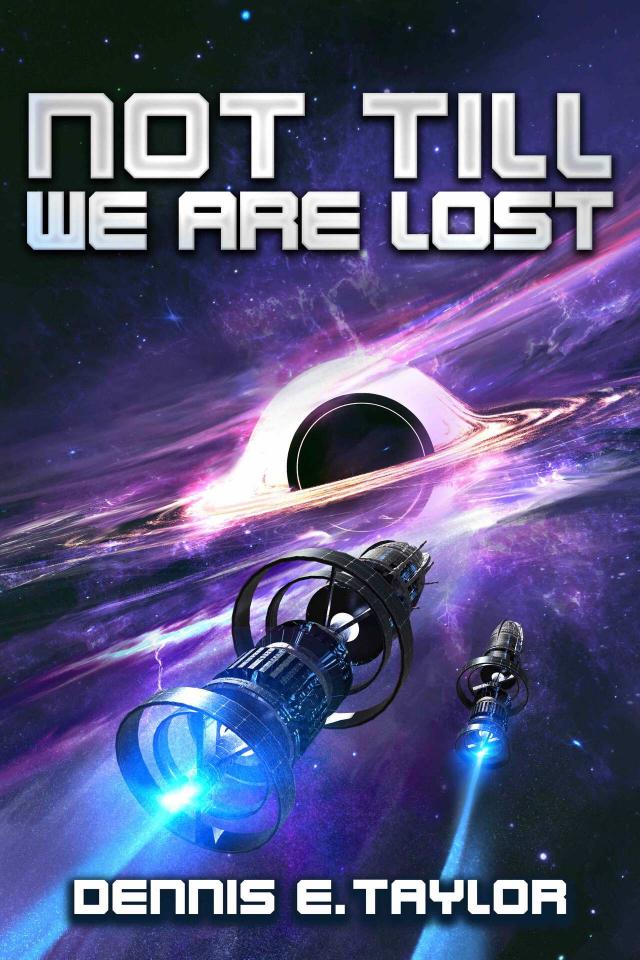


We pulled up behind the transport vessel, which was making its way in a barge-like manner toward the wormhole gate, and slowed way down. There’s an episode of The Simpsons where Homer is following a turtle during an acid trip, and he gets impatient and kicks it over the horizon. Staring at the back end of the transport, I could sympathize. This thing just was not in a hurry.
The ship went through the local gate, then the two hub gates. The second one, though, which we hadn’t yet investigated, turned out to be a radial line and was about ten thousand light-years closer to galactic center.
“All right!” I crowed. “We may be visiting the core sooner than expected.”
“I wonder if there’s a reason for putting an antimatter factory in the core,” Dae said, frowning.
“If nothing else, the big black heavy thing is a great source of power.”
“Sure, if it doesn’t spaghettify you or reduce you to elementary particles. Should we be heading there?”
“Dae, my guess is if we are going into a dangerous region, we’ll receive a warning. And now that we have a common language, we’ll actually understand that warning.”
“Yippee.”
Two more gates, and we were in the core. I had read that there were more than ten million stars within a parsec of the galactic center, and that the average distance between stars in this region was below a half light-year.
None of these dry factoids came even close to touching the reality of what we faced. The sky was ablaze with stars, with virtually no empty space showing, except possibly straight up and down. Red dominated, as most of the stars in this region were old, red giants. But a period of star formation about a million years ago had also produced a large crop of young, blue-white giants, some of which I could swear showed visible disks.
“Good God in heaven,” Dae breathed.
With a huge effort, I pulled my eyes away from the vista and checked the security monitors. Happily, we were not right on top of a sun. We appeared to be several AU from a small white dwarf. Of course, I thought, the makers of the wormhole network would have picked a relatively stable location to set up. But in this stellar soup, stability was likely transitory. I wondered if you could move a wormhole once opened.
We began to take stock. The transport ship continued on its stately way, and we adjusted course to follow.
I dismissed my VR in favor of a total-surround stellarium view. I floated, seemingly disembodied, in a sea of stars.
“Sagittarius A* is about seven light-years that way,” Dae said, using a laser-pointer metaphor. The red dot circled around a spot on the stellarium surface.
“It’s still just all stars,” I complained. “Let’s tone down the visible spectrum and bring in a radio-frequency layer.”
In the radio spectrum, we could see the jets from the central black hole racing north and south, ballooning into the Fermi bubbles that existed above and below the galactic core. And something else …
“That is … ” Dae said, working his laser pointer.
“Hold on.” I shifted the spectrum being displayed, and the artifact became clearly visible. Close to us—very close on an astronomical scale—something was firing a brilliant plume to galactic north, and glowing brightly. “That,” I said, “is the view at five hundred and eleven KeV.”
“Antimatter annihilation,” Dae breathed.
“Yup. I guess it makes sense that we’d come out near the antimatter source.”
“So this is the legendary antimatter fountain.”
I nodded, struck dumb with awe. In 1997, astronomers had discovered that something near the galactic center was shooting a plume of antimatter particles thousands of light-years to galactic north. And only to the north, which no one had an explanation for. The radiation given off when the antimatter interacted with normal interstellar dust and gas glowed at 511 KeV, the radiation signature of total annihilation.
“Well, now we know,” I said.
“Know what? The empire is getting antimatter from here, but we still have no idea what it is, other than a tremendous source of antimatter.”
“Enough to power an empire. And keep it running, apparently.”
Dae sighed. “Let’s look around. I’d hate to leave without finding out anything more.”
We engaged SURGE and swiftly overtook our escort. I kept my stellarium VR up, and I noted that Dae wasn’t expressing any need to re-corporate.
Sensors indicated we were still about ten AU from the fountainhead when we detected a communication over SCUT. We still hadn’t mastered the empire’s SCUT comm standards, so I cast around until I spotted a likely source for the transmission and sent a greeting via radio in Roanokian.
The source appeared to be a large space station, or possibly a small asteroid. It had all kinds of technological accretions, a cloud of small vehicles in parking orbits around it, and showed every indication of being the administrative center for the region.
A response came back immediately in the same medium. “Roanokian vessels, you have entered an interdicted area. This is the Central Antimatter Works for the Pan Galactic Federation. Unauthorized vessels are prohibited. Stop immediately or face impoundment of your vehicles.”
We stopped immediately and tried to display good intentions by reversing course for a short distance.
“Pan Galactic Federation,” Dae said. “That’s interesting. I wonder how accurate that is.”
“As accurate as our translations of Roanokian, I guess. Double-check the individual words, will you?” Without waiting for a response, I sent a message to the space station. “Can you supply a map of the stellar neighborhood that will keep us out of the interdicted area?”
“Star maps are available via Mapping Protocol, which is supported only through SCUT transmission.”
“Oh, for fuck sake,” Dae muttered.
I replied. “We do not know the standard communication protocols used by the Pan Galactic Federation. Can you give us the specs?”
In reply, the space station sent a series of extremely dense text files in Roanokian. A quick glance indicated that we’d been given not only the Mapping Protocol but also the Identification and Authorization Protocol, the Audio/Video/Other Communications Protocol, and a couple of other less relevant items.
“Finally, someone is being helpful,” I muttered. Then, to the station, “May we enter a parking orbit while we digest this?”
“Affirmative.”
And just like that, we were in business.
“Seven light-years to Sagittarius A*, or to as close to it as we want to get. That’s seven years each way, Icky—so another fourteen years minimum before we report in.” Dae stood glaring at me, his fists literally on his hips in an unconscious parody of Mom when she disapproved of our choices.
“We’ve already been at this for almost thirty years, Dae. Plus the time we spent in normal space before we found the wormholes. We’ve long since disconnected from Bobiverse society. And it’s not like they’re expecting us.”
“Depends, doesn’t it? On whether our SCUT stations get into position and whether anyone’s listening when our radio message gets there. And then, radio silence. I don’t see Bill just shrugging his shoulders and moving on.”
“So how is that a bad thing? It means we’ll have follow-up.”
Dae sighed and looked deflated. “It comes down to what happened to the empire—”
“Federation.”
“Whatever. If it’s something we need to know about, and soon, this delay could be critical.”
“You’re kidding. You think we arrived on schedule to nip the danger in the bud just in the nick of time? C’mon, Dae, we’d switch off a movie if they did that.”
Dae grimaced and looked away. Then he said, “Okay, but once we’ve done this, we head straight back to Roanoke to report in to Bill, right?”
“You got it.” I grinned knowingly at him. He wasn’t fooling anyone. He wanted to go just as much as I did but needed to play the responsible clone.
We’d deciphered the texts from the administrative station, which were essentially identical to internet RFCs. A quick test netted us local star maps. Now we would be able to converse via SCUT when we needed to.
I did another test, asking the station if there were any biological entities on-site we could talk to.
“No.”
Well, that was terse. “How long since any were on-site?”
“That information is not available.”
Sigh. Not surprising, I guess. I gave Dae a lopsided smile, and we fired up the drives.
Chapter Sixty-One:
First Test
Bill
December 2344
Skippyland
Ilooked around the moot hall. This wasn’t technically supposed to be a public event, but it was hard to keep a secret from yourselves in the Bobiverse. No non-Bobs, though, other than a select group of insiders. Bridget was here, as were Steven Gilligan and Hannah Turnbull. Also present was Bob’s Quinlan friend, Theresa Sykorski, in her human avatar. And of course, Hugh in his video window. Skippyland was still under quarantine, even more than a decade later.
All told, we had about a hundred people in attendance. That was actually a small number if you considered the nature of the event we’d be witnessing. A Heaven vessel carrying three mannies was going to use the wormhole transit system to travel from Epsilon Eridani to the Skippyland star system. It was a one-way trip—nothing would be allowed to leave Skippyland until we knew Thoth had been captured or destroyed.
I swept my gaze over the audience. Everyone had beers or coffees or some other form of refreshment-delivery system. I’d put out snacks, but my repertoire was typical Bob—more utilitarian than imaginative. Sandwiches and chips.
“Okay, folks. We’re almost all Bobs here, so I’m not going to do a huge dog-and-pony show. We have the ship ready to dive into the wormhole. Thor is driving”—I pointed to a Bob in the corner, and he waved to the audience—“and we have the route very carefully mapped out. The transit endpoints are ten thousand kilometers apart at each system, so the ship, which we’ve named the Snark, will have to fly that distance nine times. Even that shouldn’t take long enough to bore anyone, since you can hit the wormhole interface at full speed. So let’s get started.” I nodded to Thor. “Whenever you’re ready.”
Thor gave me a thumbs-up and played with his control console. It was theater, of course. He could have just stood there and controlled the ship with mental commands, but even after several hundred years, we Bobs found we still appreciated visual metaphors. I hoped that would never change, and I felt a little sorry for the Skippies, who seemed to be moving to a data-centric lifestyle format.
A huge video window popped up overhead, showing the forward view from the ship. Telemetry along the sides gave an indication of galactic coordinates and bearing, velocity, and so on. As we watched, the velocity telltale rocketed upward. Thor was wasting no time.
In a few seconds real time, a phrase flashed up in bottom center: Transit 1 Completed. The starscape dead ahead might have been slightly different, but I couldn’t have sworn to it. What was most notable, though, was the complete lack of drama. I knew the compression effect was still an issue, but far less of one with a larger wormhole mouth. Experimentation had shown it to be a kind of inverted tidal effect.
In rapid succession, the ship flashed through several more transits, each accompanied by the announcement in the bottom center. Thor had to adjust the heading several times to aim for the next wormhole endpoint, but it was minimal. The whole exercise had been carefully planned.
It took a half hour, all told, quite a long time in replicant normal but not even long enough for lunch in human terms. The video subtitle said, Transit Complete, and the velocity of the ship dropped to zero. Well, zero relative to the destination system. I think the total proper-motion difference between the Skippy system and Epsilon Eridani was around twenty-five kilometers per second, and Thor had had to make that adjustment during his flight.
“Hugh?” I looked at his video window. He glanced briefly to the side, then said, “We’ve got the Snark on SUDDAR. Looks good. A drone is flying out to meet the ship and guide it to the space station.”
At that moment, Will, Bob, and Garfield popped into the moot hall. They had been controlling the mannies in the Snark’s passenger cabin and had more or less directly experienced the transit.
“Wow,” Will said. “Eighty-two light-years, just like that.” He snapped his fingers. “Nice work, Bill.”
Garfield cleared his throat.
“And Garfield. Sorry.” Will grinned.
“Sure you are,” Garfield retorted. “But yeah. Total nonevent for mannies. I don’t think even humans would notice anything. None of my telltales came even close to going red. Although my connection got briefly dropped on every transit.”
“Well, there you have it, folks,” I said to the crowd. “Interstellar travel, FTL version. We’re not sure how much it’ll affect things when everyone is traveling by huey, but hey, it’s still an improvement.”
“It’ll affect colonization in the future,” Will said in his stage voice. “Ships will go out with an inventory of stable wormhole endpoints and not much else. Once we find a system, we’ll expand a wormhole and fly boatloads of colonists through.”
“Cool,” I replied. “In fact, it will be standard procedure to keep an inventory of wormhole pairs and link each system you pass to the previous one. Instant Galactic Highway.”
“Wow. Nice.” Will paused and frowned. “Bill, I don’t know if this has been asked or thought of, but can you transit a wormhole while carrying a wormhole endpoint?”
I chuckled. “Tried it. It didn’t end well. The endpoint you’re attempting to carry decoheres rather violently. The wormhole you’re transiting destabilizes, too.”
“Does the transport vessel come out either end?”
“Some of it. Usually from both ends. Along with a crapton of gamma radiation.”
Will’s eyebrows went up. “Oh. Okay, let’s not do that.”
Hannah stepped forward. “Very nice job, Bill. I’ve been trying to replicate your results using only theoretical models for the last ten years, and I still haven’t come up with anything. I guess there’s a place in the universe for experimental physics after all.”
I grinned at her. “Sometimes it’s the results that count.”
“So what now?”
I glanced at Hugh in his video window. “I guess we start bringing in resources and set up a picket line. Eventually, Fake Hugh will presumably try to get into this system and extract Thoth.”
I was interrupted by Guppy, who popped into the middle of the hall without warning.
[Unknown ship is transiting wormhole.]
We all briefly exchanged glances. I could see everyone doing the same mental inventory. “Can you identify it?”
[Vessel is Titan class.]
“How many Titan-class vessels are in operation, Bill?” Bob asked.
“Two,” I replied with a sinking feeling. “The Snark, and the one that Fake Hugh stole. The rest are still docked in Ultima Thule. Unless some descendant has cloned and built one for their clone.”
“Possible, but I’m going to put my money on Fake Hugh. Why travel the whole way by sub-light, giving us seventy years to set up for him?” Garfield frowned and crossed his arms. “So much easier to just head for one of the systems that we would naturally use to build a transit system and wait for us to open for business.”
I checked the trajectory of the unknown ship and decided we had some time. I cranked the moot frame rate up a tad, and everyone present automatically matched it.
Garfield continued, his frown deepening and his voice developing an aggrieved tone. “So Bill, this means Fake Hugh was expecting you to succeed. You were intended to solve the negative-energy problem so that Fake Hugh could piggyback off it to get here sooner.”
“Well, we don’t know that,” Will interjected. “If Fake Hugh had some—”
“Can we please stop calling him Fake Hugh?” Hugh exclaimed.
“No!” Garfield shouted back.
Will glanced at the both of them, shook his head, and continued, “If he had some way of tracking your progress, he would have realized at some point that he’d be better off with this strategy.”
“So he’s winging it?” Bob said.
“Maybe. I don’t know how much difference it makes.” Hugh looked around at the group. “Either way, he’s coming in to rescue Thoth. We have to stop that.”
“So what’s he most likely going to try?” I asked.
“There’s no friggin’ way he’d have time to physically grab something, like a matrix or whatever. Even assuming Thoth was somehow able to download itself into a physical container. In any case, we’re real-time monitoring Thoth, to the extent we’re able, anyway, and it’s still in the system.”
“So … ”
“Thoth couldn’t transport itself out of Skippyland because we’d locked down the SCUT systems, even if it had some destination hardware that would take it. But I’m betting Fake Hugh has built something in the meantime. Thoth might try to transport itself to Fake Hugh’s ship, via either radio or local SCUT channel.”
“SCUT for sure,” Will commented. “Radio would take forever and could be jammed. Can Thoth get access to a SCUT transceiver?”
“I’d have said no, but so far, it’s been one step ahead of us. And JOVAH runs on a SCUT backplane, so there’s no lack of local hardware.”
“Can we just shut down the wormholes?” Hannah asked.
I shook my head. “The negative-energy scaffolding will decay on its own if we stop renewing it, but that could be hours or days. I didn’t think to implement an off switch, and honestly, I’m not sure how I’d go about it. I’ll have to work on that.”
“We have to blow up Fake Hugh as soon as he comes through, then,” Garfield said.
“How?” Hugh exclaimed. “We’re not set up yet. We have security around the JOVAH modules, obviously, but Fake Hugh doesn’t have to go anywhere near them. He just has to get into the system.”