Quantum chaos quantum se.., p.1
Quantum Chaos (Quantum Series Book 5),
p.1
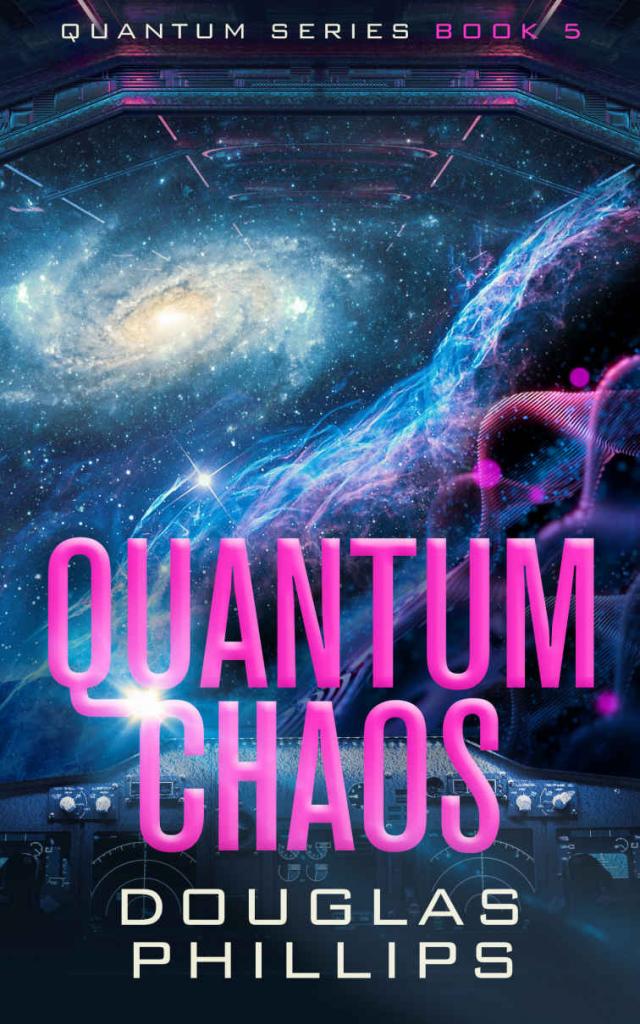


Quantum Chaos
Douglas Phillips
Text and images Copyright © 2023 Douglas Phillips
All rights reserved. No part of this publication may be reproduced, distributed or transmitted in any form or by any means, without prior written permission.
This story was conceived and written by one human brain. No artificial intelligence writing applications were involved at any step.
http://douglasphillipsbooks.com
This is a work of fiction. References to actual places, buildings, government agencies, and corporations assist in setting a level of realism. However, all characters and events portrayed in the story are products of the author’s imagination. Any resemblance to actual persons, living or dead, or actual events is purely coincidental.
For the physicists, astrophysicists, astronomers, and cosmologists who create and verify the astonishing explanations of reality, known in science as theory. You make my job easy.
CONTENTS
Prologue
1Explorers
2Litian-nolos
3Deep Space
4Horizon
5Zero-g
6Arrival
7Chitzas
8Rings
9Planet
10Alone
11Freefall
12Afeesh Tm
13Kyan Ta
14Lost
15Cliff House
16Sibyl
17Vector
18Darkness
19Captain
20Survivor
21Chaos
22Breakout
23Universe 2
24Silver
25Registration
26Enhancement
27Reality
28Random Seed
29Random Chaos
30Time
31Celebration
32Eternity
33Milky Way, Earth, Santa Fe
Afterword
Acknowledgments
From the Author
Prologue
chaos
/ˈkāˌäs/
noun
A state of disorder and confusion.
In Greek mythology, the primordial entity from which sprang the first deities Gaia, Tartarus, Erebus, and Nyx.
The formless condition that is assumed to have existed before the creation of the universe.
Human
/ˈhyü-mən/
adjective
Pertaining to or characteristic of the people of Earth: the Human brain.
noun
A person from Earth. A Human being.
Etymological note: Since the discovery of extraterrestrial civilizations, non-capitalized usage (human) has been discarded in favor of a capitalization standard when referencing any intelligent species by name: Sandzvallon, Litian-nolo, Szitzojoot, Chitza, Human. For the general noun applicable to any intelligent species, see people or person.
“All Human beings, by nature, desire to know.” – Aristotle
“Funny how there are always consequences.” – Daniel Rice
1
Explorers
Satisfied with himself, his crew, the universe, and everything in it, Captain Zeeno tugged off his boots, leaned back in his padded seat, and extended furry legs across the only sliver of the control panel not crowded with dials, switches, and displays. In the cramped cockpit of a Chitza scout ship, there weren’t many places to stretch.
Their final course had been loaded into navigation. Soothing green lights pulsed on a secondary panel overhead, confirming a faultless performance. A gentle vibration in the floor produced a hum in the air—outside, twin compression turbines were spinning like precision drills.
Zeeno slapped the throttle quadrant between two pilot seats where a large red handle angled forward. “She’s purring like a Cheeble kitten. Time for some tunes, ya think?”
Zeeno’s first officer, Aussik, sat in the right seat. Technically, Aussik 8. His brother, Aussik 7, had been copilot on the last mission.
Aussik’s chin quills twitched. “You got it, Boss.”
The copilot twisted a dial then jammed a curved claw into a recessed button. Audio speakers hidden among an array of complex electronic components resonated with smooth notes and a syncopated rhythm.
“Damn fine choice, my friend,” Zeeno said. “Your family reeks of quality.” Competent, loyal, and resourceful, Zeeno couldn’t ask for a better copilot.
Aussik grinned with a display of razor sharp canine teeth that all Chitzas regularly flaunted, partly out of style, but mostly because ritualized displays of aggression reinforced an aura of bravado. Chitzas were well known for their bravado.
Zeeno smoothed his backbone quills and settled in for the remainder of their long journey. The ship’s forward viewport provided a sweeping vista ahead—not that there was anything to see. Since morning coffee break, they’d traversed nothing but a black, empty void. A million light-years of it. Space so deep they’d left the stars behind. “Let’s see those jockin’ Toraks do what we do. Ha!”
Aussik’s crown quills pulsed in time with the oh-so-groovy rhythm filling the cockpit. “Toraks are amateurs. Nobody beats a Chitza.” Truer words were never spoken.
“Nobody beats a Chitza!” Zeeno yelled, loud enough for everyone else onboard to hear.
“Together we live and together we shall die!” came the spirited response from the deck below. Probably the ship’s safety officer, Onner. It sounded like her, but distinguishing between squeaks was hard even for Chitzas.
Every scout ship required four crew members, located on two decks connected by a ladder and a whole lot of enthusiasm. Nobody beat Chitzas because no other space-faring species even knew what Chitzas could do. By any measure, this small but agile ship had journeyed a long way from home. Beyond the Milky Way and a whole lot more.
Zeeno couldn’t have been prouder if he’d taken first place in the Triannual Chitza Danger Games. Which, in fact, he had.
“Humans too. Can’t touch us,” he bragged.
“Especially Humans,” Aussik agreed. “I gotta say, though, she is kind of cute… at least, for a—.”
“Don’t say it,” Zeeno warned, looking over his shoulder through the open cockpit entryway.
Humans, the newest species to join Sagittarius Novus, often suggested that Chitzas resembled a small rodent on their home planet—something called a hedgehog. Chitzas took no offense. Physical comparisons were how newcomers made sense of the menagerie of life found in the galaxy.
Not that there weren’t comparisons for Humans, there were. But calling out their resemblance to a hairless dookah, a lumpy cave-dwelling scavenger back home, just wouldn’t do. Not on Zeeno’s ship. Humans would eventually see it for themselves. In fact, their passenger already had. Shown a dookah photo, she had laughed until she cried, an unusual combination of emotions. Which pretty much summed up Humans.
“Hey guys, crank it up!” cried the Human voice from below.
Aussik bumped up the bass.
“Nice!” came the muffled response, along with some rhythmic thumping against the ship’s bulkhead.
Compact scout ships weren’t exactly spacious even for Chitzas, and a Human stood three times taller. How a creature so large could even fit below deck was surprising, but she hadn’t complained.
“She’s fun, I’ll give her that,” Zeeno admitted. “Laughs a lot.”
“Curvy,” said Aussik.
“Curvy, too.” Zeeno ruffled the fur across his chest. “Funny how their males don’t look that way.”
They’d provided a Human-sized seat squeezed behind the two lower-deck workstations where Onner and Beets maintained the machinery that kept this marvel of technology running. A wedge, as the scout ships were sometimes called, could go almost anywhere, its range only limited by how high they were willing to set Tau, the ratio of 3-D spatial compression. Compression turbines affixed at two corners of the ship’s triangular shape would do the rest, sucking in the appropriate amount of vacuum energy extracted from empty space to create a surrounding 4-D bubble. Always magenta. Never the purple or pink hues of more fragile bubbles. These things had to be done right.
They could also decompress the space they’d just traversed simply by swiveling the turbine intake ports to align with a reverse vector, then scaling back on Tau. The technique provided the ability to go deep, subdividing an immense journey into manageable segments while leaving behind nothing more than a thin 4-D communications filament.
But even a segmented strategy wasn’t enough to cross a billion light-years. For that, the Chitzas tucked several more tricks into their boot sleeves, but they weren’t about to divulge those secrets to anyone. Especially not the Humans.
Onner had been assigned babysitting duty for this mission. Luckily the Human had behaved herself—except for that weird thing she’d been doing with her hair. For some reason, Human head fur grew ridiculously long, and she’d bugged Onner to help tie down the unruly mess during the few periods they’d run without the gravity generator turned on.
Zeeno kept one eye open to monitor gauges and lights as they progressed ever deeper into the unexplored void. Just when he thought this segment would be as routine as the last, Aussik raised his paw and pointed out the forward viewport. “What’s that?”
Zeeno looked up. Where there had been nothing but darkness, light now appeared. Uneven, but attention grabbing. A spark here, a flash there. The first departure from empty in a while.
Zeeno eased back on the red handle, scaling Tau to a more leisurely pace. More sparks popped to their right. A series of streaks zipped past on their left. The view from any 4-D bubble limited visibility to an oblique 3-D plane, but there was little doubt the sparks of light spread across their path in every direction. Something big lay ahead.
Zeeno pulled the handle again. Turbines wound down. The ship slowed to a crawl. “It’s got to be the boundary?” he half-stated, half-asked. They had no science officer onboard. Probably should have thought of that before they left home.
“Maybe ask our passenger?” Aussik chirped.
These hairless dookah lookalikes weren’t stupid, and this one had already demonstrated knowledge of galaxies, nebulas, and such. Zeeno queried with a shout to the deck below.
“Hell if I know,” came the response.
Zeeno shrugged. They’d come a long way. Their ship hovered in uncharted territory—by design—but that didn’t make their current position any less threatening. They’d need to drop out of 4-D to do a proper reconnaissance of this sparkling wall of doom.
“Prepare for a sniff test,” Zeeno commanded.
“Gotcha, Boss,” Aussik said.
“Three-D coming up,” their engineer, Beets, yelled from below.
Aussik grabbed a visor off a hook and slipped it over his eyes. He’d need every bit of the infrared spectrum to monitor this maneuver. He toggled several big switches above his head, and the ever-present whir of compression turbines dropped in pitch. Vibrations in the ship’s structure reduced to a low rumble.
A magenta circle on Aussik’s display corresponding to the four-dimensional bubble that surrounded them, shrank to nothing. The collapse of artificial space came with an unsettling twisting sensation and produced a dramatic change in the view outside.
What had been a squashed plane now expanded to a vertical wall. It roiled with multicolored mists. Glowing layers of blue, white, and pink shimmered in undulating waves that traversed its surface. Random pops, sparkles, and streaks of light shot out like an out-of-control fireworks display.
They hovered in front of an impassible cliff—if cliffs were electrified.
“Damn big,” Zeeno said as he scratched the shorter quills protruding from his chin. Over years of exploration, he’d never seen anything like it. “You’re recording this?” He tossed a look toward Aussik who nodded back.
Zeeno studied the enigma, but not for long.
“Uh, Boss… we’re still moving,” Aussik said with a hint of alarm in his squeak. He scanned the readouts flashing across his panel. “It’s nothing I’m doing. I don’t know, I’ve got a bad feeling about this. Something’s pulling on us.”
Sparks of light loomed closer. Nearby flashes now fully illuminated the cockpit. Zeeno had seen enough.
“Give me a compression vector backward along our last segment.”
Aussik touched several buttons on his control panel and when the whirring spun up, Zeeno eased the big red handle backward.
“We’re moving,” Aussik called out. “But the wrong way.”
The multicolored wall of churning mist and spontaneous sparkles loomed over them as if a giant electric tarp were being slowly pulled over their heads. Zeeno jammed the Tau lever to its limit. The whine turned into a roar as compression turbines spun up on either side of the wedge, but no magenta bubble appeared.
“Some kind of gravitational anomaly!” yelled Onner from below. “Whatever it is, it’s getting stronger.”
Zeeno furiously pushed more buttons. “Frack balls! Where the hell is our 4-D?” No one answered.
One side of the turbulent wall burst into a sheet of white light as brilliant as any sun. Zeeno flinched and covered his eyes with one arm. Pain came instantly.
“Ultra-gamma blast!” Onner screeched.
Cracks appeared in the ship’s viewport, spreading like a sheet of ice struck by a hammer. The glass quickly hazed over, which did little to temper the intense explosion of incoming light.
“Emergency dimensional burst!” Zeeno yelled. “Get us out of here!” At this point, getting back to a higher plane of existence was their only hope.
“On it, Boss!” Aussik’s paws flew across the controls at his workstation.
“Hull breach!” someone from below decks yelled.
“Oh hell,” Zeeno said to himself, covering his mouth with a paw. The quills on the right side of his chin had curled up like burned tree needles. Sharp pain stung his face.
Zeeno took a deep breath. When things went south, they did so in a hurry. Alternatives were disappearing quickly.
“Abandon data.” It was a decision no Chitza pilot ever wanted to make and might be the last command he would ever give.
“On it!” Aussik flipped a metal cover marked Do Not Open and jerked a handle beneath. A slim cartridge the size of an Elitrean tea saucer rose from its electronic slot. “Ejecting data pack.” He jumped up from his workstation and ran to the ladder leading to the deck below.
Zeeno called over his shoulder, “Take Onner and Beets. The Human too if she fits.”
Already three rungs down the ladder, Aussik paused. “You sure?”
“Just get it done.” Zeeno pressed a button that would send an automated emergency communication packet down the micro filament they’d stretched across distances too large to comprehend. In all likelihood, he wouldn’t be around long enough to see the response.
2
Litian-nolos
The hospital attendant folded multiple knee joints spaced equally down two articulated legs until her broad, flat head lowered to window height. She peered through the glass, blinking large green eyes that protruded above iridescent skin sparkling in aquamarine and violet colors. The lanky Litian-nolo was profoundly puzzled by what she saw.
She waved her coworker over to the window, one of many positioned uniformly down a quiet hallway. “He hasn’t moved since planet rise.”
The Human male inside the barren and dimly lit room lay prone on a flat board hung between chains attached to the ceiling. He wore a narrow white cloth around his midsection but nothing else.
The second attendant blinked. “Are all Humans so sluggish?”
Being mostly bone and ligament, giant Litian-nolos were reasonably agile, but the attendants had been all the way to the hospital commissary and back three times since planet rise, and in that time the Human hadn’t so much as raised one of his keratin-topped fingers.
The attendant curled the edges of his flexible head—matching the curvature of a Human tongue. “He’s still alive, isn’t he?”
“Not to worry. See his chest? It lifts as he breathes.”
“Ahh, yes. And look there! Movement!”
The Human twisted his neck one way and then another. A slight popping sound echoed across the nearly empty room. He didn’t seem to be injured by the bone snap. Perhaps even oddly satisfied.
“He is not asleep. I have seen time mentors do this, even our own. It is a state of relaxation.”
“It’s called Zen. He told me.” The attendant sharply curled his head.
She stared at her colleague with a mix of mistrust and jealousy. He wasn’t lying about his direct contact with the Human—their species was incapable of deception—but Litian-nolos regularly engaged in one-upmanship to gain social standing. Not another living being in the galaxy could raise a Litian-nolo’s social standing as much as this Human could.
The man lying before them was not only the first of his species to stand upon their planet, but widely praised across the galaxy. Ask any member of Sagittarius Novus, and they would repeat his name: Daniel Rice, the scientist who had solved the riddle of the Star Beacon.
********************
Daniel lifted from the long plank and gave the wood a gentle pat. “Thank you.”
No ordinary board, the intricate hand-carved inscriptions along its edges were hundreds of years old and told an ancient story of life renewed. The wood came from the semi-conscious lei’i kai tree, proven by scientifically rigorous tests to be self-aware, a rarity among plants. Litian-nolo time mentors—advisors with finely tuned responsibilities over key future events—treated these surfboard-like resting platforms with great respect. Daniel wasn’t about to break with their tradition.