Kalin, p.2
Kalin,
p.2


"Now," said Dumarest. He cut the deck into three stacks. "You know this game?"
She nodded. "Highest, lowest, man-in-between. You want me to pick the winning card?"
"If you can."
"This one," she said after a moment's thought. The tip of one slender finger rested on the left-hand stack.
Dumarest turned over the cards. The others showed a ten and a three; hers a seven. As man-in-between she would have won the pot. Again he shuffled, taking special care not to see the cards, taking even more care that the pips were shielded from her view. Again she chose the winning stack. And again, again—ten times in all before he called a halt.
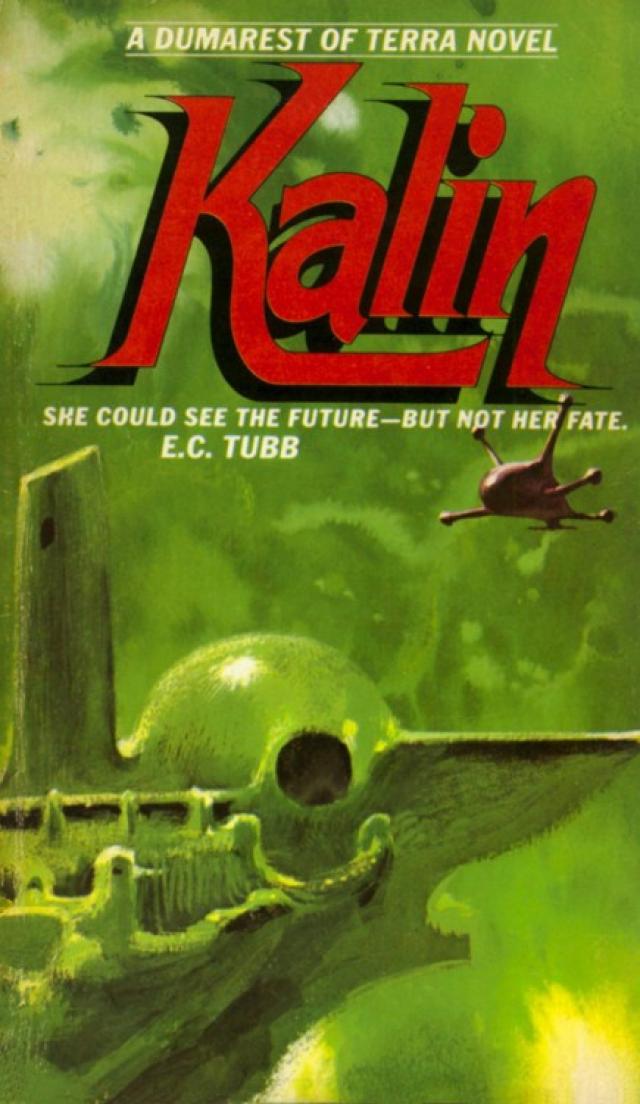
Thoughtfully he leaned back and looked at the girl. She had bathed and the terror and strain had left her face and eyes. They were still green pools of fire, still enormous in the translucent whiteness of her face, but now she looked what she was, an amazingly attractive woman instead of a hunted animal.
"Kalin," he said. "Kalin what?"
She shrugged. "Just Kalin."
"No Family? No House? No Guild?"
"There are people who live without such things," she said. "You, for example."
"You know?"
"I guessed," she admitted. "But it's pretty obvious. You have the look of a man who has learned to rely on no one but himself. A man who has lived hard and alone. The way you saved me shows that. Other men would have waited for someone to tell them what to do. You simply acted. If you had hesitated I would have been killed."
"Hunted down for being a witch," he said. "Are you?"
"Am I what? A witch?"
He waited, watching.
"I don't know," she confessed. "Just what is a witch supposed to be? I told people things," she explained. "I wanted to be friendly and tried to warn them: a woman who ate bread made of diseased grain, a boy who was chopping wood and lost an eye, about a substance in which a woman fell. I warned them," she said bleakly. "But they took no notice and then, when they had hurt themselves, they blamed me."
"Naturally," he said. "They would hardly blame themselves for ignoring your advice." He paused, and then abruptly asked: "What were you doing on Logis?"
"I was born—"
"No," he interrupted. "You were never born on that planet. Not with your color skin and hair. And why try to lie to me? What's the point?"
"None," she admitted, "but sometimes a lie can save a lot of explanation." She lifted her head, met his eyes. "I was born a long way from here on a planet close to the Rim. Since then I've traveled a lot. I joined up with a necromancer who took me to Logis. We worked there: telling fortunes, reading palms, astrology, all that stuff. I think he had a sideline in chemical analogues. I know for sure that he dealt in abortifacts and hallucinogens. He tried to sell me a few times but I wouldn't be sold." Her eyes were clear, direct. "You understand?"
Dumarest nodded. "And?"
"I slipped a knife into him at Bloodtime. That made it legal. They couldn't touch me for doing that. The rest you know."
"Tell me."
She bit her lower lip, teeth white against the bloom of redness. "They came for me. The ones I'd tried to help. They were like animals. If I hadn't moved fast they would have torn me to pieces." She reached out and touched the sleeve of his tunic. "You saved my life," she said. "I'm not going to forget that."
He felt the warmth of her nearness, caught the scent of her hair, the biological magic of her body. Her eyes were green wells into which a man could immerse his being. The translucent skin reflected the light as if made of living pearl.
Deliberately he picked up the cards, shuffled and began to deal, the pasteboards vanishing from his hands to instantly reappear on the surface of the table. The magic of quick-time did that. Not accelerate the cards but slow his metabolism down so that he lived at one-fortieth the normal rate. He, the girl, the others who traveled on High passage. The drug was a convenient method to shorten the apparent time of the journey, to shrink the tedious hours.
He leaned back, looking at the lounge, seeing the duplicate of a hundred others he had known on as many similar ships. Soft padding, a table, chairs, an overhead light. The inevitable furnishings of a small ship catering to few passengers.
"That one." Her finger touched a stack of cards. Unconsciously he had dealt for highest, lowest, man-in-between. He turned it over. Again she had picked the winner.
He rose, crossed to the spigots, drew two cups of Basic, handed one to the girl as he returned. Sitting, he sipped the thick, warm liquid. It was sickly with glucose, heavy with protein, laced with vitamins; a cupful contained enough nourishment to supply a spaceman's basic needs for a day. A heating element in the base of the container kept the liquid warm during its long journey from wall to table, from table to mouth.
Dumarest put down his empty cup and looked at the girl. "The people of Logis were right," he said. "You are a witch."
Her eyes clouded. "You too?"
He shrugged. "What else can you call someone who can see the future?"
"A freak," she said bitterly, and then, "How did you know?"
Dumarest reached out and touched the cards. "You won too often. It couldn't have been telepathy because I took care not to see the pips. You couldn't have cheated because you didn't touch the cards. Teleportation would serve no purpose unless you knew which stack to move where. And it couldn't have been simple luck, not with such a high score. So," he ended quietly, "there can only be one explanation."
Kalin was a clairvoyant.
* * *
The mirror was made of a lustrous plastic, optically perfect, yet cunningly designed to flatter the user when seen in a special light. Sara Maretta had no time for such deceit. Irritably she snapped on the truglow tube and examined her face. Old, she thought, and getting older. Too old and stamped with time and experience for ordinary cosmetics to be of much use, no matter how thickly applied. A complete face transplant was what she needed.
The fair skin and smooth contours of a young girl to replace the sagging flesh and withered skin. A complete face-transplant and more. The breasts and buttocks, the thighs and calves, the arms and hands. Especially the hands.
I need a new body, she thought looking at them. A complete new body and, if rumor were true, she might get one. The surgeons of Pane, so it was whispered, had finally solved the secret of a brain transplant. For money, a lot of money, they would take out her brain and seal it within the skull of a young and nubile girl. It was a rumor, nothing more, yet a rumor she desperately wanted to believe.
To be young again! To watch the fire kindle in a man's eyes as he looked at her. To thrill to the touch of his hands. To live!
Looking at her, Elmo Rasch read her thoughts as if her mind had been an open book. The mercenary leaned against the wall of the cabin, eyes hooded beneath his brows, mouth a thin, cruel line. Deliberately he reached out and snapped off the truglow tube. With the dying of the harsh light she lost ten years of apparent age.
"Elmo?"
"Why hurt yourself?" he said quietly. "Why twist the knife for no purpose. Is it so necessary to be young again?"
"For me, yes."
"Was youth such a happy time?" His voice held bitterness. "If so you were luckier than I. But perhaps you enjoyed the Houses where you were paraded for sale. The mansions of depravity."
She looked at him and smiled without humor. "Where men like you," she said softly, "lined up to pay for pleasure you would not otherwise obtain."
"True." He dropped to sit beside her on the bunk, his thigh hard against her own. Reflected in the mirror his face was a mass of crags and hollows, the thin line of scar tissue a web-like tracery. "Soon," he said. "Very soon now."
He saw the faint tremble of her hands. On her fingers the gems flashed in living rainbows. Elmo reached out, touched them with a blunt finger.
"Pretty, aren't they?" he said mockingly. "Good enough to delude, but you and I and any jeweler know what they are really worth. Stained crystal with plated settings. The cost of a short High passage, perhaps, certainly no more."
"Are your scars worth as much?"
"Less," he admitted. "Which is why we are together. Why we must work as a team. My experience and knowledge; your money. What you had of it. And," he said meaningfully, "you have very little left."
And that was as true as the rest of it. A lifetime of work to end in what? Degradation and poverty. Of what use was a woman when she was ugly and old? Sara looked at her companion. Elmo left much to be desired but he, at least, understood. And yet, woman-like, she wished that he had been other than what he was.
A man like Dumarest, for example. She could trust a man like that. Trust him to drive a hard bargain, perhaps, but to keep it to the bitter end.
Had she been younger he would not be traveling alone. Even now she could dream, but long ago she had learned to live within her limitations. She could love Dumarest but he would never love her. And now, with that girl from Logis—
Irritably she shook her head. Dreams, stupid dreams at a time like this!
Elmo reached into his pocket and produced a flat case. He opened it and the light winked from polished metal and unbreakable glass. The hypo-gun was a work of art, a multi-chambered model calibrated to a hair. It would air-blast any one of a half-dozen drugs in a measured dose through clothing, skin and directly into the bloodstream.
"I could only afford one," he said. "But it's loaded and ready to go."
"Are you sure?" She was practical. "Are the drugs as specified? You could have been cheated," she pointed out. "Transients are easy prey."
Elmo growled deep in his throat. A mannerism to add emphasis. "The last man who tried to cheat me lost an eye. The drugs are good. I checked them before handing over the money. Your money," he said flatly. "But, Sara, never was cash more wisely spent."
Gem-fire betrayed her agitation.
"A few minutes," he said. "That's all it will take. A brief flurry of action and our troubles are over. The ship and all it contains will be ours. Ours, Sara! Ours!"
His eyes glowed and she wished that she could share his supreme confidence. And yet the plan made sense. To attack the crew, drug them into insensibility, take over the vessel was, basically, simple enough. Piracy, as a crime, was not unknown, but to take over a vessel was not enough. The thing was to dispose of it. Spacemen were clannish and united against all who threatened their security. Even the cargo of a stolen ship would be almost impossible to sell.
And yet Elmo claimed to have solved the problem.
It was possible he had, but his vagueness at times irritated her to the point of rebellion. Then he would remind her of what wealth could bring, but never could she forget the penalty of failure.
"You know what will happen if they catch us," she said. "Eviction into space with a suit and ten hours' air. Doped so that a scratch will feel like the slash of a knife. Our senses sharpened so that we'll scream our throats raw." Her hands clenched as she thought about it, the brown spots on their backs standing ugly against the skin. "Elmo! If they should catch us!"
"We'll die," he said. "A little before our time, perhaps, but we'll die and that is all. A few years lost against what? But we won't fail," he insisted. "I've been over this a thousand times. First the steward and his hypogun. It'll be loaded with quick-time. You take it and use it on the lower deck crew. I'll tackle the officers, a shot of serpenhydrate and they will be marionettes, helpless to do other than obey. They will alter course, take the ship where we want it to go, land it as it needs to be landed."
"And then?" She liked this part, liked to hear him say it again and again as though, by repetition, hope could be turned into fact.
"Money," he said thickly. "Enough to buy the new body you desire. Enough for me to hire an army and win a principality, a planet, an empire! The galaxy, Sara! Ours for the taking!"
Simple, she thought. So very simple. Too simple. Surely, somewhere, there must be a catch?
Then she caught sight of her face in the mirror and longing overwhelmed her doubts.
* * *
It was like the spread fingers of a hand. Five pictures, sometimes more, but only five were of any real use. The others were too vague, too hopelessly indistinct.
"The strongest one is the future," Kalin explained. "I concentrate and there it is. Like cards," she said. "I wanted to win so I looked to see which pack would win and chose that one."
And because she chose it, it won; because it won, she chose it. A closed cycle to ensure that the visualized future would be correct.
"The other pictures?" asked Dumarest. "Are they alternates?"
She frowned. "I think so. Like the cards again. Two showed different packs which lost. Two, very vague, showed no cards at all."
Alternate universes, thought Dumarest. Or rather alternate futures in which they had not played cards or had stopped playing them. Unless?
"The time element," he said. "Can you determine it? Can you select how far you will see into the future? An hour, a day, a year?"
She shook her head, frowning. "No, not with any great accuracy. Some things are big and stand out even though the details are vague. Others, smaller and closer, are very clear. I could see the cards without trouble. I can see other things," she said. "One of them is very strong. You are kissing me," she told him. "That and something else." Her hand reached out for his own. "We are going to become lovers," she said quietly. "I know it."
"Know it?"
"It is there," she insisted. "When I concentrate about us and look into the future it is there and it is very sharp and very strong." Her eyes searched his face. "Earl! Is something wrong?"
He shook his head.
"Is the prospect so distasteful?"
He looked at her and felt her attraction. The biochemical magic of her flesh transmitted through sight and sound and smell. She was beautiful! Beautiful!
Beautiful and the possessor of a wild and wanton talent which caused men to call her witch!
She moved and a trick of the light turned her hair into a cascade of shimmering silver, painted elfin contours on her face. Derai!
Dumarest felt his nails dig into his palms, the sweat bead his forehead.
"Earl!" She moved and the illusion was broken. Once again the hair was billowing flame, the face a rounded pearl. "Earl, what is it?"
"Nothing. You reminded me of someone, that is all."
Jealousy darkened her eyes. "A woman?"
"Yes." He opened his hands and stared at the idents on his palms. "Someone I once knew very well. Someone who—" He took a deep breath. "Never mind. She's been gone a long time now."
"Dead?"
"You would call it that."
He leaned back, again calm, able to stare at her with detachment. A clairvoyant. Someone who could see into the future. There were others with similar talents and some with even more bizarre; among the scattered races of mankind mutation and inbreeding had done their work, but all had one thing in common. All seemed to have paid a physical price for their mental abilities.
What was wrong with Kalin?
Mentally he shrugged; time alone would tell. In the meanwhile he could speculate on her talent. It must be like a man at sea sailing through objects misted with uncertainty. In the distance, looming gigantic though unclear, the mountain of death could be seen across a lifetime. Closer, the hills of age, misfortune, birth, illness, disaster—visible for years. Then the things which could be determined for perhaps months. Smaller events unclear beyond a day. Trifles which had a visible range of minutes or even seconds.
To Kalin her talent was merely an extension of her vision.
He felt the warmth of her hand resting on his own, the strength of her fingers as she squeezed. "Earl," she said. "Come back to me."
"I'm here."
"You were thinking," she said. "Of what? Places you have seen? People and planets you have known?" The fingers tightened even more. "Where is your home, Earl? Which planet do you call your own?"
"Earth."
He waited for the inevitable derision but, to his surprise, it didn't come. He felt a momentary hope. The girl claimed to have traveled. It was barely possible that she might—
"Earth," she repeated, and shook her head. "An odd name. Dirt, soil, loam, but you don't mean that, of course. Is there really a planet with such a name?"
"There is."
"Odd," she said again, frowning. "I seem to have heard of it somewhere, a long time ago. When I was a child."
A child?
Age was relative. For those traveling Low time it had no meaning. For those traveling High, using the magic of quicktime, an apparent year was two generations. But no matter how time was judged, the girl could not be older than twenty or twenty-five biological years.
Less when the real standard was used. The only measure that had true meaning. Experience.
"Try to remember," he urged. "What you know about Earth."
She smiled. "I'll try. Is it important?"
Was a reason for living important? Dumarest thought of all the journeys he had made, the ships he had ridden, sometimes traveling High, more often traveling Low. Doped, frozen and ninety percent dead, riding in the caskets meant for the transport of animals, risking the fifteen percent death rate for the sake of economy. Traveling, always traveling, always looking for Earth. For the planet which seemed to have become forgotten. The world no one knew.
Home!
He waited, watching her as she closed her eyes, frowning in concentration, doing what came hard to her—looking back instead of forward, fighting her natural inclination.
Was the price she paid for her talent the inability to recall the past?
She opened her eyes and saw the impatience registered on his face, the hope. "I'm sorry, Earl."
"You can't remember?"
"No. It was a long time ago. But I'm sure that I've heard the name somewhere. On a tape or in a book, perhaps. Earth." She repeated it softly to herself. "Earth."
"Or Terra."
She raised her eyebrows.
"Another name for Earth," he explained. So much, at least, had he learned. "Does it strike a chord?"