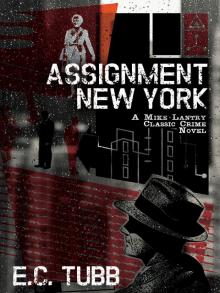
Assignment new york, p.4
Assignment New York,
p.4


‘Yes. I—’ I broke off, staring at a man who had just appeared from the rear of the building.
He was young, tall, with a mottled face and a weak chin. His eyes matched his chin and his clothes looked as though they’d been slept in. He reeked of stale smoke and stale liquor. He held an empty bottle in one hand.
‘Harmond! Damn you, man! Where have you been?’
‘Here, sir.’ The butler didn’t seem to touch the floor as he glided towards the young man. ‘Yes, Mr Stephan?’
‘Bring me a bottle. Bring me two bottles. Bring me the whole damn cellar.’ Stephan swayed and almost fell. His bleared eyes focused and he blinked at me, grinning in a foolish, empty way, and waving his empty bottle. ‘Hi, stranger! You wanna drink?’
I didn’t answer and it seemed to annoy him.
‘You there! Who the hell are you, anyway?’
‘This is Mr. Lantry, sir,’ said Harmond. ‘Your father asked him to call.’
‘What about?’
‘Maybe I could answer that.’ I stepped forward and smiled at the drink. ‘How about letting me join you in a snort?’
He thought about it. He let the idea soak into his mind, and I could almost see the wheels go round as he pushed away the alcohol fog to make room for a new idea. He nodded.
‘Sure, why not?’
I looked at Harmond, who vanished to get more supplies, then followed my host into a room.
Once it had been a study, but now the only studying done in it was of the relative merits of different brands of liquor. Some paintings hung on the walls, and I thought of Reubens and Titian and other Renaissance painters. There were some books, a desk, and something which could have been a filing cabinet. There was a typewriter standing in the middle of a mass of crumpled paper, and a tape-recorder had been knocked to the floor.
But the main item of study was shown by the bottles which littered the room.
Harmond knocked and I relieved him of a tray bearing a fifth of rye, a syphon, and a couple of clean glasses. I was glad of the clean glasses. I opened the bottle and sniffed at the contents. I’m not too fond of rye, myself. If I’m going to drink hard liquor I like Scotch. I’d settle for cognac if I can’t get Scotch, but mostly I have to drink what’s around.
This was one of those times.
I tilted the bottle over the glass, poured out a generous three fingers into each, and passed one to Stephan. I raised the other in a toast.
‘To us.’
‘To crime,’ he corrected, and downed his drink at a gulp. I refilled his glass.
‘To crime,’ he said again, and swallowed the dose as before. I was curious.
‘Why do you say that?’
‘Say what?’
‘To crime.’ I motioned with my glass. ‘What’s so good about it to drink to?’
‘Why not?’ He leaned forward, a strange expression in his bloodshot eyes, and a lock of hair fell over his forehead, giving him a peculiarly boyish look. If you can imagine a boy with the bloated face of a drunkard and a glass of liquor in his hand.
‘Listen, my friend.’ He wagged a finger at me. ‘In a world in which everyone has been pressed down to a neutral grey, your criminal is your modern adventurer. He flies in the face of authority, and with the skill of his body and brain, cuts a path for himself and so makes his own destiny.’ He dribbled rye down his chin. ‘You agree?’
‘Sure,’ I said dryly. ‘Most of our so-called criminals are victims of society. They never had a chance and, by hitting against the law, they assert their independence.’ I forgot where I had originally heard that patter—from some long-haired social worker, probably, but whoever it was had obviously never been mugged and rolled, never had his home broken into or felt the burning kiss of a razor as it slashed his cheek.
If he had, then he’d never have uttered such rubbish.
Stephan nodded, pleased with me for agreeing with him.
‘Good,’ he said unsteadily. ‘Tell me more.’
‘You tell me.’ I sipped my drink and, setting it down, lit a cigarette. ‘I’m interested in your mother. I—’
‘My what!’ He jerked to his feet, and the glass fell from his hand, bouncing and rolling until it came to rest against the leg of a table. I picked it up.
‘Your father’s wife,’ I explained. ‘His first one. Your mother.’
‘Oh.’ He licked his lips and stared at me in a kind of glassy semi-stupor. ‘I thought that you meant—’ He shook his head. ‘Never mind that now. What do you know?’
‘When did she die?’
‘My mother? About two years ago. Why?’
‘Nothing, just asking.’ I dragged at my cigarette. ‘Was she a fit woman? Did she enjoy good health?’
‘She died in a car accident,’ he said tightly, and something of the private hell in which he lived peered out through his bleared eyes. I poured rye into his glass and handed it to him.
‘So she died in a car accident.’ I nodded. ‘And your step-mother? When did your father first meet her?’
‘Norma? About nine months after the accident. I wouldn’t know.’
‘Not know?’ I put just the right amount of incredulity into my voice, and it acted as the spur I hoped it would.
‘Yes,’ he snarled. ‘I know. I know just when he did meet her, damn him!’
‘So you knew her first?’ It was a guess, but I hit the target.
‘I did. We ran around together. It was fun while it lasted, but it didn’t last. Mother died and the Colonel saw Norma. He saw her and took her, just like that.’ He tried to snap his fingers, but couldn’t make it. ‘He bought her, paid for her with my mother’s money. Ninety-five pounds of warm, living flesh. At how much the pound?’ He giggled. ‘You ask him. I did, and he almost threw me out, he and that damned chauffeur of his, and she stood there and laughed at me when they did it. Laughed, and laughed and—’
He swayed, the glass falling from his hand, then, as if all the life had gone out of him, he toppled and fell towards the floor.
I caught him as he fell.
I held him for a moment before letting him settle gently on the floor. I searched for a button to summon help, but couldn’t find one. So I opened the door, and there, as I’d expected, stood Harmond.
‘Stephan.’ I jerked my head backwards into the room. ‘He’s passed out.’
‘I understand, sir.’ The old butler swallowed, and if I hadn’t been there he would have wiped his eyes. ‘The poor devil,’ he murmured. ‘The poor, poor, devil.’
‘Need any help?’
‘No thank you, sir.’
‘You’ve known him a long time, Harmond. How long has he been like this?’
‘Only since just after his mother died, sir.’
‘Since the Colonel married his girlfriend?’
‘I wouldn’t know, Mr. Lantry.’ He did know, but he wasn’t telling. He stepped past me and picked up the youth as though he had been a baby. I stepped in front of him and stared into his eyes.
‘Ten o’clock, Harmond.’
‘Yes, sir. I will be there.’
I let him go then and poured myself another drink. It was good liquor, even though it was the wrong kind for my taste, so I savoured it, rolling it around my tongue and tried to appreciate the burnt, wood-smoke flavour. I wandered around the room and stared at one of the paintings. It intrigued me; I couldn’t tell in this light whether it was genuine or not, but if it was it was worth a lot of money. When I turned round again, a girl stood in the doorway watching me with a peculiar, half-contemptuous, half-timid stare.
‘Well?’
‘Well what?’
‘You wanted to see me, didn’t you?’ She advanced towards me, a cigarette held casually in her red-tipped fingers, her dress clinging to her youthful, lissome figure. She stopped beside me, the top of her head coming about level with the lobe of my ear. That made her about five feet eight inches tall, say five-five if you discounted her high heels. I had already guessed her weight.
‘You’re Susan,’ I said. ‘Stephan’s sister.’
‘I’m Susan,’ she admitted. ‘And you’re the big, tough, private eye whose going to find my dear stepmother.’ She looked around the room. ‘Where is Stephan, by the way?’
‘Asleep.’
‘Drunk, you mean.’ She sniffed the air and glanced distastefully at the empty bottles littering the floor. ‘He’s always drunk.’
‘Maybe he has a reason.’ I gestured towards the typewriter. ‘His?’
‘Yes.’ She explained without being asked. ‘He’s trying to write a play. He’s been trying for a long time now and he’s still working on the first act.’
‘I bet that I could guess the plot,’ I said. She shrugged.
‘No prize. Well, what can I do for you?’
I didn’t answer straight away, but spent some time looking at her. Young, supple, and yet beneath her makeup she showed signs of strain. A brittle tiredness, as if she just couldn’t bother to care any longer, and a recklessness which didn’t match the softness of her lips and eyes.
‘I’m trying to find your step-mother,’ I said. ‘I can do it either of two ways, the hard way or the easy. If you want to help, it needn’t turn out to be so hard. Will you help me?’
‘How?’
‘Tell me what you know about her, who her friends are, where she might be, the usual thing.’
‘Isn’t that what you’re supposed to do?’ She crossed towards the bottle and poured herself a drink. ‘I don’t know Norma any too well. She isn’t much older than I am, and I suppose I resented her coming to live here. We don’t get along too well.’
‘Your fault or hers?’
‘Mine, probably.’ Susan shrugged. ‘I’m afraid that I can’t help you, Mr. Lantry. All I know is that she didn’t turn up one morning at breakfast.’
‘Mike,’ I said.
‘Mike?’
‘My name, we can dispense with the “mister”.’ I joined her in a drink. ‘Here’s to crime.’
‘Good old crime,’ she said dully. ‘For you, money in the bank. For us and people like us, trouble, lots of it.’ She bit her lips and for a moment I thought that she was going to cry ‘To hell with crime!’
‘A sensible woman.’ I put down my untasted drink and looked at her. ‘At least, you don’t think that she’s dead.’
‘Norma? Why should she be?’
‘Just an idea I had.’
‘It’s possible,’ she agreed. ‘But if anything had happened to her, we’d know, wouldn’t we? I mean, an accident or anything like that.’
‘I wasn’t thinking of accident,’ I said deliberately.
‘Murder! Ridiculous!’
‘Or suicide?’
‘Don’t be stupid.’ She was really upset now. ‘I’m not too fond of Norma, but she wouldn’t do a thing like that. Why should she?’
‘Why ask me? I only work here.’ I picked up my drink again and swallowed it. ‘You saw her every day; did she seem upset, worried, something like that?’
‘Not that I noticed.’
‘Your brother is in love with her, isn’t he?’
‘Is he?’
‘Is your father in love with her?’
‘Why don’t you ask him.’ She moved away from me and I could see that now she was really angry. ‘I suggest, Mr. Lantry, that you concentrate on the job, and forget about prying into things which can’t possibly concern you.’
‘Sorry,’ I said. ‘Just one more question. When she didn’t turn up for breakfast, questions must have been asked. I’d like you to tell me if anyone saw her leave the house during the night.’
‘Why don’t you ask the staff?’
‘I’m asking you because I want the correct answer. By now the staff know that something is wrong and they won’t be eager to say anything to incriminate themselves. I’m not a cop, but I’m the nearest thing to one, and most people are shy of the law. Well?’
‘No one saw her,’ she said after a moment. ‘No one at all.’
‘Thank you.’ I nodded as though she had done me a favour and moved towards the door. ‘Sorry to have troubled you.’
She didn’t answer, and I had the impression she was glad to see me go.
Harmond let me out, his face expressionless, and I stood for a moment staring at the lawn. The gravelled drive swung in a wide loop before the house, joining up with itself on the other side of the moss-grown statue and running between a tall avenue of trees. An extension of the drive led around the house towards the garage, and I followed it, my Oxfords crunching on the clean stones.
I found Marvin hard at work polishing the big limousine. He glanced at me, thinned his lips, and went on polishing.
I waited for about two minutes standing wide-legged, my hands thrust into the pockets of my gabardine, not speaking, not moving, not doing anything but stare at the busy man. At the end of that time his nerve broke and he dropped his duster.
‘What the hell do you want?’
I stared at him. A good-looking young man with thick curly hair, nice nose, and healthy cheeks. His eyes were anxious.
‘How’s the leg?’
‘What’s that to you?’ He stepped forward, not too far, but far enough so that I could see the limp had vanished. I shook my head.
‘You’ve got the wrong idea. I’ve come to give you something, not argue about what happened.’ I took one of my hands from my pocket and held out a ten-dollar bill. ‘Here, buy yourself some more cartridges for that mail-order gun of yours.’
He said a bad word.
‘Then buy some linament for that jaw.’ I dropped the bill on to the gravel, and automatically his eyes followed it. When he looked up again, I was inside the garage.
It held three cars. The limousine, an estate car, and a small convertible. It could have held more, but the vacant space was littered with tools and tyres, cans of oil, and a portable air-generator. I leaned casually over the side of the convertible.
‘Which is Mrs. Geeson’s car?’
‘You’re leaning on it.’
‘I see. You and the other servants use the estate car, and the Colonel the limousine. What do the children use?’
‘They don’t own cars.’
‘How come?’
‘When the Colonel’s first wife died in that car crash, the Colonel sold them. He said that one accident in a family was one too many, and he didn’t want any more. If they want to go anywhere, I drive them.’
‘And if you’re not here?’
‘They phone for a private car. We’ve an account with the Blue Star Company. They provide a car and driver at any time.’
I nodded and sat down on the edge of a bench. I looked for a cigarette and found only an empty packet. I was looking at it when the chauffeur offered me one of his own.
‘Thanks.’ I snapped my lighter and offered him a light in return. We both inhaled and stared at each other.
‘How long have you worked for the Colonel, Peter?’
‘Three years.’
‘So you were here when the old lady died?’
‘Yes.’
‘How did it happen?’
‘Burst front tyre. She wasn’t all that old and still liked to drive herself.’ He looked at me. ‘Why all the questions? I thought that you’d been hired to find Norma.’
‘Norma?’
‘We all call her that.’ He seemed uncomfortable. ‘Hell, she isn’t any older than I am.’
‘That’s right. Are you carrying a torch for her too?’
‘Me?’ He seemed to be surprised. ‘What gave you that idea?’
I shrugged. ‘It’s been known to happen before. You’re young, good-looking, and always around. The Colonel is old, but he has the money. A smart woman could figure a way to combine the two.’
This time he almost got me. If I hadn’t been watching for it I’d never have known what hit me, but I saw him move, and by the time he swung I was well out of the way. I pushed and he grunted as he slammed against the edge of the bench. He turned, a wrench in his hand, and came towards me.
‘You dirty shamus,’ he gritted. ‘I’m going to open that skull of yours and let the fresh air clean up what’s inside. I—’ He stopped, looking at the Browning in my hand.
‘Put down that wrench,’ I said quietly. ‘That’s better. So I made a mistake. But I’ve been hired to do a job and I’m going to do it. You can help me or get in my way, I don’t care what you do, but the next time we play, we play for keeps.’ I dropped the cigarette and trod it to ruins against the concrete floor of the garage. I hefted the gun and put it away. I didn’t need it, hadn’t needed it, but I was in no mood for trading punches. Marvin hesitated.
‘You’re wasting your time,’ he said. ‘Norma took a powder and run out on the old man. So what?’
‘So I’m going to find her. Any ideas?’
‘No, and if I had any, I wouldn’t tell you.’
‘Look, Marvin,’ I said patiently. ‘Twice now you’ve tried to beat me up for no apparent reason. You’re not a hood or a bum, you wouldn’t just do a thing like that for the laughs, so there must be something you know and I don’t.’ I stared at him. ‘You don’t want me to find her, do you.’ The way I said it didn’t make it a question.
He didn’t answer.
‘Okay, so you don’t want to tell me. Tell me this, then. Did you drive Norma into town the night she vanished?’
‘No.’
‘How about that company, the Blue Star?’
‘We phoned them,’ he said sullenly. ‘No dice.’
‘Then she must have walked.’
‘Or phoned for a cab,’ he suggested. ‘She could have done that.’
‘Without anyone seeing her leave?’
‘Why not?’ He shifted uncomfortably. ‘Why ask me, anyway? I’m only the chauffeur around here.’
‘It might be a good idea,’ I said pointedly, ‘if you remembered that.’
I left him then, staring after me and hating me with his eyes. I didn’t let it worry me. I’ve been looked at that way before and I’m still warm and moving around, but the people who did the looking, quite a few of them anyway, are cold and very, very still.
The wind had risen a little as I started the long walk down the drive and powdery flakes of snow tried to push their way between my neck and collar, I pulled it higher around my ears, gave the brim of my hat a downward tug, and stepped out a little faster.