Master flea, p.2
Master Flea,
p.2


This letter would have plunged Mr. Tyss and his spouse into no little alarm, if by the very same post another had not arrived from the lost son, wherein he excused himself, with the most melancholy expressions, saying that it had been utterly impossible for him to execute the received commissions, according to his father's wishes, and that he found himself irresistibly attracted to foreign countries, from which he hoped to return home in a year's time with a happier and more cheerful disposition.
"It is well," said the old man, "that the younker should look about him in the world; he may get shaken out of his day dreams."—And when Peregrine's mother expressed an anxiety lest he should want money for his long journey, and that, therefore, his carelessness was much to be blamed in not having written to tell them where he was going, the old gentleman replied laughing, "If the lad be in want of money, he will the sooner get acquainted with the real world; and if he have not said which way he is going, still he knows where his letters will find us."
It has always remained unknown which way his journey really was directed; some maintain that he had been to the distant Indies; others declare that he had only fancied it; thus much, however, is certain, he must have travelled a great way, for it was not in a year's time, as he had promised his parents, but after the lapse of full three years, that Peregrine returned to Frankfort on foot, and in a tolerably poor condition.
He found his father's mansion fast shut up and no one stirred within, let him ring and knock as much as he would. At last there came by a neighbour from 'Change, of whom he immediately inquired whether Mr. Tyss had gone abroad? At this question the neighbour started back, terrified, and cried, "Mr. Peregrine Tyss! Is it you? Are you come at last? Don't you then know it?"
Enough,—Peregrine learnt that, during his absence, both parents had died, one after the other; that the authorities had taken possession of the inheritance, and had publicly summoned him, whose abode was altogether unknown, to return to Frankfort and receive the property of his father.
Peregrine continued to stand before his neighbour without the power of utterance. For the first time the pain of life crossed his heart, and he saw in ruins the beautiful bright world wherein, till now, he had dwelt with so much delight. The neighbour soon perceived that he was utterly incapable of setting about the least thing that the occasion called for; he therefore took him to his own house, and himself arranged every thing with all possible expedition, so that, on the very same evening, Peregrine found himself in his paternal mansion.
Exhausted, overwhelmed by a feeling of disconsolation such as he had not yet known, he sank into his father's great arm-chair, which was still standing in its usual place, when a voice said, "It is well that you have returned, dear Mr. Peregrine; ah, if you had but come sooner!"
Peregrine looked up and saw close before him the old woman, whom his father had taken into his service chiefly because she could get no other place, on account of her outrageous ugliness: she had been Peregrine's nurse in his early childhood, and had not left the house since. For a long time he stared at the woman, and at last began with a strange smile, "Is it you, Alina? The old people live still, do they not?" And with this he got up, went through every room, considered every chair, every table, and every picture, and then calmly added, "Yes, it is all just as I left it, and just so shall it remain."
From this moment Peregrine adopted the strange life which was mentioned at the very beginning of our story. Retired from all society, he lived with his aged attendant in the large roomy house in the deepest solitude: subsequently he let out a couple of rooms to an old man, who had been his father's friend, and seemed as misanthropical as himself— reason enough why the two should agree remarkably well, for they never saw each other.
There were four family festivals which Peregrine celebrated with infinite solemnity; and these were the birth-days of his father and mother, Easter, and his own day of christening. At these times Alina had to set out a table for as many persons as his father had been wont to invite, with the same wine and dishes which had been usually served up on those occasions. Of course the same silver, the same plates, the same glasses, such as had then been used, and such as they still remained, were now brought forward, in the fashion which had prevailed for so many years. Peregrine kept to this strictly. Was the table ready? He sat down to it alone, ate and drank but little, listened to the conversation of his parents, and the imaginary guests, and replied modestly to this or that question as it was directed to him by any one of the company. Did his mother put back her seat? he too rose with the rest, and took his leave of each with great courtesy. Then he retired to a distant chamber, and consigned to Alina the division of the wine and the many untasted dishes amongst the poor; which command of her master, the faithful soul was wont to execute most conscientiously. The celebration of the two birth-days he began early in the morning, that, according to the custom of his boyhood, he might carry a handsome nosegay into the room where his parents used to breakfast, and repeat verses which he had got by heart for the occasion. On his own day of christening, he naturally could not sit at table, as he had not then been long born; Alina, therefore, had to attend to every thing, that is, to invite people to drink, and, in the general phrase, to do the honours of the table: with this exception, every thing was the same as at the other festivals. But in addition to these, Peregrine had yet another holiday in the year, or rather holy evening, and that was Christmas Eve, with its gifts, which had excited his youthful fancy more than any other pleasure.
He himself carefully purchased the motley Christmas lights, the playthings, the sweetmeats, just as his parents had presented them to him in his childish years; and then the presentation took place, as the kind reader has already seen.
"It is very vexatious," said Peregrine, after having played with them some time—"it is very vexatious that the stag and wild boar hunt should be missing. Where can they be? Ah, look there!"—At this moment he perceived a little box which still remained unopened, and hastily snatched at it, expecting to recover the missing treasure. But on opening it he found it empty, and started back as if a sudden fright had seized him.—"Strange!" he murmured to himself; "strange! What is the matter with this box? It seems as if some fearful thing sprang out upon me, that my eye was too dull to grapple with."
Alina, on being questioned, assured him that she had found the box among the playthings, and had in vain used every exertion to open it; hence she had imagined that it contained something particular, and that the lid would yield only to the experienced hand of her master.
"Strange!" repeated Peregrine, "very strange!—and it was with this chase that I had particularly pleased myself; I hope it may not bode any evil!—But who, on a Christmas Eve, would dwell upon such fancies, which have properly no foundation? Alina, fetch me the basket."
Alina accordingly brought a large white basket; in which, with much care, he packed up the playthings, the sweetmeats, and the tapers, took the basket under his arm, the great Christmas-tree on his shoulder, and set out on his way.
It was the kind and laudable practice of Mr. Tyss to surprise some needy family, where he knew there were children, with his whole cargo of Christmas-boxes, just as he had purchased it, and dream himself for a few hours into the happy times of boyhood. Then, when the children were in the height of their joy, he would softly steal away and wander about the streets half the night, hardly knowing what to do with himself, from the deep emotions which straitened his breast, and feeling his own house like a vault, in which he was buried with all his pleasures. This time his Christmas-boxes were intended for the children of a poor bookbinder, of the name of Lemmerhirt, who was a skilful, industrious man, had long worked for him, and whose three children he was well acquainted with.
The bookbinder, Lemmerhirt, lived in the top floor of a narrow house in the Kalbecher-street; and as the winter storm howled and raged, and the rain and snow fell with mingled violence, it may be easily imagined that Peregrine did not get to his object without great difficulty. From the window twinkled down a couple of miserable tapers; with no little toil he clambered up the steep stairs, knocked at the door, and called out, "Open! Open! Christmas sends his presents to all good children."
The bookbinder opened the door in alarm, and it was not till after some consideration that he recognised Peregrine, who was quite covered with snow.
"Worshipful Mr. Tyss!" he exclaimed, full of wonder—"How in the name of Heaven do I come to such an honour on Christmas Eve?"
Worshipful Mr. Tyss, however, would not let him finish, but calling out, "Children! Children! Alert! Christmas sends his presents"—he took possession of the flap-table in the middle of the room, and immediately began to pull out his presents from the basket; the great Christmas-tree, indeed, which was dripping wet, he had been forced to leave outside the door. Still the bookbinder could not comprehend what it all meant; the wife, however, knew better, for she smiled at Peregrine, with silent tears, while the children stood at a distance, devouring with their eyes each gift as it came out of the cover, and often unable to refrain from a loud cry of joy and wonder. At last he had dexterously divided, and ordered the presents according to each child's age, lighted all the tapers, and cried, "Come, come, children! this is what Christmas sends you." They, who could yet hardly believe that all belonged to them, now shouted aloud, and leaped, and rejoiced; while their parents prepared to thank their benefactor. But it was precisely this thanksgiving that Peregrine always sought to avoid, and he therefore wished, as usual, to take himself off quietly. With this view he had got to the door, when it suddenly opened, and in the bright shine of the Christmas lights stood before him a young female, splendidly attired.
It seldom turns out well, when an author undertakes to describe narrowly to the reader the appearance of this or that beautiful personage of his tale,—showing the shape, the growth, the carriage, the hair, the colour of the eyes; it seems much better to give the whole person at once, without these details. Here, too, it would be quite enough to state that the lady, who ran against the startled Peregrine, was uncommonly handsome and graceful, if it were not absolutely requisite to speak of certain peculiarities which the little creature had about her.
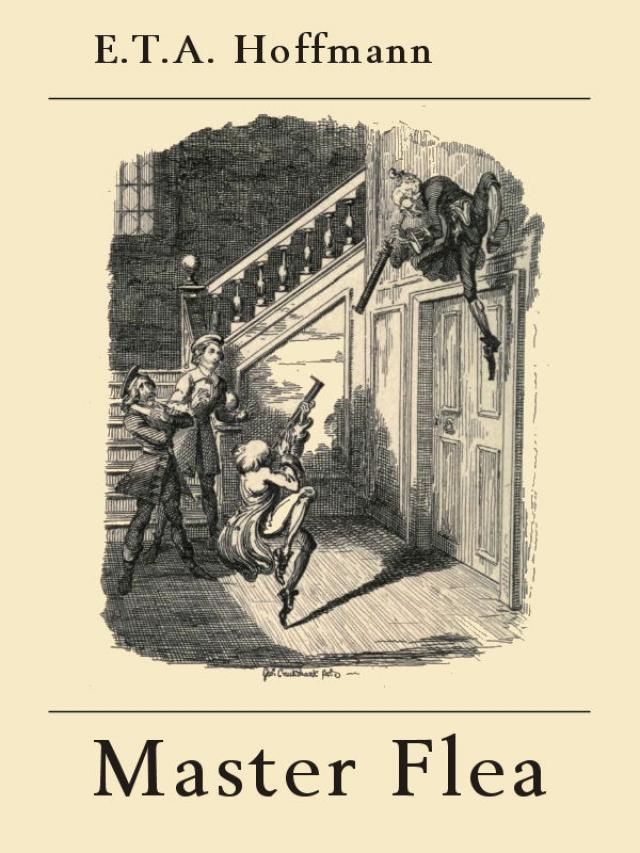
She was small, and, indeed, somewhat too small, but, at the same time, neatly and elegantly proportioned. Her forehead, in other respects handsomely formed and full of expression, acquired a something strange and singular from the unusual size of the eyeballs, and from the dark pencilly brows being higher placed than ordinary. The little thing was dressed, or rather decorated, as if she had just come from a ball. A splendid diadem glittered amongst her raven locks, rich point lace only half veiled her bosom, a black and yellow striped dress of heavy silk sate close upon her slender body, and fell down in folds just so low as to let the neatest little feet be seen, in white shoes, while the sleeves were just long enough, and the gloves just short enough, to show the fairest part of a dazzling arm. A rich necklace, and brilliant ear-rings, completed her attire.
It could not but be that the bookbinder was as much surprised as Peregrine,—that the children abandoned their playthings, and stared with open mouths at the stranger: as, however, women in general are wont to be the least astonished at any thing unusual, and are the quickest to collect themselves, so, on this occasion also, the bookbinder's wife was the first that recovered speech, and asked, "In what she could serve the lady?"
Upon this the stranger came fairly into the room, and the frightened Peregrine would have seized the opportunity to take himself quickly off, but she caught him by both hands, lisping out, in a little soft voice, "Fortune, then, has favoured me! I have found you, then! O Peregrine, my dear Peregrine, what a delightful meeting!" Herewith she raised her right hand, so that it touched Peregrine's lips, and he was compelled to kiss it, though, in so doing, the cold drops of perspiration stood on his forehead. She now, indeed, let go his hands, and he might have fled, but he felt himself spellbound, he could not move from the place—like some poor little animal that has been fascinated by the eye of the rattle-snake.
"Allow me," she said, "dear Peregrine, to share in this charming treat that you have so nobly, and with such real goodness, prepared for the children. Permit me, also, to contribute something to it!"
From a little basket which hung upon her arm, and which had not been remarked till now, she took out all sorts of playthings, arranged them on the table with graceful bustle, brought forward the children, pointed out to each the present intended for him, and sported so prettily withal, that nothing could be more delightful. The bookbinder thought he was in a dream, but the wife laughed roguishly, fancying that there must be some particular acquaintance between Peregrine and the stranger.
While now the parents were wondering, and the children were rejoicing, the lady took her seat upon an old frail sofa, and drew down Mr. Peregrine, who, in fact, scarcely knew any longer whether he actually was this same person. She then gently lisped into his ear, "My dear, dear Peregrine, how happy, how delighted I feel by your side!"—"But, lady," stammered Peregrine, "honoured lady——" On a sudden, Heaven knows how, the lips of the stranger came so close to his, that, before he could think about kissing them, he had really done it. That by this he lost all power of speech is easily to be imagined.
"My sweet friend," continued the lady, creeping up to Peregrine so closely, that she almost sate in his lap—"My sweet friend, I know what troubles you; I know what has so much afflicted your simple heart this evening. But, take comfort. That which you lost, that which you hardly hoped to find again,—see, I bring it to you."
With this she took out a little wooden box from her basket, and gave it into the hands of Peregrine. In it was the hunting-set that he had missed on the Christmas-eve table. It would be hard to describe the strange feelings which were now thronging and jostling in his bosom.
The whole appearance of the stranger, in spite of all her grace and loveliness, had yet something supernatural about it, which those, who had not Peregrine's awe of woman, would yet have received with a cold shudder through every vein; of course, therefore, a deep horror seized the poor Peregrine, already in sufficient alarm, when he found the lady most narrowly informed of all that he had been doing in the profoundest solitude. Still, when he looked up, and met the glance of two bright black eyes flashing from under the silken lids—when he felt the sweet breath of the lovely being, and the electric warmth of her limbs— still, with all his terror, there awoke in him the sadness of unutterable desires, such as he had not yet known. For the first time his whole mode of life, his trifling with the Christmas presents, appeared to him absurd and childish, and he felt ashamed that the stranger should know of it; but then again it seemed as if her gift was the living proof that she understood him, as none else on earth had understood him, and, in seeking to gratify him after this manner, had been prompted by the most perfect delicacy of feeling. He resolved to treasure up the dear gift for ever, never to let it go out of his own hands; and, carried away by a feeling which totally overpowered him, he pressed the casket to his breast with vehemence.
"Delightful!" murmured the maiden, "my gift pleases you! Oh, my dearest Peregrine, then my dreams, my presentiments, have not deceived me!"
Mr. Tyss came somewhat to himself, so that he was able to say, with great plainness and distinctness, "But, most respected lady, if I only knew to whom in all the world I had the honour——"
"Cunning man," said the stranger, gently tapping his cheeks,—"to pretend as if you did not know your faithful Alina! But it is time that we should leave the good folks here to their own pleasures. Accompany me, Mr. Tyss."
On hearing the name Alina, Peregrine naturally reverted to his old attendant, and he felt exactly as if a wind-mill were going round in his head.
The strange Alina now took the kindest and most gracious leave of the family, while the bookbinder, from pure wonder and respect, could only stammer out a something unintelligible; but the children made as if they had been long acquainted with her, and the wife said, "Such a kind, handsome man as you are, Mr. Tyss, well deserves to have so kind and handsome a bride, who, even at this hour, assists him in doing acts of benevolence. I congratulate you with all my heart."—The strange lady thanked her with emotion, protesting that the day of her wedding should also be a day of festival to them; and then, strictly refusing all attendance, took a taper from the Christmas table to light herself down the stairs.
It is easy to imagine the feelings of Peregrine at all this, on whose arm she leant.—"Accompany me, Mr. Tyss,"—that is,—he thought within himself,—down the stairs to the carriage which stands at the door, and where the servant, or perhaps a whole set of servants, is in waiting, for in the end it must be some mad princess, who——Heaven deliver me with speed from this strange torture, and keep me in my right senses, such as they are!
Mr. Tyss did not suspect that all, which had yet happened, was only the prologue to a most wonderful adventure, and had therefore, without knowing it, done exceedingly well in praying to Heaven for the preservation of his senses.
No sooner had the couple reached the bottom of the stairs, than the door was opened by invisible hands, and, when they had got out, was shut again in the same manner. Peregrine, however, paid no attention to this, in his astonishment at finding not the slightest appearance of any carriage before the house, or of any servant in waiting.—"In the name of Heaven," he cried, "where is your coach, lady?"
"Coach!" replied the stranger—"Coach! what coach? Did you think, dear Peregrine, that my impatience, my anxiety, to find you, would allow me to come riding here quite quietly? No; hurried on by hope and desire, I ran about through the storm till I found you. Thank Heaven that I have succeeded! And now lead me home; my house is not far off."
Peregrine resolutely avoided all reflection on the impossibility of the stranger going a few steps only, tricked out as she was, and in white silk shoes, without spoiling her whole dress in the storm, instead of being, as now, in a state that showed not the slightest trace of discomposure; he reconciled himself to the idea of accompanying her still farther, and was only glad that the weather was changed. The storm, indeed, had past, not a cloud was in the heaven, the full moon shone down pleasantly, and only the keen air made the midnight to be felt.


_preview.jpg)
_preview.jpg)