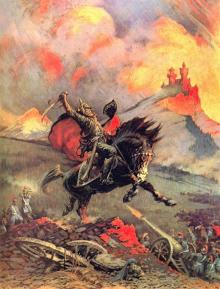
Pirates of venus v 1, p.12
Pirates of Venus v-1,
p.12


During the night, as I lay awake trying to plan for the morrow, I heard some one prowling around the room, and now and again a whisper. I could only wonder who it was and try to guess what he was about. I recalled the bottle of wine that Anoos was supposed to have, and it occurred to me that he might be giving a party, but the voices were too subdued to bear out that theory. Finally I heard a muffled cry, a noise that sounded like a brief scuffle, and then silence again fell upon the chamber.
"Some one had a bad dream," I thought and fell asleep.
Morning came at last, and the hatch was removed, letting a little light in to dissipate the gloom of our prison. A sailor lowered a basket containing the food for our meager breakfast. We gathered about it and each took his share, and moved away to eat it, when suddenly there was a cry from the far side of the room.
"Look what's here!" the man shouted. "Anoos has been murdered!"
Chapter 10—Mutiny
YES, Anoos had been murdered, and there was a great hue and cry, much more of a hue and cry, it seemed to me, than the death of an ordinary prisoner should have aroused. Officers and soldiers swarmed in our quarters. They found Anoos stretched out on his back, a bottle of wine at his side. His throat was discolored where powerful fingers had crushed it. Anoos had been choked to death.
Soon they herded us on deck, where we were searched for weapons following an order from the captain of the ship, who had come forward to conduct an investigation. He was angry and excited and, I believe, somewhat frightened. One by one, he questioned us. When it was my turn to be questioned, I did not tell him what I had heard during the night; I told him that I had slept all night on the far side of the room from where Anoos's body was discovered.
"Were you acquainted with the dead man?" he asked.
"No more so than with any of the other prisoners," I replied.
"But you are very well acquainted with some of them," he said rather pointedly, I thought. "Have you ever spoken with the man?"
"Yes, he has talked to me on several occasions."
"About what?" demanded the captain.
"Principally about his grievances against the Thorists."
"But he was a Thorist," exclaimed the captain.
I knew that he was trying to pump me to discover if I harbored any suspicions concerning the actual status of Anoos, but he was not clever enough to succeed. "I certainly would never had suspected it from his conversation," I replied. "If he were a Thorist, he must have been a traitor to his country, for he continually sought to enlist my interest in a plan to seize the ship and murder all her officers. I think he approached others, also." I spoke in a tone loud enough to be heard by all, for I wanted the Soldiers of Liberty to take the cue from me. If enough of us told the same story it might convince the officers that Anoos's tale of a conspiracy was hatched in his own brain and worked up by his own efforts in an attempt to reap commendation and reward from his superiors, a trick by no means foreign to the ethics of spies.
"Did he succeed in persuading any of the prisoners to join him?" asked the captain.
"I think not; they all laughed at him."
"Have you any idea who murdered him?"
"Probably some patriot who resented his treason," I lied glibly.
As he questioned the other men along similar lines, I was pleased to discover that nearly every one of the Soldiers of Liberty had been approached by the perfidious Anoos, whose traitorous overtures they had virtuously repulsed. Zog said that he had never talked with the man, which, to the best of my knowledge, was the truth.
When the captain finished his investigation, he was farther from the truth than when he commenced it, for I am certain that he went aft convinced that there had been no truth in the tales that Anoos had carried to him.
I had been considerably worried at the time we were being searched, for fear that the key to the armory would be discovered on Kiron, but it had not been, and later he told me that he had hidden it in his hair the night before as a precaution against just such an eventuality as had occurred.
The Amtorian day consists of 26 hours, 56 minutes, 4 seconds of earth time, which the Amtorians divide into twenty equal periods called te, which, for clarity, I shall translate into its nearest earthly equivalent, hour, although it contains 80.895 earth minutes. On shipboard, the hours are sounded by a trumpeter, there being a distinguishing bar of music for each hour of the day. The first hour, or one o'clock, corresponds to mean sunrise. It is then that the prisoners are awakened and given food; forty minutes later they start work, which continues until the tenth hour, with a short recess for food in the middle of the day. Occasionally we were allowed to quit work at the ninth and even the eighth hour, according to the caprices of our masters.
On this day the Soldiers of Liberty congregated during the midday rest period, and, my mind being definitely determined on immediate action, I passed the word around that we would strike during the afternoon at the moment the trumpeter sounded the seventh hour. As many of us as were working aft near the armory were to make a dash for it with Kiron, who would unlock it in the event that it were locked. The remainder were to attack the soldiers nearest them with anything that they could use as weapons, or with their bare hands if they had no weapons, and take the soldiers' pistols and swords from them. Five of us were to account for the officers. Half of our number was to constantly shout our battle cry, "For liberty!" The other half was instructed to urge the remaining prisoners and the soldiers to join us.
It was a mad scheme and one in which only desperate men could have found hope.
The seventh hour was chosen because at that time the officers were nearly all congregated in the wardroom, where a light meal and wine were served them daily. We should have preferred launching our plan at night, but we feared a continuation of the practice of locking us below deck would prevent that, and our experience with Anoos had taught us that we might expect the whole conspiracy to be divulged by another spy at any time; therefore we dared not wait.
I must confess to a feeling of increasing excitement as the hour approached. As, from time to time, I glanced at the other members of our little band, I thought that I could note signs of nervousness in some of them, while others worked on as placidly as though nothing unusual was about to occur. Zog was one of these. He was working near me. He never glanced toward the tower deck from which the trumpeter would presently sound the fateful notes, though it was with difficulty that I kept my eyes from it at all. No one would have thought that Zog was planning to attack the soldier lolling near him, nor have imagined that the night before he had murdered a man. He was humming a tune, as he polished the barrel of the big gun on which he was working.
Gamfor and, fortunately, Kiron were working aft, scrubbing the deck, and I saw that Kiron kept scrubbing closer and closer to the door of the armory. How I wished for Kamlot as the crucial moment approached! He could have done so much to insure the success of our coup , and yet he did not even know that such a stroke was contemplated, much less that it was so soon to be launched.
As I glanced about, I met Zog's gaze. Very solemnly he closed his left eye. At last he had given a sign that he was alert and ready. It was a little thing, but it put new heart into me. For some reason, during the past half hour I had felt very much alone.
The time was approaching the zero hour. I moved closer to my guard, so that I stood directly in front of him with my back toward him. I knew precisely what I was going to do, and I knew that it would be successful. Little did the man behind me dream that in a minute, or perhaps a few seconds, he would be lying senseless on the deck, or that the man he guarded would be carrying his sword, his dagger, and his pistol as the last notes of the seventh hour floated sweetly out across the calm waters of this Amtorian sea.
My back was toward the deck houses. I could not see the trumpeter when he emerged from the tower to sound the hour, but I knew that it could not be long before he stepped out onto the tower deck. Yet when the first note sounded I was as startled as though I had expected it never to sound. I presume it was the reaction after the long period of nervous tension.
My nervousness, however, was all mental; it did not affect my physical reactions to the needs of the moment. As the first note came softly down to my awaiting ears, I pivoted on a heel and swung my right for the chin of my unsuspecting guard. It was one of those blows that is often described as a haymaker, and it made hay. The fellow dropped in his tracks. As I stooped to recover his arms, pandemonium broke loose upon the deck. There were shrieks and groans and curses, and above all rose the war cry of the Soldiers of Liberty—my band had struck, and it had struck hard.
For the first time now, I heard the weird staccato hiss of Amtorian firearms. You have heard an X-ray machine in operation? It was like that, but louder and more sinister. I had wrenched the sword and pistol from the scabbard and holster of my fallen guard, not taking the time to remove his belt. Now I faced the scene for which I had so long waited. I saw the powerful Zog wrest the weapons from a soldier, and then lift the man's body above his head and cast it overboard. Evidently Zog had no time for proselyting.
At the door to the armory a battle was being waged; men were trying to enter, and soldiers were shooting them down. I ran in that direction. A soldier leaped in front of me, and I heard the hiss of the death rays that must have passed close to my body, as he tried to stop me. He must have been either nervous or a very poor shot, for he missed me. I turned my own weapon upon him and pressed the lever. The man slumped to the deck with a hole in his chest, and I ran on.
The fight at the door of the armory was hand to hand with swords, daggers, and fists, for by now the members of the two factions were so intermingled that none dared use a firearm for fear of injuring a comrade. Into this melee I leaped. Tucking the pistol into the band of my G string, I ran my sword through a great brute who was about to knife Honan; then I grabbed another by the hair and dragged him from the door, shouting to Honan to finish him—it took too long to run a sword into a man and then pull it out again. What I wanted was to get into the armory to Kiron's side and help him.
All the time I could hear my men shouting, "For liberty!" or urging the soldiers to join us—as far as I had been able to judge, all the prisoners had already done so. Now another soldier barred my way. His back was toward me, and I was about to seize him and hurl him back to Honan and the others who were fighting at his side, when I saw him slip his dagger into the heart of a soldier in front of him and, as he did so, cry, "For liberty!" Here was one convert at least. I did not know it then, but at that time there were already many such.
When I finally got into the armory, I found Kiron issuing arms as fast as he could pass them out. Many of the mutineers were crawling through the windows of the room to get weapons, and to each of these Kiron passed several swords and pistols, directing the men to distribute them on deck.
Seeing that all was right here, I gathered a handful of men and started up the companionway to the upper decks, from which the officers were firing down upon the mutineers and, I may say, upon their own men as well. In fact, it was this heartless and stupid procedure that swung many of the soldiers to our side. Almost the first man I saw as I leaped to the level of the second deck was Kamlot. He had a sword in one hand and a pistol in the other, and he was firing rapidly at a group of officers who were evidently attempting to reach the main deck to take command of the loyal soldiers there.
You may be assured that it did my heart good to see my friend again, and as I ran to his side and opened fire on the officers, he flashed me a quick smile of recognition.
Three of the five officers opposing us had fallen, and now the remaining two turned and fled up the companionway to the top deck. Behind us were twenty or more mutineers eager to reach the highest deck, where all the surviving officers had taken refuge, and I could see more mutineers crowding up the companionway from the main deck to join their fellows. Kamlot and I led the way to the next deck, but at the head of the companionway the surging mob of howling, cursing mutineers brushed past us to hurl themselves upon the officers.
The men were absolutely out of control, and as there were but few of my original little band of Soldiers of Liberty among them, the majority of them knew no leader, with the result that it was every man for himself. I wished to protect the officers, and it had been my intention to do so; but I was helpless to avert the bloody orgy that ensued with a resulting loss of life entirely disproportionate to the needs of the occasion.
The officers, fighting for their lives with their backs against a wall, took heavy toll of the mutineers, but they were eventually overwhelmed by superior numbers. Each of the common soldiers and sailors appeared to have a special grudge to settle either with some individual officer or with them all as a class and for the time all were transformed into maniacal furies, as time and again they charged the last fortress of authority, the oval tower on the upper deck.
Each officer that fell, either killed or wounded, was hurled over the rail to the deck below, where willing hands cast the body to the main deck from which, in turn, it was thrown into the sea. And then, at last, the mutineers gained access to the tower, from which they dragged the remaining officers, butchering them on the upper deck or hurling them to their shrieking fellows below.
The captain was the last to be dragged out. They had found him hiding in a cupboard in his cabin. At sight of him arose such a scream of hate and rage as I hope never to hear again. Kamlot and I were standing at one side, helpless witnesses of this holocaust of hate. We saw them literally tear the captain to pieces and cast him into the sea.
With the death of the captain the battle was over, the ship was ours. My plan had succeeded, but the thought suddenly assailed me that I had created a terrible power that it might be beyond me to control. I touched Kamlot on the arm. "Follow me," I directed and started for the main deck.
"Who is at the bottom of this?" asked Kamlot as we forced our way among the excited mutineers.
"The mutiny was my plan, but not the massacre," I replied. "Now we must attempt to restore order out of chaos."
"If we can," he remarked dubiously.
As I made my way toward the main deck, I collected as many of the original band of Soldiers of Liberty as we passed, and when I finally reached my destination, I gathered most of them about me. Among the mutineers I had discovered the trumpeter who had unknowingly sounded the signal for the outbreak, and him I caused to sound the call that should assemble all hands on the main deck. Whether or not the notes of the trumpet would be obeyed, I did not know, but so strong is the habit of discipline among trained men that immediately the call sounded the men began to pour onto the deck from all parts of the vessel.
I mounted the breech of one of the guns, and, surrounded by my faithful band, I announced that the Soldiers of Liberty had taken over the ship, that those who wished to accompany us must obey the vookor of the band; the others would be put ashore.
"Who is vookor?" demanded a soldier whom I recognized as one of those who had been most violent in the attack upon the officers.
"I am," I replied.
"The vookor should be one of us," he growled.
" Carson planned the mutiny and carried it to success," shouted Kiron. " Carson is vookor."
From the throats of all my original band and from a hundred new recruits rose a cheer of approval, but there were many who remained silent or spoke in grumbling undertones to those nearest them. Among these was Kodj, the soldier who had objected to my leadership, and I saw that already a faction was gathering about him.
"It is necessary," I said, "that all men return at once to their duties, for the ship must be handled, no matter who commands. If there is any question about leadership, that can be settled later. In the meantime, I am in command; Kamlot, Gamfor, Kiron, Zog, and Honan are my lieutenants; with me, they will officer the ship. All weapons must be turned over immediately to Kiron at the armory, except those carried by men regularly detailed by him for guard duty."
"No one is going to disarm me," blustered Kodj. "I have as much right to carry weapons as anyone. We are all free men now. I take orders from no one."
Zog, who had edged closer to him as he spoke, seized him by the throat with one of his huge hands and with the other tore the belt from about his hips. "You take orders from the new vookor or you go overboard," he growled, as he released the man and handed his weapons to Kiron.
For a moment there was silence, and there was a tenseness in the situation that boded ill; then some one laughed and cried, "No one is going to disarm me," mimicking Kodj. That brought a general laugh, and I knew that for the time being the danger was over. Kiron, sensing that the moment was ripe, ordered the men to come to the armory and turn in their weapons, and the remainder of the original band herded them aft in his wake.
It was an hour before even a semblance of order or routine had been reestablished. Kamlot, Gamfor, and I were gathered in the chart room in the tower. Our consort was hull down below the horizon, and we were discussing the means that should be adopted to capture her without bloodshed and rescue Duare and the other Vepajan prisoners aboard her. The idea had been in my mind from the very inception of the plan to seize our own ship, and it had been the first subject that Kamlot had broached after we had succeeded in quieting the men and restoring order; but Gamfor was frankly dubious concerning the feasibility of the project.
"The men are not interested in the welfare of Vepajans," he reminded us, "and they may resent the idea of endangering their lives and risking their new-found liberty in a venture that means nothing whatever to them."
"How do you feel about it, personally?" I asked him.
"I am under your orders," he replied; "I will do anything that you command, but I am only one—you have two hundred whose wishes you must consult."
"I shall consult only my officers," I replied; "to the others, I shall issue orders."