Miss granbys secret or t.., p.1
Miss Granby's Secret: Or The Bastard Of Pinsk,
p.1
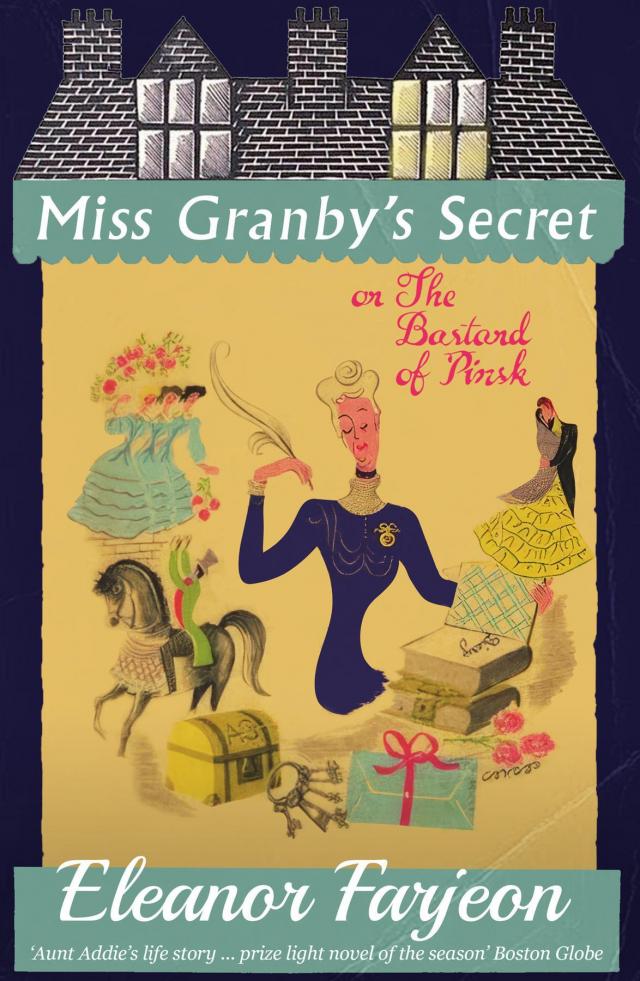


eleanor farjeon
MISS GRANBY’S
SECRET
or
The Bastard of Pinsk
Eleanor Farjeon, born on February 13, 1881, in London, England, daughter of Benjamin and Maggie (Jefferson). Farjeon was a renowned English author, poet, playwright, journalist and broadcaster. Home-schooled, she began writing at the age of five and quickly gained recognition, particularly in children’s literature. Her simplicity of style, combined with profound emotional depth, made her works accessible and enduring. She is perhaps best known for her hymn Morning has Broken which gained international acclaim thanks to the recording by Cat Stevens.
Throughout her career Farjeon maintained a close circle of literary friends and contributed to the World War II effort. She received numerous literary awards, including the Carnegie Medal in 1955, the Hans Christian Andersen Medal in 1956 for her novel The Little Bookroom, and the Regina Medal for children’s literature in 1956. The Children’s Book Circle present a prestigious annual Eleanor Farjeon Award.
Farjeon never married but had a contented 30-year relationship with George Earle, an English teacher. After his death in 1949, she befriended actor Denys Blakelock, who wrote a memoir: Eleanor, Portrait of the Farjeon (1966). She passed away in Hampstead, London on June 5, 1965, leaving behind a rich legacy of enchanting tales and timeless poetry.
SELECTED NOVELS BY ELEANOR FARJEON
Ladybrook (1931)
The Fair of St. James (1932)
Humming Bird (1936)
Miss Granby's Secret (1940)
Brave Old Woman (1941)
The Fair Venetian (1943)
Ariadne and the Bull (1945)
Love Affair (1947)
The Two Bouquets (1948)
ELEANOR FARJEON
MISS GRANBY’S
SECRET
or
The Bastard of Pinsk
With an introduction
by Elizabeth Crawford
DEAN STREET PRESS
A Furrowed Middlebrow Book
FM97
Published by Dean Street Press 2024
Copyright © 1940 The Miss E Farjeon Will Trust
Introduction © 2024 Elizabeth Crawford
All Rights Reserved
The right of Eleanor Farjeon to be identified as the Author of the Work has been asserted by her estate in accordance with the Copyright, Designs and Patents Act 1988.
First published in 1941 by Simon and SchusterCover by DSP
ISBN 978 1 915393 92 0
www.deanstreetpress.co.uk
Contents
SELECTED NOVELS BY ELEANOR FARJEON
Introduction
FOREWORD BY PAMELA LANG
CONVERSATION WITH MY GREAT-
AUNT ADDIE
LAST WILL AND TESTAMENT
LINES TO A******* G*****
MY YELLOW WOODEN TRUNK
LETTER TO “MY GREAT-NIECE
PAMELA LANG”
MY DEAR STANISLAW
LETTER FROM “A. M. L.”
SCRAPBOOK
YOUNG LADY’S DIARY: 1848
CONVERSATION WITH ALICIA
MARY LINTON
Proem
Chapter One
Introducing Lord Tarletan
Chapter Two
Introducing Pauline la Reine
Chapter Three
Exit Casimir
Chapter Four
Two Old Friends Meet Again!
Chapter Five
As Handsome as Lucifer
Chapter Six
An Adventurous Nature Seeking Its Ideal
Chapter Seven
News of Expected Guests
Chapter Eight
The First Step in Deception
Chapter Nine
The Accident!
Chapter Ten
The Couch of Sickness
Chapter Eleven
The Margrave’s Son
Chapter Twelve
The Suitors
Chapter Thirteen
Sporting and Courting
Chapter Fourteen
Close, Close Was the Embrace!
Chapter Fifteen
Brother and Sister
Chapter Sixteen
Pink Kid Gloves
Chapter Seventeen
Love Vignettes
Chapter Eighteen
La Polonaise!
Chapter Nineteen
Esmeralda Swoons
Chapter Twenty
News for Lord Tarletan
Chapter Twenty-One
The Moujik and the Governess
Chapter Twenty-Two
Check!
Chapter Twenty-Three
“Forget Not Stanislaw”
Chapter Twenty-Four
The Truth at Last
Chapter Twenty-Five
Adieu! Adieu! Adieu!
Chapter the Last
(a)
Dried Rose leaves
Chapter the Last
(b)
The Rose Re-blooms
Chapter the Last
(c)
Dried Rose leaves
VISIT TO PELHAM PLACE
DANNY
ALABASTER PEEPSHOW
LINES TO MISS MEYER
“IF YOU LOVE MEE—”
LETTER FROM ADELINE TO STANISLAW
YOUNG LADY’S DIARY: 1849
NOTE BY “S.P.”
LETTER FROM ALICIA TO STANISLAW
STANISLAW’S FATHER
QUERY BY PAMELA LANG
About the Book
Introduction
Of Miss Granby’s Secret the Liverpool Daily Post (27 November 1940) commented, ‘In this amusing book Miss Farjeon exercises once more the enviable gift which enables her to raise whole edifices on a foundation of cobwebs and moonshine’. And at no time was such an edifice more necessary as a protection from Real Life than in the Blitz winter of 1940. Indeed, as the publisher’s note reveals, it was ‘in a bomb shelter in London’ that those cobwebs and moonshine were spun into this multi-storied, many-roomed, mansion of a tale. Dismiss, however, the image of a bomb shelter as a crowded Tube platform, for Eleanor Farjeon’s was purpose-built, cosy and private, a few steps across the cobbled mews from her Hampstead cottage. It was here, with her companion George Earle, she settled down of an evening with ‘blankets, eiderdowns and pillows, a table with books, writing materials, playing cards, aspirin, boiled sweets, torch and a little travelling clock’ and conjured up the worlds of Adelaide Granby and of Stanislaw, the Bastard of Pinsk.
Remembered now principally as a prolific and successful writer of prose and verse tales for children, Eleanor Farjeon (1881-1965) was born to parents whose past lives might have seemed fanciful if met in a novel. Her father, Benjamin Farjeon (1838-1903), from an impoverished Jewish family in London’s East End, Made Good in a peculiarly 19th-century manner. As a boy, with little education, he was a Fleet Street apprentice, a ‘printer’s devil’, until, aged 17, lured to Australia by the Gold Rush. There he found no gold, but embarked on a new career as a newspaperman, eventually settling in New Zealand as manager of the Otago Daily Times. Impetuous, however, and determined to make his living as a novelist, in 1868 he returned to England, on the strength of kind, if lukewarm, encouragement from his hero, Charles Dickens. In London he became reacquainted a few years later with the famed American actor Joseph Jefferson, first met in New Zealand, and in 1877 married Jefferson’s daughter, Margaret (1853-1933). Eleanor, their only daughter, was the second of four surviving children, a son dying shortly after her birth. By 1885 the family had moved to Hampstead, where, home-schooled by tutors and governesses, the children formed a close unit, Eleanor pairing with her elder brother Harry, and Joe with the youngest, Bertie.
In her attic bookroom Eleanor dreamed through her childhood and youth, writing all manner of stories, plays, and poems, her imagination stimulated by visits to all the new stage shows of the day, a privilege consequent on her family’s theatrical connections. But, as she confessed in A Nursery in the Nineties (1935), ‘I had no self-confidence, no foothold anywhere if it wasn’t in my writing’, while in Morning Has Broken (1986), a biography of her aunt, Annabel Farjeon comments that young Eleanor’s ‘thick, steel-rimmed spectacles, dark hair that would not keep in place, pallid thick-fleshed texture of her cheeks and awkward movements were not the attributes of a fairy princess or even a heroine’. It is, therefore, unsurprising to discover that TAR, a game of fantasy created with Harry, dominated Eleanor’s life, allowing her to become whomsoever she wished.
Meanwhile, from his study several storeys below, Benjamin Farjeon sent out into the world nearly 60 novels, battling to maintain both his family and the status appropriate to a prosperous author. Alas, on his death he left little money, his tales of sentiment, of mystery, and of colonial derring-do already old-fashioned, and his young sons had no choice but begin earning their livings, stepping into the literary, theatrical, and musical worlds. Eleanor, however, remained, as was considered fitting, ‘the daughter at home’, still under the spell of TAR. That ended one day in 1910 when Harry decreed the game was over. As Eleanor wrote, ‘I did not know that my life was about to begin when, pushed off the bright cloud of illusion, I fell through a vacuum and at last touched earth’. She was 29.
As she unravels Miss Granby’s Secret, Pamela, Adelaide Granby’s practical great-niece, comments, ‘Aunt Addie’s romance was like one of
those Indian boxes that charmed in childhood; the green one contained a yellow, the yellow, a red, the red a blue, the blue a pink, and so on seemingly ad infinitum, till one reached the core, as tiny as a seed, which the nest had held like a secret, round which it had grown’. Similarly, with hindsight, it is possible to discern in Eleanor Farjeon’s life the seed that in 1940 blossomed into Miss Granby’s Secret, a seed first watered when in 1910 she ‘at last touched earth’.
For it was only after the spell of TAR was broken that Eleanor emerged from the bosom of her family into a circle of Hampstead friends, among whom were some who, like Miss Granby’s Pamela, were ‘Young Fabians’, members of the Fabian Society, espousing socialism and equal rights for men and women. It is known that Eleanor then quickly fell in love, an unrequited passion that pre-dated her well-known devotion to Edward Thomas, and it is with this first flowering of romantic feeling that Farjeon endows young Adelaide Granby. But whereas Adelaide pours her heart into The Bastard of Pinsk, Eleanor’s feelings found expression in thirteen sonnets, eventually published as the opening sequence of First and Second Love (1949). Incidentally, many years after her death it was revealed that her secret attachment had been to Stacy Aumonier, a married member of the Hampstead circle, then a painter, two of whose watercolours were hanging on Eleanor’s walls at the end of her life.
In Miss Granby’s Secret young Adelaide Granby and the Tarletan Triplets are, as is the natural lot of heroines, beautiful, the latter with ‘transparent complexions and sylph-like forms’. Moreover, like Miss Granby, the Tarletan Triplets ‘share the romantic dreams which people the caverns of their ignorance’. In a similar manner 18-year-old Eleanor Farjeon’s verse was so naively ‘knowing’ that it elicited the comment, ‘Where did you get your knowledge from, young lady?’ As the older Eleanor remarked, ‘in the Nineties, when one was eighteen, one didn’t know what sort of knowledge Mr X meant.’ Over twenty years later she still retained this innocence, understanding, as her niece Annabel recounts, ‘almost nothing of sex in theory and practice’. She was told by Eleanor ‘that it was on a visit to Paris, sitting in the Luxembourg Gardens, that [George Earle] discovered this fact ...[and] explained, drawing in the sand at their feet diagrams of the male and female parts and how they worked with the tip of his stout British walking stick.’ However, in the novel, Miss Granby, the author of 49 torrid romances, resolutely refuses Pamela’s offer to educate her in this matter remarking, ‘I always shocked my public. If I had known the facts of life, I couldn’t have done it. I should have been much too coy. But fortunately, I had only my inklings’. Shortly after the 1920 visit to Paris, with facts now having replaced inklings, Eleanor and George ‘sealed as true a marriage as could be without the benefit of clergy’, the latter comment an allusion to the fact that Earle was married, though long separated.
In the inter-war years, while stories and poems for children streamed from her pen, along with, for much of that time, a lengthy rhyme each day for the Daily Herald, Eleanor published only one novel specifically for adults. In fact, her adult novels are little remarked and, although Annabel Farjeon includes Miss Granby’s Secret in her bibliography, she makes no mention of it in the biography. Conversely, although Brave Old Woman, Eleanor’s 1941 adult novel, is mentioned in the biography, it is omitted from the bibliography. Brave Old Woman drew on the life of Miss Newman, her erstwhile governess, the wartime atmosphere doubtless encouraging retrospection. Similarly, writing Miss Granby’s Secret in the bomb shelter, perhaps reading sections aloud to George, Farjeon was moved to look back fondly on her young self, the Eleanor who had created romance in dreams and on paper.
For, stacked one inside the other, the Indian boxes of Miss Granby’s Secret contain both Eleanors, the young daydreamer and the successful author. They can be found there along with both Adelaide Granbys, the youthful innocent and the novelist whose works were considered so shocking they were read behind the locked doors of the ‘Doubleyou-Cee’; practical Pamela; raven-locked Stanislaw, carrot-haired Stanley Pinner, and, perhaps, a memory of Stacy Aumonier. Also included are the all-important governesses, Adelaide’s romanticising Miss Linton, the Tarletan Triplets’ sinister Madame Leroy, and a memory of Eleanor’s own Miss Newman. In addition, we encounter a funeral, a will, a trunk, letters, a scrapbook, a diary (in two parts), Definitions, a full-length novel, letters, conversations, and a Query, transporting us from 1848 to 1932 by way of all manner of tribulation and coincidence, products of a peculiarly fertile and unfettered imagination.
Derbyshire is the county favoured as the setting of both outer and inner novels, with ‘Braddon Hall’ the mansion in which Count Stanislaw, the Bastard of Pinsk, stirs the blood of the Tarletan Triplets, and ‘Pelham Place’ the home of young Adelaide Granby, eventually inherited by Pamela. In these house names we can catch allusions to two very popular late-19th-century novelists, Mrs Braddon and Bulwer Lytton, the latter singled out by ‘Aunt Addie’ as favourite reading of her youth. Readers can enjoy teasing out other such references, although I dare say it will only be the exceptionally earnest Farjeon scholar who will recognise that ‘6 May’, a date so crucial in Adelaide Granby’s life, was also the birthday of Eleanor’s much-loved brother, Harry.
Miss Granby’s Secret was lauded in the Tatler (11 December 1940), as ‘A rather lovely resurrection of all those taboos, those moral prohibitions, that conventional veneer which made the ’eighties and the ’nineties so outwardly strict, yet, at the same time, and perhaps as a consequence, made a love-affair something in the grand manner, more exciting, more romantic, and infinitely more memorable. Miss Farjeon has never written a more delicately humorous or more charmingly sentimental story. Only, I warn you, it is all a joke — a witty joke.’ Thus, at Christmas 1940, with a vision of young love adorning its dust wrapper, Miss Granby’s Secret offered an excellent distraction from the worries of war. Similarly, what 21st -century reader could resist a novel that, in the words of the Liverpool Daily Post, is ‘elegant, gay, and a trifle improper’?
Elizabeth Crawford
Part One
MISS ADELAIDE GRANBY
Summer 1912
FOREWORD BY PAMELA LANG
My Aunt Addie died in 1912, at the age of seventy-nine. Her death received plenty of comment in the Press, though the paragraphs would have been still longer if she had died forty years earlier, in the bloom of her fame. This is what The Times said of her on July 3rd.
“We regret to announce the death from pneumonia of Miss Adelaide Granby, at her home in Sydenham, yesterday evening. Miss Granby will be a loss to her many readers, though it was a past generation that admired her most. She was born in Derbyshire in 1833; thirty years later the audacity of her first novel, Miss Ponsonby’s Past, took London by storm. Her heyday was reached in the ‘Seventies and ‘Eighties, the sales of her best-known, often-reprinted work, The Purple Empress, reaching half a million copies. Miss Granby’s style was not impeccable; she allowed herself a freedom of expression which was disconcerting to certain sections of the reading public, and was not above splitting an infinitive. But her novels were crowded with movement and incident, and she wrote with a zest that carried her, as well as her readers, away. One cannot doubt that she found enjoyment in the romances she turned out year after year. They amassed her a considerable fortune, out of which she endowed homes for Unfortunate Women and Stray Cats. Her indefatigable pen was busy to the last, and the proofs of the forty-ninth novel were beside her when she died. Her passing breaks another link with the past.”
“The past indeed!” I hear Aunt Addie scoffing. “Fiddlesticks! I never belonged to the past, even when I wore ringlets. These chaps don’t know what they’re talking about.
An Advanced Woman: that is how Aunt Addie would have described herself. It is a pity she couldn’t write her own obituary.
On July 5th The Times printed a letter from “A Correspondent”. It was headed:
THE PASSING OF A ROMANTIC
A THACKERAY ANECDOTE
“Those to whom the death of Adelaide Granby means more than the end of a distinguished literary career may perhaps be forgiven for wishing to picture her to an age that rarely saw her. In her last years she suffered from delicate health, and went seldom abroad; but she welcomed all old friends in her seclusion, and nothing pleased her more than when young ones penetrated it. She had retained the incurably romantic heart of her own youth, as well as youth’s gift of dwelling in delightful illusions—a gift which goes far to explain her popularity with two generations of readers. At the time when, as your notice says, ‘she took London by storm’ with her first novel, her success as a woman was no less than her success as a writer. Her attractive appearance, artless behaviour, naive wit, and personal charm were welcomed everywhere, and she formed friendships with most of the Victorian giants—‘although dear Mr. Thackeray,’ I have heard her say, ‘allowed me but not my books into his house. I wondered why, but the only reason he gave was “I have daughters”. I then expressed a wish that he would read them himself, and, making a comical face, he said in a big whisper: “I do!” “Oh, where?” I cried; “in your Club?” “Heaven forbid!” said the great man, and taking me by the elbow—“I read your books, dear Miss Granby, under the rose.” “Oh!” I exclaimed, “how delightful! I had far rather my books were admitted into your rosary than into your house. May we meet there one evening and read one together, like Paolo and Francesca?” The proposal, Miss Granby added, left Mr. Thackeray rather bashful, and the affair, to use her own term, remained ‘unconsummated’. Miss Granby’s powers as a vivacious and unexpected conversationalist increased with her years, and she retained to the last the dancing eyes, fine skin, and small exquisite hand for which young Miss Granby was as famous as for her pen. It was a surprise to all who knew her that she never married, but domesticity’s loss was literature’s gain.