The children of the dead, p.1
The Children of the Dead,
p.1
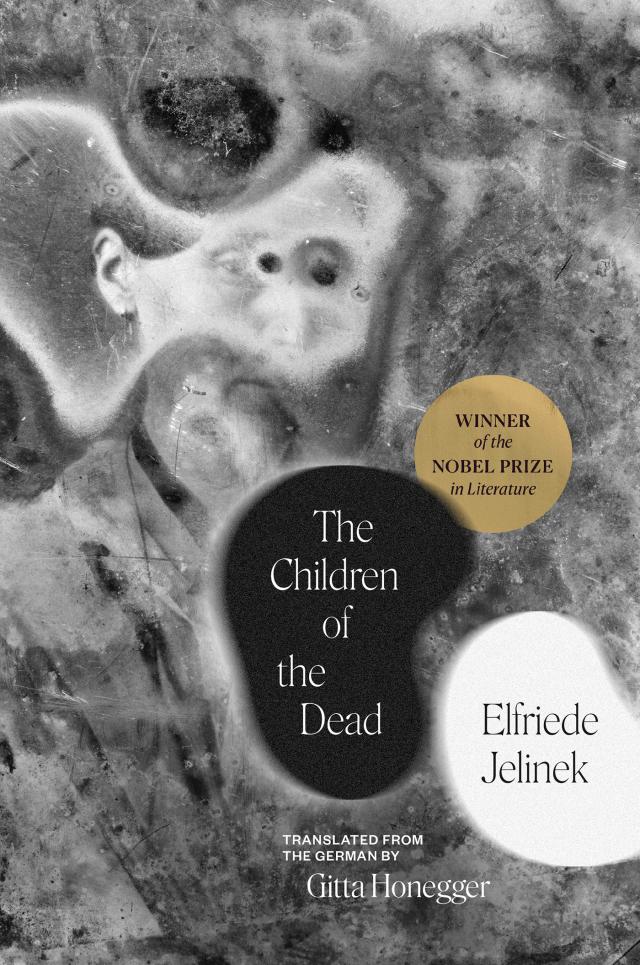


The Children of the Dead
ELFRIEDE JELINEK
The Children of the Dead
Translated from the German by Gitta Honegger
The Margellos World Republic of Letters is dedicated to making literary works from around the globe available in English through translation. It brings to the English-speaking world the work of leading poets, novelists, essayists, philosophers, and playwrights from Europe, Latin America, Africa, Asia, and the Middle East to stimulate international discourse and ceative exchange.
Originally published in Germany as Die Kinder der Toten by Rowohlt Verlag GmbH. Copyright © 1995 by Rowohlt Verlag GmbH, Reinbek bei Hamburg.
English translation copyright © 2024 by Yale University.
Art: Eran Schaerf, Mezuzah.
Among the persons who gave me valuable incentives, I especially thank the satanism expert Josef Dvorak. (E.J.)
This book may not be reproduced, in whole or in part, including illustrations, in any form (beyond that copying permitted by Sections 107 and 108 of the U.S. Copyright Law and except by reviewers for the public press), without written permission from the publishers.
Yale University Press books may be purchased in quantity for educational, business, or promotional use. For information, please e-mail sales.press@yale.edu (U.S. office) or sales@yaleup.co.uk (U.K. office).
Set in type by Motto Publishing Services
Library of Congress Control Number: 2023942844
ISBN 978-0-300-14215-0 (hardcover : alk. paper)
A catalogue record for this book is available from the British Library.
This paper meets the requirements of ANSI/NISO Z39.48-1992 (Permanence of Paper).
Prologue
This land needs a lot of air space for its blessed spirits to move freely above the waters. In some areas it rises over three thousand meters. That’s how much nature has gone into this land. In turn, the land—perhaps as a way of paying back its debt to nature—has treated its people quite generously, throwing them right back into it as soon as they take the bait. The great dead, to name just a few, include: Karl Schubert, Franz Mozart, Otto Hayden, Fritz Eugen the Last Breath, Zita Zits, Maria Theresiana, plus everything her namesake imperial military academy, the Theresianum, produced in Wiener Neustadt until 1918 and in Stalingrad 1943, plus several million more destroyed creatures. A place for wheeling and stealing: those sorts of deals and double deals are part and parcel of the tourist trade, in the course of which people, rather than getting worn out and thrown away, return in newer and better condition than they came; they get less for themselves, though, because they have nothing left in their budget. Still, it was worth it. Unfortunately, some also crash in the process. We find ourselves where we can truly find ourselves at the core of our being, in an Austrian village—or, rather, at its outermost reaches, which the mountain has already slipped into its pants pockets. Located rather on the fringe of tourism, the place is largely undeveloped. Only older people and families with lots of children go there, since there are hardly any opportunities for serious sports and entertainment. But all the more fresh air and deep forests. And beautiful mountains, about two thousand meters high, some even higher, though this area does not yet quite belong to the high alpine region. Hiking trails, a small local railroad, brooks, a clear river; however, if the dam is opened too quickly, the trout choke in the mud and they float by the bridge, belly up, countless squadrons, traveling along their choppy route just a moment ago, now driving away the tourists, who want to get to the inn on the other side, which is built into the rock and can be reached only over a sort of chicken ladder, a nearly impassable pathway.
Today some of the guests registered for a trip. They want to visit the Wild Alps region with its lakes and the small castle of the Habsburg archduke Johann, who married the postmaster’s daughter from Aussee and then dug up the land like a mole—because besides those daughters above the earth, there had to be some iron left for the sons below the earth that could be processed for plows or cannons, both sharing, as always, a place next to each other in harmony. The earth gave the ore, and in return, the hammer barons from the Mürz River canyon and the iron barons from Vienna returned to the earth her tender children, the cannon fodder. So there is a lot to see in this area, if you are interested in the history of the iron dynasty. Fresh cold air. The minibus they had reserved well in advance stops in front of the inn, which is connected to a farm and a small hotel. Six people registered for the tour. Two of them, a couple from the Ruhr area, are dawdling around the entrance, asking each other for items they forgot and for the place they were to stop for lunch (included in the price); they are joined after a while by a single woman from Halle, (formerly East) Germany, they chat a bit—will the weather hold out, were they dressed properly, might it even be possible to arrange for a tour by one of the archduke’s heirs? Would they be able to see the famous speedwell flower that the Habsburg gentleman had planted himself in honor of the postmaster’s daughter? The Chrysler Voyager, ready to receive the passengers, pushes her snub nose across the parking lot, she’s already gotten wind of her living prey. It’s up to her whom she wants to deliver at the destination and in what condition, she has wild horses under the hood. The chauffeur is already slightly drunk, but he doesn’t care, around here everyone’s always somewhat inebriated, it’s the custom of the region, and the regional champions eliminate each other in nightly piss-offs. Mornings at eight not even the players in the qualifying games are playing; they are asleep, leaden from the evening before. After the three passengers have already mounted the best seats, ready to let themselves be pushed out onto the water-gray country road that nearly gets squashed between all that luscious green rolling in from the left and the right, from above and below, four more people arrive—wait a minute, that’s one too many, no problem, we’ll just squeeze together a bit. On vacation you are more willing to accept things you wouldn’t tolerate at home. One of them, a young man, hadn’t made a reservation but wants to come along, nonetheless. Others, a mother and a daughter, not exactly a spring chicken either, the daughter, would not want to give up their seats or sit apart. Besides, the old lady wants to sit all the way in the front. That’s not possible either. But it’s possible to squeeze everyone into the car. We are not that fat, joke the passengers, who like company.
There is a murmur in the air that it will be a sunny day after all, and people are eager, all too eager, to learn about anything assuring them that they are part of this world. Time has passed, the sun has climbed a bit, taking a breath around midday, but the car is merrily rolling along, now she climbs up a mountain road, snaking higher and higher around the steep curves. It seems to be quite warm outside. People on bikes are showing off their bodies. The pavement ribbon, a grayish, living continuum. The alpine panorama reveals itself here, at the Niederalpl, the little lower alp, in all its splendor—mountains are pointed out by name, they nearly drown in all the sunlight, the motor hums soothingly. Now we are approaching the highest point, the summit of this ancient mountain path, and on the other side we’ll have to get down again. The summer storms, which hit this area especially hard, took parts of the road down into the river with them. Pretty red-white-red plastic ribbons stretched between poles have been placed along the road in many spots where the concrete had broken off; caution, motorists and fellow travelers! Where there used to be a firm shoulder and just enough room to get out of the way of an approaching SUV, there is a sudden chasm, a jagged wound in the road’s side. One doesn’t have to thrust anything—a lance—into it to see that the wound is real. Again and again signs commanding extremely low speed limits. A voice from Halle requests in a strange German accent to follow orders—ancient obedience drills keep twitching in this woman’s paws—but in this country official orders, which cling to us hungrily and want to ruin all our fun, are on principle not taken quite so seriously. So let’s keep driving those sixty kilometers per hour, what can happen. I am telling you: Unfortunately, coincidentally, a tour bus will pass exactly the same part of the road. Tough luck. Here, that giant vehicle harnessed in metal advertisements is irrefutably the stronger. Unexpectedly, that monster which a month ago bit off a side of the road and spit it into the creek gets an unexpected dessert that’s not much easier to digest. Only some garnish is missing, but wait—we can still get you some: this bloody multicolored woolen jacket looks quite good, that torn-off shoe over there, yeah, it’s a little asymmetrical, the second one’s missing, it’s still stuck to a dirty, twisted foot. And what’s that minibus doing down there all of a sudden, like a careless beetle tossed on its back by a giant step, limbs spread apart, idling in helpless rotations? Lying here are four persons who spurted out of it, not wearing seatbelts, of course, now they lie here, colorful splashes of Miracle Whip and cream dotting the steep grassy incline that merges, together with the debris of the road, into the creek that still carries the floodwaters. One, two uprooted trees in between. But those are left over from the flood. A twisted young man, two twisted women, an old woman, screaming, screaming like a sinner at the tabernacle, hurry, hurry!, before this roadside sale of humans closes. Torsos bent out of shape, arms tossed up high, as if a deep joy had overwhelmed those poor souls. Cool mountain air wafts across it all. The wheels are still spinning. The driver is pinned to the steering wheel that crushed his chest, a bit of liquid trickling from his mouth. But he won’t be able to drink it, he was dragged away from his discount beverages; clutching the half-filled bottle of his life, he still seems braced to
resist the steering of a higher power. Up on the hill, people are getting off the bus, screaming and crying they are also trying to find their way down the hill to the colorful meadow dotted with humans. Pine trees stand tall. Birds screech because of the disturbance, though deep inside they are unimpressed. The bus driver mumbles something sitting on the steps of the dangerous colossus entrusted to him. In any event, here you really can feel the tangy mountain climate. Like his passengers, the driver is Dutch and no longer understands the mountains or the world or those defeated people around here, this special breed that prides itself as nature’s master and can’t even master its own cars. Something has been felled here, a clearing opens up, it generously makes room for the sun to shine on like a spotlight. Like rolling stones, helpful inhabitants of the valley clamber across the muddy meadow. From the giant balcony above, the terrace of the tourist center, more human wrecks are tumbling down, unharmed but unhinged by their grief for the victims, they will get in the way of the rescue workers. All are wearing colorful summer clothes until evening. Then they will throw on their sweaters. Like a woolly dog, playful and fresh, nature jumps around her guests, circling them, tossing them in the air but not catching them, because another little stick flying through the air seems suddenly more attractive; capriciously, nature puts her paws on this and that, lets go again, ignoring that her playmate has been completely squashed and torn apart by her. She sniffs at the pieces, howls her song into the light until nightfall, then hauls another song from deep down in her throat. Nature! Jumping about clumsily, she bullies her way across the terrain like her bulldozers, which are already on the way. Endless the thrill of those life-size dolls scattered about, their limbs spread-eagled, their mouths no longer speaking words. Branches are broken off, their leaves already wilting. Rising high in the midday heat are the human slopes, decorations for the landscape, from which this land lives, they stretch all the way up the hill, to the tourist center and even inside, where those still living are scurrying about, rescuing their belongings on the trash pile; they’ve been saved, now they can spend themselves on the fitness trail. Dark forests below; those recent storms merely ripped the hem, soon construction brigades will have it fixed and rip us off if we dare to speed across it over thirty kph. Let us proceed on foot, into the woods. The sun holds up a lamp to our faces, we think the glare in front of us is a mirror, and bang our heads against the rock that is us. Thus, we throw ourselves down the alpine valley, the dogs bark, something grabs us by the neck, but not the dogs, they want to assure us for now.
1
In the mountains, where tranquillity can quickly be ruptured by lightning, those passing bolts of terror that actually produce little but destroy a lot, up in those mountains several people disappeared. Others returned, who weren’t even missed. We, the recovered ones, experienced it all, and now we talk about it as if a word had just brushed against us and, in passing, suddenly stepped on us.
For a while the missing could squeeze into the crevices of the mountain, a mannerly herd seeking shelter according to a brochure that dared to contain it, and then a hand, with the flick of the wrist, ripped them out of there. Those were folks, tourists, who did not withhold their presence anywhere, which makes their sudden absence all the more surprising. They demanded leashes for animals, rules for humans: Figures who one day didn’t sign themselves back in at reception; too bad, we had gotten used to serving them. Now they won’t touch their food anymore. Who will be touched by the surrounding beauty, now that they are gone? Who took them from nature, their second home? The person of culture swings back and forth inside himself like some vehicle, but if he wishes to rest for a moment, he has nothing to hold on to. He reached for immediacy, which was exactly the way to turn everything sacred to him into its opposite: his simply being here; beautiful mountains! That is what we expect. Nature, that ole barrack leader, who always lets the others do the cleaning! Did these people die in the mountains after an attack that dispatched them to death? Did the Unreal commit a procreative act, which simultaneously bade farewell to the lives of the disappeared? A ceremony that is still in process at this hour?
Not even one bat of an eyelash was left of them hanging in the air. The bats had already returned to the pits. Now rocks burst apart and the batter of the unthinkable that nonetheless had just been experienced is dripping from their skin. Look how brightly the mountains bore through the sky’s frosting! (Being nature means being perceivable!) Vigilant and humorous the natives, whose blood contains a high level of confusion. Thoughtlessly we keep them on their toes, those unpolished fellows; not even with the stamp of money can you impress on them the brands of beer or schnapps they should serve us. We must repeat our order every day, and every conversation deals with the dilemma of everything tasting so good on the one hand and not being good for you on the other. The rock gets battered with pitons but does not flinch; that happened earlier, as reported in a special newsbreak, when the pit went up in the air. The mountain is back to being a cuddly pet, pacified, Watch out! Duck!—You are about to enter the text at hand. It slides through your fingers, but it doesn’t matter, someone else will have to carry me through to completion, a mountain guide, not you!
All of a sudden, completely useless, the past is here again, it’s impossible to love her. Why now? We just sent her out on an errand, to a supermarket where they are selling human spare parts, and now she’s back already. We don’t yet have any change for bills. Besides, the old supplies must first be removed from the fridge of our memory, where they were kept, frozen and past their expiration date. What’s the charge? Whom do we charge? Even fruit trees must accept their fruit being taken from them! But since guests from abroad also dine here sometimes, we must work a little harder. She seems to have stumbled, the past, staggered, just before she reached the finish line—once again the weather was quite rude to her and now—oh no, now she made a wrong turn to boot, and now she shoots right out of the finish line. With determination I now close my path for today and give it a path name before it gets scorched by this red-hot experience. Will we dare to expel this sight emerging from the dark? Or will we be terrified when the past tries to pick our lock and, unsightly and coarse, without any gains but all wrapped up in new bargains, spreads out in our best room, which we, of course, had reserved. Our last topic was rocks. Like the old days that rocked the world, it’s impossible to contemplate them romantically when they are five centimeters away from your face and you have no free hand to get yourself out: it wasn’t us! People disappeared! Yes, here, from nature, that gingerly beginning of being. Tourists—well, folks who don’t know about beginnings, because they are always so quickly finished. And then they regret the end to no end. I offer them the opportunity to do so. This land has always kept still, that is, it has style: as a matter of principle, it explores humans only when they are already hurling into the trash can. The terrain is so difficult, it is impossible to simply keep going. You must learn to economize yourself and your energies, because the road keeps going up and down again so that it appears to be much longer than calculated. For the fun of it, some residents are posing for the photographer now, they don’t understand a word they say, but no one gives them a hearing anyway. We don’t need any outside judges is how they put it here. Sometimes the youngest among our forever young sing in Austro-Pop schmaltz local dialect, which they zing into the wrinkles we’ve got because of them. I don’t have enough paper to wipe it all off. The rock is opening up, watch out! The creek also opens up in front of us. Terrific! Oh, my dear radio, dearest Austrian broadcasting, I forgot that even if people disappear in crippling catastrophes, you will always be here as long as our rushing mountain creeks keep gushing over the stones. Then the water that used to flow crystal clear into the pipes spouts out a lot of dirt. It is totally confused and doesn’t know what’s in the pipes. Those are only the loudspeakers, the only ones allowed to come out of the station sometimes, but they are not the up-and-comers, because soon a change of executives is due. Done deal! They all want to stay forever, but they are not allowed.