While the city sleeps, p.1
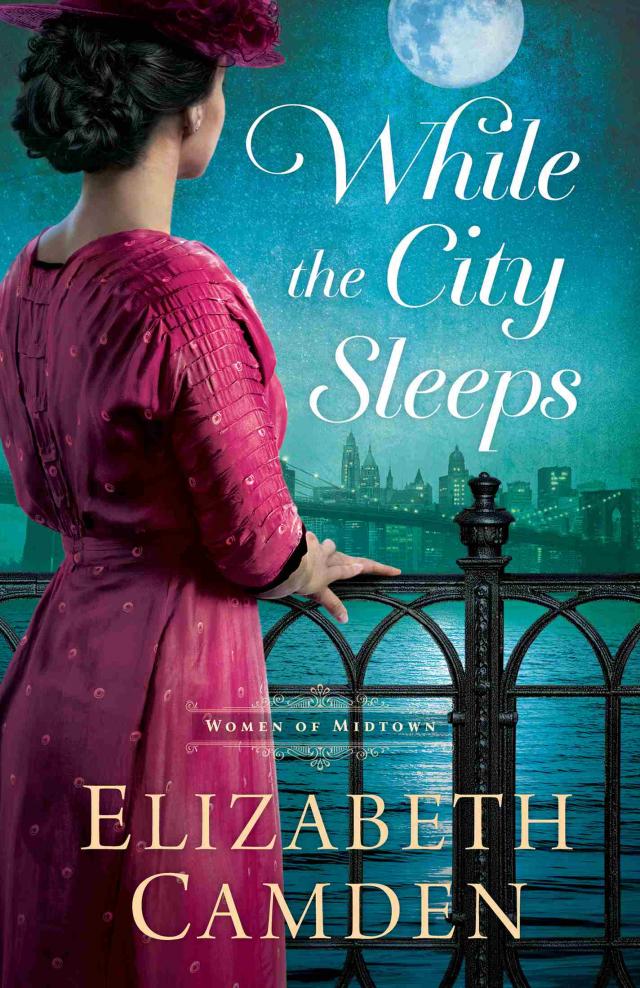
While the City Sleeps,
p.1


Books by Elizabeth Camden
WOMEN OF MIDTOWN
While the City Sleeps
THE BLACKSTONE LEGACY
Carved in Stone
Written on the Wind
Hearts of Steel
HOPE AND GLORY
The Spice King
A Gilded Lady
The Prince of Spies
The Lady of Bolton Hill
The Rose of Winslow Street
Against the Tide
Into the Whirlwind
With Every Breath
Beyond All Dreams
Toward the Sunrise: An Until the Dawn Novella
Until the Dawn
Summer of Dreams: A From This Moment Novella
From This Moment
To the Farthest Shores
A Dangerous Legacy
A Daring Venture
A Desperate Hope
© 2024 by Dorothy Mays
Published by Bethany House Publishers
Minneapolis, Minnesota
www.BethanyHouse.com
Bethany House Publishers is a division of
Baker Publishing Group, Grand Rapids, Michigan
www.bakerpublishinggroup.com
Ebook edition created 2023
All rights reserved. No part of this publication may be reproduced, stored in a retrieval system, or transmitted in any form or by any means—for example, electronic, photocopy, recording—without the prior written permission of the publisher. The only exception is brief quotations in printed reviews.
Library of Congress Cataloging-in-Publication Data is on file at the Library of Congress, Washington, DC.
ISBN 978-1-4934-4513-4
Scripture quotations are from the King James Version of the Bible.
This is a work of historical reconstruction; the appearances of certain historical figures are therefore inevitable. All other characters, however, are products of the author’s imagination, and any resemblance to actual persons, living or dead, is coincidental.
Cover design by Dan Thornberg, Design Source Creative Services
Baker Publishing Group publications use paper produced from sustainable forestry practices and post-consumer waste whenever possible.
Contents
Cover
Half Title Page
Books by Elizabeth Camden
Title Page
Copyright Page
1
2
3
4
5
6
7
8
9
10
11
12
13
14
15
16
17
18
19
20
21
22
23
24
25
26
27
28
29
30
31
32
33
34
Historical Note
Questions for Discussion
Sneak peek at the next book of the Women of Midtown series
About the Author
Back Ads
Back Cover
1
NEW YORK CITY • APRIL 1913
People were rarely in a good mood while in a dentist’s chair, but Dr. Katherine Schneider’s patient was singing. Vittorio had been terrified when he first arrived because he’d never been to a dentist before, but the sedative had finally taken effect. Nitrous oxide, sometimes known as laughing gas, often had the delightful side effect of euphoria.
“How are you feeling?” Katherine asked, and Vittorio gave her a wide smile.
“Life is wonderful,” he said, then went back to singing “The Sugar-Plum Tree.”
Vittorio had brought his brother along for moral support. The brother didn’t share Vittorio’s easy mood and interrupted the singing with a blunt, angry spiel of words spoken in Italian.
She glanced down at Vittorio. “What did he say?”
“Gino says he doesn’t believe a woman can be a real dentist.”
“I’m a real dentist,” she assured him, pointing to the diploma on the wall from the Philadelphia Dental College, class of 1911. She had been one of four women in her graduating class, but not a day went by when someone didn’t question her qualifications.
“Gino doesn’t believe it,” Vittorio said. “He wants to know if there’s someone else who can pull my tooth.”
The only other dentist in the clinic this late in the evening was Dr. Alvin Washington. Alvin wanted to leave soon for his anniversary dinner with his heavily pregnant wife, but if a patient refused to be treated by a female dentist, Alvin would step in to do the job.
She opened the door of her compact treatment room to call down the hall. “Dr. Washington? Could you come introduce yourself? My patient might be more comfortable with a man.”
Alvin had been chatting with the janitor in the lobby, but agreeably headed down the hall, past the six other treatment rooms that were closed for the evening, and into her room. He had to navigate around the narrow space between the dental chair and a table covered with gleaming surgical instruments already laid out for work.
Vittorio took one look at Alvin and blanched. “He’s a dentist?”
“I’m a dentist,” Alvin replied. “Harvard University School of Dentistry, class of 1906.”
“But you’re Black!” Vittorio said, his voice both shocked and bewildered. Laughing gas removed the filters people normally had in place, causing them to blurt out whatever thoughts floated through their minds. She and Alvin were both used to it.
“Yes, I’m Black,” Alvin said. “And you’re in a lot of pain from that badly infected tooth. If you want it fixed tonight, you can have me do it or Dr. Schneider. Or you can wait until tomorrow.”
Tomorrow they’d have a whole crew of dentists staffing one of the largest and most forward-thinking dental clinics in the country. The owner, Dr. Edgar Parker, believed that not only should the office stay open late at night to accommodate working people’s schedules, but patients could also be treated by dentists with whom they felt comfortable. Their office had dentists who were fluent in German, Russian, and Chinese. Dr. Parker also hired Black and female dentists. By hiring dentists who looked like the diverse population of New York City, at least one obstacle that made people reluctant to see a dentist had been removed.
Vittorio and his brother conferred in Italian while Katherine waited. Finally, Vittorio relaxed back into the chair. “I want the woman to do it,” he announced. “Smaller hands.”
“Excellent reasoning,” she said, and Alvin sent her a smile of relief. His wife and their anniversary dinner were waiting.
Alvin left while Katherine began preparing the equipment to pull the tooth. The only real pain Vittorio would experience tonight would happen when she injected his gum with a numbing drug that Dr. Parker had invented. It was highly effective, making a tooth extraction merely uncomfortable instead of painful.
Though Vittorio was already feeling good from the laughing gas, she needed him completely relaxed before giving him the injection. She squeezed the rubber ball to feed another dose of nitrous oxide into his mask while he breathed deeply. He smiled and pulled the mask away and continued rambling his odd collection of thoughts, jumping from one topic to another with no logical sense.
“Cleopatra was a goddess of the Nile,” he mumbled. “She might get mad when she sees what we did. What do you think, lady dentist, will Cleopatra be mad at me or is she good and dead?”
“Cleopatra is good and dead,” Katherine assured him. “Open wide, and you’re going to feel a prick. I need you to hold still.”
The patient obeyed but still let out a wailing howl as she injected the pain-killing solution into his gum. This was always the worst part. He reared up a little, still squealing, but didn’t fight her.
They both gave a sigh of relief when the injection was over. It would take a few minutes for the medicine to numb the area, and she set out cotton balls while Vittorio prayed to the Virgin Mary to have mercy on him. Then he added Saint Patrick for good measure because “good old Saint Patrick” was probably mad at him too.
“I don’t like Saint Patrick,” Vittorio said. “Sure, he drove the snakes out of Ireland, but what did he ever do for the Italians? Nothing! I shouldn’t feel bad. Saint Paddy deserves whatever he’s got coming to him.”
It wasn’t unusual for patients under the influence of narcotics to ramble. Sometimes people got giggly, others became weepy. Tonight, it made Vittorio philosophical as he speculated about various people from world history.
She gave Vittorio a final breath of nitrous oxide. By now he was coming to enjoy the drug, and he clamped her hand holding the rubber mask to his face to suck it in deeply.
Katherine pulled it away, then rolled the table with the tools closer as Vittorio continued to ramble. “Lorna Doone,” he said dreamily. “Have you ever read that book, lady dentist?”
“I’ve never read it.”
“Sad, sad story. Oh, poor Lorna Doone. At least she wasn’t an old lady. A boring gray lady who hates us. No, Lorna Doone isn’t like the awful gray lady.”
“Time to stop talking,” she said in a soothing voice. “Open wide, we’re ready to begin.”
There was no such thing as painless dentistry, even though the name of their clinic was Painless Parker Dentistry.
That was her boss’s idea, and it outraged the respectable dentists in the city.
Traditional dentists branded Dr. Edgar Parker a menace to the dignity of the profession, claiming that his large crew of dentists treated patients as though they were on a production line. They didn’t like the way Edgar kept his clinic open during unconventional hours. They didn’t like Edgar’s low fees that dramatically undercut what other dentists charged. They didn’t like Edgar’s garish advertisements, his stable of dentists, or the fact that a man who started his career as a vaudeville tooth-puller was now the richest dentist in the country.
But nothing outraged the dental establishment so much as the name of Edgar’s clinic, Painless Parker Dentistry, which they claimed was false advertising. Edgar hadn’t been to the office for a month because he was battling a lawsuit from the American Dental Association to force him to stop using the name. Edgar’s chain of dental clinics on both coasts all used the name, and it brought customers beating a path to their doors. Most dentists used similar pain-killing drugs, yet Edgar was the only one who exaggerated his services with his clinic’s memorable name.
After Katherine’s work was finished, she helped Vittorio slowly rise from the chair, an arm around his back to steady him. He held a block of ice wrapped in a towel to his swollen jaw, but still managed a wobbly smile.
“Are you feeling okay?” she asked.
“Okay, lady dentist,” he mumbled.
Katherine locked gazes with Vittorio’s brother and gestured for him to take over. She waited until the brother had his arm firmly around the patient before she led them down the hall, through the waiting room, and out the front door into the warm June night.
Vittorio leaned heavily on his brother as they wandered toward the subway stop, loudly singing the refrain from “The Sugar-Plum Tree.” To a casual observer, they probably looked like a pair of drunks, but the effects of the drug would wear off soon. Vittorio was walking on his own by the time they disappeared into the crowds of Times Square.
It was only nine o’clock and Katherine had another patient waiting. Birdie Jamison’s hands were covered with the nicks and scars of someone who worked in a cannery. Birdie could never have afforded care at a fancy dental office with drapes on the windows and upholstered chairs in the waiting room. Katherine smiled at her next patient and led her into a treatment room.
Maybe the Painless Parker Dentistry clinic was little better than a production line, but New York City was home to almost five million people. One-third of them had been born overseas and lived close to the bone. Thank goodness there were dental clinics to bring relief to those who couldn’t afford it elsewhere. Poor people suffered the same amount of pain as rich people, and they deserved access to a decent dentist.
Katherine prayed Edgar won his lawsuit, because if the courts ordered him to stop using his brash advertisements, this clinic would be forced to close. It meant patients like Birdie Jamison could no longer afford basic dental care, and Katherine would be out of a job.
Katherine’s final task before closing the clinic at midnight was to peel off the white high-collared tunic she wore while treating patients. She traded it for a nip-waisted jacket, then smoothed her upswept dark hair, taking care to arrange a few tendrils to frame her face because . . . well, because she always liked looking nice for Lieutenant Birch.
It was mortifying to care so much about the dashing police officer’s opinion, especially since he never showed the least amount of romantic interest in her. And yet why did he always show up after her shift to walk her to the subway? He’d been doing this for two years, and it wasn’t part of his official duties. Still, he seemed very protective of her.
Katherine snagged a large pretzel from the break room before heading to the front lobby. Dr. Friedrich was from Germany and often brought a sack of freshly baked pretzels for the staff to share. The only other person in the clinic was Hector, their janitor, who was busy cleaning up.
“There are still some pretzels in the break room if you want,” she offered to Hector.
“I’ve already had my fill,” Hector replied, not looking up as he mopped the tile floor. It had been a long day for them both. “Good night, Dr. Schneider.”
“Good night, Hector,” she said before leaving through the front door. She turned to take in the dazzling view of Times Square at midnight, brightly lit by hundreds of streetlamps and theater signs. The night air shimmered with excitement, lively music spilling from the restaurants that catered to affluent crowds after the theaters let out. Even at midnight, Times Square blazed with radiant light.
It was why Edgar opened his clinic here. Patients wouldn’t feel safe venturing out to see a dentist at night unless it was in a clean, well-lit part of town. Most people visiting Times Square saw only the glittering lights and the people carousing in an all-night party, but Katherine saw another side of the famed theater district of Midtown Manhattan. None of this could happen without the overnight staff who made it possible. Cooks and waitresses served food. Actors, dancers, and musicians put on the shows. Police officers patrolled the square, and streetcar operators drove people wherever they wanted to go. Janitors cleaned offices, and bakers were already kneading dough for tomorrow’s breakfast. Across the street, the New York Times building was lit up like a Christmas tree all night long. Inside, journalists, editors, and printing crews were hurrying to get the newspaper ready for sale by sunrise.
Katherine’s parents back in Ohio worried incessantly about her late-night hours, but she was twenty-eight years old and navigated the city with ease. Six years after fleeing the humiliation of a mortifying heartbreak in Ohio, she had fulfilled her improbable dream of becoming a dentist. Her heart had mended, for nothing healed a wounded heart faster than a crush on another man, even if it was unrequited.
She glanced both ways, then hurried across the street. The subway stop was three blocks away, and she started munching on the pretzel that was already a bit stale and brushed a few crumbs from her chin.
Like clockwork, Lieutenant Birch emerged from the crowd farther down the block and strode toward her. She admired the chiseled set of his jaw and quiet intensity of his expression, partially hidden beneath the brim of his police cap. Always alert, always cool and unruffled. He appeared to be in his thirties and attracted plenty of female attention whenever he walked her to the subway station.
He tipped his head in greeting. “Good evening, Dr. Schneider.”
The way he said her name gave her a quick thrill. His tone was precise and polite, delivered in a smooth tenor wrapped in velvet.
“Lieutenant Birch,” she greeted, trying to sound equally nonchalant. “How has your evening been?”
“Fine.”
The fact that he didn’t elaborate was not a surprise. Lieutenant Birch never talked about himself. Ever. He didn’t merely draw a line around his personal life; it was more like a fortress topped with barbed wire and searchlights to keep out intruders. After two years, the only thing she knew about him was his deep appreciation for Italian cuisine.
He glanced at the pretzel she held. “You don’t really like pretzels, do you? Pretzels are dry, lifeless bread. Try this. It’s much better.”
He handed her a paper sack, and she peeked inside to see a wedge of golden bread flecked with bits of herbs. It was still warm. She tore a piece from the soft loaf, inhaling an herbal fragrance that made her mouth water. She tossed the remnant of the pretzel into a trash can where it hit with a clang.
“It’s focaccia,” Lieutenant Birch said. He repeated the word and even spelled it for her. The freshly baked bread was an explosion of flavor with an airy texture beneath a golden crust.
“Why did you say pretzels are lifeless bread?” she asked as they continued walking, their footsteps in tandem.
“Pretzels are nothing but flour and yeast that’s been boiled and salted. But focaccia,” he said, his voice suddenly much warmer. “Focaccia is an Italian bread infused with the oil of olives that were cold-pressed just a few days earlier. It has rosemary and oregano baked into it. This bread is so fresh you can taste the sunlight in the herbs.”
How did he know so much about fancy food? Katherine’s friend Blanche had a brother who was a police officer, and he said Lieutenant Birch grew up at a spartan orphanage, where Katherine sometimes donated free dental care. It was not the kind of place where anyone could have learned to appreciate fine food. She once inspected the building, and the industrial kitchen had oatmeal and dried rice by the barrel, not cold-pressed olive oil or herbs that captured sunlight.