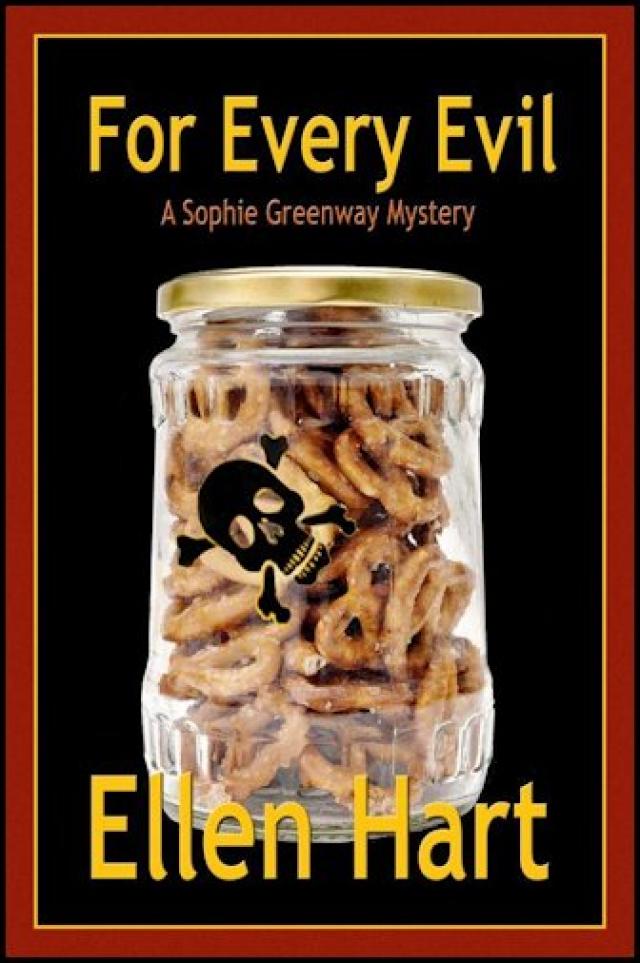
For every evil, p.12
For Every Evil,
p.12


“That’s what we need to find out.” The detective stood. “That’s all for now. But we’ll need you to come down to the station sometime tomorrow and sign your statement. Most likely we’ll want to talk to you again. You weren’t planning to leave town, were you?”
“No.”
“Good.” He motioned for the officer to follow him out.
21
John turned his Blazer into a scenic overlook and stopped. The Mississippi River Valley lay in front of them, vast and black in the weak moonlight Rudy had said very little after the police finished with him. Sensing his need to get away from everyone who might want to ask more questions, John poured Rudy a stiff brandy and waited while he drank it. Then, explaining to Sophie that he’d make sure Rudy got home safely, he’d stuffed his sullen friend into the front seat of his truck and headed across town to 494, then south to Bob Dylan’s famous Highway 61. The lights of Red Wing shimmered in the distance.
“Quite a view,” said Rudy, turning down the radio. “I’d like to come back here sometime when it’s daylight.”
John pointed to the sky. “What do you think of that?”
Rudy leaned forward to get a better look. “The northern lights! I’ve seen them once before, but they weren’t this bright.”
“You have to leave the city to get the full effect.”
Rudy leaned back in his seat. “Thanks.”
“For what?”
“For kidnapping me.”
John laughed.
“What an evening.”
“Yeah. You don’t have to talk about it. We can just sit here and watch the show.” He could tell Rudy was a little high.
They were both silent for several minutes.
Finally Rudy said, “Did I ever tell you I used to believe Christ was going to return on the Feast of Trumpets, 1989?”
“Pardon me?”
“Yup. I was going to be whisked away into the heavens with the rest of God’s elite. I guess God’s apostle got the date wrong.”
“Who’s God’s apostle?”
“The head of our church. Howell A. Purdis.”
“I see. Well, that’s too bad — for him, I mean.”
“And for everybody who sold their houses and businesses and gave the money to the church in anticipation of the great event.”
“Well, didn’t the church just give it back? I mean, it was their error.”
“No way. I guess you could say that was the first time I had a real argument with my father. I told him I thought it was wrong.”
“What did he say?”
“He told me the people that did it were following their own conscience. God would bless them in the end.”
“In the meantime, they could always go on welfare?”
“I guess.”
John unzipped his leather jacket. “Rudy?”
“What?”
“Well, I mean you sound pretty bitter.”
He shrugged.
“Do you still believe all the stuff you were taught as a kid?”
Another shrug. “Did you know the first time I was ever around a Christmas tree was this winter? Bram and my mother bought a big Norway pine. I felt kind of funny having Christmas dinner with them. It’s a pagan day, you know. Nothing Christian about it.”
“Really?”
“And doctors. We never went to doctors, except once when I was little. I’ve never even taken an aspirin. That is, until last fall. I had to get all these shots before I could attend the university. My dad would have pitched a fit.”
“What did you do when you got ill?”
“We sent for the elders of the church to pray.”
“And if that didn’t work?”
Rudy stretched his arms over his head. “Well, that meant you didn’t have enough faith. If you did, God would heal you. Except, I found out from a friend that some of the top ministers were going to doctors. But the people in the local church areas were still forbidden.”
John shook his head. “You’re lucky you never got sick.”
“I know,” said Rudy. “I had a good friend die of skin cancer. I didn’t realize at the time how treatable it was. She was an older woman. I’d known her since I was little.”
“I’m sorry,” said John.
“Yeah. Such a waste.” He wiped a hand across his eyes. “I used to have to study the Bible an hour every night. And pray two hours a day. We even had a prayer closet. That way Dad could monitor me and Arlene — the woman he married after he divorced Mom.”
“What did you pray about for two whole hours?”
“Oh, sometimes I’d go into the closet and sleep. Other times I’d think about … you know. Sex.”
John grinned. “I did most of my daydreaming in the woods.”
“The thing is, in our church, no one could have sex before marriage. Sometimes I nearly went crazy thinking about it.”
“Did you have a girlfriend in high school?”
He rubbed his hands along the tops of his jeans. “No. Dad wouldn’t have allowed it. We couldn’t be unequally yoked together with unbelievers. I could have dated someone in the church, but … I don’t know. I never did.”
John watched him.
“I really want to have kids,” continued Rudy. “That would be the greatest. How about you?”
“I haven’t given it much thought.”
“I’d make sure they grew up being able to make their own decisions about … life. About God. Not that my father is a bad man. I know he loves me.”
“Do you still believe in God?”
“Yeah. Absolutely. I’ve just got a lot of sorting out to do. I have to make my peace with certain things. It’s hard to explain.” He shifted in his seat. “What about you? Do you believe in God?”
“I’m not sure God means to me what he does to you. Fundamentalists have always seemed like a lot of emotional bullies to me. And these TV evangelists … I can’t stand to watch them. They’re so smug about their ignorance.” He shook his head. “I hope that doesn’t hurt your feelings.”
“No,” said Rudy, looking up again at the sky. “You know, I used to be so sure about everything, about where I fit. My entire life was mapped out for me. I’d go to Purdis Bible College. Graduate and become a minister like my father. I’d marry, have children, preach sermons every Sabbath, attend ministerial conferences, anoint the sick. Everything was decided. I knew with absolute certainty what was right and what was wrong. All I had to do was believe what I was told and my life would be great. But somewhere along the line, things changed.”
“You grew up.”
“Maybe. But it’s more than that. It’s like I hit a wall. Nothing’s been the same since.” He pressed his fists hard against his temples. “Sometimes, my mind just aches from thinking.”
John started the motor and turned up the heat. It was beginning to get cold inside the truck.
“You know, Hale was a terrible man.” Rudy leaned his head against the glass.
“I agree,” said John. “Was the police questioning pretty bad?”
“Not really. I just told them what I saw.”
“And that was?” John knew he shouldn’t press him, but he had to know.
“I told them I’d heard someone close the back door while I was coming up the front stairs. By the time I’d recovered from the shock of finding Hale dead on the floor and I’d walked over to the window, all I could see was a form entering the main house.”
“Could you describe the person?”
“No, other than to say it was a woman. That’s all I know for sure.”
John nodded. “I see.” He stared straight ahead. “Why did you go outside in the first place?”
“To look for you. I couldn’t find you anywhere. Where’d you go?”
“Upstairs.”
“I thought that was off-limits.”
John shrugged. “I didn’t see a sign. Anyway, Bram was introducing you around. I thought I’d take the chance to check out the second floor. See how rich people really live.”
“And?”
“There were lots of bedrooms. Oh, and there’s a great library filled with old art books.”
Rudy nodded. After a minute, he said, “Hey, I’ve got an idea. Let’s drive into Red Wing. See if we can find a Burger King or something.”
“All right” John slipped the truck into reverse and pulled back out onto the highway. It was best to let the rest of his questions drop. For now. “That’s a good sign, you know.”
“What is?”
“You’ve got your appetite for junk food back.”
“After eighteen years of brown rice and vegetables, what do you expect?”
“Perfect arteries?”
“And perfect boredom.”
22
Late Monday afternoon, Bram stood in front of the window in Sophie’s office and watched the traffic move silently along Kellogg Avenue, twelve stories below. Rush hour was always a snarl in downtown St. Paul. The light snow, which had been falling since noon, didn’t help. “I can’t believe the police suspect that Rudy had anything to do with Hale’s murder. Unless there’s something we’re not being told.”
Sophie leaned her elbows on top of the massive oak drafting table, which had served as her desk for the past twelve years. She preferred it to a regular desk. The space available for layout was much greater, but most of all, being of diminutive size, she liked the sense of height and power it gave her. “Then why do they want to talk to him again?”
Bram glanced over his shoulder, but said nothing.
“I just wish …” Her voice trailed off.
“Wish what?”
“Oh, you know. What I always wish — that I knew him better.”
“Come on now, Soph. Don’t tell me you think he’s involved?”
“No. Of course not.” She straightened a stack of papers and looked glum. “But that doesn’t mean he’s telling us the entire truth. Something’s going on with that kid.”
“Maybe John knows what it is. They spend enough time together.”
“You mean, when he’s not working or reading.” She dropped her chin on her hands. “He invited me into his room the other night. I couldn’t believe my eyes. He must have had two hundred plays up there. He said he’d read every one.”
“He burns the midnight oil.”
She shook her head. “Why won’t he open up to me?”
Bram walked over and stood behind her, putting his hands on her shoulders. “Maybe you want it too much. He senses that and it puts him off.”
“Do you think so?”
“I think,” he said, nuzzling her hair, “that this has been a bad couple of days. What say I take you out to dinner?”
“I’ve already made reservations.”
He swiveled her chair around, keeping his face very close to hers. “Where?”
“You’ll see.” She flapped her eyelashes.
“I was thinking maybe a burger and a brew.”
“Is that what you were thinking?”
“The oyster bar at the Maxfield?”
“You’re getting warmer.” All day she’d been fantasizing about the lemongrass beef, heavy on the garlic,
served at their favorite Vietnamese restaurant. And, of course, a plateful of delicate spring rolls with vinegar and anchovy sauce.
He straightened up, folding his arms over his chest. “You know” — he walked back to the window — “I’ve given Hale’s murder a good deal of thought. Somebody at that party the other night was undoubtedly responsible. All we have to do is determine the motive.”
“I suppose wanting to rid the world of an arrogant ass isn’t enough.”
He raised an eyebrow. “Not usually.”
“A week ago, I would have said Ivy was the one whose life was in danger. First someone takes a shot at her. And then the day she was on your show, she nearly collapsed. I know everyone thought it was just a drug mix-up, but Kate thought otherwise.”
“What do you mean?”
“She suggested that Hale was responsible for both.”
“Attempted murder?”
Sophie nodded.
Bram shook his head. “What a mess.”
“I agree. And now we’re involved, whether we want to be or not.” She reached for her shoulder bag, the one Bram lovingly referred to as the potato sack. “It’s all such a muddle.”
Instead of continuing to brood, Sophie decided to take a quick look at her makeup before they headed down to the parking garage. Inside her bag was the small, beaded purse she’d worn to the Micklenbergs’ party. With all the commotion yesterday, she hadn’t thought to empty it. This morning, she’d simply tossed it into her bag, knowing she could sort out the contents later. As she opened the clasp, she saw the piece of crumpled paper she’d found two nights ago at the party.
“What’s that?” asked Bram, seeing her face flush with interest.
She smoothed it flat against the drafting table. “I found it on Saturday night. Since I was in a hurry, I just stuffed it into my purse.”
“And forgot about it?”
“Don’t be tedious.”
It was a drawing. A sphinx with fire between its paws. A picture of Hale had been pasted in the flames. Underneath someone had printed:
I’m here and I’m watching. I want you to call the police and tell them the truth. Tell them what you did. Nothing less will be acceptable. Do it now. If you refuse, you’ll pay the price. Remember: “For every evil under the sun, there is a remedy …” Make that call!
Ezmer Hawks
Bram moved up next to her. “Who the hell is Ezmer Hawks?”
Sophie was bewildered. “He’s an artist. One of Hale’s favorites.” She tapped a pencil against the top of the desk. “But if he was at the party Saturday night, why didn’t he introduce himself? Kate never mentioned seeing him. Neither did anyone else. He’s doing a show at the Chappeldine next month.”
Bram picked up the note and studied it. “I think the answer is pretty obvious.” Sophie’s eyes rose to his face. “Don’t you see? This note makes everything clear. It’s not only given us the motive for his murder, but the name of the murderer! Hale was threatened. That’s why he went out to the gate house. He must have been waiting there for —”
“Ezmer Hawks,” whispered Sophie. “Of course. But what did this Hawks fellow want Hale to tell the police?”
Bram shrugged. “That’s just a detail. Maybe Hale did something illegal. Something he got away with. This guy knew about it and wanted him to fess up.”
“But why should he care? Hale didn’t even know the man.”
“He didn’t?” Bram scratched his head. “But that’s impossible. He must have.”
Sophie had to agree. The note sounded too familiar. And come to think of it, it wasn’t the first note he’d received from the artist. That day she’d run into Hale at the gallery he’d received one in the mail. She tried to remember his face, his demeanor, after he’d read it. Something had clearly upset him.
“You better show this to the police right away,” said Bram. “It’s just what they’re looking for.”
She nodded. “Right.”
He put his hands on his hips. “Sophie? What’s going on inside that head of yours?”
She looked up, realizing he’d caught the hesitation in her voice.
“Come on. Out with it.”
“Well, I mean, Rudy … is my son. And right now, he seems to be a suspect.”
“So?”
“It’s just … maybe the police will think I’m trying to manufacture evidence to get him off the hook.”
Bram stared at her. “Nonsense.”
“Is it? Think about it. My fingerprints are all over the note. If Hawks was careful at all, his won’t be.”
“But we can’t withhold evidence.”
Her shoulders sank. “I know. I just think giving it to Detective Cross right now might make matters worse.”
Bram brushed a golden hair away from her face. “It’s a risk,” he said, his voice gentle, “you have to take. In the long run, it’s going to be best for everyone if the police can find out the truth.”
“Right,” said Sophie, though she knew her voice held little conviction.
23
“When do the lawyers read the will?” asked Max, his feet propped up on die glass coffee table in his office. He and Ivy were both reclining on the sofa, his arm around her shoulders.
“On Wednesday morning. Everyone named in the document has been summoned to die offices of Weise and Crawford.” She closed her eyes and let her head sink back against the cushions.
He leaned over and gave her a kiss. “It’ll be over soon.”
“Not soon enough.”
“Come on, Ivy. Don’t get impatient. In a matter of days we’ll have everything we want, even more than we dreamed.”
She loved the look of his strong, doctor’s hands. God, how was it possible she’d lived for so many years without passion? What a waste. “I know. You’re right.”
“Black suits you,” he said, tracing the curve of her jaw with his fingers. “When is the funeral?”
“Tomorrow afternoon. It seems like this is my week for funerals.”
“Mmm. Right.” His mood changed almost instantly as he reached for his glass of mineral water. “How did your lawyer friend do this morning?”
She knew he didn’t like Louie. Well, he could just deal with it. Louie was her friend. She wasn’t about to send him packing just because Max didn’t want him around. “It was hard for him. His wife wanted to be buried at Lakewood, so he made all the arrangements. There were lots of relatives and friends — people he hasn’t seen in years. I sat with him in the front row.”
“Did you?” He took a sip, making a sour face. “I hate funerals.”
“Why? Because they remind you you’re mortal?” She squeezed a particularly hard muscle in his arm.
He brushed her hand away. “Is Louie still staying with you?”
She shook her head.
“Good. I don’t like competition.”
“Oh, get real. You don’t seriously think Louie is a threat?”
“He cares a great deal for you.”
“The feeling is mutual.”
Max downed the rest of his water, setting the empty glass back on the coffee table with a crack. “Wonderful.”