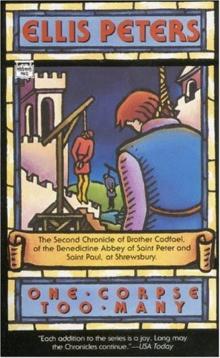
One corpse too many, p.23
One Corpse Too Many,
p.23


Hugh stooped, and raised the inert body by the left shoulder, turning it to see where the blood issued; and there, driven deep through the leather jerkin, was the dead man’s own poniard, which he had flung away to grasp at the sword. By the look of it the hilt had lodged downwards in thick grass against the solidly braced boot of one of the Flemings. Hugh’s onslaught had flung the owner headlong upon his discarded blade, and their rolling, heaving struggle had driven it home.
I did not kill him, after all, though Beringar. His own cunning killed him. And whether he was glad or sorry he was too drained to know. Cadfael would be satisfied, at least; Nicholas Faintree was avenged, he had justice in full. His murderer had been accused publicly, and publicly the charge had been justified by heaven. And his murderer was dead; that failing breath was already spent.
Beringar reached down and picked up his sword, which rose unresisting out of the convicted hand. He turned slowly, and raised it in salute to the king, and walked, limping now and dropping a few trickles of blood from stiffening cuts in hand and forearm, out of the square of lances, which opened silently to let him go free.
Two or three paces he took across the sward towards the king’s chair, and Aline flew into his arms, and clasped him with a possessive fervour that shook him fully alive again. Her gold hair streamed about his shoulders and breast, she lifted to him a rapt, exultant and exhausted face, the image of his own, she called him by his name: “Hugh… Hugh…” and fingered with aching tenderness the oozing wounds that showed in his cheek and hand and wrist.
“Why did you not tell me? Why? Why? Oh, you have made me die so many times! Now we are both alive again… Kiss me!”
He kissed her, and she remained real, passionate and unquestionably his. She continued to caress, and fret, and fawn.
“Hush, love,” he said, eased and restored, “or go on scolding, for if you turn tender to me now I’m a lost man. I can’t afford to droop yet, the king’s waiting. Now, if you’re my true lady, lend me your arm to lean on, and come and stand by me and prop me up, like a good wife, or I may fall flat at his feet.”
“Am I your true lady?” demanded Aline, like all women wanting guarantees before witnesses.
“Surely! Too late to think better of it now, my heart!”
She was beside him, clasped firmly in his arm, when he came before the king. “Your Grace,” said Hugh, condescending out of some exalted private place scarcely flawed by weariness and wounds, “I trust I have proven my case against a murderer, and have your Grace’s countenance and approval.”
“Your opponent,” said Stephen, “proved your case for you, all too well.” He eyed them thoughtfully, disarmed and diverted by this unexpected apparition of entwined lovers. “But what you have proved may also be your gain. You have robbed me, young man, of an able deputy sheriff of this shire, whatever else he may have been, and however foul a fighter. I may well take reprisal by drafting you into the vacancy you’ve created. Without prejudice to your own castles and your rights of garrison on our behalf. What do you say?”
“With your Grace’s leave,” said Beringar, straight-faced, “I must first take counsel with my bride.”
“Whatever is pleasing to my lord,” said Aline, equally demurely, “is also pleasing to me.”
Well, well, though Brother Cadfael, looking on with interest, I doubt if troth was ever plighted more publicly. They had better invite the whole of Shrewsbury to the wedding.
*
Brother Cadfael walked across to the guest hall before Compline, and took with him not only a pot of his goose-grass salve for Hugh Beringar’s numerous minor grazes, but also Giles Siward’s dagger, with its topaz finial carefully restored.
“Brother Oswald is a skilled silversmith, this is his gift and mine to your lady. Give it to her yourself. But ask her—as I know she will—to deal generously by the boy who fished it out of the river. So much you will have to tell her. For the rest, for her brother’s part, yes, silence, now and always. For her he was only one of the many who chose the unlucky side, and died for it.”
Beringar took the repaired dagger in his hand, and booked at it long and somberly. “Yet this is not justice,” he said slowly. “You and I between us have forced into the light the truth of one man’s sins, and covered up the truth of another’s.” This night, for all his gains, he was very grave and a little sad, and not only because all his wounds were stiffening, and all his misused muscles groaning at every movement. The recoil from triumph had him fixing honest eyes on the countenance of failure, the fate he had escaped. “Is justice due only to the blameless? If he had not been so visited and tempted, he might never have found himself mired to the neck in so much infamy.”
“We deal with what is,” said Cadfael. “Leave what might have been to eyes that can see it plain. You take what’s lawfully and honourably won, and value and enjoy it. You have that right. Here are you, deputy sheriff of Salop, in royal favour, affianced to as fine a girl as heart could wish, and, the one you set your mind on from the moment you saw her. Be sure I noticed! And if you’re stiff and sore in every bone tomorrow—and, lad, you will be!—what’s a little disciplinary pain to a young man in your high feather?”
“I wonder,” said Hugh, brightening, “where the other two are by now.”
“Within reach of the Welsh coast, waiting for a ship to carry them coastwise round to France. They’ll do well enough.” As between Stephen and Maud, Cadfael felt no allegiance; but these young creatures, though two of them held for Maud and two for Stephen, surely belonged to a future and an England delivered from the wounds of civil war, beyond this present anarchy.
“As for justice,” said Brother Cadfael thoughtfully, “it is but half the tale.” He would say a prayer at Compline for the repose of Nicholas Faintree, a clean young man of mind and life, surely now assuaged and at rest. But he would also say a prayer for the soul of Adam Courcelle, dead in his guilt; for every untimely death, every man cut down in his vigour and strength without time for repentance and reparation, is one corpse too many. “No need,” said Cadfael, “for you ever to look over your shoulder, or feel any compunction. You did the work that fell to you, and did it well. God disposes all. From the highest to the lowest extreme of a man’s scope, wherever justice and retribution can reach him, so can grace.”
Glossary of Terms
Alltud
A foreigner living in Wales
Arbalest
A crossbow that enables the bow to be drawn with a winding handle
Baldric
A sword-belt crossing the chest from shoulder to hip.
Bannerole
A thin ribbon attached to a lance tip
Bodice
The supportive upper area of a woman’s dress, sometimes a separate item of clothing worn over a blouse
Brychan
A woollen blanket
Caltrop
A small iron weapon consisting four spikes. Set on the ground and used against horses and infantry
Capuchon
A cowl-like hood
Cariad
Welsh for ‘beloved’
Cassock
A long garment of the clergy
Castellan
The ruler of a castle
Chatelaine
The lady of a manor house
Chausses
Male hose
Coif
The cap worn under a nun’s veil
Conversus
A man who joins the monkhood after living in the outside world
Cottar
A Villein who is leased a cottage in exchange for their work
Cotte
A full- or knee-length coat. Length is determined by the class of the wearer
Croft
Land used as pasture that abuts a house
Currier
A horse comb used for grooming
Demesne
The land retained by a lord for his own use
Diocese
The district attached to a cathedral
Dortoir
Dormitory (monastic)
Electuary
Medicinal powder mixed with honey. Taken by mouth
Eremite
A religious hermit
Espringale
Armament akin to a large crossbow
Frater
Dining room (monastic)
Garderobe
A shaft cut into a building wall used as a lavatory
Garth
A grass quadrangle within the cloisters (monastic)
Geneth
Welsh for ‘girl’
Gentle
A person of honourable family
Glebe
An area of land attached to a clerical office
Grange
The lands and buildings of a monastery farm
Groat
A small coin
Gruel
Thin porridge
Guild
A trade association
Gyve
An iron shackle
Hauberk
A chainmail coat to defend the neck and shoulders
Helm
A helmet
Horarium
The monastic timetable, divided into canonical hours, or offices, of Matins, Lauds, Prime, Terce, Sext, None, Vespers and Compline
Husbandman
A tenant farmer
Jess
A short strap attached to a hawk’s leg when practising falconry
Largesse
Money or gifts, bestowed by a patron to mark an occasion
Leat (Leet)
A man-made waterway
Litany
Call and response prayer recited by clergyman and congregation
Llys
The timber-built royal court of Welsh princes
Lodestar
A star that acts as a fixed navigational point, i.e. the Pole Star
Lodestone
Magnetised ore
Lye
A solution used for washing and cleaning
Mandora
A stringed instrument, precursor to the mandolin
Mangonel
Armament used for hurling missiles
Marl
Soil of clay and lime, used as a fertiliser
Messuage
A house (rented) with land and out-buildings
Midden
Dung-heap
Missal
The prayer book detailing Mass services throughout the calendar
Moneyer
Coin minter
Mountebank
Trickster or entertainer
Mummer
An actor or player in a mime or masque
Murage
A tax levied to pay for civic repairs
Murrain
An infectious disease of livestock
Myrmidon
A faithful servant
Nacre
Mother-of-pearl
Oblatus
A monk placed in the monastery at a young age
Orts
Food scraps
Ostler
Horse handler
Palfrey
A horse saddled for a woman
Pallet
A narrow wooden bed or thin straw mattress
Palliative
A pain-killer
Pannikin
A metal cup or saucepan
Parfytours
Hounds used in hunting
Parole
The bond of a prisoner upon release from captivity
Patten
A wooden sandal
Pavage
A tax levied for street paving
Penteulu
A Welsh rank: captain of the royal guard
Pommel
The upward point on the front of a saddle
Poniard
A dagger
Prelate
A high-ranking member of the church (i.e. abbot or bishop)
Prie-Dieu
A kneeling desk used in prayer
Pyx
A small box or casket used to hold consecrated bread for Mass
Quintain
A target mounted on a post used for tilting practice
Rebec
A three string instrument, played using a bow
Rheum
Watery discharge of nose or eyes
Saeson
An Englishman
Scabbard
A sword or dagger sheath
Sconce
A bracket for candle or torch set on a wall
Sheepfold
A sheep pen
Shriven
Having received confession
Shut
An alley between streets
Skiff
A rowing boat for use in shallow waters
Sow
The structure protecting the men wielding a battering ram
Springe
A noose set as snare for small animals
Stoup
Drinking vessel
Sumpter
Pack-horse
Synod
A council or assembly of church officials presided over by the bishopry
Tallow
Fat used in candle or soap manufacture
Timbrel
A tambourine-like instrument
Tithe
A tax levied against labour and land and used to support the clergy
Torsin
Alarm bell
Toper
Drunkard
Touchstone
A heavy black stone used to test the quality of gold or silver
Trencher
A wooden platter
Troche
Medicinal lozenge
Uchelwr
A Welsh nobleman
Vassal
Tenant of a plot of land leased by and under the protection of a lord
Villein
Serf or tenant bound to a lord
Virelai
A French song form that usually has three stanzas and a refrain. It is one of the three formes fixes (the others being the ballade and the rondeau)
Vittles
Food and provisions
Votary
A person who vows to obey a certain code, usually religious
Wattle
Building material consisting of interwoven sticks, twigs and branches
Wicket
Small door or gate within or adjacent to a larger door
Wimple
Linen or silk cloth a woman would fold round her head and wrap under her chin
Yeoman
A freeman, usually a farmer, below the status of gentleman
A Guide to Welsh Pronunciation
ae
As in chwaer (sister), like the y in sky, never the ae in Caesar.
c
As in cael (have), like the c in cat, never the c in city.
ch
As in chwech (six), like the ch in Scottish loch.
dd
As in Caerdydd (Cardiff), like the th in then, never the th in throw.
f
As in fioled (violet), like the v in violin.
ff
As in coffi (coffee), like the f in friend.
g
As in glaw (rain), like the g in crag, never the g in gene.
ll
As in llaeth (milk), like saying an h and l simultaneously. Made by putting your tongue in the position of l and then blowing out air gently.
r
As in carreg (stone), should be trilled and always pronounced, never dropped.
rh
As in rhain (these), should be trilled with aspiration. Like saying an h and r simultaneously.
s
As in sant (saint), like the s in sound, never the s in laser.
th
As in fyth (never), like the th in think, never the th in those.
w
As in gwin (wine), like the oo in book.
y
As in wy (egg), like uh in above
About The Author
ELLIS PETERS (the pen name of Edith Pargeter, (1913–1995) is a writer beloved of millions of readers worldwide and has been widely adapted for radio and television.
She was born in the village of Horsehay (Shropshire, England), where her father was a clerk at a local ironworks. She was educated at Dawley Church of England School and the old Coalbrookdale High School for Girls. She had Welsh ancestry, and many of her short stories and books (both fictional and non-fictional) are set in Wales and its borderlands, and/or have Welsh protagonists.
During World War II, Pargeter worked in an administrative role in the Women’s Royal Naval Service (the “Wrens”)—and reached the rank of petty officer. On 1 January 1944 she was awarded the British Empire Medal (BEM).