Before after alone, p.13
Before, After, Alone,
p.13


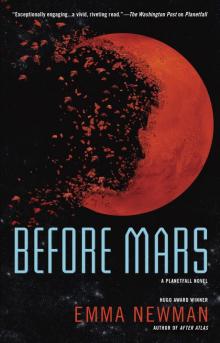
I don’t think I could have - or would have - written Before Mars without the experience of postnatal depression. But I don’t think that counts, as that’s not my writing changing, per se, rather the topic I would focus on. Perhaps I am being pedantic though. Has it changed the sorts of stories I tell? In the case of that novel, yes. But only that one aspect of the novel. I suppose I am far less likely to write a crime novel centred around something appalling happening to a child, but then again, I find it much easier to write about distressing things than to experience them through the consumption of books, TV and films. Probably because I’m in control of the narrative.
* I wrote tens of thousands of words throughout my childhood and early teens. It was all absolutely terrible, aside from, it seems, a short story that I wrote for my A-level English coursework which then secured me a place at university. But that is a whole other (and frankly, ridiculous) tale that would be too long to relate here! By proper writing, I mean the stuff I wrote after committing to really work at it.
Planetfall has aliens, the alien structure, and the elaborate setup of the flower that imparts a compulsion and knowledge/genius, apparently as a deliberate setup by some unknown agency but presumably aliens. The other books don't follow up on any of that. Did you intend to do so, or to leave those as ineffable mysteries?
I had other things I wanted to focus on more in the books I was given the chance to write after Planetfall, but I always intended to return to God’s City one day. Whether all of the more mysterious elements would be fully explored remains to be seen. Part of me feels they don’t need to be, as they have served their purpose. Another part of me thinks they’re cool and a rich vein to be mined. I’ll see what happens when I get there!
Who is your favourite character or characters to write?
Linda, the pathologist in After Atlas is the first to spring to mind! But I think I just really liked her as a person, and that is different.
I did enjoy writing the various APAs and AIs, just because it required careful thought. And writing the interactions between members of the established team in Before Mars was fun too.
As for a favourite? I don’t know... each of the protagonists were both wonderful and absolutely awful to write. Wonderful because they demanded so much care and attention, to ensure the portrayal of their mental health issues was presented as sensitively and authentically as possible. Absolutely awful in that each of them invited me to tap into some of the worst times of my life and dredge up all the hurt again. Each one disturbed my psychological silt in their own way, and that was hard to go through, particularly Before Mars.
Which character would you actually want to meet?
Oh, I think I answered that! Linda, the pathologist. I want her to be either an eccentric aunt who I can go to in times of crisis, or a best friend who gives me the confidence to do wild things.
Did you know from the start that there would be actual, self-aware AI?
Yes, from the start of writing Atlas Alone, if I recall correctly. Not when I started to write Planetfall some 4 years or so earlier!
It felt... inevitable? If consciousness in humans is an emergent property of having such complex brains, then why can’t the same happen for advanced AIs with incredibly complex hardware underpinning them? It’s a simplistic approach to the question of consciousness, but seeing as we don’t seem to have worked out how to even properly define consciousness in such a way as to be able to study it scientifically, I don’t feel too bad about it.
In your own mind, does printed food actually taste different from organic food, or is it indistinguishable and it's a totally psychological difference?
(This answer includes a discussion about eating chicken.) A few years ago I tried a new brand of crisps (chips, for my American lovelies) and it short-circuited my brain. Or rather, the artificial flavouring did. The flavour was roast chicken and thyme, and what really baked my noodle was how it really did taste exactly as described, but obviously with a texture that couldn’t be more wrong. It made me question the point of refining artificial flavours to the extent that they were that good at tricking my brain, only to put them on crisps that crunch and then soften in all the wrong ways for chicken!
However, I am absolutely certain that the artificial taste isn’t exactly right either. It’s a composite of the experience of eating roast chicken, I think, heightened and without the variety that is present in a real roast. Some mouthfuls are really infused with herbs near the surface of the chicken, some are not. There’s the other flavours in a roast dinner too, like the gravy, the vegetables, that have a huge impact on the experience of that meal, whereas the crisps only provide one sliver of it, unchanging and far too intense, bite after bite.
What I’m saying here, is that certain areas of artificial taste technology are already creating a genuine uncanny valley experience. Will they get better at it? Yes, I expect so, because there is profit in getting people to eat more cheap rubbish that tricks their brains into wanting more. And for that exact reason, I think that the printed food in the novels creates a similar experience to the crisps. The technology will be able to do more sophisticated things with altering textures (depending on how good the printer in that person’s price range is, because capitalism) to better match artificial tastes. Put a home-made lasagne made with real ingredients next to a printed one, and even the best quality printed food will not be as good (just a passable substitute, akin to present-day microwave meal versions set against a skilled cook’s lasagne made with fresh ingredients). I think the success of food printers will really rely on most people not being able to afford real food, and thereby have no basis of direct comparison. They will be evoking the memory of real food for some older people, and becoming the baseline for the younger ones. I think this is already the case nowadays for people (myself included) who only eat the processed versions of certain foods because they are so cheap and convenient.
Wow, that’s depressing. Sorry.
I really enjoyed the use of neo-pronouns for some of the characters. What was your driver for taking this approach?
When writing After Atlas, I did a lot of thinking about what the world could be like about 80 years from now if things continued down the path I could see we were on. This was before Trump, before Brexit (oh, those halcyon days!), and the thing I was most concerned about was the way that late-stage capitalism has pretty much destroyed any sort of decent, moral governance of populations. Business needs and the maximisation of profit is placed before any other concern. The TTIP trade agreement was being debated at the time, and I thought that if that went through in its most extreme form, it could have given corporations more powerful and robust ways to sue governments for access to resources (like water, and we all know how responsibly and ethically corporations are handling that now, right?). I could imagine a cascade of problems stemming from that, leading to the collapse of the state in many, many countries.
Anyway, needless to say, the future I envisaged using this logical extrapolation of a worse-case scenario was pretty damn bleak. I wanted there to be a sliver of light, a bit of hope that not everything was entirely awful. A bit like how even though in the UK we’ve suffered for far, far too long under a terrible government, somehow gay rights have been improved. So I thought that maybe the fight for better acceptance of gender identities beyond the male/female binary could have happened, and been enshrined in law.
Back when I was writing After Atlas, neo-pronouns were not being as widely used and discussed in mainstream media, and it felt like there was still a jostling and settling of what would become the default. In the real world, they/them seems to have become the most prevalent pronouns for non-binary people, but back when I was writing these books, there were lots of different pronouns being used (and still are, I hasten to add!). I simply picked the ones that appealed to me.
Human society and politics haven't progressed in a particularly positive direction in your books. The rise of gov-corps and so on all seems very plausible, but I was wondering if there have been any events or trends in the last few years that you see as pointing in a more positive direction and that might find their way into your future writing?
(Has another sip of tea, stares out of the window, sighs heavily.) There have been many, many positive things happening in the world in recent years, and they are easier to find when you go and look for them. The media only delivers the worst to our mental door and it is easy to let that steal hope from us.
I have a huge and personal interest in the upsurge of sustainable building, natural building, regenerative agriculture and ‘rewilding’ projects that do seem to be having a wonderful renaissance.
There’s a lot of genuinely wonderful technology being developed and rediscovered to help people. I’m thinking about the extraction of fresh water from the air, from fog nets to super efficient condensers that can be used in deserts. And the amazing creation and storage of ice in the desert (look up the yakhchal, if you’re curious!)
I was genuinely thrilled to see the Australians finally boot out Morrison, despite the grip that Murdoch’s evil empire has. And I am thoroughly enchanted with the energy and attitudes of so many teenagers campaigning for the environment and inclusivity of all genders and sexualities. More people seem to be questioning late-stage capitalism, and the growing union movement and increasing number of strikes here in the UK gives me hope too.
But.
But.
I find it very difficult to see a solution to the biggest problems facing us today with power structures staying as they are. I find it hard to get excited about carbon recapture projects when the banking and political systems actively fund fossil fuel companies and huge segments of industry to carry on pumping more into the atmosphere. The people who have the power to change things having no will, incentives, nor moral decency to start dismantling the structures that have made them too powerful and too wealthy. I see no political action within the current dominant structures that will ever address the rampant wealth inequality and wanton destruction of the planet they benefit from.
As for my future writing, having written several novels set in a particular dark timeline, I am choosing to turn towards the light. I almost feel guilty for having written—and potentially given a tiny amount of power to—the darkness of dystopia. I am feeling a huge need, nay responsibility (at the risk of sounding far too self-important) to write a vision of a better future, a way to avoid where we’re heading.
Science fiction is such a powerful genre, but it is far too easy to write about all the damage and horror that technology brings. And it makes sense; so many technological advances have brought terrible consequences with them, especially when unfettered capitalism, greed and corruption are added to the mix. All science fiction novels ever written are about the ‘today’ of the author, and their fears for the future. A rare few focus on the hopes, and I wish to join them. A better world really is possible, especially if we stop prioritising profit over people.
Okay, I’ll get off my soapbox!
A lot of the technology that the characters use day-to-day seem within the realm of possibility in the not too distant future. Putting aside the interplanetary travel which is more in the realm of sci-fi, how much of the technology detailed in the books is based on tech that is currently in R&D phase? What other tech is there in the Planetfall universe that we do not see.
Examples - the description of Carl and his boss in the car where it was explained that to self-drive a vehicle you need a special licence and the system would not let you self-drive during high traffic times. That seems very plausible. Similar to some of the tech from the movie minority report - just far enough to be futuristic but familiar enough to be realistic.
I am such a nerd and love reading about tech developments. A huge amount of the technology featured in the housing in Planetfall is synthetic biology technology already being developed, and was inspired by a talk given by one of the scientists involved in that technology, Dr Rachel Armstrong. I made some guesses about how it could develop in places, but it’s all within the realms of possibility.
A couple of years after Planetfall was published there was an article about the first human organ replacement being printed, which made me very happy. The possibility had been speculated upon for a long time before that.
Lots of 3D printed houses are being created now, after years of speculation. However, this year is the first time I’ve seen actual real world tech being used to 3D print houses out of local dirt excavated on the build site, instead of concrete. Now THAT really excites me! Truly sustainable building is a real passion of mine.
The neural chip technology is something that I could see happening one day, but it will take much longer than 80 years to get the sort of integration seen in the books. That was a bit of artistic licence I allowed myself. But again, the foundations of that technology have existed for some time. Deep brain implants have used electrical stimulation to improve the symptoms of Parkinson’s Disease for years now. Using similar technology for severe depression has also seen some more recent breakthroughs, as has using neural implants to enable people with locked-in syndrome to communicate. And alongside all of this, for years biohackers have been doing all sorts of things with chips implanted beneath the skin.
The only tech I haven’t come across an example of (which does not mean it isn’t out there, of course!) is the noise suppression technology mentioned briefly in passing in After Atlas. There’s a reference to it being used at the nice apartment block that Carlos lives in at the start of the novel. That mostly came out of me thinking about how technology could plausibly be developed to reduce noise pollution for the wealthy people who want the convenience and cultural vibrancy of living in a city, but don’t want the noise.
Lastly, the one big lie, science fiction speaking, in all of the books is the method of propulsion used for interstellar travel. We don’t yet have the ability to generate enough power from a fuel with low enough mass to achieve travelling those distances. Yet.
Did all countries become gov-corps? Did all areas use the bears for the kids to help them and create a digital history?
I cannot speak for every country in the world, as that is both outside of the scope of the books and outside of my understanding and ability to make plausible extrapolations of the future. Definitely the States, Canada, the UK, the majority of (present day) Europe and Russia.
As for the Bears, I see them being in widespread use in those same countries, probably more. And I don’t see them as a positive thing either. I envisaged them as tools of mass surveillance with just enough benefits to make people happy to have them in their homes and not think too hard about how all the data was used.
The evolution of gov-corps - in one of your short stories, you tell the story of a shipping employee stuck on an island all those years. When he is discovered and going to be rescued, the gov-corps sound good and not menacing. And yet, in the novels, the gov-corps have a more sinister feel. I suppose that is a combination of the evolution from a corporation just gaining power and trying to placate citizens to a corporation fully entrenched and also the personal experience of these complex characters ensnared in corporate slavery.
Yes, exactly. If you look at the evolution of pretty much all major corporations, they tend to become more greedy, more profit orientated, more geared towards making the owners and shareholders rich at the expense and exploitation of everyone else. I see no reason why they would stop doing that when they gain total power. After all, an incredibly pessimistic and jaded view would be that they are just like the most powerful corporations today who simply no longer need to lobby and... incentivise politicians. I guess they’ve cut out the corrupt middle man.
The non-human status. Need some more details about that. If Dee's family was as well connected and well-off as they seemed, why would they have no contingency of someone to take care of her? Wouldn't the gov-corps have some basic human rights as part of their charters? Taking care of orphans etc?
The non-person status is really just an extreme evolution of the current state of existing in modern day Britain or America. In those countries (and, let’s face it, many others), if you are unwilling or unable to generate income (assuming you do not have any inherited wealth or support), you will suffer. There are no ways for anyone to legally have their own shelter or means of obtaining food or water that do not involve paying somebody (and not only paying for what you get, but also paying enough for owners and shareholders to massively profit). The non-person status in the books is simply a refinement and streamlining of that pressure. Today, homeless people are either overlooked, ignored or actively punished by the state. When the ‘state’ becomes an entity that solely exists to generate profit, with no concerns above that and serving the interests of those with the most power, then people who are not generating profit (or at the very least earning enough to survive) become problems that need to be removed and put through a branch of the system designed to make them profitable again, namely hot-housing. There are other things that happen to the ‘non-persons’ who cannot cope with the process that Dee and Carlos went through.
Dee’s family were wealthy before the riots, but then her parents died and the system collapsed. Data was lost, sometimes genuinely, sometimes conveniently for the gov-corps. They may well have made a contingency (although many people die without wills in place), but when society collapsed and the gov-corps took over, there was no-one actively seeking out the people who fell through the cracks other than the forces taking people off the streets and processing them. It really is that bleak, and given the way the current British government is gleefully (and entirely predictably) using Brexit as an opportunity to dial back human rights as quickly as possible, I think it is sadly plausible.