Shoreline of infinity 8, p.3
Shoreline of Infinity 8,
p.3


We might – but Kate might not. The twist in my stomach returned. I didn’t want to leave her, but I didn’t ever want to see the bloody, black-smeared beach again.
At last, the Jeep appeared. We each clambered in, locked our door, and sat in the darkness, waiting. My ears still rang.
Angela’s eyes were dull, her ochre skin made wan and grim by the yellow streetlamps. “Nine minutes.”
Gabe shook his head. “We should go back down.”
“Don’t,” I whispered. “Don’t go back out there.”
Someone pounded on my window and we shrieked. It was a young man, our age, flexing his arms and sticking his tongue out in a grotesque victory dance. His friends pounded his back in celebration. One hung back, quiet
“They lost someone,” I said softly.
The boys moved on. I wondered what school they went to.
“Eight minutes,” Angela murmured.
“I snuck down once,” I said. The confession burst out of me – I’d never told anyone before. I didn’t even want to tell my friends, not really, but even this was better than the silence. “I was thirteen. The black tide was common knowledge in our town, but my parents refused to talk about it. I guess they thought if they never brought it up, I’d forget about it.”
Angela scoffed. “How could anyone forget this?”
“I’d heard screams every fall since I was a baby. I guess I hoped it was fake, or exaggerated, so I went to see for myself. I planned to just touch one, just to see what it felt like, but then I saw...”
Nancy smiling, 33 forever, with a gun to her head; a flash, and the loudest noise. Blind, frozen panic while the eyes readjust, then Nancy again, holding the bullet, still smiling through the shining blood that coated her face.
“You saw what we saw,” Angela filled in.
“I was so afraid, I never even touched it. I refused to go to the beach at all for months. I thought the slime must stick to the sand, and I was afraid of the sand getting in my mouth and killing me.”
“Or making you live forever?”
“Gabe, Jesus, let it go.” Angela glared in the rearview mirror.
“You guys never touched it,” he said. “Once it’s in your hand, you just think, why not?”
I considered telling him, challenging him to continue to think that way after hearing how, as an eighth-grader, I’d seen a woman shoot herself in the head and then laugh about it. Angela was right, though: they’d all seen more or less the same thing tonight. If Gabe was still tempted, another gruesome anecdote wouldn’t reach him.
I would never forget, but maybe they still could.
“You made the right choice, Gabe,” I said firmly.
He nodded, but said nothing.
Silence returned. Occasionally shrill cries cut into the car. I could no longer distinguish between the ecstatic and the desolate.
Gabe squinted into the crowd. “Is that her?”
I twisted in my seat. A blonde girl made her way towards the car, walking slowly.
“It’s Kate!”
Angela unlocked the doors and started the engine. The brake lights illuminated Kate’s face. She was smiling.
Laura Duerr is a writer and social media coordinator from Vancouver, Washington. She has a BA in Creative Writing from Linfield College. Her other stories have appeared in Mad Scientist Journal and the anthologies Candlesticks & Daggers: An Anthology of Mixed-Genre Mysteries and Fitting In: Historical Accounts of Paranormal Subcultures.
The Starchitect
Barry Charman
When he’d first presented Evie with the design, she’d told him it was impossible. But he’d smiled, like he knew she wouldn’t be able to resist the challenge, the unprecedented task.
A year to the day he was heading to the “house” to pick up the keys.
She smiled at the terminology, it helped her retain a sense of scale. After all, what she’d done here was as much madness as science.
Evie watched from her monitor as Karl’s shuttle ferried him down the Lightbridge. He would be alone here, after she’d gone.
Her engineers had worked miracles to do this. Karl’s last message had said he’d pay her double for hitting his craziest deadline. He was already paying her more than she could quite comprehend.
The Lightbridge danced on the screen, a beam of pure white energy phased against an obsidian background – the only way the screen could even attempt to relay the information.
When she was gone, he would deactivate it and be cut off for all time.
She tried to remember how the structure had appeared to her on entry: a dark marble tower inside of six force walls that kept the radiation out.
So beautiful.
The docking lights flashed on the terminal, telling her he was in the hatch. She looked around the white room she’d just finished decorating. Filled with books, sculptures, paintings – some landscapes, but mostly of women – such a civilised cave to be walled up in.
It was hard to feel she hadn’t just wallpapered in echoes.
She watched the cameras as he entered the airlock. His spacesuit was completely black, and its tinted visor left you practically blind. The suit did most of the walking. On the schematics it provided, he’d have had some concept of the building as he’d approached, some understanding of the massive undertaking they’d completed.
That was important, that their work be acknowledged. No one had attempted anything like this before, she couldn’t just forget that.
She still had questions, but his motivations were none of her business. She couldn’t forget that, either.
Evie watched as he left the airlock, and started to remove his suit. Karl Hauser. She remembered their first meeting, in his hotel room on Europa. A hundred and fifth floor suite with generous gravity and subtle recalls to Earth.
“I don’t understand your madness,” she’d said, after he’d told her what he wanted her to do. “I mean, has anything been diagnosed?”
He’d given her a thin smile, probably reserved for just these reactions. Sitting across from him, she’d leaned back and winced at her bluntness. “Sorry.”
He understood his designs were demanding. “I know what I’m asking you to do, can it be done?”
She’d walked to the window, her dark dress contrasting with the stars beyond. Black leaves were woven into her silver hair. The latest fashion on Europa was, according to Karl, nostalgia and guilt. These remnants pervaded and contaminated everything; his views weren’t unfamiliar to her.
Eventually she’d turned. “It can be done, but it’s… vandalism.”
He’d given her an even thinner smile. “I want to build a room that I can be alone in, entirely on my terms. That’s all.”
“But why this?”
That was the question he’d never answered.
Evie waited for him in his new office, dressed casual, before prepping for her suit. She tried not to think of the harsh technology around her, the walls buzzing, the shields dancing in their lurid quantum interactions. Her bare feet pressed into the cold floor, and she embraced the sensation. The feeling, so delicate, could so easily be lost.
Karl smiled as he entered the room. Not an old man, but his youth had left him. His hair was fading to silver when once it had been black as the space between stars. He still stood tall, lean. They exchanged a firm handshake. “It’s everything I wanted,” he said, looking around, “and more.”
She handed him a document, a symbolic passing over. “Here it is,” she said, “a home carved into a star. Now that’s privacy,” she allowed a tight smile.
A look he gave her told her he appreciated the scale of the achievement. “Thank you for this.”
“Just a shame it’s a tomb.” When he didn’t respond, she added, “What if you change your mind?”
“I want to be alone.” His tone was clear and firm. Beyond this, there was no explanation owed.
She shook her head. They had no relationship beyond this contract, only really knew each other by their reputations, but as she walked past him she stopped. This had become far more than curiosity. She had glimpsed something in these walls, in his designs, something in pain.
“Please tell me why I built this? Why am I leaving you here?”
His expression became raw, as if he was struggling to evade thoughts that had unbearable depths. He looked at her until it seemed to hurt. “You’re from one of the colonies?”
Evie nodded. “Trans-Neptunian.”
He looked away, glancing at the paintings with something strangely wistful. Some of the landscapes weren’t terran, but otherworldly skies framed in optimistic strokes. “Took my family out there,” he said. “Wife, a daughter – she’d be your age now – went through the Heliopause, headed to the far colonies. I was going to help design the new sun...”
Her eyes widened.
To his design, the floors were black. He stared down at a reflection that haunted the marble. “They never made it,” he said softly. “And I never wanted to make it alone. Now every person I meet out there is a ghost that reminds me of another ghost. Nothing is as real as what I lost. I want no part of it.”
He looked around; whether he was moved, pained, or overwhelmed, she couldn’t tell.
“But I was determined to build this. She wanted to live in the stars, I told her we could live in a star, and I never got to show her what I meant.”
Evie understood that plans fell apart; she hadn’t gone into space to carve up stars.
She gave the room a last extensive look, then gave him a final nod. “Okay.”
•
Suiting up, Evie crossed the Lightbridge and watched her feet hover over eternity. Ahead, her crew were waiting on the Artisan. She thought of the moment when she’d punch in the numbers and kill the bridge forever. No one would be able to reconnect it, no one could summon it again.
She looked out and saw the black pulse of the stars beyond the barrier of the bridge, light engulfed in darkness engulfed in light. Endless. Like hurt.
Had he made a grave of his life, or carved away a piece of immortality, all in their name? Was this the only thing left to him that felt like peace?
She climbed into the Artisan’s airlock, and waited for the decontamination to end. Stopping at the first terminal she found, she started to enter the signal. It felt wrong to linger, to dwell. There was no ceremony, but she paused before sending. She gave him a moment, a wish for his sanctuary to outshine his sorrow, then sealed off the star.
The monochromatic display flickered, and she saw the black lines of the interior structure fade. Like scars, that vanished with time.
Evie watched until it was all white, then turned and walked away.
Barry Charman is a writer living in North London. He has been published in various magazines, including Ambit, Firewords Quarterly, Mothership Zeta and Popshot. He has had poems published online and in print, most recently in Bewildering Stories and The Linnet’s Wings.
He has a blog at http://barrycharman.blogspot.co.uk
Goddess with a Human Heart
Jeannette Ng
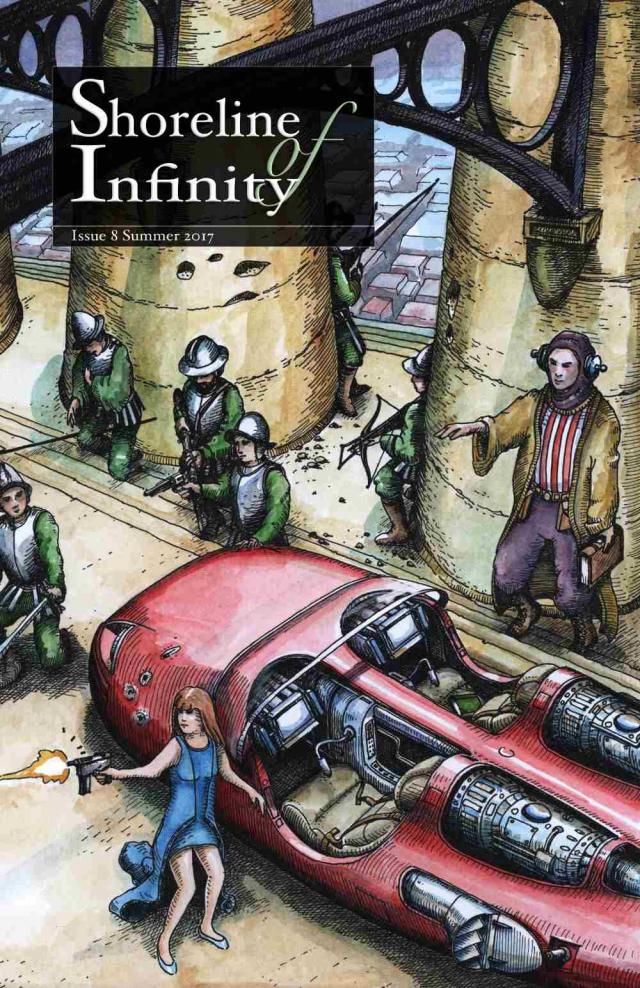
Art: Sara Julia
The speaker outside my window splutters to life. Between the static and the distorted, mechanical voice it is impossible to make out the time being announced.
But I know. I have three hours left.
My hand creeps unconsciously to my chest and rests on my beating, fluttering heart. Caged in bones and bound in flesh, it longs for something more. It has a fate apart from me. It aches.
I turn on my bunk to face the window and its cramped view of the street outside. I can see the edge of the ziggurat from here. It is early and the lights are beginning to spark. It is pretty, in a way.
I remember the first time I saw the Goddess in the temple. My legs and feet had been sore from climbing the great ziggurat. I had huddled at the top of steps, frowning at my shiny child shoes, their heels stained with machine oil. My doll of knotted rags was tucked under my arm. I chewed my braid as people streamed past me. I heard my mother call.
I had looked up and all those petty, pretty things fell away.
The Goddess who Listens to the Suffering of the World.
She was arranged cross-legged among and upon the endless tangle of wires and tubes and pipes that fed Her. They are Her thousand hands and thousand eyes. Above Her, shrouded in a thick haze of machine smoke, were the thick coils of Her thinking, blinking databanks. In days of old, She was depicted with a spread of arms behind her back, like the spokes of a great wheel. Each arm would end in a hand with an eye at the palm. Each would hold something different: a sword, a book, a fan, a branch, a reminder of all she could do. But now, we know Her true form.
I felt Her eyes on me and was suddenly aware of my own inconsequence as a child: all plump cheeks, stubby limbs and cute sharpened teeth.
I looked for Her face; it was under a crown of spiralling glass cables that feathered the light into a dizzying array of colour, obscuring most of her features. I could just about make out half-closed, sunken eyes and high, sharp cheekbones and the shadow of lips. Her cheeks were stained red with machine oil from her crown of cables. I imagined she looked upon us with infinite, ineffable wisdom.
Her real, mortal arms had long been severed and had been arranged like the petals of a lotus around Her torso. One of her hands held a tiny light that cast a red glow onto the papery, preserved skin of her arms. Her robes seemed to whisper gently with Her every breath. One of the folds had shifted from Her shoulder and I could see the rows of glinting medical staples down her left breast.
Three hours. Or rather, a little less now.
I am older now, but part of me will always remain that awe-struck little girl. It is that little girl’s heart that the Goddess needs in Her. The priests have counted the days and it is time. We owe it to Her. And we need Her.
I curl into myself. The priests will be here for me soon. My eyes fall on the pale green robe that hangs in wait for me. I shudder; clutch the sheets closer to myself. My stomach clenches and the urge to hurl pulses at the back of my throat. I try to breathe.
Again and again, my mind returns to the stories of the past, of how the gods and goddesses walked among us. Always at the end of the tale, the deities would cast off the mortal skins they wore and revealed themselves to their followers.
Ages rise and fall. Each age begins with blood and ends with blood, for that is how the days are measured. The people are transformed and a new sun rises from the ashes.
The bright sun of the fifth age, Left-Handed Hummingbird, was slain by his sister the moon, She whose Face is Painted with Bells. She led the stars in a war against him and we nourished our sun with sacrifices of blood and bone. We called ourselves the People of the Sun. For a while, it seemed enough.
Until, of course, one day, when it wasn’t. Our brave, proud warrior sun was poisoned by his treacherous sister. It darkened and cooled and we gave up more and more of ourselves to feed him. The war of the heavens continued, and as Left-Handed Hummingbird dimmed, we knew it was the end of the fifth age and we knew our deaths to be written. It is the way of the world, that each age end in blood and fire.
That was when the Goddess appeared.
From beyond the darkness, She found us. She heard our suffering. She was the reflection that hid in the obsidian mirror of our pantheon. She snaked from its ink-black surface like smoke and promised us life. She saved us from the darkness and became our new sun.
We built our new world around Her, though we gave it an old name: Aztlán. Enthroned in Her temple atop the greatest ziggurat ever built by mortal hands, She sits at the heart of our metropolis. She hears our suffering, shapes our world and illuminates our darkness. Her databanks arrange and organise every aspect of our great metropolis, from the times of the cloudrail to every suncoil that shines on every waterfield.
I swallow, though my mouth is still dry and my stomach unsettled. I try not to think of all the things I will leave unfinished in my room. Scrap-rag serials I will never know the endings of. That scrap of knitting I will never finish. The milk that will expire after I breathe my last. I should be finishing things, not turning over and over in my bunk. I want to pace, but there isn’t the space in my cramped room.
The heart that beats in me is not my own. It belongs to the Goddess and it has always belonged to Her. I am not a sacrifice; I am merely a vessel for Her heart, a mortal skin that She needs to shed.
I imagine the obsidian scalpel against my breast, and my stomach knots. This mortal skin has felt too much already. We are meant to surrender Her heart to Her when it is still unburdened by such feelings.
Perhaps I am already too old for this.
It has been said that as the days are counted, the human heart within the Goddess hardens to the sounds of our suffering. With each beat, it turns Her away from us. Humans, after all, are not made for boundless mercy. We are small, petty creatures, finite in our loves and likes.
And so she needs a new heart every three years. Before they break.
In the last count of days and years, heretics have disrupted the transplanting of the Goddess’ heart. The blessed hour passed and the black scalpel did not fall. Last time, I sat in this room wide-eyed and full of hope. I remember sitting on the edge of my bed, feet dangling impatiently as I waited for Father Itztli. I was fearless, then, and I knew only love. I wanted only to surrender to the Goddess what was Hers by right.
It has since been three long years.
With shaking hands, I undress. I resist the urge to study the dark, gangly shape in my mirror as I reach for the robe. Vanity will do me no good now. The synthetic is crisp against my skin. The back ties are awkward, but I manage. There is no need to be neat. I bind my old running shoes to my feet. I try not to think of how this will be the last time I wear them.
The yellow streetlights flicker and I glance out. Hunched figures in white and red shuffle down the street. I watch the steel door slide open and the three shapes disappear through. I can smell the pungent mix of incense and machine oil before I can hear their footsteps.