1635 the papal stakes as.., p.36
1635: The Papal Stakes as-15,
p.36
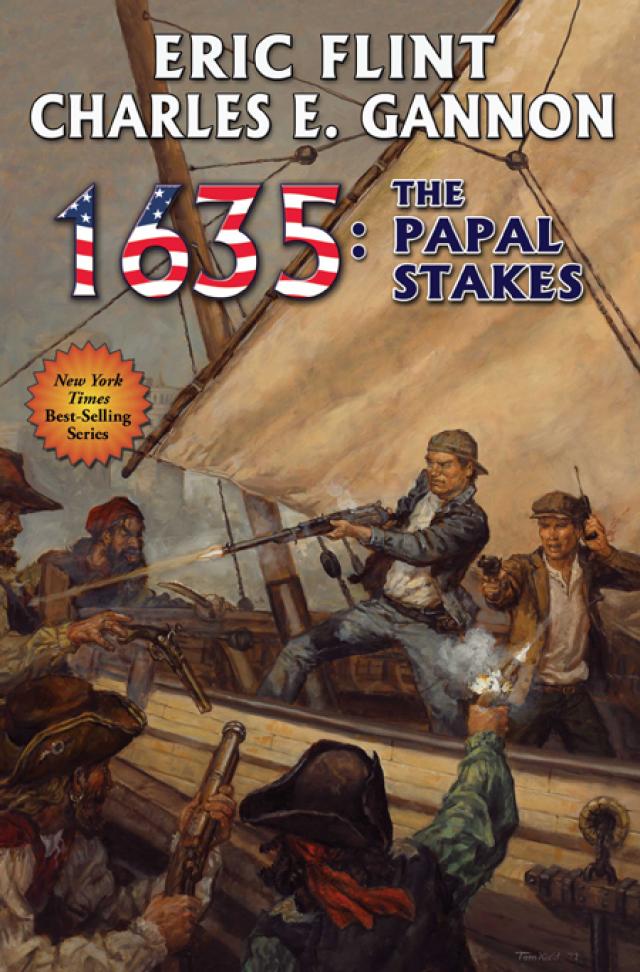


Owen came out of the courtyard at a sprint, right behind the wounded Piero. He turned as he exited, grabbing a handful of what was left of the doors and pulled them shut: felt the thud as two musket balls hit them a moment later.
Owen turned-and found himself facing a cavalry charge.
Jayzus! “Fire what you have!” he shouted to the clustered Wild Geese. He raised his pistol and started squeezing off rounds. The sustained barrage from their pepperbox revolvers slowed the charge, the riders clearly baffled to encounter so steady a volume of fire from such a small group. But they came on, even so.
The next ten seconds seemed longer than most days Owen had lived through. Caught in a whirl of horses, blazing guns, and falling bodies, there was no time to give orders or even think. Owen dodged, fired, lost his grip on John, fired again, which sent a horse tumbling toward him. He scrambled away, saw a Spaniard loom out of the smoke and chaos, pistol raised, hammer falling. A flash, a boom-and Synnot, who was still close beside him, carrying John with one arm, went down with a bullet through his forehead. Owen brought his own gun to bear, fired back, and missed. But even so, the Spaniard spilled out of his saddle, albeit in the opposite direction from what Owen would have expected.
It made no sense, but Owen had no time to be puzzled; having spent the last three shots in the cylinder, he let the pistol fall on its lanyard, ready to draw steel. But, through the smoke, he saw the last three Spanish cavalrymen had already reversed, leaving five of their number behind. Only now did Owen register the more distant shots he had missed hearing during the melee, and which probably explained the mysterious demise of the last Spaniard he had faced. The rifles of the Hibernians and Harry had come to their aid like angels-angels of death, of course, but angels nonetheless.
He turned, looked for John, and discovered him pinned beneath a horse, inarguably dead. Probably had been from the first shotgun blast that had ripped down through his body. Only sheer animal vitality had kept him going after that.
Owen reached out, took a firm hold on the earl’s traveling cloak, just below the embroidered pattern of the Tyrones, and yanked hard. And again. On the third try, it came free, and clutching it as he waved his remaining men into their retreat, Owen wondered for whom have I taken this cloak? Who is left of the line of the O’Neills who might justly receive it? And if there are none such, then what good is it at all?
For more than a man named John O’Neill had died in Rome that night. Half the hopes of Ireland had expired with him.
Harry sighed, glad to have saved Owen-anyone-out of all this mess. He had just started thumbing fresh rounds into his empty rifle when the figure of a dark-cloaked man-not much more than a speck, since Lefferts was not using the scope-emerged from the ranks of the of the Spanish foot and walked up behind Juliet. For a moment, he stood very still, watching her drag her broken body away. Then, looking first toward George, who had been tackled by the rest of the Wrecking Crew, and next, vaguely in the direction of Harry himself, he took a step forward. The man drew a revolver, large enough to be the one that Lefferts had seen in Frank’s bar, and shot Juliet in the back of the head.
Then the dark-cloaked man stepped back into the ranks of his soldiers. For they were clearly his soldiers; they parted before, and then closed around, him like a sable tide making way for whatever power had conjured it in the first place.
Even as George screamed wordlessly at the now-steadily approaching Spanish infantry, Sherrilyn grabbed both his cheeks, hard, and pulled his face down to look at her. “We need you,” she shouted.
If it wasn’t for the two Hibernians with the lever actions, she was pretty sure they’d all be dead by now. But those long-range rounds had struck down so many of the foot soldiers’ lead rank that they had scattered into the lee of the buildings for cover. Facing this fire immediately after watching their cavalry cut apart by the revolvers of the Wild Geese, the renowned Spanish infantry had apparently decided against making any headlong rushes. Yet.
“George, listen. You have to carry Felix,” she lied. “You’re the only one strong enough. He needs you.”
“Juliet needs me, she-”
“No. She doesn’t. Not anymore. Here’s Felix: carry him.”
Harry stared at the ruin of the plan that he thought, at first, had come together. But instead, it had come apart. The Wild Geese were leap-frogging to the rear in fire teams of three. Sherrilyn had hoisted Felix onto George’s back, who seemed bowed, like a tired draft horse about to drop in its traces. Piero was keeping what was left of the lefferti moving together along the streets that lay between the Spanish and the Crew’s main line of retreat, thereby serving as a flanking screen.
The boy that Harry had sent with Benito to spread the withdrawal orders came pounding back up the stairs. “Signor Lefferts?”
“Yes?”
“You must go.”
“Yeah, I was just about to stroll on home. Where’s Benito?”
The boy made a face. “He got shot. Not killed, though. Not yet, anyway.”
Harry’s jaws tightened.
“Any orders?” the boy asked.
“Orders? For who?”
“Why, for me, sir.”
“Yes. Here are my orders: run like hell. Then get lost. And don’t get found.”
Thomas North looked over at Sean Connal for the fourth time in as many minutes. “That’s too much gunfire,” he opined. “Too much, for too long.”
“So you’ve said. And so I’ve agreed.”
North stood. “Then I’m retasking this force to provide a base of covering fire for a retreat.”
“We need a diversion. If Borja has any forces waiting here in the Trastevere, we’ll need to draw them away from the Crew’s path of retreat. We’ll also need to keep them busy long enough so that they miss detecting and following these boats-or we will never get out of Italy alive.”
“Excellent points. I hope you have an equally excellent plan.”
“It just so happens I do.” North turned to the one lefferto who had been left with them. “You. Are there abandoned houses in the north side of Trastevere?”
“ Si. Many. I know of one near the Via Aurelia-”
“Fine. Now take this. It is an explosive. You understand that? No? Hmm, let’s try a new approach: this box goes BOOM! Now do you understand? Excellent. Take this to the house you mentioned. Light this fuse, like so. And then run away as fast as you can. Do not stop until you hear the boom. Then find a hiding spot, get rid of all your lefferto rubbish, and walk away.”
“Why? I am proud to be a lefferto and I will not-”
“You will be dead if you do not do as I tell you. The attack has failed. The Spanish will find many dead lefferti. They will search very hard for the rest. Do not be stupid. Get rid of the lefferti clothes and doo-dads and do not look back. Go into hiding for a week, at least. Can you do this?”
“ Si. I-”
“Excellent. Go. Now. Dr. Connal?”
“Yes?”
“You stay here with the boats.” North held up a hand. “No complaints. Someone has to guard our ride home.” He turned to his own men. “You two come with me. I suspect our rifles will be needed to help Captain Lefferts with his fighting withdrawal. Which, if my ears don’t deceive me, is rapidly approaching.” He scooped up one of his favorite up-time toys-an SKS semiautomatic carbine-and ran toward the Ponte Cestia at a crouch.
For one terrifying moment, as new gunfire crackled out over the Tiber behind him, Harry Lefferts feared that the Spanish had boxed him in. That they had somehow known he planned to withdraw by boat after traversing the Isola Tiberina and had therefore put a blocking force at the bridge.
But the steady fire was coming from Thomas North’s anchor watch. The Limey had apparently pulled his team forward. As Harry reached the Ponte Fabricia, he dropped to a knee and reloaded his Remington for the third time. He looked up intermittently to wave the rest of the Wrecking Crew past him, then the Hibernians, and then the Wild Geese. By the time Owen Roe came along, bringing up the rear, having expended the last of his ready pepperbox cylinders, the Spanish had started closing the distance. They were getting bold again.
Despite the fading light, the early moon showed Harry a good target at just over fifty yards: a foot soldier whose slightly heavier and more weapon-festooned outline suggested a senior sergeant, marshalling the advancing troops. Harry raised his rifle, ignored the incendiary throbbing in his shoulder, let the crosshairs float down to settle on the silhouette and squeezed the trigger. He did not wait to see the result; he simply turned and ran.
As he passed North and his men, there was a loud explosion in the distance, somewhere in the north of Trastevere, from the sound of it.
Harry continued to run until he reached the boats. Thomas North and his two Hibernians were already close behind him by the time he got there. They jumped over the sides together. Waiting hands grabbed them while others-white with clutching poles and oars-pushed the shallow-bottomed punts off and out into the swifter current. As the oars started to creak in the locks and the boats picked up speed, Harry looked back over his boats and the city.
In his own boat, Owen Roe O’Neill sat in the thwarts, empty-eyed, clutching the bullet-tattered cloak that had belonged to the earl of Tyrone. George Sutherland was alternately weeping and laughing. Matija, the bleeding from his arm wound staunched, watched with dull eyes as Dr. Connal moved away from Felix and sat next to Harry.
“Let me look at that shoulder, Captain Lefferts.”
“I’m just Harry, Doc. And I can wait. Finish up with Felix, first.”
“I have finished. He’s dead, Harry.”
The pain as the doctor started cleaning the shoulder wound was welcome. Resisting that pain made it easier to resist the deeper, sharper agonies that were cutting down into his soul. Gerd. Juliet. Felix. John O’Neill. Several of the Wild Geese. Most of the survivors wounded. And scores of rioters and lefferti littering the streets of Rome. Their jaunty hats trampled. Their faux sunglasses shattered.
Harry reached into his chest pocket and drew out his own sunglasses. They were the ones that had given birth to, and had become the trademark of, the myth of Harry Lefferts: commando, ne’er do well, adventurer. And above all, a man who could not be beaten. He looked at his own, distorted reflection in the glasses, ghostly in the fading light. Unbeatable. Uber cool. Yeah, right.
Harry snapped the glasses in two and threw them into the Tiber.
PART FOUR
June-July 1635
And plunged in terror down the sky
CHAPTER THIRTY
Cardinal Gaspar de Borja y Velasco actually clapped his hands once in sharp, exultant glee. “Senor Dolor, this is excellent news. And we owe our victory, it seems, to your excellent stratagems. Which you must explain to me: how were you able to defeat the Wrecking Crew when no one else in Europe seemed capable of doing so?”
Dolor shrugged. “By giving them what they expected to see. In every particular.”
Borja frowned. “More detail, please, senor: I am not a military man.”
Truer words were never spoken-particularly by you, red hat. “Your Eminence, you may use simple traps to catch simple beasts; a bit of food left dangling over a pit will capture most unwary predators. But Lefferts and his Crew were not unwary predators; like foxes, they were inherently wary of traps and ploys-having used so many themselves.
“So, in setting this trap, I was mindful that we had to create the illusion of a reasonable defense, but with a few subtle flaws that they could exploit.”
“Such as?”
“Such as their belief that we had only a third of the troops that we actually had stationed in the insula Mattei. To create that illusion, we had to mimic-in every detail-what an undermanned garrison would do. In this case, that involved denying casual access to the interior of the insula, thereby concealing our supposedly scant numbers. But careful observers would detect other hints of insufficient forces: our victualing from sutlers was sufficient for only one-third of our men. To make that possible, we had to stock the insula weeks beforehand with enough food and drink to supply the other two-thirds of our men for three months. So the Wrecking Crew drastically underestimated our true strength.”
“Also, the second story of the courtyard of the Palazzo Giacomo Mattei was the only site in the entire insula where it would be reasonable to house prisoners, and yet have them visible to the outside. Had Lefferts not been able to see his targets ahead of time, he would either have had to cancel or mount a general assault.”
“Which we would have crushed,” Borja asserted with chin raised.
“Yes, but with much greater cost to us, Your Eminence. It was essential to make Lefferts confident that he would be able to succeed with finesse, rather than brute strength. I do not think a brute strength approach would have worked in any event, but we could be sure of this: if the Wrecking Crew had resolved themselves to the idea that they could only succeed through direct, massive destruction, they would have been far more dangerous to us. Look what they did to the Tower of London. So I gave them a scenario in which it seemed reasonable-quite reasonable, in fact-to believe that they could achieve their objective by finesse. This is particularly attractive to the up-timers, who show marked concern with the amount of peripheral damage-and therefore, civilian casualties-they might inflict.”
“They are contemptibly stupid,” put in Borja.
They are excessively moral-a distinction you will certainly not perceive, Borja. “Whatever the reason, preventing unnecessary casualties is a routine component of their modus operandi, Your Eminence. And we counted upon it here. Sure enough, perhaps a week before Lefferts’ attack, we began to notice careful movement within and around the belvedere. We set up long-barreled wheel-lock rifles in the shuttered rooms of the courtyard’s loggia, each weapon mounted in weighted braces and held fast by vises. This ensured that their aim points remained constant unless we changed them.”
“You used them almost as if they were artillery pieces.”
“Your Eminence understands perfectly. From prior tests, we knew exactly the elevation and charge required to hit the belvedere, and had some reasonable wind indicators that the enemy would not notice. Unfortunately, one of our snipers was also killed.”
“Truly?”
Dolor shrugged. “Every gun flashes when fired-and if you are looking straight down the barrel when it flashes, it is only logical that its operator’s head is leaned over that barrel. So, if one aims a bit above the muzzle flash-” Dolor saw a shudder move through the cardinal. “As I said, the up-time tools are not to be underestimated. Nor are their operators; they are superbly trained and very disciplined.”
“It sounds as though you admire them, Senor Dolor. I hope I do not need to remind you that-”
What could be more tiresome than the pious indignation of a hypocritical cleric? “I am not a man much given to admiration of anyone or anything, Your Eminence. But I recognize capability when I see it. And I acknowledge it freely. That same clarity of perception, of understanding all the strengths and weaknesses of my enemy, was what delivered them into your hands last night, Cardinal Borja.”
Borja fell silent, eyes bright but not friendly. Dolor wondered: had he let some of his carefully controlled impatience edge into his tone? Or had the insufferable red hat simply bristled at being interrupted, even if only to reassure him?
“It seems your dispassionate methods are effective,” was Borja’s only response. “And yet it was still not enough to kill Lefferts. Are you sure it was he in the belvedere?”
Dolor shrugged. “It is hard to be sure of anything one does not personally witness, Your Eminence. But all conjecture points towards it. From the neighboring Jews we have already subjected to questioning, they had agreed to rent the roof of this tower to a man answering Lefferts’ description, although they were originally approached by lefferti — ”
“Verminous traitors,” supplied Borja.
Dolor did not understand how Romans working against the occupiers of their own city could reasonably be branded as “traitors,” but he pressed on. “However, even without those confessions, the belvedere was a logical location for Lefferts. From there he was able to send the signals that started the attack, initiated supporting fire from other persons with up-time rifles, and indicated it was time to withdraw.”
Borja waited a moment before his next comment, which sounded more like an accusation. “So, Lefferts escaped, although he is probably wounded. Indeed, I find it hard to understand why any of them escaped at all, Senor Dolor. Why did your wonderful plans not succeed in this particular?”
Dolor shrugged. “Because the attackers were smart enough not to depend upon any local resources when they infiltrated back into Rome. According to our informers, the Wrecking Crew did not inform Duke Taddeo Barberini’s court at Palestrina of their return, much less request assistance from that quarter. Nor did they depend upon lefferti to get them into Rome, for even if the lefferti are loyal, they would have had to make arrangements with other Romans, some of whom would surely have been on our payroll. Instead, Lefferts entered Rome in such a way that he did not need to inform anyone else ahead of time, and his group immediately went into hiding with the lefferti. This meant we had no information as to their whereabouts beforehand, nor any way to determine how they planned to exit the city after the attack. I surmised it would be by boat, but that did not help us very much. Without more precise information, we would have had to have set far more pickets along the Tiber-which would have shown the Wrecking Crew that we were expecting them.
“They also had a force armed with up-time weapons covering their withdrawal over the Ponte Fabricio, as well as diversionary explosions in Trastevere. Taken together, this significantly delayed and confused our pursuing forces. As I said, Your Eminence, even in defeat, the up-timers and their handpicked allies are not to be underestimated: they are far more accustomed to this style of warfare.”