The kid clips a coupon, p.1
The Kid Clips A Coupon,
p.1
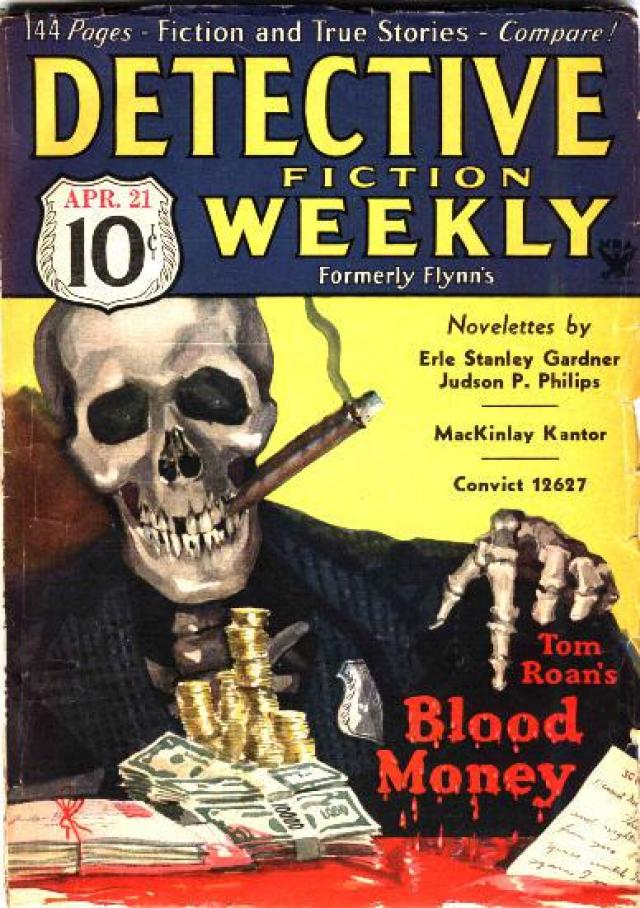


The Kid Clips a Coupon
Erie Stanley Gardner
I - The Clue of the Jam
Dan Seller lounged in the big chair and listened as Police Inspector Phil Brame recounted the circumstances of the crime for the edification of the small group of cronies who frequented the choice corner of the club.
“Just a plain case of murder,” Inspector Brame was saying, “and a bit of strawberry jam is going to send the guy to the chair.”
“I don’t think Dan Higgins intended to commit murder when he broke into the place. Mrs Morelay, paralyzed from the hips down, was in the living room, seated in her wheelchair, going over a bunch of account books. Higgins broke in to get some food. Mrs Morelay heard him moving around in the kitchen. There was a telephone attached to her wheelchair. She called police headquarters and reported someone in her kitchen, stealing food.
“Higgins heard her telephoning. It sent him into a furious rage. The man was a hungry. He dashed into the room and split the woman’s head open with a hatchet he had picked up in the kitchen. Then he helped himself to food. He spread some homemade strawberry jam on a slice of bread and ate it. He spilled some jam on his necktie without knowing it. He had gone less than a block from the place when the police radio car came along.
“Higgins looked like just the type who would be stealing food-a half-starved chap with clothes that were pretty much the worse for wear. Our men stopped and picked him up on suspicion and then went to the house and found that murder had been committed. Higgins denied he’d been near the house, and he’d evidently learned his lesson about fingerprints, because there were no fingerprints on any of the stuff in the kitchen. The police found a pair of dirty gloves in his pocket. Evidently he’d worn those while he was eating. But there was strawberry jam on his tie. The jam was analyzed. The amount of sugar it contained was carefully noted by the police-chemists, and then an analysis was made of the strawberry jam in the jar in the sink. The jam on the tie Higgins was wearing at the time of his arrest came from that jar of homemade jam.”
“Wasn’t there someone who saw him leaving the house?” Renfroe, the banker, asked.
“Yes,” Brame said. “Walter Stagg, the man who acts as manager for Mrs Morelay, drove up to the house in his automobile. He arrived there almost at the same time that the police did. He was just coming up the cement walk when the police car rounded the corner. He said that he had seen Higgins coming around the back of the house, as though he had either slipped out of a window, or had been snooping around the house. Stagg said he intended to unlock the front door-which was always kept on a night latch-and see if anything was wrong. If anything was missing, he was determined to jump into his car and follow the man until he could notify a policeman. Stagg was unarmed so he didn’t want to encounter an armed crook unless he had an officer handy.”
Bill Pope, the explorer, stared steadily at the curling smoke of a cigarette.
“It seems strange,” he said, “that a man would have gone ahead and eaten heartily after having committed a murder, particularly the murder of a helpless old woman who had done nothing to injure him.”
“She telephoned for the police,” Inspector Brame said. “Don’t forget that.”
“But,” Dan Seller pointed out, “if that was the motive for the crime and the man knew she had telephoned for the police, he’d have been doubly foolish to have murdered her and then gone on eating, knowing that the police were on their way in a radio car.”
Inspector Brame’s face flushed.
“More of your amateur detective stuff,” he said. “It’s an easy thing for you wealthy young coupon-clippers to construct theories proving that the police are always wrong. Doubtless, an attorney for the defence will try to bamboozle a jury into believing the police got the wrong man. But he won’t be able to-not with that strawberry jam on the man’s necktie.”
“Was there,” asked Bill Pope, “robbery as well?”
“Apparently not. Higgins had nothing in his possession when he was arrested. He might have taken something from the body and buried it somewhere in the vicinity. She was supposed to have a large sum of cash money which she always kept on hand, but there wasn’t any money found on her body.
“Higgins was wise. He didn’t leave a single fingerprint. We fingerprinted everything about the body, and didn’t find a thing. The books that were open in front of her didn’t have a single fingerprint on the page other than the prints of Walter Stagg, the manager, who kept all the books and submitted them to Mrs Morelay for examination.”
“Perhaps a draught of wind might have blown one of the pages,” Dan Seller said. “Did your men take prints on the other pages to see if that had happened?”
“As it happens, my bright young man,” the inspector said, “we did that very thing, although we didn’t need to, because when the woman’s skull was split open, blood spattered upon the pages of the open account book, and we had no difficulty in telling what page was in front of her at the time.”
“Very clever detective work, inspector,” Renfroe, the banker, said. “Undoubtedly the man will go to the chair on the strength of that strawberry jam.”
“Mrs Morelay was wealthy?”
“Quite wealthy. She leaves no will. The property goes to a niece, Tess Copley. She’s the only surviving relative.”
“Live here in the city?” Renfroe asked.
“Yes.”
“They found the weapon with which the crime was committed?” Bill Pope inquired.
“Oh, yes, of course. It was there in the room. There could be no question about it. A bloodstained hatchet that had been taken from the kitchen.”
Bill Pope’s clear eyes surveyed Inspector Brame.
“You should feel pretty happy, inspector,” he said, “but you seem to be down in the dumps.”
Inspector Brame sighed.
“It’s that damned Patent Leather Kid,” he said.
“What about him?” asked the explorer.
“He’s been meddling again. The man is a crook, a gangster, a public enemy. And yet, he appeals to the public. He tries to pull some of this Robin Hood stuff, and the people fall for it. Slowly but surely he’s becoming a public hero, and he’s making the police appear ridiculous.”
“Why don’t you catch him,” asked the banker, “and put him away?”
“Have you,” asked Bill Pope, “got anything definite on him? His methods are irregular, perhaps illegal, but can you get him on any specific felony and make it stick?”
Inspector Brame’s voice was ominous.
“Listen,” he said, “when we get that guy, we’ll make something stick. Don’t worry about that. I wouldn’t want to be quoted publicly on the thing, you understand, but that fellow has been a thorn in the side of the Police Department long enough. It wouldn’t take very much framing to pin a good murder case on him.”
“Don’t you think framing him for murder is pretty steep?” the explorer asked.
“Well, perhaps not for murder,” Inspector Brame said. “I was speaking impulsively. But I can promise you this, that if we ever get our fingers on The Patent Leather Kid, he’ll go away for a long, long time.”
Dan Seller arose, yawned, and took a cigarette from a hammered silver case.
“Referring to that murder case once more, inspector,” he said, “didn’t Walter Stagg agree to notify Tess Copley, and fail to do so?”
“Notify her of what?” the police inspector asked.
“Of her aunt’s death.”
“He promised to go and get her, but he had some trouble starting his car. His battery was weak, and in the end the police telephoned and had a messenger sent to her. Tess Copley was working in a place where the girls weren’t allowed to receive telephone calls.”
“Then,” Dan Seller said, “her aunt didn’t part with any money while she was alive.”
“I’ll say she didn’t,” Inspector Brame said. “She was as tight as the bark on a tree-one of those misers who salted money away in gold coin. She’d been collecting gold for some time.”
“And hadn’t turned it in?”
“No.”
“What was the amount of the money?”
“I don’t know exactly. No one does. She had been collecting it for years.”
Dan Seller lit his cigarette, nodded casually to the small group. “Well,” he said, “I’ll be seeing you later.”
Bill Pope, the explorer, followed Dan Seller with quizzical, speculative eyes, but said nothing.
II - Fingerprints and a Stalled Car
The process by which Dan Seller, the wealthy club man, became The Patent Leather Kid, spectacular figure of the city’s underworld, was tedious and complicated. However, it left no back trail, and when The Patent Leather Kid entered the apartment hotel where he maintained a penthouse, he might as well have appeared from thin air for all the trail he had left.
The manager greeted The Kid with deference.
Gertie, the telephone operator, flashed him a glance from eyes that were starry, as she reached for the switchboard to notify Bill Brakey that The Kid was on his way up.
The Kid’s private elevator whisked him directly to the roof. Bill Brakey, ensconced behind bullet-proof doors, made certain that The Kid was alone, and that there was no trap laid by police or gangster enemies before he opened the door.
Bill Brakey’s face never showed the slightest nervousness. Only his hands and his eyes betrayed the everlasting watchfulness, the readiness to explode into instant action.
r /> “You made a short trip this time, Kid,” he said.
“Yes,” The Kid told him. “Let’s go in where we can have a drink and talk. I’ve got something on my mind.”
The Kid dropped into a chair, stretched out his feet and sighed.
“Seems good to be back, Bill,” he said.
Bill Brakey brought out a bottle of Scotch, drew the cork and poured out whiskey and ginger ale.
“What’s on your mind, Kid?”
Brakey’s eyes were not fastened upon The Patent Leather Kid, but were slithering about in a nervous survey of the windows and doors. It made no difference that he knew no one could get through the roof without a warning coming over the telephone, without an automatic alarm shrilling a strident warning should the only elevator which communicated with the penthouse start on its way without The Kid’s key having first unlocked an electrical contact.
Bill Brakey’s watchfulness was purely mechanical, purely a matter of long habit.
“I’m interested,” The Patent Leather Kid said, “in the murder of Mrs Fannie Morelay.”
“Inside stuff is,” Brakey said, “that Higgins is going to the chair because he had some strawberry jam spilled on his necktie. He didn’t leave any fingerprints, but it looks as though it was a dead open and shut case.”
“Except for one thing,” The Patent Leather Kid said, slowly.
“What’s that?” asked the bodyguard.
“This fellow, Stagg.”
“You mean the manager?”
“Yes.”
“He’s okay,” Bill Brakey said. “The police looked him up just to make sure. He’s got the highest references. He’s been with Mrs Morelay for years. He handled all of her business affairs. You see, she couldn’t get around at all by herself, and she had quite a bunch of business interests. She was worth over a million dollars. Nobody knows just how much more.”
“Stagg was just coming up to the house when the police came. He’d just driven up in his car, and saw Dan Higgins moving about as though he’d been prowling around the house.”
Bill Brakey flashed The Kid a sharp glance.
“Even if he was lying about that” he said, “the strawberry jam on Higgins’ necktie is enough to send him to the chair. Higgins says he wasn’t near the house. The chemists can absolutely identify that jam. No two batches of homemade jam are made according to the same actual recipe. There are minor variations of sugar content, and that sort of stuff, and-“
“That’s all right,” The Patent Leather Kid remarked, “but when Walter Stagg wanted to notify Tess Copley, the niece, of what had happened, his car didn’t start, the battery was weak.”
“Well,” said Brakey, “what about that?”
“If he had just driven up to the house,” The Kid said, “his car would have been warm. And, what’s more, the battery would have been freshly generated from a run. It would have turned over a warm motor. The fact that it didn’t turn over the motor indicates that the motor was cold. It’s more probable that Stagg had left the house and was running towards the car, trying to make a getaway, when he heard the police car coming, and, knowing that he couldn’t get away, turned and started back towards the house, pulling out his key to open the front door as he did so.”
There was an interval of silence. The Kid sipped his highball thoughtfully.
“Of course,” Brakey said, “that doesn’t prove anything. It’s a suspicious circumstance-that’s all.”
“That’s why I didn’t call it to the attention of the police,” The Kid said. “It’s something that we’ve got to run down.”
Bill Brakey nodded.
“When do you want to start, Kid?” he asked.
“Sometime tonight,” The Kid told him. Brakey’s poker face did not change.
“There’s a police guard at the place?”
“I presume so. I don’t know. I can find out.”
The Kid let smoke stream from his nostrils.
“Better slip out there this afternoon. Bill,” he said. “Look the ground over and make a report. I’ll get a little sleep and get caught up on some of my reading. As soon as you come back with the report, we’ll have dinner and then proceed to look the premises over.”
Bill Brakey nodded.
“I’ll have all the lowdown on it,” he said.
“Another thing,” The Patent Leather Kid muttered, hesitatingly, “that doesn’t check, is the fingerprints on the book of accounts. They found the fingerprints of Walter Stagg on those books. No other print.”
“Higgins was wearing gloves,” Brakey said.
“I know,” The Kid said, “but if this woman had been checking over the books of account, it’s almost a cinch that her fingerprints would have been on the books somewhere.”
“That’s so,” Brakey agreed.
“Apparently they weren’t. Just Stagg’s prints.”
“What do you make of that, Kid?”
The Patent Leather Kid shrugged his shoulders so slightly that the action was all but imperceptible.
“That,” he said, “is something which remains to be determined.”
“They were the books she was working on, all right,” Brakey said, “because there were bloodstains on the leaves. They were the books she was working on when she was murdered, regardless of who did the murder.”
“Then why weren’t her fingerprints on the pages, Bill?” The Patent Leather Kid pointed out.
“Gosh, Kid, I don’t know,” Brakey confessed.
“That’s something we’re going to find out.”
III - Inside the Murder House
The Patent Leather Kid adjusted the black patent leather mask which covered the upper half of his features. He worked his hands into soft, pliable leather gloves, nodded to Bill Brakey.
“Ready, Bill,” he said.
Bill Brakey jimmied the window.
The Patent Leather Kid was the first one through. He paused for a tense moment while he listened, then muttered to Bill Brakey: “Okay, Bill, let’s go.”
Brakey slid noiselessly after him.
The place was musty, with a peculiar suggestion of death.
The Kid produced a flashlight.
“This the window he came through, Bill?” he asked.
“This is it.”
“And the murder took place in this next room?”
“Yes. On the other side of that swinging door.”
The men moved upon silent feet. The Kid pushed open the swinging door and gazed upon the room in which the crime had been committed.
Inasmuch as Tess Copley, the sole beneficiary of the estate, did not care to occupy the house, the police had left the room just as it had been found when the crime was discovered. All that had been removed was the corpse of the victim. For the rest the furniture remained undisturbed. The shades were drawn so as to shut out any light, and The Patent Leather Kid let his flashlight flicker around the room, taking in the various details.
“There’s a guard in front, Bill?” he asked.
“Yes. A harness bull that was taken off his beat. He doesn’t take it very seriously. He’s probably dozing off right now. For some reason, the district attorney wants to keep the room just as it was so that he can show it to the jury. In order to do that, he’ll have it appear that the place was guarded by an officer who will testify he was there to see nothing was disturbed.”
The flashlight centred upon a lacquered box.
“What’s the box, Bill?”
“That’s a lock-box they found in the room. There was nothing in it. There was a file of papers by the side of it that probably were taken from the box.”
The Kid knelt by the box. It was unlocked. He lifted back the lid and stared at the interior.
“Notice the way the enamel is chipped on the inside, Bill,” he said. “That wouldn’t have been done by papers.”
He pulled the lid of the box back and looked at the metal handle.
“Notice the bulge in the top of the box,” he said. “It looks as though it had been filled with something very heavy and lifted repeatedly.”
“Gold?” asked Bill Brakey.
“Looks like it.”
“Where was the manager’s office, Bill?” asked The Kid. “Did he have one here in the building?”
“Yes, he had one way in the front.”