

The case of the half awa.., p.1
The Case of the Half-Awakened Wife,
p.1
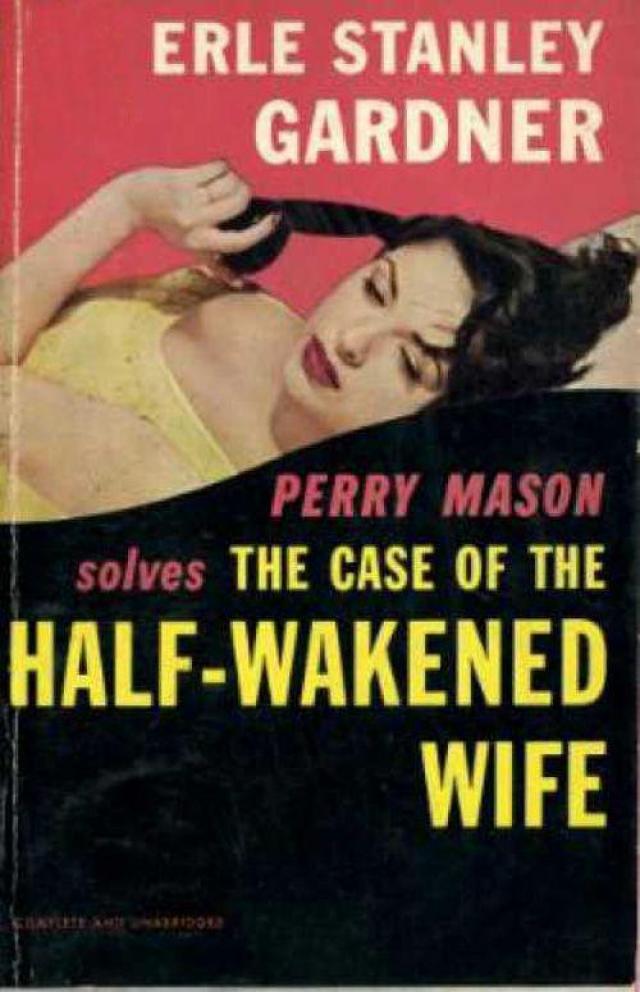


The Case of the Half-Wakened Wife
Erle Stanley Gardner
© 1945, 2011 Erle Stanley Gardner. All rights reserved.
Cast of Characters
JANE KELLER, a worried widow and owner of an island that’s up for sale
LAWTON KELLER, Jane’s brother-in-law, a glib talker, who makes his living impressing women with his shrewdness
MARTHA STANHOPE, Jane’s sister, acquisitive and unimpressed by Lawton
MARJORIE STANHOPE, Martha’s daughter, interested in the sale of the island because a loan from her aunt depends upon it
FRANK BOMAR, Marjorie’s fiancé, a wounded veteran
DELLA STREET, Perry Mason’s beautiful and brainy secretary
JACKSON, an assistant to Perry Mason who detests violence
PERRY MASON, attorney at law who thrives on violence
SCOTT SHELBY, a shady promoter whose suddenly remembered oil lease on Jane Keller’s island threatens to upset the sale
ELLEN CUSHING, a green-eyed blonde real estate agent
PARKER BENTON, millionaire yachtsman and prospective buyer of the island
MARION SHELBY, the “half-wakened wife” of Scott Shelby who, when fully aroused, finds herself charged with murder
PAUL DRAKE, a detective who tries not to look like one
LIEUTENANT TRAGG, less antagonistic to Perry Mason than most members of the Homicide Squad
ARTHUR LACEY, Ellen Cushing’s inarticulate fiancé
MRS. CUSHING, Ellen’s mother, upholder of her daughter’s virtue
JUDGE MAXWELL, who has trouble keeping order in the court
HAMILTON BURGER, the district attorney with whom Perry Mason has matched wits before
DR. HORACE STIRLING, who performed the autopsy on the corpse
ROBERT P. NOXIE, a ballistics expert with pictures to prove it
Contents
Copyright
Chapter 1
Chapter 2
Chapter 3
Chapter 4
Chapter 5
Chapter 6
Chapter 7
Chapter 8
Chapter 9
Chapter 10
Chapter 11
Chapter 12
Chapter 13
Chapter 14
Chapter 15
Chapter 16
Chapter 17
Chapter 18
Chapter 19
Chapter 20
Chapter 21
Chapter 22
Chapter 23
About the Author
Chapter 1
At five minutes before three in the afternoon Jane Keller entered the bank and took her place at the end of the line in front of the window marked PAYING AND RECEIVING J-M.
As though her entrance had been an anticipated signal, the man in the dark blue pin stripe, single breasted suit took from his breast pocket a leather wallet, worn shiny from much use. Slowly he walked toward the line where Jane was standing.
Jane Keller frowned abstractedly at the clock on the far wall. It was easier for her pinched face to adjust itself to an expression of worried futility than into a smile. The line before the teller’s window shuffled slowly forward. Jane Keller kept pace with it, from time to time looking up at the clock in the manner of one who must necessarily devote an increasing amount of mental energy to rearranging the pattern of life, and finds the responsibility too great a strain.
The man in the blue pin stripe moved up.
He was a shrewd-faced chap in his early forties, nervously wide-awake. A keen student of character would have classified the man as a savage, vicious little fighter who would never stand up in an aggressive, toe-to-toe slugging match, but would wait for the opportunity he wanted, then be quick to seize the advantage. If his opponent went down, the man would ruthlessly exterminate him. If he didn’t, the man would run for cover—a crooked little opportunist who gave himself every advantage, specializing in gouging and kicking below the belt.
He moved up to stand beside Jane Keller in the line. The stubby fingers of his left hand suddenly shoved five one-hundred-dollar bills into Jane Keller’s hand. “Here you are, Mrs. Keller.”
Jane Keller’s fingers automatically closed on the money. Then she looked down at it with the bewildered expression of one emerging from a sleep that has been troubled by some annoying dream. She turned her eyes to the face of the man in the dark suit.
The man behind Jane Keller growled, “You can’t double up this way. Get back behind me at the end of the line.”
Jane Keller’s voice had once been well modulated; now it was getting slightly harsh as she found it necessary to cope with more and more annoying factors in life. “What’s this?” she asked. “Who are you?”
The man was obviously reciting by rote. “I’m the agent for Scott Shelby. This is five months’ deferred drilling payments under our oil lease on your property. Sign this receipt. Right here on the dotted line. Here’s a pen.”
He whipped a receipt book from his pocket, snapped back the cover and held the blanks where Jane Keller could see them.
“But … Why! … Mr. Shelby doesn’t have any interest. … He has abandoned the property.”
“Oh, no.”
“He certainly has! He hasn’t done anything with it for months.”
“I’m making the payment covering deferred drilling. A hundred dollars a month. Isn’t that right?”
“Why, yes. That’s the rate. But … he had to pay it every month if he wanted to hold the property.”
“Oh, no.” The man was smiling now and his voice was almost patronizing as he recited glibly, “The lease provided that he must pay at that rate every month to keep his drilling rights. But another paragraph provided that any covenant of any sort in which either party has been in default can be fully performed by the party obligated, at any time within six months, unless in the meantime the lease has been terminated by written notice. You’d better read your lease.”
The line moved forward. Automatically Jane Keller moved forward with it. The man behind Jane Keller said to Jane, “Don’t take it.”
The man in the blue pin stripe suit said, “I want a receipt.”
“But I can’t … I haven’t … I don’t own it anymore; I’ve sold it.”
“Sold it?”
“Yes.”
“When?”
“Why, the papers were signed two weeks ago.”
“Who bought it?”
“Parker Benton.”
“Well, Mr. Shelby doesn’t know anything about that and he doesn’t care. This is five months’ back rent at one hundred dollars a month—deferred drilling payments. Our lease is with you. You can square things with the other people.”
“I won’t accept it.”
“Why?”
“I’ve told you why. Because I’ve sold the property.”
“Who did you say had bought it?”
“Mr. Parker Benton.”
“What’s his address?”
“The Knickerbocker Building.”
Almost reluctantly the man in the blue pin stripe suit took back the five hundred dollars, said to the man standing in line just behind Jane Keller, “Would you mind giving me your card—I may need a witness.”
The man scowled, said, “It’s none of my business. Quit picking on a woman.”
The line moved up, paused, moved again.
“Just a card,” the man insisted. “All I want is your name and address.”
The last man in the line hesitated a moment then produced a card.
The woman in front of Jane Keller picked up the money which the assistant cashier shoved through the wicket. Jane moved into position before the window. An officer of the bank appeared, summoned by the guard, and, sizing up the faces of the three people who clustered about the window, asked, “What’s the trouble?”
Jane Keller said, “I wanted to make a deposit. This gentleman has just given me five hundred dollars.”
“And you want to deposit it?”
“No, I gave it back to him. I don’t want to deposit that money. This is money of my own.”
“What’s the trouble?”
The man in the blue suit said affably, “No trouble at all. I just want to …”
“Let Mrs. Keller tell it,” the banker said sharply.
Jane Keller cleared her throat nervously. “I sold the island to Mr. Parker Benton and …”
“I know,” the banker said. “The deal went through the bank. What about it?”
“My brother-in-law and I thought the oil lease was all finished.”
“It was.”
“But this gentleman claims it isn’t.”
The cold blue eyes of the banker shifted to the face of the stocky man, a face that was now hiding behind the mask of an affable grin.
“I’m representing Mr. Shelby,” the man said, cheerfully. “I’m supposed to make a payment of five hundred dollars covering five months’ payment for deferred drilling. The lease has a clause that any default doesn’t invalidate the lease provided performance is made within six months, unless the lease has been canceled by written notice in the meantime.”
“Where’s the five hundred dollars?” the banker asked.
“I gave it back to him,” Jane Keller said.
With the manner of one showing a bank’s customer the protection afforded by the institution’s impregnable righteousness, the official said, “Then that seems to terminate the matter.
Get out.”
“You know this lady?” the man asked.
“Certainly I know Mrs. Keller.”
“And the gentleman here behind her?”
“Certainly.”
The grin broadened into a smirk. “Thank you. I guess that’s all. Remember about the five hundred bucks—all of you.”
He melted away into the closing-hour crowd of the bank. Jane Keller’s hand was shaking so that the tremor was noticeable as she held her money through the counter. “Oh dear, I’m so nervous.”
“You needn’t be,” the banker smiled at her. “Those oil people are always trying to pull fast ones.”
“But do you suppose there is such a clause in the lease?”
The smile was reassuring. “I wouldn’t pay too much attention to it; but if you’re worried, you might consult an attorney. … The bank can recommend one in case you’d like a lawyer. … Let’s see, this deposit is three hundred and ninety-six dollars and fifty cents.” He pushed it through the wicket to the teller. “There you are, Mrs. Keller. Thank you ever so much. Do you want us to see about a lawyer?”
“No thank you. I … I’ll call my brother-in-law. He’ll know what to do.”
She snapped her purse shut and moved away from the window.
Chapter 2
Lawton Keller answered the telephone and Jane was relieved to hear his voice on the wire. There was something about Lawton’s voice that always reassured her, probably its ringing note of confidence.
During his lifetime, Jane’s husband, Gregory, had never cared greatly for Lawton; but Jane had put it down to brotherly jealousy. Lawton was the older; he had a smooth, easy assurance, a graceful, extemporaneous charm of manner. Gregory, on the other hand, had been reticent, inarticulate, sensitive, a man who modestly refrained from tooting his own horn and didn’t like to hear others talk about themselves.
After Gregory’s death, Lawton had taken Jane under his wing, advising her what to do with the insurance money, always offering alibis for their losses, which were invariably due to “conditions,” and taking great credit to himself for their profits.
When Lawton answered the phone, Jane exclaimed with relief, “Oh Lawton, I’m so glad you’re there!”
“What’s the matter, Jane? You sound worried.”
“I am.”
“Where are you?”
“At the bank—in the phone booth.”
“The bank’s closed, isn’t it? It’s after three—or is it?”
“Yes. They’re just closing it, the outer doors.”
“Make your deposit all right?”
“Yes.”
“What’s the matter?”
“Lawton, you remember that oil lease on the island?”
“It wasn’t exactly a lease,” Lawton said judicially. “I consider it more an option for a lease. However, it’s all over now.”
“No, it isn’t. A man who is the representative of Mr. Shelby caught me at the bank.”
“At the bank?”
“Yes.”
“How did he know you were going to be there?”
“I don’t know.”
“What did he want?”
“He wanted to pay me five hundred dollars.”
“For what?”
“To keep the lease alive.”
Lawton Keller’s voice showed excitement. “Don’t take it, Jane. Don’t touch a …”
“I didn’t, Lawton. I gave it right back to him.”
“Gave it back to him,” Lawton all but shouted. “You mean you took it?”
“Well I just sort of held it. He shoved the money into my hands, of course, well naturally … But I handed it right back.”
“You shouldn’t have ever touched it in the first place. What did you tell him?”
“I told him I couldn’t take it, that the lease had expired.”
“That’s right. Don’t tell him anything about the sale.”
“Oh, but I did.”
Lawton Keller’s voice showed irritated impatience. “Don’t tell all you know.”
“Well, I thought … I thought he was entitled to an explanation.”
“You didn’t tell him the name of the person who is buying it, did you?”
“Why … why, yes. Shouldn’t I have done it, Lawton?”
Lawton groaned over the telephone. “Jane, why didn’t you call me?”
“There wasn’t time. I’m calling you now.”
“Well there’s nothing you can do now. Come and see me right away. I’ll wait here.”
“All right. I have to go by and see Martha first.”
“What does Martha want now?” Lawton Keller’s voice was cold.
“Why, she doesn’t want anything, Lawton, except—well, you know, after all, she’s my sister. I want to see how Margie is getting along.”
“Well, cut it short and then get in touch with me. Jane, here’s something you’d better do.”
“What?”
“While you’re there at the bank draw out every cent in your account.”
“But why should I do that?”
“It’s just a hunch. They might try to tie up your bank account.”
“Who?”
“Shelby.”
“But I don’t see how he could.”
“Never mind about that. You go over and draw out all your money.”
“But the bank’s closed.”
“Just the front door. You’re in there, and you can find someone to wait on you. Draw out every cent you’ve got. How much is it?”
“I don’t know. Something over two thousand dollars.”
“All right. Draw it out, every penny of it. Get it in the form of cash and carry it with you.”
“Well … all right, if you say so, Lawton … if you think it’s best.”
“I think it’s best, Jane, and don’t talk with anyone else. Don’t tell anyone about it.”
“All right, Lawton.”
“And then get in touch with me just as soon as you can get away from Martha.”
“Yes, Lawton.”
“Don’t let Martha know you’ve got any money with you,” he warned, and hung up.
Chapter 3
Jane Keller took a streetcar to South Omena Avenue, walked two blocks to a three story brick apartment house and pressed the bell marked “Manager.”
After some five seconds the electric buzzer threw back the latch and Jane Keller entered an ornamental lobby which was as stiff as a nurse’s starched uniform. She climbed half a dozen stairs to a corridor and stopped in front of the first door on the left, which was marked MANAGER, and below that in a little container a card bearing the words Mrs. Martha Stanhope.
Jane Keller tapped nervously on the door and Martha opened it.
Martha was Jane Keller’s older sister. In her early forties, she was inclined to put on weight but still had enough pride in her personal appearance to combat the tendency. Her husband had died fifteen years earlier and she had never remarried. The necessity of making a living for herself and her daughter Marjorie had kept her watchfully eager to grasp every opportunity which might come her way. This eager, objective selfishness had become a dominant trait in her character. Her eyes were bright, alert, and greedy. Even when she smiled, her eyes remained watchful.
“Oh, hello, Jane. I didn’t know it was you. I was dressing and thought it was someone looking for an apartment. You can put up a sign NO VACANCIES and still they come, asking questions about whether someone isn’t going to leave, or if you don’t know of some place … Come in and sit down. Margie will be in in a minute.”
Jane followed Martha into the over-furnished apartment, sank down in a chair, placed her hands on her lap and smiled a wan, vague smile.
“What’s the matter? You look all in,” Martha said.
“Well, I … I’ve just had a jolt.”
Martha Stanhope’s eyes were hard and probing. “What sort of a jolt?” she asked, running the words together in a quick staccato of inquiry.
“I was at the bank.”
“Yes, go on.”
“A man tried to give me five hundred dollars.”
“Oh,” Martha said, and smiled. Relief relaxed the tension of her manner. She ceased to stand rigidly poised in front of her sister and moved easily over to a little locker, brought out a bottle of brandy and two glasses. “A little drink will do you good.”
“Yes, I … I suppose so … not much, Martha.”
Martha Stanhope poured out two stiff slugs of the brandy. “So you’re upset because someone paid you five hundred dollars?”















