The case of the hesitant.., p.1
The Case of the Hesitant Hostess,
p.1
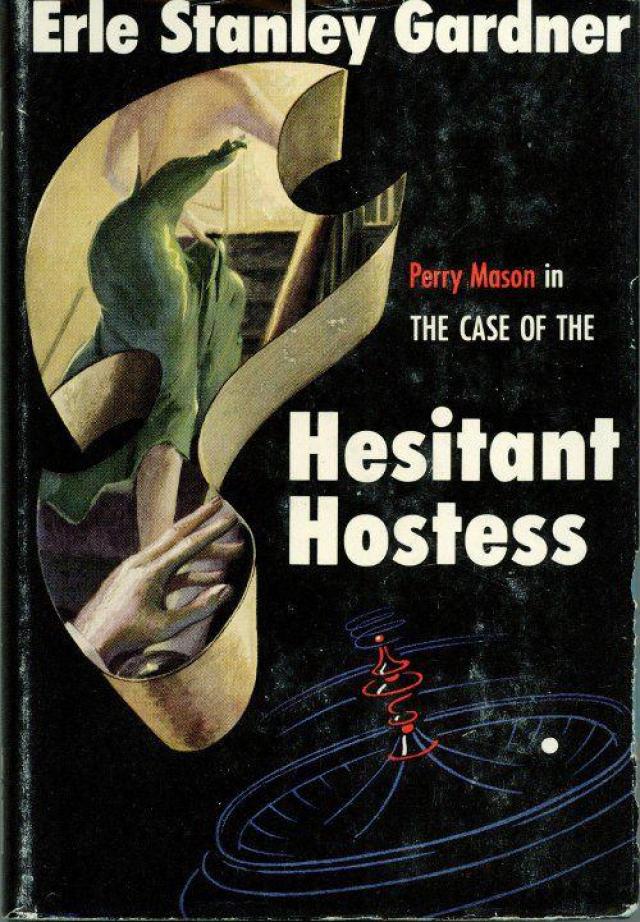


ERLE STANLEY
GARDNER
* * *
The Case of the
HESITANT HOSTESS
© 1953, 2011 Erle Stanley Gardner. All rights reserved.
Contents
Copyright
Foreword
Chapter 1
Chapter 2
Chapter 3
Chapter 4
Chapter 5
Chapter 6
Chapter 7
Chapter 8
Chapter 9
Chapter 10
Chapter 11
Chapter 12
Chapter 13
Chapter 14
Chapter 15
Chapter 16
About the Author
Foreword
There is something about the appearance of Dr. Milton Helpern that is strongly reminiscent of a big, cheerful English squire.
Even a pretty shrewd observer experienced in cataloguing the characters and occupations of men whom he meets would be likely to misinterpret Dr. Helpern and associate him with a country estate somewhere, with flower gardens, hedges and pastures.
Actually the man knows as much about murder as anyone in the United States, and behind his genial, easygoing demeanor is a shrewd, remorseless brain.
The attorney who wants to cite a list of authorities that will dispose of a question in the field of forensic medicine will be apt to top his list with a reference to Legal Medicine and Toxicology by Gonzales, Vance and Helpern.
Twice each year Dr. Helpern takes a train from New York to Boston and comes ambling into the lecture hall at Harvard University’s School of Medicine, where Captain Frances G. Lee is holding one of her seminars on homicide investigation. There Dr. Helpern lectures for an hour or an hour and a half on some important aspect of homicide investigation. He speaks in an amiable, conversational manner, but his talk fairly bristles with bits of knowledge that are completely unknown to the average investigator.
At these times the eighteen law enforcement officers, who have been carefully selected as being worthy to attend one of Captain Lee’s seminars, will be participants in a spectacle of the greatest incongruity.
Standing up in front of the class, lecturing them, will be a man who looks more like a human mastiff than a human bloodhound. It is difficult to associate him with murder.
At the rear of the room is the fabulous Captain Frances G. Lee, whom I have mentioned before from time to time. A woman in her seventies, she was brought up in the formal mid-Victorian surroundings of a wealthy New England family, and according to tradition should have retired to a life of coupon clipping.
However, some fifteen years ago, Captain Lee took an interest in legal medicine, donated a fortune to establish a school of legal medicine at Harvard University, then became interested in police science and is now everywhere recognized as one of the outstanding figures in police science and homicide investigation.
To attend one of these seminars, where a handpicked group of the keenest officers in this country rub elbows with men who have been sent over from Scotland Yard, from Canada, and even at times from India, is a rare privilege. It is a privilege that is only available to men who have for the most part (if they live in the States) been cleared by the state police and the governors of the states where the men live.
The lecturers at these classes are even more carefully selected. They are the cream of the crop. To be invited to so appear is a recognition of high merit and professional standing.
Dr. Helpern appears regularly, always smiling, always good-natured, as precisely accurate as a delicate surveying instrument.
Having finished his lecture, Dr. Helpern takes the train back to New York and there resumes his profession of examining dead bodies, ferreting out the cause of death, making deductions which would be a credit to Sherlock Holmes, and doing it all so casually and unostentatiously that only those who are familiar with legal medicine realize that he is one of the outstanding figures in the United States.
Talking with Dr. Helpern, going through the long rows of specimens which have been collected in the course of thousands of autopsies, one begins to realize the importance of the work of a thoroughly skilled medical examiner.
Dr. Helpern will prowl around among these bottled specimens with the air of an enthusiastic gardener showing off sortie choice flowers. “Now here,” he will say, “is a collection of excellent examples of spontaneous subarachnoid hemorrhage.” Dr. Helpern will indicate an assortment of carefully dissected brains, many of them proof that an innocent man could well have been convicted of murder if it hadn’t been for competent medical work.
“The spontaneous subarachnoid hemorrhage,” Dr. Helpern will point out, “is more frequently encountered than many people realize. Too often the inexperienced autopsy physician will certify death as being due to a hemorrhage caused by external violence. Actually it is nothing of the sort. But the peculiar circumstances under which such hemorrhages occur and the confusing symptoms which they produce may lead to an erroneous suspicion of violent death and to the conviction of innocent people.
“Most subarachnoid hemorrhages arise from the unexpected bursting of a small aneurysm, which is a thin sac-like protrusion, in some cases no larger than a match head, of one of the blood vessels at the base of the brain. Such aneurysms of the arteries of the brain develop at points of weakness in the blood vessel wall and eventually blow out or rupture, causing a more or less rapid hemorrhage to spread out on the under surface of the brain. Death may occur within a few minutes or be delayed. Some individuals recover after the first hemorrhage to have a second episode of bleeding. If the aneurysm is embedded in and bolstered by brain tissue, as it often is, the hemorrhage is at first slow and affects only a small part of the brain without producing loss of consciousness.
“It frequently happens that this localized bleeding causes the individual to become disturbed and aggressive, and at the same time to lose orientation and mental perspective.
“Perhaps an usher in a theater will be called to quiet a man who has suddenly become obstreperous. The usher suggests that the man leave the theater. The man makes an ineffectual swing at the usher, mutters something that is completely unintelligible, and the usher, warding off the blow, grabs the man around the shoulders and rushes him toward the theater exit.
“Halfway to the exit the man collapses. An ambulance is called and the victim is dead on arrival at the hospital.
“An incautious and inexperienced medical examiner, learning the history of the case and encountering an area of cerebral hemorrhage, and overlooking the small aneurysm from which it arose, is very likely to jump to the conclusion that the hemorrhage resulted from injury and that the usher had roughed the man up a bit. Sometimes a person in the audience will describe the altercation in terms sufficiently vivid to indicate that a blow was struck by the usher and that the victim fell to the floor.
“The usher finds himself facing a charge of involuntary manslaughter and the theater faces a huge suit for damages.”
That is, incidentally, one case which actually happened and which Dr. Helpern likes to talk about as he pauses before the section on spontaneous cerebral and subarachnoid hemorrhage.
Modesty keeps Dr. Helpern from telling about the part he has played in a whole series of cases where death, apparently from natural causes, was, by his careful work, proven to be murder.
He will, however, on occasion show one of his close friends the evidence in one of the most remarkable cases of circumstantial evidence in the United States.
A man engaged in an altercation with another received a blow on the side of the head. He went on fighting and won the fight. He went home, and after a while began to feel ill.
He went to bed, got up, wandered around in something of a daze, and, finally, was sent to a hospital where in due course he died. There was no conspicuous wound on the head and no one suspected the cause of death, but Dr. Helpern, in performing a routine but thorough autopsy, found a hemorrhage, which had resulted from a stab wound of the skull and brain. The blade of the weapon had penetrated the skull and had broken off flush with the scalp, part of it embedded in the brain.
Dr. Helpern inquired into the man’s history, learned of the altercation, had the police pick up the other combatant and search him, whereupon they found in the prisoner’s possession a penknife with the blade broken off.
Dr. Helpern fitted the segment of the blade found in the head of the dead man to the broken stub of the blade of the knife found in the possession of the defendant, and the two parts fitted together into a perfect whole.
Dr. Helpern, who received his early training from the late Dr. Charles Norris, the first Chief Medical Examiner in New York City, and has been closely associated with Dr. Thomas A. Gonzales, Dr. B. Morgan Vance, Dr. Harrison S. Martland and Dr. Alexander O. Gettler, in the Office of the Chief Medical Examiner in New York City and in the Department of Forensic Medicine at the New York University Post Graduate Medical School, was, with his distinguished colleagues, among the first to pioneer the field of the Medical Examiner. He has been largely instrumental in establishing consistently higher standards in the field of the medicolegal necropsy. His innate modesty and good-natured, retiring disposition have kept the public from learning the extent of its indebtedness to him. Only in the field of the professional investigator is his eminence known, and this is a shame because people generally should know something of what he has done.
Ther
efore it gives me great pleasure to tell my readers about his invaluable work and to dedicate this book to my friend,
DR. MILTON HELPERN.
- Erle Stanley Gardner
Chapter 1
For the past fifteen minutes it had been apparent that Harry Fritch, the assistant district attorney, was marking time. He fumbled through papers, asked repetitious questions, and from time to time surreptitiously glanced at the clock on the wall of the courtroom.
Abruptly he straightened. “That is all,” he said, and, turning to Perry Mason with a bow of official courtesy, added, “You may cross-examine, Mr. Mason.”
Mason got to his feet, realizing the trap into which he had been led.
“If the Court please,” he said affably, “it is twenty minutes to five on a Friday afternoon.”
“What of it?” Judge Egan asked in his most irate manner.
“Merely this,” Mason added, smiling. “It occurs to me that the Court might not care to interrupt the cross-examination of this witness with an adjournment. My cross-examination will, I feel, be rather protracted, and perhaps if we postponed it until Monday morning …”
Judge Egan was courtesy itself in a routine case which was tried without a jury, but when the courtroom was filled with spectators, when a jury was present, Judge Egan made it a point to be rude. A shrewd politician, he had long since learned the popular appeal of dominating his courtroom and bullying the lawyers. He was hated by the lawyers but idolized by the voters.
“Court will adjourn at the usual time, Mr. Mason,” the judge said. “Court adjourns at the hour of adjournment, not at the convenience of Counsel. You have some twenty minutes. The jurors want to get this case over with and get back to their business. Proceed with your cross-examination.”
“Very well, Your Honor,” Mason said, and, ostensibly turning to sort through some papers on the counsel table, gained a few precious seconds in which to study his strategy.
The woman on the witness stand was deadly clever. Unless he could shake her testimony the defendant was going to be found guilty. Mason had one surprise, and only one surprise. He hoped it would be a bombshell.
There was hardly time to spring that surprise and capitalize on the confusion it would cause before five o’clock, yet if he floundered around for twenty minutes with an aimless cross-examination the jury would retire for the week end firmly convinced that the woman’s testimony should be taken at face value.
Mason reached a decision.
“Mrs. Lavina,” he said, smiling courteously—
The well-tailored, good-looking woman on the witness stand smiled right back at him, a smile which seemed to indicate she was only too glad to face the most searching cross-examination he could give her.
“You have,” Mason said, “identified the defendant in this case as the man who perpetrated the holdup.
“Yes, Mr. Mason.”
“When was the first time you saw this defendant? When was the first time you ever saw him in your life?”
“The night of the holdup. Mr. Archer had stopped the car for a traffic light. The defendant sprang up seemingly from nowhere, jerked open the door of the car, thrust a revolver almost directly into Mr. Archer’s face, calmly proceeded to take his wallet, his diamond stickpin and my purse. It was all done so rapidly I hardly knew what was going on until the man sprinted back to the curb, jumped in a car that was pointed in the other direction and took off.”
“And Mr. Archer tried to follow him?”
“Indeed not. Mr. Archer did nothing so foolish. The man was armed. Mr. Archer was unarmed. Mr. Archer drove across the intersection, stopped at a drugstore and telephoned the police.”
“And what did you do?”
“I waited in the car,” she said, “until I realized I could wait no longer.”
“How long did you wait?”
“I would say a good five minutes. Then a radio patrol car showed up.”
“Then what happened?”
She said, “While Mr. Archer was talking with the police, a young woman whom I know drove past, recognized me sitting in the car, drove ahead and parked her car. I called a bystander and told him to tell Mr. Archer that I would be available in case the police wanted a statement, but that I was going on to The Villa.
“Why didn’t you wait and talk with the police?”
“Mr. Archer could tell them everything the police needed to know. I had some very important matters to attend to. The police are hired by the taxpayers for the convenience of the taxpayers. If there was anything they wanted from me it would be an easy matter for them to come and find me.”
“You were with Mr. Archer at the time of the holdup?” “Certainly, M. Mason. I have said so several times.” “And where did you go after you left Mr. Archer?” “To The Villa.”
“Now, by The Villa, you are referring to The Villa Lavina?”
“If you wish to be specific, Mr. Mason, The Villa Lavina Number Two.”
“That is owned by you?”
“The property is not owned by me. I lease the property, but The Villa itself is owned by me, perhaps I should say it is operated by me.”
“You were en route to The Villa with Mr. Archer at the time of the holdup?”
“Yes.”
“And who was it who came along in the automobile and picked you up—the young woman whom you said you knew?”
“Miss Kaylor.”
“Miss Kaylor, I believe, is more than an acquaintance?”
“She is an acquaintance, a friend and an employee.”
“She works for you?”
“I take it you wish to know if she worked for me at the time of the holdup?”
“Yes.” “Yes, she was a hostess.” “And she picked you up at the scene of the holdup?”
Mason asked.
Mrs. Lavina smiled sweetly. “No,” she said.
Mason raised his eyebrows. “I understood you to say.”
“I don’t know whether you are trying to trap me, Mr. Mason, but I said very distinctly that after the holdup Mr. Archer drove on through the intersection and parked his car at the drugstore. The place where Inez picked me up was a distance of perhaps one hundred and twenty-five to one hundred and fifty feet from the scene of the holdup.”
She smiled smugly, and one or two of the jurors grinned.
“I didn’t mean to trap you,” Mason said. “I was speaking generally.”
“I cannot afford to speak generally. You see, Mr. Mason, I am under oath.”
A distinct rustle of merriment rippled the courtroom.
With a dramatic gesture Mason turned from the witness. “Mr. Paul Drake,” he called.
Paul Drake, head of the Drake Detective Agency, straightened into lanky height. The curious eyes of the spectators turned toward him.
“Will you,” Mason said, “please step into the law library and bring Inez Kaylor into the courtroom?”
Drake nodded and walked down the aisle and through the double swinging doors.
“Now,” Mason said, whirling to confront Mrs. Lavina, “I want the truth. Are you absolutely certain that Inez Kaylor drove by and picked you up?”
The witness, frozen into immobility, controlled her facial expression so that by not so much as the flicker of an eyelash or the quiver of a lip was it possible to tell her thoughts.
“Well,” Mason said, “can you answer that question?”
The witness slowly averted her eyes, frowning rather thoughtfully. “I am quite certain it was Inez Kaylor. Of course, Mr. Mason, it was some time ago, and…”
“How long have you known Inez Kaylor?”
“For approximately eight months.”
“How long had you known her before this holdup took place?”
“About two months I believe.”
“You are the proprietress of the chain of night clubs known as The Villa Lavina?”
“Not a chain, Mr. Mason. There are only three.”
“All right. You operate them?”
“Yes.”
“You employ hostesses?”
“Yes.”
“How many?”
“Eighteen in all.”
“You are a good businesswoman?”
“I try to be.”
“You are in touch with your various night clubs every night?”