The case of the fiery fi.., p.1
The Case of the Fiery Fingers,
p.1
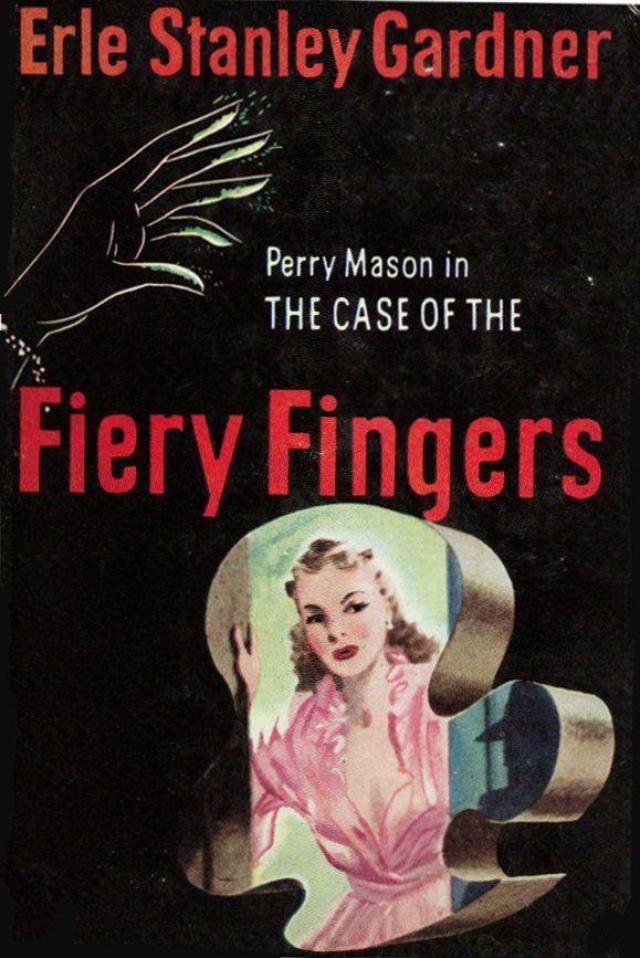


ERLE STANLEY GARDNER
THE CASE OF THE
FIERY
FINGERS
© 1951, 2011 Erle Stanley Gardner. All rights reserved.
Contents
Foreword
Cast of Characters
Chapter 1
Chapter 2
Chapter 3
Chapter 4
Chapter 5
Chapter 6
Chapter 7
Chapter 8
Chapter 9
Chapter 10
Chapter 11
Chapter 12
Chapter 13
Chapter 14
Chapter 15
Chapter 16
Chapter 17
Chapter 18
Chapter 19
Chapter 20
Chapter 21
Chapter 22
Chapter 23
About the Author
FOREWORD
IN ALL THE EARTH THERE IS PROBABLY NO MENTAL OCCUpation quite as fascinating as that of finding clues and then accounting for them, which is all that detective work really is and about all that astronomy really is.
A detective, for instance, finds the head of an unburnt match broken off and lying by itself on the floor at the scene of a murder. Is it a clue or is it just one more bit of trivia?
Perhaps he will deduce that the murderer was given to the habit of snapping matches into flame with his thumb nail, that this particular match was slightly defective and therefore the head broke off in place of snapping into flame.
Then when the murderer is apprehended the detective will find out that the man simply wanted a small stick with which he could push a key out of the lock in a door, and had broken the head off a match and used the matchstick to fulfill his purpose.
And so it goes. Whenever a man feels that he has an explanation to account for some physical clue he is only too likely to find that his conclusions, while brilliant and logical, are completely incorrect.
But if these clues happen to have been discovered by an officer of the Massachusetts State Police there isn’t much possibility of a brilliant but erroneous deduction.
Because such clues are sent to the laboratory of Doctor Joseph T. Walker, scientist, toxicologist and general all-around technical detective, who has an uncanny ability to separate mental wheat from imaginative chaff, the answers given are the right ones.
Let a discarded coat be picked up along one of the Massachusetts highways by a casual pedestrian who happens to notice what seems to be a bloodstain, and watch what happens.
Doctor Walker’s piercing eyes make an examination which is different from the ordinary examination because he knows of a dozen things to look for, things that never would occur to the ordinary man.
That little hole, for instance, may seem to be of minor significance until by photographing it in infrared light he brings out powder stains proving that it is a bullet hole. By using soft X-rays he will find bits of metallic fragments in the garment, and by a spectro-analysis of those fragments will name the manufacturer of the bullet in question.
Or perhaps that peculiar imprint which is visible only under a certain angle of transverse lighting will, when properly photographed, assume the form of a perfect circle indicating that the wearer of the coat may have been struck by a hit-and-run driver. The headlight of the offending automobile left its circular imprint in the garment, whereupon a microscopic examination is quite likely to bring out little slivers of glass, some of which may be distinctive enough to furnish an important clue.
A further microscopic examination of the threads of the garment may disclose a flake-like substance no bigger than the head of a pin, which Doctor Walker will turn on edge, and examine under a powerful microscope. He will then announce that this is a small chip or flake of paint peeled off from an automobile driven by the hit-and-run culprit. The automobile, he will announce, was first painted a robin’s-egg blue when it came from the factory, it was next painted a conservative black, then covered with a neutral tan and is now a vivid red.
I have watched Doctor Walker at work in his laboratory. I have peered over his shoulder while he has discovered things that the average man would never even look for, and then has translated those things into clues which, properly evaluated, have on countless occasions led to the apprehension and conviction of a criminal.
I first became acquainted with Doctor Walker at one of Captain Frances G. Lee’s seminars on homicide investigation at the Harvard Medical School. I have since had occasion to drop into his laboratory several times. Every time I do so, I find him engaged in some fascinating crime problem where his common sense, his uncanny keenness of mind and his marvelous technical training bring forth logical but unexpected conclusions, just as a magician reaches into an unpromising silk hat and brings forth a very live, very convincing, and very substantial rabbit.
Of course, the rabbit was there all the time, and from the viewpoint of the magician the silk hat was the logical place to look for it.
I know of many cases where Doctor Walker’s mind, following physical clues as a bloodhound follows scent, has brought murderers to justice, and I know of some cases where the same mental qualities have been used to prevent innocent men from being unjustly convicted.
Quietly, modestly, unobtrusively, Doctor Walker goes to his work day after day, dedicating his life to the cause of practical justice.
Society needs more men like Doctor Joseph T. Walker. The time and money spent, in the highly technical training such men must have to become thoroughly competent, represents a profitable investment on the part of organized society.
But there is more than mere technical training that makes Joe Walker the man that he is. He has an unswerving loyalty to his ideals, a quiet courage, an inherent faith.
And so I dedicate this book to a competent scientist, a true friend, and a man whose pattern of life is a source of inspiration to those who are familiar with it,
DOCTOR JOSEPH T. WALKER.
ERLE STANLEY GARDNER
CAST OF CHARACTERS
PERRY MASON—Razor-brained master of criminal law, he was wary of a client with an imaginary case
DELLA STREET—Mason’s confidential secretary, she had a nose for callers with danger in their futures
NELLIE CONWAY—With her perfect poker face, you couldn’t tell whether she was a jewel thief or a professional “do-gooder”
NATHAN BAIN—He prescribed his own brand of pills for a sick wife and had avoided divorce as a solution to his first marriage
SERGEANT HOLCOMB—Of the Homicide Squad, he laughed every time he heard Nellie Conway’s story
PAUL DRAKE—Chief of Perry Mason’s legwork division, a detective whose shambling manner cloaked an alert mind and agile feet
JIM HALLOCK—A private agent hired by Bain to keep a mournful eye on things
IMOGENE RICKER—A Charles Addams-type housekeeper, all she lacked was a peaked cap and a broom
VICTORIA BRAXTON—First-class wolf bait, she was in a desperate hurry to get her half-sister’s will drawn up
CHARLOTTE MORAY—She could have won a beauty contest anywhere, but she stood to lose everything when her boy friend’s wife found her letters
JAMES BRAXTON—A timid soul who followed his wife as if she were his seeing-eye dog
GEORGIANA BRAXTON—If you asked her the time of day, she’d tell you how her watch was made
LIEUTENANT TRAGG—He’d wink at the method-if the solution was in the bag
HAMILTON BURGER—The grizzly bear of a D.A., who thought that at last he had an airtight case
1
PERRY MASON HAD JUST RETURNED TO THE OFFICE AFTER A long day in court.
Della Street, his secretary, pushed a stack of half a dozen letters on his desk and said, “These are ready for you to sign, and before you go home there’s one client in the office whom you should see. I told her I thought you’d see her if she’d wait.”
“How long’s she been waiting?” Mason asked, picking up the desk pen and starting to skim through the letters which Della Street had typed out for his signature.
“Over an hour.”
“What’s her name?”
“Nellie Conway.”
Mason signed the first letter, Della Street efficiently blotted the signature, picked the letter up, folded it and slipped it in the envelope.
“What does she want?” Mason asked.
“She won’t tell me, but she says it’s an urgent matter.”
Mason frowned, signed the second letter, and said, “It’s late, Della. I’ve been in court all day and …”
“This girl’s in trouble,” Della Street said with quiet insistence.
Mason signed the next letter. “What does she look like?”
“Thirty-two or thirty-three, slender, dark hair, gray eyes, and the most perfect poker face you have ever seen.”
“No expression?”
“Wooden.”
“How do you know she’s in trouble?”
“Just the way she acts. There’s a peculiar tension about her and yet her face doesn’t show it.”
“Any signs of nervousness?”
“Nothing outward. She drops into a chair, sits in one position without moving her hands or her feet, her face is absolutely expressionless, her eyes move a little bit, but that’s all. She doesn’t read, she just sits there.”
“But not relaxed?” Mason asked.
“Just like a cat sitting at a gopher hole w
aiting for the gopher to come out. Not a move that you can see, but you have the feeling of inner tension—waiting.”
“You interest me,” Mason said.
“I thought I would,” Della Street said demurely.
Mason abruptly signed the rest of the letters in the pile of mail without even bothering to glance at them.
“All right, Della, let’s get her in. I’ll have a look at her.”
Della Street took the mail, nodded, stepped out into the outer office and returned shortly with the client.
“Nellie Conway, Mr. Mason,” she said crisply.
Mason motioned the woman to a seat in the soft, comfortable chair which he had installed in the office so that by lulling clients into complete physical relaxation he might relieve their emotional tension and so loosen their tongues.
Nellie Conway disregarded the motion and took one of the less comfortable wooden chairs, moving with a gliding silence as though she had trained herself to make no unnecessary sound.
“Good afternoon, Mr. Mason. Thank you for seeing me. I’ve heard a lot about you. I was hoping you’d get in earlier. I’m going to have to hurry because I have to be on duty at six o’clock.”
“You work nights?”
“I’m a nurse.”
“A trained nurse?”
“A practical nurse. I work on cases where the people can’t afford hospitalization or trained nurses. We work longer hours and, of course, we do things a trained nurse won’t do, and we get less money.”
Mason nodded.
Nellie Conway turned to fasten steady gray eyes on Della Street.
Mason said, “Miss Street is my confidential secretary. She will sit through the interview and make notes, if you don’t mind. She has to know as much about my business as I do in order to keep things co-ordinated here in the office. Now, what did you want to see me about?”
Nellie Conway folded gloved hands, turned her triangular face toward Perry Mason and, without the faintest flicker of expression in voice or eyes, said, “Mr. Mason, how does one go about preventing a murder from being committed?”
Mason frowned. “I wouldn’t know.”
“I’m serious.”
Mason regarded her with searching eyes, then said, “All right. This is out of my line. I specialize in defending people who are accused of crime and I try to see that my clients at least get an even break, but if you really want to know how to go about preventing a murder I would say there are four ways.”
“What are they?”
Mason held up his hand and checked off the four ways on his fingers. “One,” he said, “you remove the victim, or the potential victim, from the danger zone.”
She nodded.
“Two,” Mason said, “you remove the murderer, or the potential murderer, from the place where he can have any contact with the victim.”
Again she nodded.
“Three,” Mason said, “you remove all weapons of murder, which is pretty difficult to do.”
“So far they’ve all been difficult,” she said. “What’s the fourth?”
“The fourth,” Mason said, “is the easy one and the practical one.”
“What is it?”
“You go to the police.”
“I’ve been to the police.”
“And what happened?”
“They laughed at me.”
“Then why come to me?”
“I don’t think you’ll laugh.”
Mason said, “I won’t laugh, but I don’t like abstractions. My time’s valuable. Apparently you’re in a hurry. I’m in a hurry. I don’t like this business of having a client say, ‘A wants to murder B.’ Let’s get down to brass tacks.”
“How much are you going to charge me?”
Mason said, “That depends on how soon you quit beating about the bush.”
“I’m a working woman. I don’t make a great deal of money.”
Mason said, “Therefore it’s to your interest to have the charge as low as possible.”
“That’s right.”
“So,” Mason said, “you’d better tell me what this is all about, and talk fast.”
“Then how much will you charge me?”
Mason regarded the wooden face across the desk. He glanced amusedly at Della Street. His eyes turned back to his client and softened into a smile. “One dollar,” he said, “for advice, if you’ve told your story within the next four minutes.”
There was not the faintest sign of surprise in her face. She repeated merely, “One dollar?”
“That’s right.”
“Isn’t that unusually low?”
Mason winked at Della Street. “What’s your standard of comparison?”
She opened her purse, her gloved hands took out a coin purse. She opened it, selected a folded dollar bill, smoothed it out and put it on the desk.
Mason didn’t touch it. His eyes kept regarding her with puzzled curiosity.
She closed the coin purse, put it back in her bag, snapped the bag shut, put the bag on her lap, folded her gloved hands on the bag, said, “I think Mr. Bain wants to murder his wife. I’d like to prevent it.”
“Who’s Mr. Bain?”
“Nathan Bain. He’s in the produce business. You may know him.”
“I don’t. Who’s his wife?”
“Elizabeth Bain.”
“How do you know all this?”
“By using my powers of observation.”
“You’re living in the house?”
“Yes.”
“Waiting on someone?”
“Yes. Mrs. Bain. Elizabeth Bain.”
“What’s the matter with her?”
“She was hurt in an automobile accident.”
“Bad?”
“I’m afraid worse than she realizes. There’s been an injury to the spine.”
“Can she walk?”
“No, and she isn’t ever going to walk again.”
“Go ahead,” Mason said.
“That’s all.”
Mason’s face showed annoyance. “No, that isn’t all,” he said. “You think that he wants to murder her. You aren’t a mind reader, are you?”
“Sometimes,” was the unexpected answer, delivered in a calm voice.
“And you’re getting this from reading his mind?”
“Well, not exactly.”
“There are other things?”
“Yes.”
“What are they?”
She said, “Nathan Bain wants to marry someone else.”
“How old is he?”
“Thirty-eight.”
“How old’s his wife?”
“Thirty-two.”
“How old’s the girl he wants to marry?”
“About twenty-five.”
“Does she want to marry him?”
“I don’t know.”
“Who is she?”
“Some woman who has an apartment in the city. I don’t know exactly where.”
“What’s her name?”
“Her first name’s Charlotte. I don’t know the last name.”
Mason said irritably, “I’m having to draw it out of you like pulling teeth. How do you know he wants to get married?”
“Because he’s in love with this woman.”
“How do you know?”
“They correspond. He met her at a convention. He loves her.”
“All right,” Mason said, “so what? Lots of healthy men thirty-eight years of age have restless eyes and a roving disposition. It’s a dangerous age. They come back home if you leave them alone. Sometimes they don’t. There are lots of divorces, but there aren’t many murders.”
Nellie Conway opened her purse. “Mr. Bain offered me five hundred dollars if I would give his wife some medicine.”
Mason cocked a quizzical and somewhat skeptical eyebrow. “You’re certain of what you’re saying, Miss Conway?”
“Absolutely certain. I have the medicine here.”
“Why did he say he wanted you to give it to his wife?”
“He didn’t say. He just said that he thought that this medicine would be good for her. He doesn’t like his wife’s doctor.”
“Why not?”
“The doctor was an old friend of Elizabeth’s.”
“You mean Bain is jealous?”
“I think so.”
“Look,” Mason said irritably, “all of this doesn’t make sense. If Bain wants his wife out of the way he’d much rather have her divorce him and marry the doctor than to try and get rid of her by giving her poison. If he wanted to—let’s take a look at this ‘medicine.’”