

The case of the duplicat.., p.1
The Case of the Duplicate Daughter,
p.1
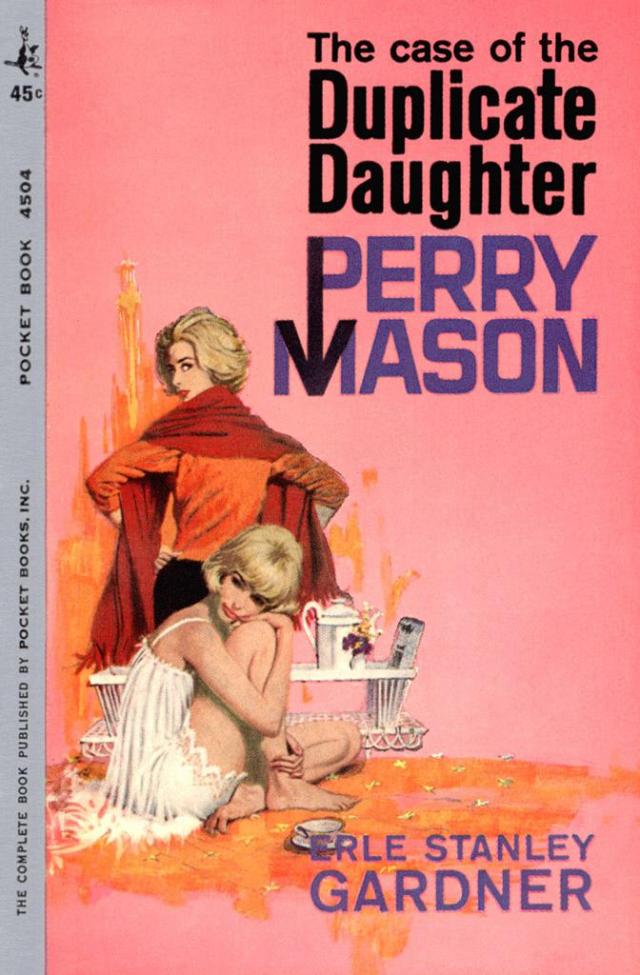


The Case of the
Duplicate Daughter
Erle Stanley Gardner
Foreword
The field of legal medicine is exacting, and it is a difficult field in which to achieve distinction. Relatively few men have gone to the top of the ladder.
The good medico-legal expert knows more about detective work than Sherlock Holmes, as much or more law than the average lawyer, and must be firmly grounded in all branches of medicine. In addition, he must have a quick, perceptive mind, be able to express his thoughts clearly and concisely and have such self-control that he can’t be rattled or enraged by the sneering type of cross-examination with which some attorneys try to embarrass a medical witness.
To achieve international distinction in this field is an honor indeed, and it is a distinction that has been achieved by my friend, Doctor Francis Edward Camps.
Dr. Camps is as much at home working with Scotland Yard on some puzzling matter as he is rendering services as a consultant while visiting friends in the United States. There is no room here to list his honors in England, but in the United States he is a member of the Harvard Associates in Police Science, and a Fellow in the American Academy of Forensic Sciences. He has written a most interesting book dealing with his work in the famous Christie case in Great Britain ( Medical and Scientific Investigations in the Christie Case—Medical Publications Ltd.) and that book alone shows the outstanding qualities of the man: his painstaking attention to detail, his innate shrewdness, his thorough training and, in addition to that, his ability to express himself so interestingly that this work, which is really a scientific treatise in post-mortem detection, reads as absorbingly as any mystery novel ever written.
In addition to this, he has recently, in collaboration with Sir Bentley Purchase, written a book on forensic medicine entitled Practical Forensic Medicine, a book which is destined to become a leader in the field.
Dr. Camps has visited at my ranch, and has shown himself to be a warm, human, personable individual. He can relax in the company of his friends and be so genially casual that one has a hard time associating such a warm and informal personality with the medical genius who has followed seemingly insignificant clues to bring murderers to death, criminals to justice and, on occasion, exonerate persons wrongly accused of crime.
In dedicating this book to Dr. Camps I am keenly aware that he wouldn’t want to be singled out as an individual, or given any personal publicity. He is, however, keenly interested in improving the public understanding of legal medicine and so I feel sure that he will accept this dedication as a part of my effort to make the reading public familiar with the importance of legal medicine to their daily lives, to their human rights, and to their safety.
Altogether too many murders have been diagnosed as suicides and, unfortunately, too many suicides have been held to be murder. It is difficult for the public to realize the hairline distinctions which must be made by a competent examiner.
Because the medical examiner is inherently modest, the public knows all too little about the extent to which its safety is protected by this group of men who have dedicated their lives in a most difficult field. A good expert in the field of legal medicine must first learn enough medicine to qualify himself as a medical doctor, then acquire enough experience to reach the highest income brackets if he chooses simply to practice medicine. Then he must study enough law to qualify as an expert. (In fact, many of these men do take the bar examinations and become attorneys at law.) Then he must specialize in pathology, go on to study crime detection, learn all there is to know about poisons and poisoners, and then deliberately obscure himself in the relatively low-paid field of forensic medicine so that he can be free to do good in the world in his chosen calling.
The public owes this unselfish and devoted body of men a great debt of gratitude.
And so I dedicate this book to a man who has achieved international recognition in a most difficult field—
My friend,
FRANCIS EDWARD CAMPS, M.D.
-ERLE STANLEY GARDNER
Chapter One
Muriell Gilman, moving from the dining room into the kitchen, was careful to hold the swinging door so it wouldn’t make a noise and disturb her stepmother, Nancy Gilman, who usually slept until noon, or Nancy’s daughter, Glamis, whose hours were highly irregular.
Muriell’s father, Carter Gilman, was hungry this morning and had asked for another egg and a slab of the homemade venison sausage. The request was unusual and Muriell felt certain the order would be countermanded if she gave her father an opportunity to reconsider, so she had hesitated over actually starting to warm up the frying pan. But after it appeared her father not only definitely wanted the added food but was growing impatient at the delay, she eased through the swinging door, leaving her father frowning at the morning paper, and turned on the top right-hand burner of the electric range.
Muriell understood her father very well indeed, and smiled to herself as she recalled his recent attempt to lose weight. This added breakfast order was probably open rebellion over his low-calorie dinner of the night before.
They lived in a huge, old-fashioned, three-story house which had been modernized somewhat after the death of Muriell’s mother. Muriell had been born in this house, knew its every nook and corner and loved it.
There were times when she felt a qualm at the idea of Nancy occupying her mother’s bedroom, but that was when Nancy wasn’t physically present. There was something about Nancy, a verve, an originality, a somewhat different way of looking at things, that made her distinctive and colorful. One could never resent Nancy Gilman in the flesh.
The sausage, which had been frozen, took a little longer to cook than she had anticipated. Having delayed starting to cook it until her father had shown signs of impatience, she had then put the egg in a frying pan that was a little too hot. As soon as she saw the white begin to bubble she lifted the pan from the stove. The egg sputtered for a moment in the hot grease, then subsided.
Muriell’s father liked his eggs easy over and very definitely didn’t like a hard crust on the bottom or at the edges.
Muriell turned the stove down and cautiously returned the frying pan to the burner. She tilted the pan, basted the yolk with hot grease so as to expedite the cooking process and then skillfully turned the egg over for a few seconds before removing it from the frying pan.
Arranging the egg and the sausage on a clean plate, she gently applied her toe to the swinging door between the kitchen and dining room and gave the door a shove, catching it on the rebound with her elbow so that the jar of the return swing would be minimized.
“Well, here you are, Dad,” she said. “You—”
She broke off as she saw the empty chair, the newspaper on the floor, the filled coffee cup, the smoke spiraling upward from the cigarette balanced on the side of the ashtray.
Muriell picked up her father’s empty plate, slid the new plate with the egg and sausage into place, put a piece of toast in the electric toaster and depressed the control.
As she stood there waiting for her father to return, her eye caught an ad in the paper, an ad which offered unmistakable bargains in ready-to-wear; so Nancy stooped, picked up the paper and became engrossed in garments and prices.
When the hot toast popped up in the electric toaster, she became frowningly aware that her father hadn’t returned.
She tiptoed to the door of the downstairs bathroom, saw the door was open, and looked inside. No one was there.
She moved around the downstairs rooms, then she called softly, “Daddy, your food is getting cold.”
She returned to the dining room, then, suddenly alarmed, she made a complete search of the downstairs part of the house.
Could it be possible that her father had gone to work without so much as putting his head in the kitchen … ? He knew that Muriell was cooking another egg and sausage. He had specifically asked her to do this. He certainly wouldn’t have left the house without an explanation. Even if there had been some sudden emergency at the office he would have let her know. But there hadn’t been any emergency at the office because the telephone hadn’t rung. There was an extension in the kitchen and Muriell would certainly have heard the bell if there had been a phone call.
Something must have happened which caused her father to go upstairs, then. Could it be that Nancy had been taken ill?
Muriell hurried up the stairs, trying to be silent but so intent upon speed that her feet made noise, and when she tried the knob of the bedroom she was in a little too much of a hurry and the latch gave a distinct click.
Nancy Gilman wakened, looked at Muriell standing tense in the doorway and said, “Well, what is it?”
“Father,” Muriell said.
Nancy glanced over at the empty twin bed with the bedclothes thrown back. “He left an hour ago,” she said irritably. And then, suddenly catching herself, smiled and said, “What’s the matter, child? Is he late for breakfast again?”
“No, it’s all right,” Muriell said. “I put on another egg for him and …well, I wanted to tell him it was getting cold.”
For a moment there was just a flicker of annoyance on Nancy Gilman’s face, then she raised herself to one elbow, punched a second pillow into submission, piled it on the first, smiled at Muriell and said, “You’re so considerate.” And then, after a distinct interval, added, “Of your father, my dear.”
Her smile was enigmatic. She dropped her head ba
ck to the pillow and closed her eyes.
There was no other place her father could possibly be unless he had gone to the attic.
A sudden disquieting thought entered Muriell’s mind. Recently her father had been rather upset. He had told her only two nights before, “Muriell, if you should ever be confronted with any emergency in connection with my affairs, remember that I don’t want the police. Do you understand? I don’t want the police.”
Muriell had looked at him in surprise and had tried to question him as to what he meant, but his answers after that were smilingly evasive. All he had wanted to impress upon her was that he didn’t want the police and he had managed to impress that upon her very thoroughly.
So Muriell, with a vision of sudden suicides, of bodies hanging by the neck from the rafters, literally flew up the stairs to the attic.
The big place was filled with the usual assortment of old boxes, trunks, an old dress form and a couple of antiquated rocking chairs. There was a smell about the place, the aroma of unpainted wood, that warm atmosphere of quiet, secluded detachment from the rest of the house which is somehow the property of old attics.
On the lower floors of the house life could go on with the constantly increasing tempo of modern civilization. But up here in the attic, removed from the rest of the house, occupied with the insignia of bygone days, there was an atmosphere of calm tranquillity as though the rapid pace of modern civilization had slowed serenely to a halt.
Something about the attic reassured Muriell. She walked around under the eaves just to make certain that no one was up there. By the time she descended the stairs she was in a much calmer frame of mind.
At the foot of the attic stairs she encountered her stepsister, Glamis Barlow, fairly bristling with indignation.
It was entirely in keeping with the character of Glamis that her sleeping garments would be of a clinging, almost transparent material, the upper garment extending only a few inches below the hips, the lower garment so brief as to be all but invisible. Her honey-blond hair framed blazing blue eyes.
“What in the world are you doing prowling around the attic at this time of the night?”
“Oh, I’m sorry, Glamis,” Muriell said. “I … I was looking … “
“Well?” Glamis asked as Muriell hesitated.
“I had to go up there for something,” Muriell said. “I tried to be quiet.”
“You sounded like a team of horses up there. You were right over my room.”
“I’m sorry.”
Abruptly Glamis laughed and said, “Forgive me, Muriell. I’m a beast at this time in the morning. Is there coffee downstairs?”
Muriell nodded.
“I’m terrible until I’ve had my coffee,” she said. “I’ll come down and have a cup and then go back and go to sleep. You’re all finished up in the attic?”
“Yes,” Muriell said. “Don’t bother, Glamis. I’ll bring you a cup. You want it black?”
Glamis nodded.
“I’m sorry I wakened you. I was getting breakfast for Dad.”
“In the attic?” Glamis laughed.
Muriell gave her a gentle pat. “Go get back into bed, honey, and I’ll bring you up some coffee.”
“It’s all right, honey,” Glamis said, “but Hartley Elliott is spending the night here and I know he needs his sleep.”
“He is!” Muriell exclaimed.
“Yes, dear. He’s in the Rose Room. We got in at a terrible hour this morning and came up to sit for a while on the porch. When he tried to start his car it seems he’d left the ignition on and the battery was run down.
“So I told him he could spend the night.”
“Does Nancy know?” Muriell asked.
“Of course not, silly! Nancy was asleep. Did you expect me to waken her to tell her I’d invited a house guest? I’m twenty, you know, and if you’re thinking of the proprieties—”
Abruptly Glamis broke off, then a smile bent the corners of her mouth. “Aren’t I the old savage bearcat in the morning?”
Muriell patted her again. “I’ll bring you coffee, honey. Get under the covers. You’re all but nude.”
“I am, aren’t I?” Glamis said, smoothing her palms over the sheer gossamer of her garments. Then she laughed, and her bare feet moved silently down the carpeted corridor.
Muriell went downstairs, convinced now that for some reason her father must have gone to the office without coming out to say good-by.
He must have thought of something that he had neglected to do; perhaps some important appointment that he had forgotten about.
Muriell was quite cheerful as she poured coffee from the electric percolator and put a couple of pieces of thin dry toast on the tray for Glamis to nibble on. Glamis was a creature of curves and she wanted to keep those curves at their seductive best. In the evening she’d overlook a calorie or two but in the morning her breakfast consisted of very thin, very crisp toast and black coffee.
Glamis was snuggled up in bed and duly grateful. “Oh, you dear,” she said. “You thought to bring some toast!”
“Hungry?” Muriell asked.
“Starved,” she said. “I always wake up with a tremendous appetite. If I let myself go I could really go to town on breakfast.”
She propped herself up in bed, ground out her cigarette in the ashtray, reached for the coffee cup, looked at Muriell, said, “I don’t know how you do it, Muriell.”
“Do what?”
“Keep that bodily machine of yours functioning so smoothly. You’re just radiating calm, competent energy. I’m a clod until after I get my coffee, then it takes me half an hour to get human.”
She broke off a piece of toast, bit into it and sipped the coffee. Abruptly she pushed the rest of the toast and the coffee cup away from her on the table, smiled at Muriell and dropped her head on the pillow.
“Thanks, darling,” she said. “I’m good for a couple of hours now.”
Muriell left the room, closing the door gently, went back down to the dining room. It was the cook’s day off but the maid who came in by the hour would be in later and clean up the dishes.
Once more a feeling of uneasiness possessed Muriell as she looked at the dining-room table, the one egg on the plate, the sausage, the newspaper on the floor. It was so unlike her father to leave without saying good-by, so unlike him to be inconsiderate even in little things, and he knew that Muriell was out in the kitchen …And then she saw his brief case.
Under no circumstances would her father have left for the office without his brief case. She knew that he had some papers in it he had been working on the night before and he expected to do some dictation on those papers the first thing at his office. He had even taken the cardboard jacket containing the agreements out of the brief case at the breakfast table long enough to verify some point, and had made a notation.
Muriell crossed the room, picked it up and opened it.
The agreements, stapled in their legal-looking blue covers, were in the brief case.
Muriell pulled them out, looked at them and then saw a notation on the cardboard jacket in which the agreements had been placed.
The notation was in her father’s handwriting. It read: “In case of any emergency call Perry Mason, the attorney, at once. Call no one else.”
The memo had her father’s initials on it and was written in ink. There was a slight smear on the last initial, as though the filing jacket had been hurriedly replaced in the brief case before the ink had had an opportunity to dry. There was also a telephone number, presumably that of Perry Mason’s office.
Could this have been what her father had been writing at the breakfast table?
Muriell looked at her watch. It was ten minutes before nine. She replaced the brief case, went back to the dining room and then, approaching the table, suddenly realized that her father’s napkin wasn’t on either the chair or the table. Her quick search revealed that it was nowhere in sight. Wherever her father had gone, he had taken his napkin with him.
Suddenly the significance of that missing napkin impressed itself on Muriell’s mind and once more aroused all of her fears. She looked under the newspaper, under the table, through the dining room, even out to the reception hall near the front door and then up the carpeted stairs toward the second floor. It was then she thought of the workshop.















