

The case of the reluctan.., p.1
The Case of the Reluctant Model,
p.1
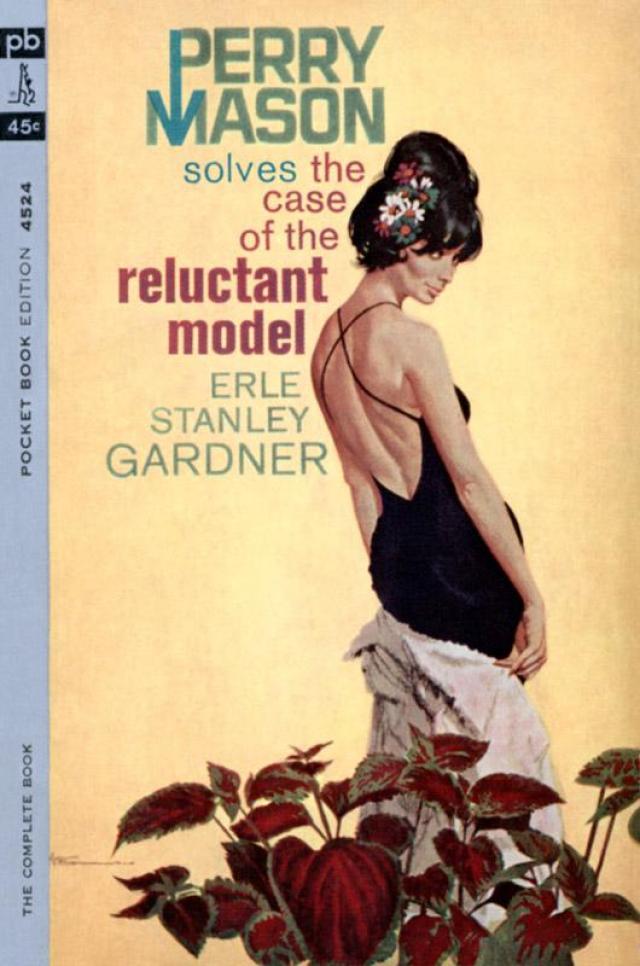


The Case of the
Reluctant Model
by
Erle Stanley Gardner
Copyright © 1961 Erle Stanley Gardner.
Renewed 1989 by Jean Bethel Gardner and Grace Naso
Electronic Book: Copyright © 2012 by The Erle Stanley Gardner Literary Trust
All rights reserved.
Contents
Copyright
Foreword
Cast of Characters
Chapter 1
Chapter 2
Chapter 3
Chapter 4
Chapter 5
Chapter 6
Chapter 7
Chapter 8
Chapter 9
Chapter 10
Chapter 11
Chapter 12
Chapter 13
Chapter 14
Chapter 15
Chapter 16
Chapter 17
Chapter 18
Chapter 19
About the Author
Foreword
The Honorable James M. Carter, one of the judges of the United States District Court in San Diego, is one of the most competent trial judges I know and an outstanding humanitarian to boot.
Not only do police and penologists respect Judge Carter but the men he sentences to prison, for the most part, share that respect.
For one thing, Judge Carter’s thinking isn’t only in multiples of five, ten or fifteen years as is the case with so many judges who pass out sentences. He thinks of each long year as a twelve-month period. For another thing, after Judge Carter sentences an individual, he has that man brought back into his chambers. There the judge divests himself of his judicial robes and talks man to man. He explains to the individual why he is being sent to prison and why he fixed the term he did. He tells the man he wants him to make good while in prison, that if he has any trouble the judge wants to know about it. Judge Carter asks the defendant to keep in touch with him.
Word percolates around, therefore, that Judge Carter is not only a just judge, but is a great humanitarian.
It was that reputation which caused an American Indian, the mother of a young man who had been convicted by Army court-martial of murder without malice and who was serving a twenty-year term, to write Judge Carter that she felt an injustice had been done.
Knowing of my interest in such matters, Judge Carter suggested that she write me and then kept in touch with me to find out what I learned about the case.
At my request, the mother sent me a transcript of the evidence and, as I studied it, it became apparent that the question of whether there ever had been any murder in the case depended upon an interesting medical conclusion. The consulting pathologist who testified at the military trial had not seen the deceased but based his testimony on the findings of the autopsy surgeon and had, apparently, gone farther than the autopsy surgeon was willing to go.
For some years I have been greatly impressed with the importance of legal medicine, its place in the administration of justice and the necessity for a better understanding on the part of the public of what it is and how it functions.
From time to time I have dedicated books to outstanding figures in the field of legal medicine.
So I chose, at random, several of these persons to whom I had dedicated books. I had my secretaries copy all the medical evidence in the transcript and send it to these people asking for their opinion on the medico-legal aspects of the case. (Since the consulting pathologist called by the prosecution had based his opinion solely on the records of the autopsy, these experts whom I called into the case had exactly the same factual evidence from the protocol and the transcript that this consulting pathologist had used in reaching his opinion.)
I limited my selection to the number of experts who could be given legible carbon copies from one run on an electric typewriter because the material was so voluminous it presented a major secretarial undertaking.
These experts, top men in their field, many of them working day and night, responded with opinions. As fast as these opinions were received I had them copied and sent out in a round-robin to all of the persons connected with the case.
Some of these experts were so conscientious that they refrained from reading the opinions of the other experts until after they had formulated their own opinion, lest they be influenced by the others’ thinking.
It was an exacting job, reviewing the mass of medical evidence and reaching an opinion; particularly in view of the fact that these experts knew their opinion would be publicized to the extent of asking for a review of the case.
I am proud of the manner in which these busy men went to work studying the evidence in this case of a penniless American Indian who had been convicted of a murder, which, it, soon developed, had in all probability never been committed.
Almost at once these experts pointed out a peculiar discrepancy. The consulting pathologist had acted upon a mistaken assumption that certain significant hemorrhagic conditions had existed, whereas the autopsy surgeon had not only failed to find such hemorrhagic conditions, but had considered their absence a significant point in reaching his conclusions.
For a period of months reports came in; well-reasoned, carefully though-out reports. And the majority were to the effect that under the peculiar circumstances of the case it was quite possible the victim had died a natural death.
This victim was an elderly, quarrelsome man who had the reputation of being the village drunkard and engaging in altercations when he was inebriated. The post-mortem findings showed beyond question that he was pretty well intoxicated at the time of his death and his reputation indicated that not only was he abusive and quarrelsome under those circumstances, but that he had probably picked a fight with the young Indian and could well have met his death not as a result of that fight, but some time later and from natural causes.
The Indian had been on a drinking spree with a companion and upon subsequently regaining his senses had insufficient recollection of what had happened to be of any help.
Listed in alphabetical order, the forensic experts, many of whom are lawyers as well as doctors, who submitted detailed reports were:
Lester Adelson, M.D.
Pathologist and Chief Deputy Coroner
County of Cuyahoga Coroner’s office
Cleveland, Ohio
Francis Camps, M.D.
London, England
Daniel J. Condon, M.D.
Medical Examiner of Maricopa County
Phoenix, Arizona
Russell S. Fisher, M.D.
Chief Medical Examiner of
Baltimore, Maryland
Richard Ford, M.D.
Professor of Legal Medicine
Harvard University
Boston, Massachusetts
S. R. Gerber, M.D.
Coroner, County of Cuyahoga
Cleveland, Ohio
Milton Helpern, M.D.
City of New York,
Office of Chief Medical Examiner
New York, New York
Joseph A. Jachimczyk, M.D.
Office of Medical Examiner of
Harris County
Court House
Houston, Texas
Alvin V. Majoska, M.D., Pathologist
Honolulu, Hawaii
LeMoyne Snyder, M.D.
San Francisco, California
Under the new revised military code many authorities feel that the military system of criminal justice approaches the ideal method of handling criminal cases. The rights of the accused are protected, but procedural technicalities are designed to facilitate proof and insure complete fairness, not as technical loopholes.
Even after conviction and the expiration of the time for appeal, a reviewing board makes an annual check-up on the prisoner and the rules are sufficiently flexible so that many matters concerning the prisoner can be given consideration at the discretion of the board.
In this case, the reports of the medical experts were passed on to the reviewing board and the careful attention given by the board, the courteous interest shown in every phase of the case, has been most reassuring.
Judge Carter made several trips from his residence in San Diego to my ranch at Temecula, interrupted his busy schedule to make a careful analysis of the evidence and made a special trip to the institution where the young man was confined, to interview him.
The file in this case has grown to huge proportions. The man-hours spent in the investigation and presentation are staggering.
Even a wealthy man could hardly afford to consult such an array of medical talent. Yet these men furnished their services gratuitously to review the case of a penniless Indian boy. Devoted to the cause of justice, these men took no count of the cost.
In these days we hear much of conflicting ideologies. Perhaps, just as we take the air we breathe for granted, many of us fail to realize the advantages we enjoy under the concept of justice which is so much a part of our traditional background.
And so I salute the military code in which ultimate justice takes precedence over technicalities, and I dedicate this book to those men who gave so unselfishly of their time to investigate the case of a penniless Indian.
Erle Stanley Gardner
Cast of Characters
PERRY MASON–A master of abstract expressionism; his courtroom techniques are as colorful as a modem painting
DELLA STREET–Perry’s amanuensis–she didn’t know anything about art, but she knew what he liked
/> LATTIMER RANKIN–in attempting to play to the gallery, this art agent would have made an exhibition of himself if it hadn’t been for Mason’s advice
PHELLIPE FETEET–his painted sunlight effects cast shadows over many lives after he was dead
MAXINE LINDSAY–an alluring artist whose brush with the law smears her almost irrevocably
Roy HOLLISTER–despite this attorney’s caution, Perry gets him out on a limb–but it’s a beautiful one!
OTTO OLNEY–this financier cruises more women than seas on his palatial yacht; he is an avid collector of well-done paintings and rare women
CORLISS KENNER–an art expert who can tell a copy from an original in paintings and gowns
GEORGE LATHAN HOWELL–A connoisseur of paintings and women and an expert appraiser of both–he could distinguish the false from the real
COLLIN M. DURANT–A double-dealing art dealer who put too much emphasis on framing and not enough on painting
PAUL DRAKE–the eye who never sleeps–his operatives get the fascinating assignment of trailing a comely model to her assignations
GORING, GILBERT–A beat painter with a pad and a palette, but no taste for money
DEPuTy D.A. DEXTER–he gives the Court a lesson in the fine art of cross-examination
JUDGE CROWLEY MADISON–brief skirts hold no brief for this astute judicator
DR. PHILLIP C. FOLEY–autopsy surgeon whose “death thermometer” findings are accurate–until Mason raises his temperature
MATILDA PENDER–she monitored the bus-station lockers, so finding the murder weapon was all in the day’s work to her
AGNES NEWTON–this female Janus was a short-sighted witness
HAMILTON BURGER–Perry paints a courtroom that has a blinding impact on this district attorney, but it opens his eyes at the same time
Chapter 1
Perry Mason, opening the door of his private office, grinned at Della Street, his confidential secretary, and said, “All right, so I’m late.”
Della Street, glancing at her wrist watch, smiled indulgently. “Okay, so you’re late! And if you want to sleep late I don’t know anyone who’s more entitled to do so–only I’m afraid we’re going to have to buy a new carpet for the reception room.”
Mason’s eyes were puzzled. “A new carpet?”
“This one’s getting worn out.”
“What do you mean, Della?”
“You have a client who has been waiting since one minute before nine o’clock when Gertie opened up the office. The trouble is he won’t sit still. He’s pacing the office at the rate of five miles an hour, looking at his watch every fifteen or twenty seconds and demanding to know where you are.”
“Who is it?” Mason asked.
“Lattimer Rankin.”
Mason frowned. “Rankin,” he said, “Rankin…. Isn’t he the one who has something to do with pictures?”
“The big art dealer,” Della Street said.
“Oh, yes, I place him now,” Mason told her. “He’s the one who testified as to the value of the painting in that civil suit–and he gave us a picture. What the devil did we do with that picture, Della?”
“It’s gathering dust in the storeroom off the law library. That is, it was until five minutes past nine this morning.”
“And then what?” Mason asked.
“Then,” Della Street said, “I got it and hung it just to the right of the door where a client will see it when he sits in the client’s chair.”
Della Street indicated the painting.
“Good girl,” Mason said approvingly. “I wonder if you’ve hung it upside down.”
“It’s all upside down if you ask me,” she said, “but at least we’ve got it there, and there’s a label on the back of the picture that has the name of Lattimer Rankin and the address of his place of business. If the label’s right side up, the picture is right side up.
“So if he looks at you disapprovingly and says, ‘Mr. Mason, you’ve got the picture upside down,’ you can look right back at him and say, ‘Mr. Rankin, you’ve got your label upside down.”
“Fair enough,” Mason said. “Let’s get him off the tenterhooks. Bring him in, Della. I knew I didn’t have any early morning appointments so I was cheating a little bit on office hours.”
“I told him you were on your way,” Della Street said, “that you’d been detained in a traffic jam.”
“How did you know?” Mason asked, grinning.
“Telepathy,” she said.
“Do you plan to read my mind all the time?” he asked.
“I’d be afraid to all the time,” she said archly. “I’ll get Mr. Rankin in before the carpet is entirely threadbare.”
A few moments later Della Street opened the door and Lattimer Rankin, a tall, dark, grim-faced individual, with piercing gray eyes, came striding into the room as though he had been walking in a marathon contest and didn’t want to break his stride. He moved across to Mason’s desk, gripped the lawyer’s hand with his own huge, bony hand, swept the office in a brief survey, said, “I see you’ve hung my picture. A lot of people didn’t appreciate that artist’s work but I’m glad to tell you it’s going across very nicely now. I knew it would. He has power, harmony–Mason, I want to sue a man for libel and slander.”
“No, you don’t,” Mason said.
Mason’s comment caused Rankin to straighten up. “I think you failed to understand me,” he said with cold emphasis. “I have been slandered. I wish to retain you to file suit immediately. I want to sue Collin M. Durant for half a million dollars.”
“Sit down,” Mason said.
Rankin settled himself in the client’s chair with the stiffness of a carpenter’s rule being folded up. The man seemed absolutely rigid except at the joints.
“I want the suit to get all the publicity we can give it,” he said. “I want to drive Collin M. Durant out of town. The man is incompetent, he’s a fourflusher, a publicity-seeker, an unethical competitor, and he has none of the instincts of a gentleman’”
“You want to sue him for half a million dollars,” Mason said.
“Yes, sir.”
“And you want lots of publicity.”
“Yes, sir.”
“You want to claim that he damaged your professional reputation.”
“That’s right.”
“To the tune of half a million dollars.”
“Yes, sir.”
“You will,” Mason pointed out, “have to specify the manner in which he did this.”
“He did it by intimating that I am incompetent, that my judgment is unsound, that I have victimized one of my customers.”
“And to whom did he make these statements? How many people?” Mason asked.
“I have long suspected that he has made them by innuendo to anyone who would listen, but now I have a very definite witness–a young woman named Maxine Lindsay.”
“And what did he say to Maxine Lindsay?”
He said that a painting I had sold Otto Olney was a rank imitation and that any art dealer worthy of the name would have recognized it as such as soon as he saw it.”
“He made that statement only to Maxine Lindsay?”
“Yes.”
“In the presence of witnesses?”
“There were no other witnesses except Maxine. Under the circumstances you would hardly have expected any.”
“What circumstances?” Mason asked.
“He was engaged in trying to promote his own stock with the young lady–making a pass, I believe is the popular expression.”
“Has she repeated the statement?” Mason asked. “That is, has she spread it around any?”
“She has not. Maxine Lindsay is an art student. I was able to help her two or three times. I have given her some bargains on painting materials and she is grateful. She came to me at once and told me she thought I should know what Durant was doing. I knew, all right, but this was the first time I had had an opportunity to prove it.”
“All right,” Mason said, “I will now repeat my statement. You don’t want to sue.”
“I’m afraid I don’t understand you,” Rankin said with formality. “My credit certainly is good. My checkbook is here. I am prepared to give you a retainer. I want suit filed at once. I want to file suit for half a million dollars. Surely the courts are open to me, and if you don’t wish to take my case—”
“Come on down to earth,” Mason said. “Let’s talk facts.”















