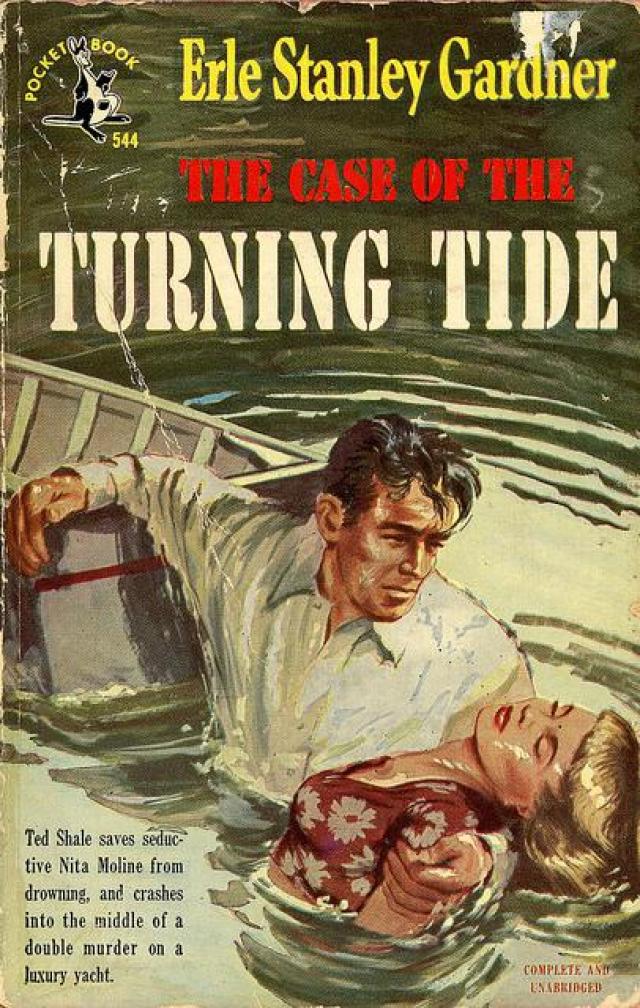
The case of the turning.., p.2
The Case of the Turning Tide,
p.2


Lassen said, "Been a double murder on a Los Angeles yacht, Frank. Man by the name of Stearne who owns the yacht, and a friend of his named Right. I've notified the coroner and the chief of police. Better get down here right away."
"Where are you now?"
"At the yacht club."
"What's the yacht?"
"The Gypsy Queen II."
Duryea said, "Okay, I'll be down directly," started to hang up, then said, "Oh, hello, Pete."
"Yeah."
"Where are the bodies, aboard the yacht?"
"Yes."
"Who's there? Anyone?"
"Yeah. Art Perrin, and—and here's Sam Krause coming."
Duryea said, "Don't let them move anything until I get there. Any witnesses?"
"We've got three people who know something about it. They've all been in the drink."
"All right, hold them," Duryea said.
He hung up the telephone, and finished the last of his tomato juice.
"As important as all that?" Milred asked.
"Uh huh. A double murder."
"All right, go ahead. I'll be a dutiful wife, and give you first crack at the bathroom."
"No shave, no shower," Duryea said, peeling off the coat of his pajamas, and pulling his undershirt on over his head. "Pete Lassen has pulled his usual stunt of notifying me last. The coroner was just driving up as he telephoned, and Art Perrin, the chief of police, is already on the yacht. That means he called them about half an hour ago."
Milred pulled Frank's pillow over behind her head so that she could prop herself up in bed, and said, "Hasn't he been doing a lot of that lately?"
"Uh huh," Duryea said.
"Put some powder on your face if you're not going to shave, Frank. You look ragged."
"Can't help it," he said. "Three witnesses, and all of them have been in the water."
"How did that happen?"
"I don't know. Pete didn't say."
"Frank, is it true that Oscar Romley is going to run against you?"
"Darned if I know," Duryea said, knotting his necktie. "There's been some talk of it. There are half a dozen potential candidates who'd like the job."
"Frank, that shirt's been worn and looks it. Can't you . . ."
"Haven't time to break out a clean one," he said, opening the closet door and jerking his coat off a hanger. "What about Romley?"
"Oh, nothing. Only I saw Romley and Jerry Bellinger holding a low-voiced conversation on the street. They gave the impression of having their heads together. They started when they saw me—a guilty start like small boys in the jam when mamma opens the pantry door. Better watch your step."
"Okay. If I'm not back in a couple of hours, take the car if you want it."
"I don't want the car. I want to go back to sleep. You take the car."
Duryea said, "Be seeing you."
"You left your hat on top of the radio when we came in last night," she told him, snuggling back down into the bed. "Are you going to pull down those shades, or do I have to?"
"You have to," Duryea said. "If I'm gone all day, it'll be the only exercise you'll get." He went out through the dining room, grabbing his hat off the radio, and slamming the front door.
Quite a crowd of people were gathered at the yacht club float, staring out at the yacht. One of the city police officers was on guard, saying occasionally, "Keep moving, folks. Keep moving. Don't block the road here. Keep moving."
No one paid him the slightest attention.
The officer saw Duryea, nodded, and said, "The chief's out there with the sheriff. Guess you can take any one of these boats."
Duryea felt unusually conspicuous as he cast loose the line of a small dinghy. He wasn't particularly accomplished as an oarsman, and realized keenly the loss in political prestige which would come from catching a crab in front of this silently curious crowd.
Duryea's progress to the yacht was awkward but safe. He worked the oars entirely with an arm motion. The horizon seemed suddenly possessed of a desire to spin around in crazy circles, but eventually he reached the yacht, tied up the dinghy, and climbed aboard.
Sam Krause, the coroner, A. J. Perrin, the chief of police, and Bill Wiegart, a deputy sheriff who handled fingerprints and photography, were all on the yacht.
Duryea said, "Hello," and, although he had seen all of these men within the past forty-eight hours, went through the formality of shaking hands, as though a murder had in some way interrupted their relationship and made this meeting something in the nature of a reunion.
He went down into the cabin and regarded the two sprawled figures. His stomach, never very strong in the morning, became decidedly squeamish. He knew that presently he was going to be sick.
"Where are the witnesses?" he asked Lassen.
"In the pilot house up forward."
"I'll go talk with them," he said, and it sounded to him as though the words came through his clenched teeth. He turned and hurriedly sought the air; but even the freshness of the ocean breeze and the warm sunlight couldn't erase what he had seen from his mind. He didn't want to talk with the witnesses. He didn't want to talk with anyone.
"Kinda tough," the sheriff said, joining him.
Duryea nodded, said, "I hadn't had breakfast. It's too much for an empty stomach. How many witnesses are there?"
"Three: man by the name of Shale, a salesman; girl by the name of Harpler from another yacht—she's the one in the bathing suit. Girl by the name of Nita Moline, easy on the eyes, came up from Los Angeles on invitation to join Stearne on a yachting party. Knows both of them, has an alibi, if what she says is true. They've all been in the drink. Guess I'd better go in with you and introduce you. Addison Stearne was the man lying on his back with his eyes open. The younger fellow was C. Arthur Right. Okay, let's go."
The sheriff performed the introductions.
Duryea said wearily, "Tell me what you know. Hit the high spots. I'll ask questions about details. Which one of you is Miss Moline?"
The golden-haired girl nodded.
"You first," Duryea said.
"I'm acquainted with both Mr. Right and Mr. Stearne. I'm —we were all good friends. They came up here yesterday. Addison told me he was going to give the crew twenty-four hours' leave after he tied up. . . . Listen, I've got to go get some dry clothes on. I'm cold."
"In just a minute. What time did you get here?"
"An hour or so ago. I don't know the exact time. The skiff for the yacht was tied up at the float. I got in and rowed to the yacht. I rather expected someone would take the painter and help me aboard. No one showed up. I got aboard by myself, and tied up the skiff. I thought at first they were all asleep, then I looked down in the cabin and—I came up. I—I remember leaning over the rail. The next I remember 1 was sitting up in a boat. These two people were with me."
Duryea asked, "When did you last see them alive?"
"I hadn't seen Arthur for a couple of days. I saw Addison yesterday morning just before he left. I drove him down to the yacht harbor. ... I simply can't stand these clothes any longer!"
"Why didn't you come up on the yacht?"
"I had an appointment at the hairdresser's and some other things to do. I've told the sheriff all this."
"What time did you leave Los Angeles?"
"It was real early, right around six o'clock."
Duryea turned to the other young woman. "You're Miss Harpler?" he asked.
"Joan Harpler."
"What do you know about it?"
"Nothing."
Shale met Duryea's eyes. He said, "I think this is a damned outrage, keeping us here while we're all sopping wet. I can tell you my story in a few words. I got up early this morning, went down to the beach to take a walk, saw Miss Moline come out of the cabin and fall overboard. I grabbed the first boat I came to that had oars and oarlocks in it, and rowed out to rescue her. Miss Harpler got there just about the same time I did. Together, we got her in the skiff. I knew she belonged on this yacht, and thought there was probably someone here who'd be interested in what had happened. I went aboard to find out, and saw the two bodies down in a cabin. I didn't go down. That's all I know."
"You don't live here?" Duryea asked.
"No."
"Where do you live?"
Shale hesitated, said, "I travel."
"A salesman?"
"Yes."
"Whom are you with now?" "The Freelander Pasteboard Products Company."
"What brought you here?"
"Business."
"Now when you came to the yacht, was there any small skiff or boat . . ."
"Yes, that one tied up to the rail."
"That was the one in which I came aboard," Miss Moline said. "And if you don't realize it, it's dreadfully cold here."
"Just one or two more questions," Duryea said. "The yacht came up here yesterday?"
"That's right."
"Was Mr. Right aboard when you drove Mr. Stearne down to the yacht club at Los Angeles?"
"No. He hadn't showed up then, and I didn't wait. 1 had a beauty-shop appointment."
"I suppose you can prove all of this."
Her eyes were scornful. "Naturally."
"Where can I reach you, Miss Harpler?"
"I'll be aboard my yacht, the Albatross."
"You, Miss Moline?"
"As soon as I can leave here, I want to go back to Los Angeles."
"What's your residence there?"
"Six-o-nine Maplehurst Apartments."
"And you?" Duryea asked of Shale.
"I'm at the Balboa Hotel."
"How long do you intend to remain there?"
"Not very long."
"You'll be there all day today?"
"No. I'm leaving."
"I'm going to have to ask you to stay over at least one more day."
Shale said, "It costs money to stay here. I can't afford to . . ."
Duryea said, "I can probably make arrangements with the hotel. The county isn't very generous with me on such matters. The supervisors adopt the position that we maintain a proper boarding house."
"The jail?"
"Yes."
"Surely, you're not going to . . ."
"That's just it," Duryea said. "We have a wing on the jail we call a detention ward, but it's part of the jail just the same. You're a material witness. I don't want you to leave here until after I've checked into this a little more fully."
"There's not much chance I could walk along the beach and kill ..."
"I'm not accusing you of anything. I'm simply telling you I want you to stay as a material witness."
"For heaven's sake," Miss Moline said, "quit arguing with him. I'll pay your expenses at the hotel. Listen, there's some whiskey in the liquor closet, and . . ."
"I don't think it's wise to touch anything," Duryea said.
She flared at him, said, "You wouldn't!" stamped a soggy foot, and raised fingers to the fastening of her slacks. "I'm going to get out of these clothes right now."
Duryea said hastily, "Thafs all. You may all go."
Joan Harpler said to Nita Moline, "Suppose you come over to my yacht. I can fix you up with some clothes."
"Thanks. They'll be more than welcome," Miss Moline said.
There was a moment's silence. Joan Harpler looked at Ted Shale. "I suppose there's no way I could—I'm sorry."
Ted laughed. "Forget it. I'm on my way to the hotel."
CHAPTER 3
FRANK DURYEA stopped in at a restaurant on the road home for a cup of coffee. He noticed that his hand was shaking slightly as he poured a spoonful of sugar into the steaming liquid. Well, after all, he told himself, he'd been up until three o'clock, had rolled out at nine, and then had this murder case dumped into his lap. He felt pretty shaky. The hot coffee revived him somewhat.
Driving home, he found himself thinking of a dozen questions he should have asked the witnesses. However, it wouldn't have been wise to keep them there in their wet clothes. If one should turn out to be suspect, a clever lawyer could make a grandstand play to the jury by harping on how the accused had been kept standing in wet clothes while being interrogated, first by the sheriff, and then by the district attorney.
Duryea rounded the corner, swung wide for his driveway, and then, with an exclamation of surprise, slammed on the brakes and stopped the car. A somewhat dilapidated-looking automobile and a house trailer which bore the unmistakable stamp of being what was known in the trade as "a backyard job" were parked in his driveway.
Duryea parked his car parallel to the curb, got out, and walked up the steps of his bungalow, regarding the visiting car and trailer dubiously.
Milred, attired in sharkskin slacks, came to the door. Ignoring the fact that he already had his latchkey in the lock, she made quite a ceremony of opening the front door.
"Why, hello, Frank! I didn't expect you'd be back so soon. Guess who's here?"
Her voice was raised sufficiently to be distinctly audible to a visitor who was in the Living room, and she accompanied her question with the distress signal of a lowered right eyelid— a wink so violent that it twisted up the right-hand corner of her mouth.
Duryea winked back and raised his voice. "Gosh, 1 don't know. Who is here?"
"Gramps."
Duryea looked blank.
"You remember. Grandfather Wiggins. I've told you about him. You never met him, though. He was down in Mexico when we were married. Remember? He . . ."
Duryea heard quick steps coming across the living room, then an under-sized man with twinkling eyes, white hair, a close-cropped white mustache, and quick motions, so spry they seemed birdlike, came bearing down on him.
"It's all right, my boy! She's trying to break it to you easy. I'm bad news, but I ain't goin' to stay. Got Milred up out o' bed on a Sunday when she wanted to sleep, that's what I did! Just a damned old nuisance. She said you'd been up until three or four o'clock this morning makin' whoopee. More power to you. Didn't think you had it in you. Thought you was pantywaist. Heard you was district attorney, an' thought you'd be somethin' of a stick. How are you, son?" Grandpa Wiggins shot out his right hand, shook hands, said, "Turn around to the light. Let's have a look at you."
Duryea saw twinkling blue eyes surveying him through 15
steel-rimmed glasses, eyes framed in a network of kindly crow's-feet. "Look all right," Wiggins said. "Damn it, you look human. Had any breakfast?"
"Not yet," Duryea said. "We'll go out and get something. The maid's off for a couple of days, and . . ."
"Have breakfast with me," Wiggins said. "No use spendin' money at a restaurant. I'm the black sheep o' the Wiggins family, but I'm a good cook. I'll go cook up some breakfast. Good idea-mighty goodl I'll get out an' Milred'll give you the dirt on me. I've been a heller, an' I ain't reformed yet. I'm the rollin' stone that's gathered no moss. All right, folks, when you hear me beatin' on the bottom of a fryin' pan, that'll mean breakfast's ready. Nothin' fancy, now. Just plain wholesome grub, but it'll do you good."
He nodded three or four times, beaming at them, then turned and darted across the living room, through the dining room, and out to the kitchen. Duryea had a departing glimpse of fast-moving legs, of baggy, somewhat frayed trousers, sur-mounted by a completely disreputable sweater.
When the bang of the back door announced their guest had left the house, Milred looked up at him. "Well, that's it, Frank. That's the family skeleton in the Wiggins closet."
Duryea asked, "What do we do with him?"
She said, "We dpn't do anything with him. No one ever has yet. The question is what he's going to do with us. He's capable of darn near anything. Honestly, Frank, I never thought you'd have to see him. That's why I never told you more about him. He doesn't like cops or the law, and, knowing you were a district attorney, I thought he'd give you a wide berth."
Duryea grinned. "What's he done?"
"Oh, everything and nothing. I think he did a little boot-legging once. He hates conventional things. He likes people who are—well, sort of on the fringe. He's always getting chummy with some down-and-outer. The last time I saw him, he was telling about a bank robber he knew, said he was a splendid chap—that the only difference between whether you robbed a bank or whether the bank robbed you was which one got there first. He's simply impossible, Frank—and yet he's likeable."
Duryea said, "I thought he had some mining property down in Mexico."
"He did. They took it away from him. He has some sort of an annuity that keeps him going. He just doesn't care enough about money to be bothered with it. Frank, I'll get rid of him by tomorrow, but if it isn't too much, can you put up with him today?"
Duryea slid his arm around her shoulders. "Sure thing, hon. Why shouldn't I put up with him? He's your family."
"I know, but he's so thoroughly unpredictable, and—gosh, you just can't tell what he'll do. I remember Dad telling stories about him. Dad was methodical and prudent, and—well, I think Grandfather hated him—said he took after his mother's side of the family."
"Where in the world did he get that trailer?" Duryea asked. "And where's he been?"
"He made the trailer himself, and he's been everywhere. I tell you, Frank, he has the weirdest assortment of friends and cronies scattered around the country, and . . ."
Duryea patted his wife's shoulder. "Listen, babe, you're all worked up. Sure, I'll like him—only we'll have to put him in the guest room, and get that trailer out of the neighborhood."
"You won't get Gramps Wiggins out of the trailer," she said. "That's his. It's his home."
"Been in it yet?" Duryea asked.
"No. He only got here about half an hour ago, and I kept him waiting while I bathed and dressed."
"Reminds me, I'm going to shave."
"You'd better hurry," she warned, "because Gramps moves like chain lightning. He's never able to stay put. Heaven knows what he'll cook for breakfast, but it won't be long before he'll be beating on the bottom of that frying pan."
Her husband made a grimace. "And me with a head," he observed. "Better go out and head off that frying pan business, Milred. The neighbors might not like it."
"Okay, you hurry with your shaving. I'll do my best. But if he says he's going to beat on a frying pan, it's my own private opinion that he's going to beat on a frying pan."