The case of the empty ti.., p.25
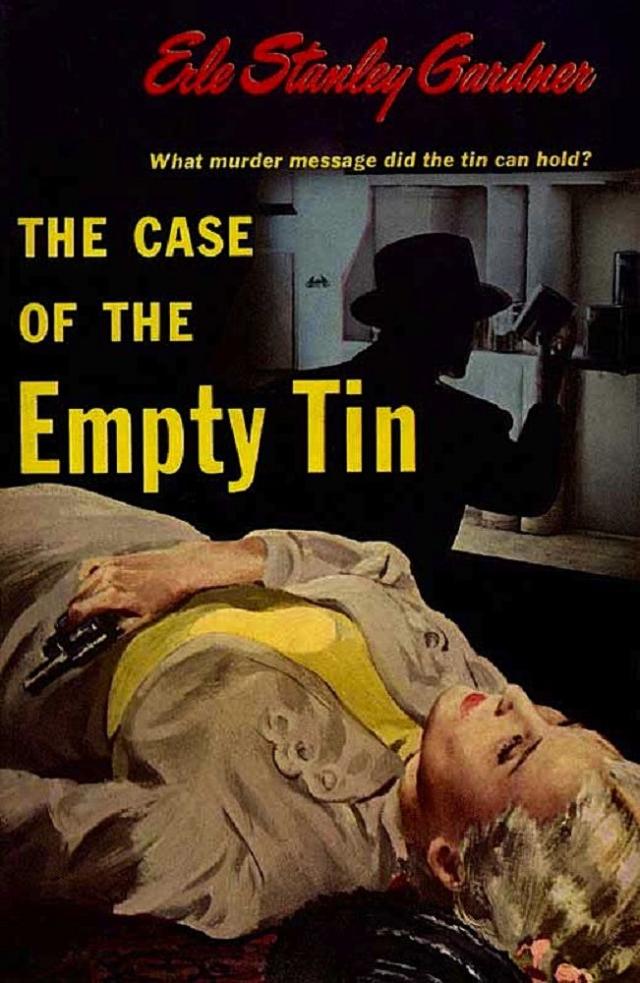
The Case of the Empty Tin (Perry Mason Series Book 19),
p.25


“You never would have got any of this if Mason hadn’t lied to me about Rodney having married that creature. I couldn’t go ahead with the scheme of killing Florence, because he sounded so drunk that he couldn’t have remembered what I told him. I have no regrets. I did what I did for the man I love. . . .”
“That’s enough,” Mason said. “It will give Tragg everything he needs.”
“How about the person who broke into her darkroom and lit a match?” Della Street asked.
Mason laughed. “Just a little more alibi stuff. Those films weren’t fogged. She simply pretended to be trying to help. She was really manufacturing a lot of confusing details.”
“And she flew to San Francisco?”
“Sure. She had a meeting of a crossword-puzzle club, and there was an opera afterwards, so she had a good excuse for one of her infrequent absences from the house.”
“I never would have suspected her,” Della said.
Mason was thoughtful. “I should have suspected her sooner than I did. Any person who has studied criminology recognizes in that type the most dangerous potential murderer. She was a creature of repressions, a sex-starved, disappointed female. By pretending to fall in love with her, Wenston had no trouble whatever in making her an accomplice. She’d have done anything for him. You have only to read any of the well-authenticated works on criminology to recognize her counterpart in dozens of murders.”
“Did you have any idea the picture was faked?” Della asked.
Mason said, “Yes. Gow Loong tipped me off to that. He’s Chinese. His eyes notice little details which we pass up, probably because the Chinese have such marvelous memories. He noticed that the picture of the Wickford family group showed a face on the father which was not only like the photograph of the picture of Tucker taken in Shanghai, but was absolutely identical with it in every line and shadow. Gow Loong didn’t know enough about photography to realize what this meant, but, as is the case with Chinese the world over, being confronted with something he couldn’t understand, he became suspicious.”
“How about Opal Sunley?”
“Just a good kid,” Mason said, “who knew something mysterious was going on. She knew she was being paid to keep her mouth shut, and she kept it shut. She was there to transcribe records. She transcribed them. She didn’t ask any questions and didn’t try to find out what was going on. Of course, Junior was in love with her. When he heard what he thought was a shot in the adjoining house, he dashed over there to investigate, because he was afraid Opal might have returned to the residence of her employer. He was in love. Her reticence about her job made him think she was having an affair with her boss. He was suspicious, and he was jealous. When he didn’t find her there, he telephoned her. Notice her number was one that could be easily dialed in the dark. When she answered, he pretended he was calling from his own house. He then went back home, ashamed of himself. He never wanted her to know that he had suspected her to the extent of going over to the adjoining flat and making a search. He’s young and romantic. He would have even gone to jail before he’d have told the truth. Della, we actually are approaching the beach.”
“Well, it does look like it,” Della said. “You don’t suppose that I got my directions mixed, do you? How about the charred remnants of the clothes Tragg found out at Mrs. Perlin’s bungalow?”
Mason said, “That’s simple. Karr went to San Francisco to be treated for his wound. According to the story he told the doctor there, he’d been shot after he’d retired. That left them with some bloodstained clothes to get rid of; trousers, underwear, shirt, possibly a coat, and most certainly a pair of shoes. When Karr came back, he gave those things to Mrs. Perlin, told her to keep out of sight for a while, and to dispose of those clothes. She burnt them in the furnace at her bungalow.”
“Why did they have her disappear?” Della asked.
“Probably because she was the weak link in their organization. She couldn’t have stood up to police questioning. Della, we definitely are headed toward the beach.”
“Well—”
Mason said, “We’ll have to telephone Gertie. Be kind of nice to cover up with warm sand and doze off to sleep, then plunge in the salt water.”
“Uh huh. Ham and eggs and coffee would be nice, too.”
“Stack of buckwheats on the side?” Mason asked.
“No. That’s too heavy. I have to watch my figure, you know.”
Mason grinned. “Not when you’re on a beach in a bathing suit, you don’t, baby. Plenty of other people are doing that for you.”
She smiled across at him. “You’re awfully nice,” she said. “It wouldn’t be so bad getting scared to death in murder cases if there were only longer interludes in between. Will we take a spin in the speedboat?”
“Will we go out in the speedboat!” Mason echoed. “Well, I hope to tell you! After we’ve had a little sleep, we’ll charter a speedboat and tear the ocean wide open. Speed, in case you haven’t noticed it, is our middle name.”
By way of illustration, Mason’s foot pressed down on the foot throttle until the speedometer needle went quivering up into the high figures.
Della Street smiled, said, “Yes, I’d noticed,” and then, adjusting the mirror on the sunshield of the car so she could apply powder to her nose, she added evenly, “And in case you’re interested, there’s a gentleman behind you on a motorcycle who seems also to have observed that trait in your character.”
Mason slowed the car, started reaching for his wallet containing his driver’s license. The siren wailed as the motorcycle officer putted alongside. “What’s the idea?” he asked, as Mason sheepishly slowed the car to a stop.
Della Street leaned across the steering wheel. “What’s the idea of stopping us?” she demanded indignantly. “We’re rushing down to interrogate some witnesses in that Hocksley murder case.”
“You one of the boys working on that?” the officer asked.
Della Street said, “Well, I hope to tell you. He’s Lieutenant Tragg’s brother!”
The officer grinned and waved them on. “Go to it,” he said. “We just got a radio report Tragg had cracked that one.”
As Mason eased the car into gear, Della Street smiled at him and said, “After all, there’s no use having relatives if you can’t get some good out of them once in a while.”
About the Author
Author photo courtesy of the Harry Ransom Center, The University of Texas at Austin
Erle Stanley Gardner (1889-1970) is a prolific American author best known for his works centered on the lawyer-detective Perry Mason. At the time of his death in March of 1970, in Ventura, California, Gardner was “the most widely read of all American writers” and “the most widely translated author in the world,” according to social historian Russell Nye. He was cited by the Guinness Book of World Records as the #1 Bestselling Writer of All Time. The first Perry Mason novel, The Case of The Velvet Claws, published in 1933, sold twenty-eight million copies in its first fifteen years. In the mid-1950s, the Perry Mason novels were selling at the rate of 20,000 copies a day. There have been six motion pictures based on his work and the hugely popular “Perry Mason” television series starring Raymond Burr, which aired for nine years and 271 episodes.
Erle Stanley Gardner, The Case of the Empty Tin (Perry Mason Series Book 19)