Hot cash cold clews, p.28
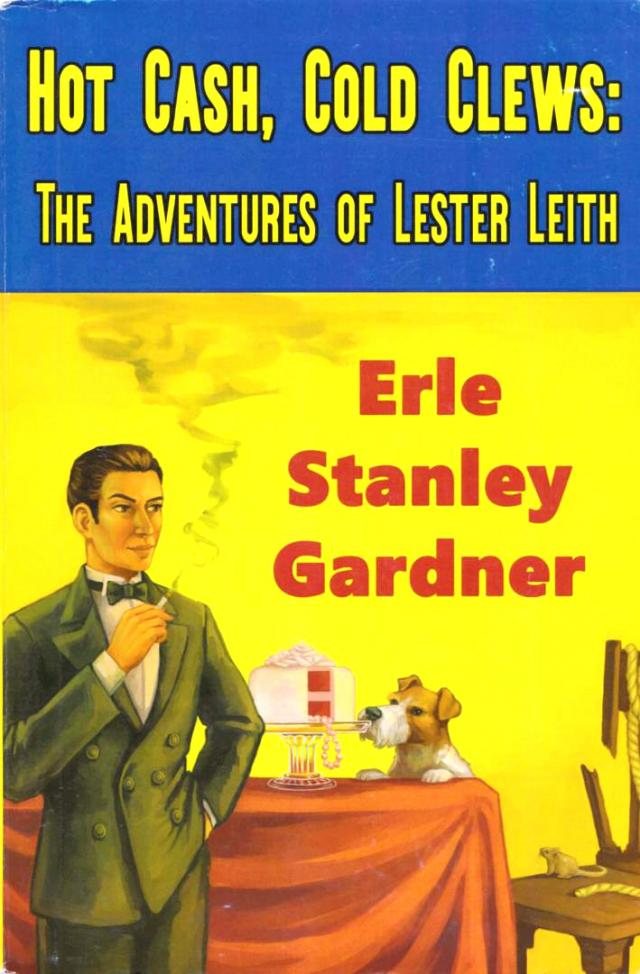
Hot Cash, Cold Clews,
p.28


“That is why Senor Jose Camulos, coming from South America with a very fine string of diamonds, arranged in advance for an appointment with Mr. Riggers, sir. It seems the necklace was very valuable, and Senor Camulos had used every precaution to conceal the fact that he had it with him.
“He went at once to the office of Mr. Riggers, and there exhibited the necklace. Mr. Riggers was examining it to ascertain what sort of an offer he could make on it, when the door of his private office was thrown open and a masked man entered the room. He had an automatic and he demanded that both men raise their hands.
“He looked desperate and they surrendered the diamonds to him. He turned and ran from the office. Mr. Riggers shouted an alarm, but the man made good his escape.”
Scuttle pawed the newspaper clippings. “Here’s a sketch plan of the store and a dotted line showing the course taken by the man as he ran from the store, sir.”
Lester Leith took the newspaper clipping, but did not look at it immediately. “How about the clerks in the store, Scuttle? Did they see the man who committed the crime?”
“They saw him when he went in, but no one seems to have noticed him particularly. When he went out he ran down some back stairs, through a work room and out into an alley. No one seems to have seen his features clearly.”
“But surely, Scuttle, a masked man would have attracted attention, entering the store!”
“Yes, sir. That’s where he was clever, sir. He didn’t put on the mask until he had entered the office where the two men were examining the diamond necklace.”
Lester Leith nodded musingly. “And he didn’t take anything other than that necklace, Scuttle?”
“That’s all, sir.”
“And he escaped in a stolen car?”
“Yes, sir. He had stolen an expensive car belonging to Mr. Charles Petterman, the lawyer, sir. Mr. Petterman is one of the most successful of the corporation and probate lawyers in the city. The thief had stolen his automobile earlier in the day. It was a stock model, two years old. It had a distinctive red band around the upper part of the body, and the people who ran into the alley after the holdup saw that car quite plainly.
“They tried to follow, but were unable to keep the car in sight. The police were notified and they started cruising around the district. It was then, and quite by chance, that they discovered the car some two miles from the scene of the crime, filling up in a gasoline station.”
Lester Leith nodded.
He looked at the newspaper sketch diagram, selected another cigarette, lit it, and sent spirals of smoke drifting upward. Finally he chuckled.
“Scuttle,” he said, “telephone Mr. Charles Petterman, and get the exact details surrounding the theft of his car, where it was taken from, how long it was stolen before the crime was committed, and ask him if he has any theories as to why a thief should take a distinctive car of that type with the red stripe running around the body.”
“But what has that to do with this crime, sir?” the valet inquired.
Lester Leith regarded him with a candid smile. “Really, Scuttle,” he said softly. “I haven’t the faintest idea. Have you?”
“No, sir.”
“Ah, yes, that simplifies matters and enables you to carry out my request without further delay.”
The valet’s face was brick red.
“Yes, sir,” he gritted, turned on his heel and strode into the closet where Lester Leith had recently housed the telephone.
The girl regarded Lester Leith over the smoldering tip of her cigarette. “You’re a funny man,” she remarked, after a few seconds.
Lester Leith shook his head. “On the contrary, it is other people who are funny. When you get to know me better, you’ll realize that I go directly after what I want, where other people waste time in milling about on detours.”
The girl raised her glass. The gray eyes regarded him speculatively over the rim.
“Here’s to knowing you better, then,” she said, and smiled.
Lester bowed an acknowledgment.
There followed an interval of silence. The actress clasped her silken knees and pulled her feet to the edge of the chair, studying Lester Leith. Lester Leith sent little smoke rings through big ones, and regarded them with thought-slitted eyes. From time to time, he nodded his head; little brief nods as though he were checking off a complicated campaign in his mind, checking each point as he came to it.
The door of the closet opened and the valet stood staring at Lester Leith.
“There’s something uncanny about you, sir!” he exploded.
Lester Leith opened his narrowed eyes. “Indeed?” he asked.
“How did you know that the car had something to do with the mystery?”
“How do you mean?” asked Lester Leith.
CHAPTER IV
The Hoodooed Car
“Mr. Petterman, sir. He says his car has been stolen three times within the last month. That it’s been used for joy rides, and recovered each time. He not only locks the transmission and ignition, but he locks the doors, and each time someone borrows the car without any more bother than if it had been unlocked.
“He says it was taken yesterday from in front of his office where it was parked against the curb, with the doors, ignition and transmission locked. He says, further, that even last night someone was prowling around his garage where he has the car stored, and that he had to notify the police.”
Lester Leith lit a fresh cigarette from the tip of the old one.
“Indeed, Scuttle. That’s interesting, isn’t it?”
The valet’s eyes were still big with wonder. “But how did you know that the car figured so much in the case, sir?”
“I didn’t,” said Lester Leith with a smile. “That’s why I had you telephone to Mr. Petterman.”
The valet shook his head as one shakes his head when some phenomenon of the physical universe challenges his credulity.
“Well, it’s got me stopped, sir. Mr. Petterman is all worked up about it, sir. He says he’s going to sell his car and buy another. He thinks his car is hoodooed.”
Lester Leith blew a smoke ring. “Hoodooed, eh? Tell you what, Scuttle, call up Mr. Petterman again, and tell him Mr. Leith is going to call on him with reference to the purchase of a new car.”
The valet regarded Lester Leith with sagging jaw. “You, sir?”
“Certainly, Scuttle. I am going to become an automobile salesman for one of the new car agencies. After all, we have a hot tip here. Mr. Petterman wants a new car. Business is quiet. The automobile agencies are finding things very slow indeed. If I show up and offer to work as a car salesman and guarantee the immediate sale of a new car, theyll probably give me a nice commission.”
The valet rubbed his ears. “You, sir! Work as a salesman, sir!”
Lester Leith nodded casually. “Yes, Scuttle. You heard me perfectly. And if you’ll hurry up with that call you’ll catch Mr. Petterman before he goes out. Tell him I’d like an appointment with him for...let’s see. It’s now two o’clock. Tell him I’d like an appointment with him for four o’clock.”
The valet sighed, turned back to the booth.
“Tell him,” called Lester Leith, “that I will give him an allowance on his old car that’s within one hundred and fifty dollars of the price that he paid for it,”
The valet halted mid-stride. “It’s two years old, sir!”
Lester Leith smiled his thanks. “Under those circumstances, Scuttle, since you doubtless know more than I do about the matter, you’d better make it two hundred dollars less than the purchase price.”
“A thousand would be more like it!” blurted the valet.
“Two hundred, and that’s final,” said Lester Leith, and waved his hand toward the closet where the telephone was located.
The girl continued to hug her silken knees up under her chin. “You,” she said, “are either the craziest or the brainiest man I know!”
“Thank you,” remarked Lester Leith. “One always likes to excel.”
And he again returned to a brown study, nodding his head from time to time. The valet found him so when he emerged from the closet.
“At four, sir.” he said, stiffly. “Mr. Petterman was only too pleased, only too much pleased.”
Lester Leith’s nod was dreamy. “Very well, Scuttle. I think we will start work on the case.”
The valet cleared his throat. “Such clews as there are, sir, and there aren’t many, are rather cold by this time. Particularly since the police have already jailed the culprit.”
Rhoda Bromley’s knees snapped downward. She was on her feet, gray eyes blazing.
“What’s that! You mean to insinuate Carl is guilty?” The valet flushed, squirmed, cleared his throat.
“Sergeant Ackley is very efficient,” he said lamely. “I was merely explaining to Mr. Leith that this case was hardly a fair test of the demonstration he was to make.”
Lester Leith, also, got to his feet. “Scuttle, you forget yourself. I did not ask you for any opinion as to whether the case was difficult or whether the clews were cold or hot.
“However, Scuttle, since you think the clews are cold, we’ll get a stove and warm them up.”
The valet blinked. “Do what?”
“Get a stove and warm them up. I want an iron stove, Scuttle, a coal stove that weighs about three hundred pounds. I want a big stove, a heavy stove, a strong stove. And I want a watch dog, twenty-eight dice, a yard of silk cord, a small vise, a portable drill, and a small emery wheel.
“But first I want the watch dog. He should be a bulldog, quite savage looking. And I shall want my walking stick, my hat and my gloves, Scuttle. You can get the dog at the kennels half a dozen blocks down the boulevard. I noticed their ad in the paper. Better get them on the telephone, Scuttle, and tell them to deliver the largest and fiercest bulldog they have. Price, of course, Scuttle, is no object.
“Then, when the bulldog comes, you can start out after the stove and the dice and the drill, the vise and the emery wheel.”
The valet’s feelings mastered him. “One of us.” he blurted, “is stark, staring crazy.”
Lester Leith nodded approvingly. “I’ve thought so at times, too, Scuttle. I’m glad you agree with me.”
He turned to the actress. “Within the next twenty-four hours. I shall have news for you. I believe, Scuttle, that is the police formula. I notice that the newspapers always quote some police official as predicting ‘an arrest’ within the next twenty-four hours. They never say one day, or tomorrow, but it’s always within another twenty-four hours. And where can I reach you when I have news, Miss Bromley?”
She handed him a card upon which had been scribbled a telephone number. “That’s my apartment. The number’s on the card.”
Lester Leith took her hand, bowed low over it. “So nice of Sergeant Ackley to send you here,” he remarked, and personally escorted her to the door.
CHAPTER V
Bobo
The bulldog arrived, escorted by a puzzled trainer from the kennels, within the next twenty minutes. The dog looked fully capable. He was a huge animal, squat, powerful, bowlegged, and his jaw was thrust out at such a sharply aggressive angle that the upturned nose seemed almost incapable of feeding enough air into the animal’s lungs. Great fangs protruded from either side of the upper lip, like the tusks of a walrus.
“This here dog,” proclaimed the trainer, “is valued at two hundred and fifty dollars. You said as how—”
And he broke off, for Lester Leith had taken a roll of currency from his pocket, and was counting off bills of large denomination.
“You’ll have to take it easy with him,” said the trainer, as he pocketed the bills. “He’s been trained to bite.”
Lester Leith nodded easily. “Just walk past me, and hand me the end of the leash,” he said, “and I’ll show you a trick I learned from Larry Trimble, the trainer of Strongheart.”
The man walked toward him. The bulldog growled throatily. Leith extended his hand and took the end of the leash. The dog crouched.
“Now walk away,” said Leith, his eyes fastened upon those of the growling dog.
The trainer walked away doubtfully. “For God’s sake, sir, don’t do that!” he warned, but Lester Leith, speaking reassuringly to the dog, was pulling him toward him, hand over hand.
The dog pulled back, braced his feet.
Leith turned to Scuttle and commented quite casually. “Be sure and get a heavy stove, Scuttle, and get it right away. I’ll telephone your instructions about delivery later. And don’t forget the other things.”
The valet nodded, his eyes on the dog.
“My hat and gloves, Scuttle.”
The valet brought them. The growling of the dog subsided.
“I’ll be hanged!” muttered the trainer.
Lester Leith waved him toward the door. “If you’ll get started now, it will simplify matters.”
The trainer left the room. Scuttle cleared his throat. “That dog, sir, is dangerous.”
“I don’t think so—not to me,” said Leith.
“His name is Bobo,” said the trainer as he slammed the door.
Leith nodded, took a handkerchief from his pocket, tossed it in front of the dog’s nose. “Guard!” he said.
The dog stiffened.
“Now, Scuttle, would you mind picking up that handkerchief?”
The valet stepped backward. “Sir?”
“Yes, Scuttle, come forward and pick up that handkerchief.”
“But, sir!”
“You heard me, Scuttle.”
The valet advanced timidly. The bulldog growled.
“Come on, Scuttle.”
The valet took another step and the dog rushed.
Lester Leith, on the end of the leash, dragged him back. “That’s all right, Bobo. That’s all right.” And he reached forward and patted the head of the dog. Then he picked up the handkerchief.
“You see, Scuttle, he knew it was mine. And he knew the leash had been surrendered to me. It only needed that little touch to make him accustomed to guarding my things…Come, Bobo.”
And Lester Leith led the dog to the door, paused. “Don’t forget the stove, Scuttle,” he said, and walked out, the dog trotting at his side.
CHAPTER VI
Lester Becomes a Salesman
Booth Garner, manager of the automobile agency, regarded Lester Leith with puzzled eyes. “Of course, Mr. Leith, you could undoubtedly sell cars to your friends in club circles. But selling cars is a specialized branch of sales effort.. We require our salesmen…”
Lester Leith interrupted. “You want business, don’t you?”
“Yes, of course, but…”
“Very well. Here’s five hundred dollars in currency. Keep it as an evidence of good faith. I will start work at once. On any day I fail to sell one new car you are at liberty to terminate the employment and keep the money. I will work on commission alone.”
The automobile dealer’s eyes bulged. “Why, you couldn’t do that…”
“Do you wish to accept the offer, or shall I make it to some other dealer?” And Lester Leith got to his feet.
“I’ll accept it,” snapped Gamer. “Don’t say I didn’t warn you.”
Lester Leith bowed gravely, snapped his fingers at the dog. “Come, Bobo. We’ve got to get to work.”
The dealer regarded Leith speculatively. “I wish I knew just what you have in mind,” he said, and he tightened his grip upon the five one-hundred-dollar bills which Lester Leith had left by way of deposit.
Leith smiled frankly. “Just the sale of new cars. One hears so much about business being quiet, you know. I wanted to see if it were at all true.
“It’s a little after three o’clock now. If you’ll give me a new car ready for delivery, I’ll take it out and try to make a sale by quitting time.”
The manager scowled at the dog. “You’ll have to tie your dog up and leave him here.”
Lester Leith smiled his acquiescence. “Oh, yes, indeed. One wouldn’t put a dog in a new car, would one?”
And something in his tone brought the trace of a frown to the forehead of the automobile dealer, but he led the way to the show room and pointed out the models on hand.
Ten minutes later Lester Leith was at the wheel of a new, shiny creation, driving it slowly out of the garage. Behind him a puzzled dealer regarded five hundred dollars in currency and a surly bulldog, tied to a bench in the workshop.
“Crazy as a March hare!” he said.
But Lester Leith, tailored to the minute, sure of himself as only those are who have social position and wealth, drove the new car to the curb opposite the office building where Charles Petterman had his office.
He noticed a car with a red stripe running around the upper part of the body, and parked the new car directly behind it.
A doorman stepped forward.
“Parking reserved for tenants of the building, sir,” he said.
Leith motioned toward the other car.
“Quite all right. I’m delivering this new car to Mr. Petterman and taking the old one in exchange.”
The doorman bowed. “Very well. Whatever Mr. Petterman says. I’m particularly charged with watching this automobile. Mr. Petterman thinks it’s a hoodooed car. He said something about selling it this afternoon, and cautioned me to keep my eye on it every minute. He doesn’t want anything to happen to it until it gets safely sold.”
Lester Leith smiled, and looked up and down the street. Charles Petterman had his office in one of the newer buildings which are springing up on the wide arteries of commerce within the cities where automobile traffic is at once a problem and an asset. The boulevard was wide. There was ample parking space, and the stores seemed to have that comfortable appearance of having plenty of elbow room with which to display their merchandise in commodious show windows.
Still smiling, Lester Leith made his way into Petterman’s office.
Petterman was of the cautious, conservative type that is frequently selected to pilot the legal affairs of large corporations.