

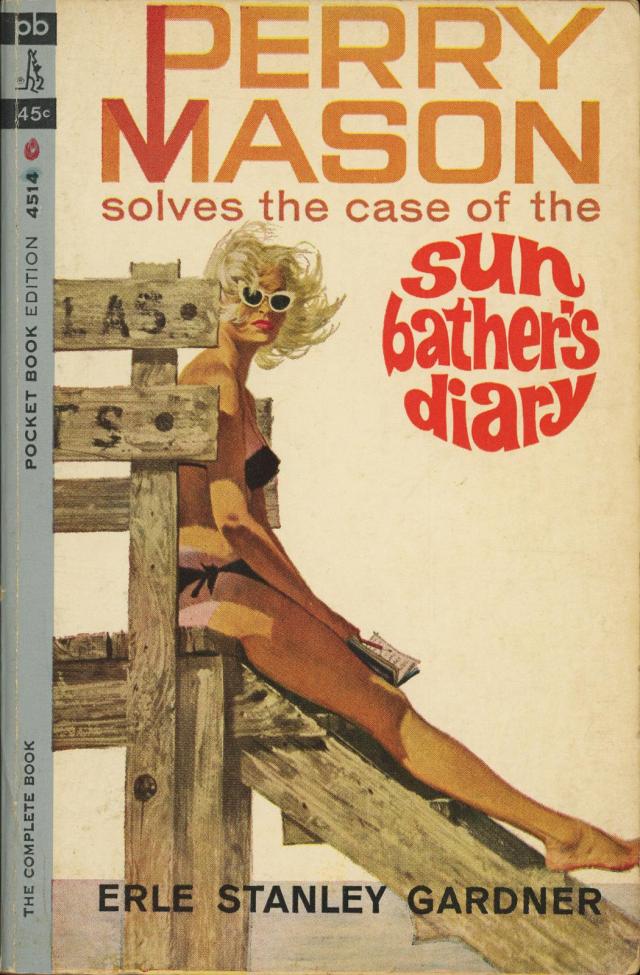
The case of the sunbathe.., p.4
The Case of the Sunbather's Diary,
p.4


“Yes, yes, of course. He—what’s the condition of the trailer?”
“There are no personal belongings left in it.”
“No, no, I mean the trailer itself. Has anyone ripped away the woodwork anywhere?”
“Apparently not.”
“Mr. Mason, it’s very imperative that I get to that trailer at once. Can you… can you meet me there?”
“When?”
“Just as soon as you can get there. I’ll be waiting.”
“Do you,” Mason asked, “have anything in your possession that would indicate that you own the trailer, the registration certificate or—?”
“I have nothing, Mr. Mason. I was left with nothing except the key to my car and the key to the trailer.”
Mason said, “Of course, if you bought the trailer there and the man who sold it to you is there… well, I’ll drive down and meet you there.”
“Right away?”
“Right away,” Mason promised.
He hung up the telephone, said to Paul Drake, “Paul, I’m not going to tip my hand in regard to Sackett for a little while at least. I think this may be a case where I shouldn’t let my client know everything that we know.”
“As far as I’m concerned,” Drake said, “you’re my client. I give information to no one else. You give it out as you want to and to whom you want to.”
Mason pushed his swivel chair away from the desk, said to Drake, “Get your men on that other job right away, Paul. Tell the two men who have the trailer under surveillance to keep on the job. Follow that trailer no matter where it goes.”
“You think your client can establish her title and move it?”
“She should be able to. Since this outfit sold the trailer in the first place, they’ll probably have a record of the original transaction and we shouldn’t have much trouble.”
“Seems strange a thief would take it back to that same place,” Drake said.
“It’s a coincidence,” Mason admitted.
“You said it,” Drake commented dryly.
“Of course, after all, there aren’t too many of these trailer sales outfits as big as the Ideal.”
“It’s still quite a coincidence,” Drake said.
Mason nodded to Della. “Ready, Della?”
“Ready,” she said.
Drake wriggled himself out of the chair. “I take it,” he said, “I’m being thrown out.”
“On your ear,” Mason told him, holding the door open.
“Well, that always helps,” Drake said, grinning. “I’ll be seeing you.”
“Keep on the job personally until nine-thirty,” Mason told him. “I may want to get in touch with you after we’ve gone down to the trailer place. And I’d like to have you get everything you can on that bank job.”
“I’ll stay until ten,” Drake promised.
Paul Drake walked down the corridor as far as his office, which was on the same floor as Mason’s but nearer the elevator.
“Okay,” he said, “I’ll get on the job.”
The lawyer and his secretary descended in the elevator and entered Mason’s car in the parking lot reserved for tenants.
Mason eased the car out into the congested traffic of the afternoon rush hour.
“How long will it take us?” Della Street asked.
“Twenty minutes at least.”
Della Street raised her eyebrows. “Your new pledge of careful driving?”
Mason nodded.
“The automobile, Della, has become a very deadly weapon. Too many people with too many automobiles are going places at the same time.”
“Well, your reformation will enable me to relax,” she said, settling back against the seat. “I won’t have to keep one eye peeled for a traffic cop.”
“From now on,” Mason said, “the traffic cops are my friends. I want more of them. If I’m going to be law-abiding, I’d like to have the other man law-abiding, too. What do you think of our new client, Della?”
“Poor kid,” Della said. “She certainly was placed in an embarrassing position.”
“Wasn’t she!”
“Chief, you sound skeptical.”
Mason slowed as the light was changing, brought the car to a stop on the amber light, and said, “When you stop to figure the cold, hard facts, we have a girl whose father was convicted of embezzling nearly four hundred thousand dollars. She drives an expensive car and lives in an expensive trailer. She does not work. She prances around barefoot in the dewy grass, letting the sunlit breezes caress her bare skin.”
“Nice work if you can get it,” Della Street observed.
“Now, Della, let’s look at if from the viewpoint of the parole board. You have Colton P. Duvall in prison on an indeterminate sentence. He claims that he was innocent, that he was falsely convicted. The circumstances are not entirely clear. You are concerned as a member of the board with just how long you are going to keep Colton Duvall in prison. Perhaps you are even considering granting a parole. So you get in touch with the police officers who did the investigative work on the case and ask them for their opinion. They tell you about the daughter driving the expensive car, living in the high-class house trailer, doing no work, and yet apparently having plenty of money.”
“Well, when you put it that way,” Della Street said, “she… good Lord, Chief, her own actions are keeping her father in the penitentiary.”
“Provided,” Mason said, smiling.
“Provided what?”
“Provided the Adult Authority, which in this state has the same duties and functions as the Board of Pardon and Paroles in most states, has any intention, no matter how remote, of granting parole. It would almost seem as though Arlene Duvall was trying to keep Colton Duvall in prison rather than getting him out. Surely from the viewpoint of the authorities, the daughter’s actions must be exceedingly exasperating to say the least.”
“Very definitely,” Della said.
“On the other hand,” Mason said, “they could be a very alluring form of bait.”
“In what way?”
“Duvall goes to prison,” Mason said. “He is given to understand, perhaps not in so many words, but nevertheless given to understand, that if he wants to disgorge the loot he will be given parole. He apparently has no intention of disgorging the loot. He’s going to wait them out. So they finally come to the conclusion that he’s going to sit tight. Then the daughter starts living without visible means of support, an ideal existence of complete leisure. Wouldn’t it be natural for the parole authorities to say, ‘Control of the money seems to have passed from the father to the daughter. How about letting this man out and keeping him under close surveillance? We’ll watch every move he makes. We can’t help it if his daughter spends money, but if he starts spending money we’ll get him on the carpet, violate his parole and perhaps be able to get the daughter as an accessory. Then we may be able to find where the money’s hidden and get some of it back!’ ”
Della Street thought things over. “Someone seems to be playing a very deep game,” she said at length.
“Exactly,” Mason agreed.
“And where do you fit in that scheme?” she asked.
“I might be intended to play the part of a pawn.”
“By being expendable?”
“That’s right.”
“Well, be careful.”
“I intend to be.”
Mason turned the car in to the freeway. For another ten minutes they proceeded in swift silence. Then Mason turned off on a cross street, drove half a dozen blocks and turned in at the Ideal Trade-In Trailer Mart.
Mason parked his car and walked over to a street where there was a long line of house trailers on display.
“What won’t they do next?” Della Street asked as Mason stopped to look at one of the demonstrators. “The way they’ve managed to conserve space, to give you every convenience, and yet keep the whole thing so compact, it’s wonderful—a real home on wheels!”
A salesman entered the trailer, smiling affably. “How about it? You folks in the market for a trailer?”
“We’d like to see the manager,” Mason said.
“Jim Hartsel?”
“Is he the manager?”
The salesman nodded.
“Where can we find him?”
“This way, please.”
The salesman led them down the street of trailers, turned to the left.
Mason said to Della Street, “You have your notebook and pencil, Della?”
“Never without them—except in the bath.”
Mason said, “When Arlene Duvall comes here she may come in a taxi. She may be driving an automobile. If she’s driving an automobile I’ll leave it to you to get the license number.”
Della Street nodded.
The salesman paused before a small building. “Here’s the office. You’ll find Mr. Hartsel inside.”
“Thanks,” Mason said, and held the door open for Della Street.
Hartsel, a broad-shouldered, barrel-chested individual with the build of a grizzly bear and the eye of an auctioneer, sized them up.
“Hello, folks. What’s the beef?”
“The beef?” Mason asked.
“Sure,” the man said, grinning infectiously. “When people come in ready to close the deal on a trailer they have smiles all over their faces. They’ve reached the important decision in their lives. They’re going out on the road and play gypsy. They’re going to begin to really enjoy life. When they come in with faces grim and manner determined there’s some sort of a beef.
“Now what is it? Did you buy a house trailer from us and is something wrong with it?”
Mason laughed. “I’m Perry Mason,” he said.
“The lawyer?”
“That’s right.”
Hartsel gripped Mason’s hand with thick, powerful fingers.
“Certainly glad to meet you.”
“And this is my secretary, Miss Street.”
Della Street started to extend her hand.
“Advise you not to, Della,” Mason said, rubbing his own hand.
“Well now, you didn’t do so bad yourself,” Hartsel said. “I did a lot of wrestling and my course on salesmanship said to give a cordial handclasp. In my book that means just a little better than the other man gives. I wasn’t able to trump your ace a bit. How do you do, Miss Street. I’m pleased to meet you. Sit down folks and tell me what’s the trouble. Have I violated a law or something?”
“Do you know an Arlene Duvall?” Mason asked.
“Duvall… Duvall… the name’s familiar somewhere… oh yes.”
Suddenly Hartsel grinned.
“A joke?” Mason asked.
“Well, let’s say a pleasant memory,” Hartsel said. “A nice little girl. Bought a Heliar trailer. Paid for it in cash.”
“What do you mean by cash?” Mason asked.
“Cash. C-a-s-h.”
“Check or—?”
“No check—cash. Cold, hard, coin of the realm. Crisp one-hundred-dollar bills.”
“Do you,” Mason asked, “know anything else about her?”
“Not when they pay for trailers in cash right on the barrel head. I don’t have to know anything else about them. What about her? Don’t tell me she’s robbed a bank or something.”
Mason started to say something, then checked himself.
“Well, what is it?”
“The Heliar trailer that you sold her has been stolen.”
“The deuce it has! Insured, I hope.”
“I don’t know,” Mason said. “My interest lies primarily in recovering the trailer.”
“Well, what can I do for you?”
“Turn it over.”
The smile faded from Hartsel’s face.
“Now wait a minute.”
“No, no,” Mason said, “I don’t intimate that you stole it, but apparently you purchased it.”
“Oh, so that’s it,” Hartsel said. “Someone telephoned a while ago, wanted to know if we’d taken in a Heliar trailer today. I didn’t buy it. I have it on consignment. As a matter of fact I happen to have the card right in front of me—a man by the name of Prim—at least that’s the name he gave me. Wanted to put it on consignment, gave me a telephone number and an address. I took the precaution of taking the license number on his jeep. I haven’t looked it up yet.”
Mason said casually, “The jeep may have been loaned him by a friend.”
“Want to take a look at the trailer?” Hartsel asked.
Mason nodded. “I expect the owner will be here momentarily. She was to meet us here.”
“Well, we can go out and take a look at the trailer,” Hartsel said. “Of course, Mr. Mason, I know you and know your reputation, but I’m going to check on this. We have records here you know—manufacturer’s body number and all that.”
Mason nodded.
“Let me look that deal up,” Hartsel said.
He walked across the office, swung back the door of a big safe, pulled out a filing drawer, ran through the files until he came to a card, and then jotted information down swiftly in a notebook.
“All right,” he said, “we can—”
He broke off as the door opened and Arlene Duvall said, “Well, good evening everyone. I was delayed in traffic—it’s terrible.”
“Well, well, well,” Hartsel said. “Miss Duvall! How are you?”
She came forward and gave him her hand. “Doing fine.”
“Well, you certainly look it.”
Hartsel released her hand, took the wrist and held the hand out for Della Street’s inspection.
“See, Miss Street, no wounds. In dealing with the opposite sex I’m gentle as a summer breeze. It’s only when someone grips that I grip back. Mr. Mason was telling me about your trailer, Miss Duvall.”
“Yes, it was stolen.”
“And I seem to have it.”
“That’s what Mr. Mason told me.”
Hartsel said, “I’m wondering if someone would kindly tell me how Mason knew about all this?”
“She paid me to find out,” Mason said.
“Not the police?” Hartsel asked.
Arlene Duvall shook her head.
Hartsel hesitated a moment, then said, “Well, let’s take a look. I’ll let you know right quick if it’s the same trailer.”
Hartsel led the way down one of the back streets of the trailer display, keeping up a running fire of conversation. “Keep my jobs that are on consignment in the back part here. Of course, we try to sell them, but usually the profit isn’t quite as good as on the ones we own outright, and, of course, when it’s a question of bringing in money and getting a turnover I like to turn over my own capital. By the time you come to the section where the trailers are on consignment you have walked past some mighty inviting trailers. I don’t know whether you folks are in the market. You should have a trailer for getting away, Mr. Mason. I suppose that wherever you go you’re pestered with people who want to talk about their problems and your cases. Now here’s a twenty-five foot job that would tow along behind your car like a whisper. You’d hardly know you had it. Light as a feather and yet it’s strong and sturdy—insulated with Fiberglas so that you can park it right out in the burning sunlight on the desert with the inside as cool as a cucumber, just as though you were inside an adobe house. Want to take a look at it?”
“Not today.”
“Well, don’t mind me,” Hartsel told him. “I always have to make a patch. I’m not really trying to sell you a trailer, I’m just keeping my line in shape. Well, here we are. Here’s the Heliar.”
“Locked?” Mason asked.
“Oh, certainly. We always keep our consigned trailers locked. In fact, we lock all of them except the ones that are on display.”
“I’ll open it,” Arlene Duvall said, taking a key from her pocket.
Hartsel, who had produced a key, promptly stepped back and waited for Arlene to fit the key in the lock.
She turned the latch and the door swung open.
Making no attempt to conceal her anxiety, Arlene jumped up and into the interior of the trailer.
Mason took Della Street’s elbow and assisted her up the step, then climbed in. Hartsel brought up the rear.
“This is it,” Arlene said.
“Well, let’s just take a look,” Hartsel said.
He located a metal plate back of the door, rubbed his finger along the plate to bring out the number and compared it with the number in the notebook.
“Sure seems to be it,” he conceded.
He opened a closet door, peered inside with a flashlight and checked another piece of metal.
“This is it. Same number anyway.”
“Aside from the number,” Mason asked Arlene Duvall, “are there any other identifying features?”
She said, “In that compartment, the little built-in vanity case by the side of the bed, the one with the mirror on it, I spilled a bottle of ink. I never did get the stain entirely removed.”
Hartsel lifted the mirrored, hinged cover, said, “Okay, sister, you win. Here it is. Anyone else want to take a look?”
Mason and Della Street stepped forward and looked.
“When was it taken?” Hartsel asked.
“This morning.”
“Well, they sure worked fast. It’s cleaned out slick as a whistle.”
Arlene Duvall nodded.
“So what are you going to do?” Hartsel asked. “I don’t want to hang on to it, but I just don’t want to turn it over to you. I suppose, of course, you’ve notified the police?”
She shook her head.
“Well, you’d better.”
“Why?” Mason asked coldly.
Hartsel sized him up. “Well,” he said, “suppose this man Prim comes back here and asks me where his trailer is and I tell him that I’ve delivered it to Miss Duvall because it was a stolen trailer. Then suppose he gets rough about it.”
“He won’t.”
“But suppose he does.”
“Well,” Mason said, “you know it’s Miss Duvall’s trailer.”
“I know it’s the trailer I sold her, that is, it has the same numbers on it and there’s nothing to indicate the plates have been tampered with in any way, but suppose he says he bought it from her. You see the position I’m in. If he shows up and makes a squawk and I say, ‘Let’s call the cops’ and reach for the telephone, then I’m in one sort of a position, but if I just have to sit there and twiddle my thumbs I’m in another position and that’s a position I don’t like.”















