

The case of the mischiev.., p.7
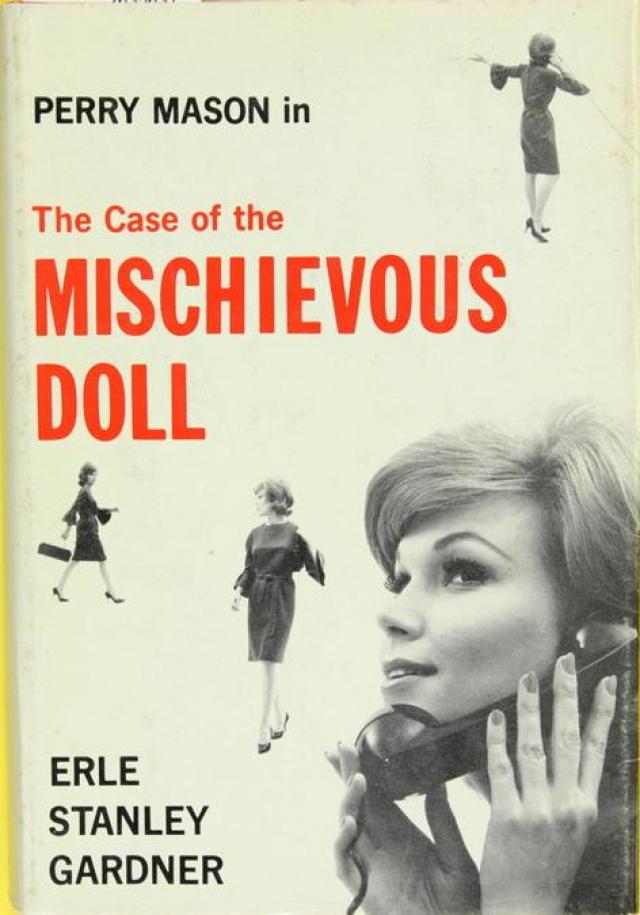
The Case of the Mischievous Doll,
p.7


The Montrose estate of Minerva Minden was an imposing edifice on a hill, and Mason, driving up the sweeping gravelled driveway through the beautifully landscaped grounds, swung his car into a parking place which contained an even dozen automobiles.
“Looks like there might be a lot of other people with the same idea,” Drake said.
“Probably some of them are reporters, some are employees,” Mason said. “You don’t know what kind of a car Herbert Knox drives, do you, Paul?”
“No.”
“I have an idea one of these cars may be his. I hope so.”
The men parked their car, went up the stairs to the broad porch. Mason rang the bell.
A burly individual who looked more like a bodyguard than a butler opened the door and stood silent.
“I would like to see Minerva Minden’s confidential secretary or business manager,” Mason said. “I am Perry Mason and I’m calling in connection with an emergency.”
The man said, “Wait there,” turned to a telephone in the wall and relayed a message into a mouthpiece so constructed that it was impossible for bystanders to hear what was being said.
After a moment, he said, “Who’s the gentleman with you?”
“Paul Drake, a private detective.”
Again the man turned to the phone, then after a moment hung up and said, “This way, please.”
Mason and Drake entered a reception hallway, and followed the butler into a room which had at one time evidently been a library. Now it was fixed up as a sort of intermediate waiting room with a table, rugs, indirect lighting, deep leather-cushioned chairs and an atmosphere which combined that of a luxurious room in an expensive residence with that of an office where people waited.
“Be seated, please,” the butler said, and left the room.
A moment later a tall, keen-eyed woman in her late forties or early fifties entered the room and strode directly across to Mason. “How do you do, Mr Mason,” she said. “I am Henrietta Hull, Miss Minden’s confidential secretary and manager; and this, I presume, is Mr Paul Drake, the detective.”
She moved easily to a chair, regarded the men with keen, appraising eyes for a moment, then said, “You wished to see me, Mr Mason?”
“Actually,” Mason said, “I want to see Minerva Minden.”
“Many people do,” Henrietta Hull said.
Mason smiled. “Is it Miss Hull or Mrs Hull?”
“It’s Henrietta Hull,” the woman said, smiling, “but if you need any other handle, it’s Mrs.”
“Would it be possible for us to see Miss Minden?”
“It would be utterly impossible, Mr Mason. Nothing, absolutely nothing, that you could say would gain you an audience. In fact I may go a little further and state that when Miss Minden’s attorney learned that you were seeking an interview, he gave Miss Minden particular instructions that under no circumstances was she to talk with you.”
“I’ll talk with him if I have to,” Mason said.
Henrietta Hull shook her head. “That would do no good, Mr Mason. Mr Knox is not Miss Minden’s regular attorney.”
“Who is?” Mason asked.
“There isn’t any,” Henrietta Hull said. “Miss Minden retains counsel as she needs them. She tries to get the very best in the field. For a matter of this sort Herbert Knox was considered the best available attorney.”
“May I ask why?” Mason asked.
Her eyes softened somewhat. “You’re asking because you feel professionally slighted?” she asked.
“No,” Mason said, “I was just wondering. You seemed so positive. I gathered that you keep some sort of list of attorneys.”
“We do, Mr Mason,” she said, “and you might be interested to know that you head the list of attorneys available in murder cases or serious felonies. There are other attorneys who are selected for their ability in connection with automobile cases and traffic violations. Mr Knox was selected in this case because of various qualifications, not the least of which is that he is frequently a golfing partner of the judge before whom the case was tried.”
“And how,” Mason asked, “did you know the particular judge who would be assigned to the case?”
She smiled and said, “After all, Mr Mason, you had a matter you wanted to take up with Miss Minden.”
“All right,” Mason said, “I’ll put my cards on the table. Miss Minden has hired a double.”
“Indeed?” Henrietta Hull said, her eyebrows raising. “You’re making a positive statement, Mr Mason?”
“I’m making a positive statement.”
“All right,” Henrietta Hull said. “Your statement is that she hired a double. Now what?”
Mason said, “The disturbance at the airport was shrewdly engineered to bring out the fact that Miss Minden had a double, but Miss Minden did some very fast and some very shrewd thinking and decided it would be better for her to take the responsibility of firing the shots than to expose the fact that she had hired a double.”
“This is rather a startling statement, Mr Mason. I trust you have evidence to back up your statement.”
“I am making a statement,” Mason said. “I would like to have you convey it to Minerva Minden. I would also like to have you tell her that I can be rather a ruthless antagonist, that I don’t know all the ramifications of the game she is playing but that I rather suspect the ad by which this double was chosen – or rather the ad which served as bait to bring this double into the position that had been selected for her – was shrewdly designed as the elaborate bait in a deadly trap.
“I don’t know whether Minerva Minden knew that this double of hers was going to be placed in a position of danger or not, but a situation has now developed where that young woman is in very great danger. I have been invited to tell the police what I know. I don’t want to release a story which may result in a lot of newspaper notoriety for Miss Minden.”
Henrietta Hull smiled and said, “Miss Minden is not a stranger to newspaper notoriety.”
“You mean she enjoys it?” Mason asked sharply.
“I mean that she is not a stranger to it.”
“All right,” Mason said. “I think I’ve told you enough so that you can appreciate my position and the fact it is imperative I have an immediate interview with Miss Minden.”
“An immediate interview is out of the question,” Henrietta Hull said. “But, as I told you over the telephone, Mr Mason, I will be glad to convey a message and to call you at your office.”
“When?” Mason asked.
“As soon as necessary arrangements have been made, or perhaps I should say as soon as necessary precautions have been taken.”
“All right,” Mason said. “I just want to point out to you that traffic violations are one thing, firing blank cartridges is another thing. But kidnapping is a felony that carries very serious penalties, and murder is punishable by death.”
“Thank you, Mr Mason,” Henrietta Hull said. “Of course you’re an attorney, but as a business woman I am familiar with certain phases of the law.”
She arose abruptly, signifying that the interview was terminated. She gave Mason her hand and the benefit of a long, steady appraisal. Then she turned to Paul Drake. “I’m very pleased to have met you, Mr Drake. I may also advise you that your agency is at the top of the list which we maintain in cases where a highly ethical agency is required.”
Drake smiled. “Meaning that you have a list of unethical agencies?”
“We have very complete lists,” she said enigmatically. Then again turned to Mason. “And don’t forget, Mr Mason, that your name is absolute tops in cases carrying a serious penalty.”
“Such as murder?” Mason asked.
“Such as murder,” Henrietta Hull said, and then after a moment added, “and such as kidnapping or abduction.”
Chapter Seven
Mason fitted his latchkey to the door of his private office, entered and was confronted by Della Street, who said, “Why secretaries get grey … Do you realize, Mr Perry Mason, that you have two appointments I’ve had to stall off and if it hadn’t been for the noon hour intervening you’d have had more. I told them that you were out at a luncheon club making a speech.”
“You’re getting to be a pretty good extemporaneous prevaricator,” Mason said.
She smiled. “Freely translated that means I’m a graceful, gifted, talented offhand liar … You see what you’ve done to my morals, Mr Perry Mason.”
“The constant dripping of water,” Mason said, “can wear away the toughest stone.”
“We were talking about morals, I believe. I suppose there was some major emergency.”
“There was a very great major emergency.”
“Have you had lunch?”
“No.”
“You have some appointments that I’ve been stalling off. I told them you’d see them right after lunch and then told them that you were delayed getting back from lunch.”
“They’re in the outer office?”
“Yes.”
“What else?” Mason asked.
“I believe you are acquainted with a very firm and dignified young woman named Henrietta Hull who is the secretary to Minerva Minden?”
“She isn’t young,” Mason said. “She has a sense of humour. She puts up a good front of being firm. What about her?”
“She called up, said that she was to leave a message for you, that she was sorry that there was no possibility of your seeing Miss Minden; that you might care to know, however, that Dorrie Ambler had been followed by a detective agency employed by Miss Minden ever since Miss Ambler had attempted to blackmail Miss Minden into making a property settlement on her.”
“What else?” Mason asked.
“That was all,” she said. “She told me that perhaps you should have that information.”
“I’ll be damned,” Mason said.
“And,” Della Street went on, “Jerry Nelson, Drake’s operative, said he missed you at the place he was told to report. He said Drake was out so he came down here to tell me that there’s a difference in colouring between Dorrie Ambler and Minerva Minden but aside from that the resemblance is startling. He said it might be very easy for an eyewitness to confuse one with the other.”
“But there was a discernible difference?”
“Oh, yes. He felt he could tell one from the other.”
“By what means? Just what is the difference?”
“Well, he couldn’t put his finger on it. He said that it’s something – He thinks the hair may be a little different and something about the complexion, but he says there’s a resemblance that – Well, the only way that he could describe it was to say it was startling.”
Mason’s unlisted phone rang.
“That’s Paul Drake,” Mason said, and picked up the receiver.
Paul Drake’s voice came over the line. “I’m sorry to bring you bad news, Perry.”
“What?”
“We were followed out to Minerva Minden’s.”
“How do you know?”
“I found out when I was parking the car.”
“How do you mean?”
“They have a plug they can slip on the end of the exhaust pipe. It releases drops of fluorescent liquid at regular intervals. By wearing a certain type of spectacles with lenses that are tinted so it can make these drops visible, they can follow a car even if they’re ten or fifteen minutes behind it.”
“And you know your car was fixed?”
“It was fixed all right.”
“But you don’t know that they followed us.”
“I don’t know they followed us,” Drake said, “but knowing Tragg as I do, I know he wasn’t wasting the taxpayers’ equipment just for the sake of the exercise.”
“Thanks, Paul,” Mason said. “I have an office full of irate clients and I’ve got to get down to a little routine work, but you get busy and see what you can find out.”
“We’re already busy,” Drake said. “I’ve got tentacles stretching out in every direction, trying to cover everything I can.”
“What about the kidnapping, Paul?”
“I don’t know. The police are playing it awfully close to their chest. Of course, under the circumstances you can realize that they wouldn’t take us into their confidence, and it’s probably good business not to tell the newspapers too much about it, but they’re certainly playing it cosy.”
“All right,” Mason said, “you get busy, Paul, and find out everything you can. Try particularly to find out something about the background of Dorrie Ambler.”
“You don’t think you should tell the police what you know?”
“I’m hanged if I know, Paul,” Mason said. “I think probably I will, but I want to think it over a bit. I’ll get rid of a few pressing appointments and then be in touch with you.”
“Okay,” Drake said, “I’ll be on the job.”
Mason said to Della Street, “I guess I’ll copy Paul Drake’s diet, Della. Get me a couple of sandwiches from the restaurant around the corner and put some coffee on. I’ll start seeing these clients who have been waiting.”
“Don’t you want to wait and eat afterwards?” Della Street asked.
“Frankly I do,” Mason said, “but some of those clients are a little angry. They feel they’ve been cooling their heels in my outer office while I’ve been out to lunch, enjoying myself.
“The psychological effect of having a hamburger sandwich in one hand and a law book in the other is remarkably soothing to the irate client. I’ll tell them I had such an important matter come up I had to break my luncheon engagement.”
“In other words,” Della Street said, “these sandwiches are to be props.”
“Props with a use,” Mason said. “Send in the first client, Della, and go get the sandwiches as soon as he comes in.”
She glided out into the outer office and a moment later Mason’s first client came stalking into the room.
Mason said, “I’m sorry I had to keep you waiting. I was out on a major emergency. I’m going to impose on your good nature by grabbing a sandwich while we talk. I’m famished.
“Della, hand me that file with the memorandum on this case and get a couple of hamburgers, if you will.”
“Right away,” Della Street promised, handing him the filing jacket.
As Mason opened the folder the expression on the client’s face softened.
Mason hurried through that interview and four more, nibbling at sandwiches and drinking coffee.
He was interviewing his last client when the telephone rang three short bells signalling that the switchboard operator was holding an important call.
Della Street picked up the telephone, said, “Yes, Gertie,” then turned to Mason. “Lieutenant Tragg,” she said.
“In the office?” Mason asked.
“No, on the line.”
Mason picked up the telephone, said, “Yes, Lieutenant, this is Mason.”
Tragg said, “I’ve given you some breaks today, Mason. I’m going to give you some more.”
“Yes,” Mason said dryly. “I hope the substance you put on the exhaust of my automobile doesn’t interfere with the operating efficiency.”
“Oh, not at all, not at all,” Tragg said.
“I presume my car was followed,” Mason observed.
“Oh, of course,” Tragg said casually. “You wouldn’t expect us to have you right in our hands, so to speak, and then let you slip through our fingers. We know all about your trip out to Miss Minden’s at Montrose.”
“I presume,” Mason said, “you’re going to extend some more favours and I’ll find that they were simply bait for a very elaborate trap.”
“Oh, but such beautiful bait,” Tragg said. “This is something that you absolutely can’t resist, Perry.”
“What is it?” Mason asked.
Tragg said, “I felt that you couldn’t make time enough to get here so I’m sending an officer. He should be in your office within a matter of seconds. If you and Della Street will come up here – just walk right into my office in case I shouldn’t be there. If I’m not in, I won’t keep you waiting very long … I’ll really do you a favour.”
“Bait?” Mason asked.
“Beautiful bait,” Tragg said, and hung up.
Again the phone rang, a series of short, sharp rings. Della Street picked it up, said, “Yes, Gertie?” Then turned to Mason. “A uniformed officer is in the outer office. He has a police car down in front with the motor running and instructions to get both of us to Headquarters just as fast as possible.”
Mason’s client jumped up. “Well, I think we’ve covered most of the points, Counsellor. Thank you. I’ll get in touch with you.”
Mason said, “Sorry,” pushed back his chair, cupped his hand over Della Street’s elbow, said, “Come on, Della, let’s go.”
“You think it’s that important?” Della Street asked.
Mason said, “At this stage of the case I welcome any new developments, either pro or con … Remember, Della, no talking in the police car. Those officers sometimes have big ears.”
Della Street nodded.
They hurried out to the outer office. The waiting officer said, “I’m under instructions to get you to Headquarters just as fast as possible without using red light or siren, but hogging traffic all the way.”
“All right,” Mason told him, “let’s hog traffic.”
They hurried to the elevator. The officer escorted them to a kerb where another officer was sitting behind the wheel of a police automobile, the motor running.
Perry Mason held the rear door open for Della Street, assisted her in, jumped in beside her and almost immediately the car whipped out into traffic.
“Good heavens,” Della Street said under her breath as they went through the first intersection.
“It’s their business,” Mason told her reassuringly. “They drive in traffic all the time and they’re in a hurry.”
“I’ll say they’re in a hurry,” Della Street said.
The car wove its way through traffic, crowded signals; twice the driver turned on the red light. Once he gave a light tap on the button of the siren. Aside from that they used no official prerogatives except the skill born of long practice and a deft, daring technique.















