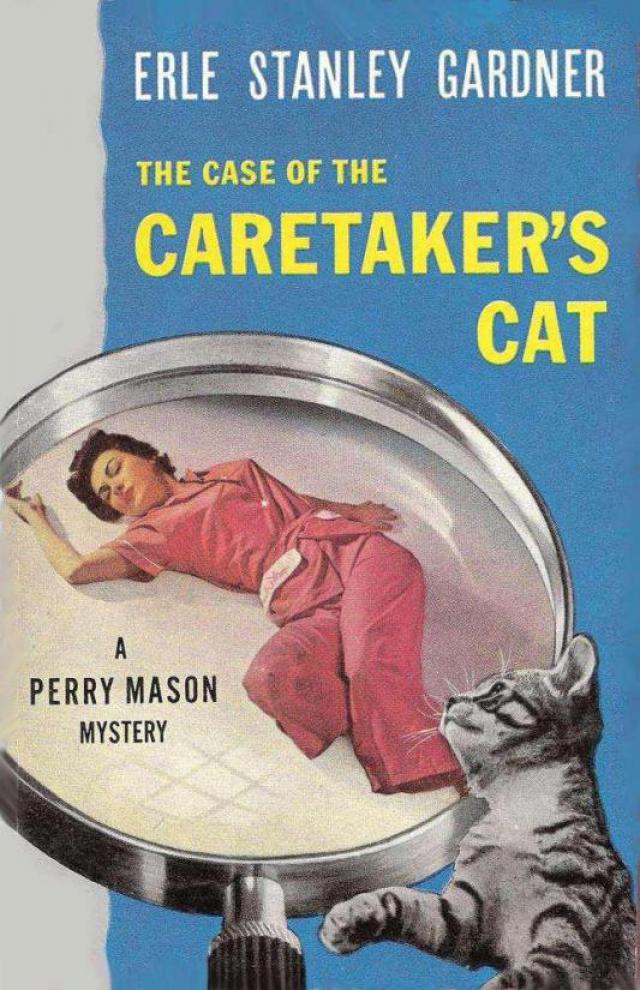
The case of the caretake.., p.8
The Case of the Caretaker's Cat,
p.8


Glassman opened the door, climbed out into the rain and turned a flashlight on the padlock which held the garage doors. He produced a bunch of keys from his pocket, and, after a moment nodded to Burger, and pulled back the sliding door of the garage.
The men opened the door of the garage.
“Be careful,” Burger cautioned, “not to slam those doors shut. We don’t want to alarm anyone until after we’ve looked the place over.”
There were three cars in the garage. Glassman’s flashlight flickered over them in turn. Mason stared with narrowed eyes at a new green Pontiac sedan. Burger, seeing the expression on his face, inquired, “Have you discovered something, Mason?”
Perry Mason shook his head.
Glassman’s flashlight explored the registration certificates. “This one’s in the name of Samuel C. Laxter,” he said, indicating a custom-built sports coupe with spare tires mounted in fender wells on either side. It was a powerful, low-hung car of glistening enamel and chrome steel.
“Sure built for speed,” Burger muttered. “Turn your flashlight down here on the muffler, Tom.”
Glassman swung the beam from his flashlight to the exhaust pipe, and Burger bent over to examine it. He nodded slowly. “Something’s been clamped around here,” he said.
“Well, let’s go have a talk with Mr. Samuel Laxter and see what he has to say for himself,” Glassman suggested.
Perry Mason, leaning nonchalantly against the side of the garage, tapped a cigarette on his thumb nail, preparatory to lighting it. “Of course, I don’t want to interfere, but there’s just the possibility you might find that flexible tubing if you looked hard enough.”
“Where?” Burger asked.
“Some place in the car.”
“What makes you think it’s there?”
“The fire,” Mason pointed out, “originated at a point in or near Laxter’s bedroom. The garage was some little distance from that. They managed to save the automobiles that were in the garage. That bit of flexible tubing was a damaging piece of evidence which Laxter wouldn’t ordinarily have left where it could be discovered. Of course, he may have hidden it afterwards, but there’s a chance it’s somewhere in the car.”
Glassman, without enthusiasm, pulled the trigger which raised the back of the rumble seat, climbed into the car, and started exploring with his flashlight. He raised the front seat, opened the flap pocket, prowled around in the back of the car.
“There’s a compartment here that’s locked,” Burger pointed out.
“For golf clubs,” Glassman explained.
“See if one of your keys will fit it.”
Glassman tried his keys, one after another, then shook his head.
“See if you can’t pull that piece out in the back of the front seat and see down into it.”
The car springs swayed as Glassman’s heavy body moved around. Then he said in a muffled voice, “There’s something down here that looks like a long vacuum sweeper tube.”
“Jimmy the door open,” Burger ordered, his voice showing excitement. “Let’s take a look.”
Glassman pried the lock, saying as he did so, “This isn’t a very neat job. It’s going to lead to an awful squawk if we’re wrong.”
“I’m commencing to think we’re right,” Burger remarked grimly.
Glassman reached in his hand and pulled out some twelve feet of flexible tubing. On one end were two adjustable bands which tightened with bolts and nuts. The other end contained a mushroom-like opening of soft rubber.
“Well,” Burger said, “we’ll get Laxter out of bed.”
“Want us to wait in here?” Mason inquired.
“No, you can come up to the house and wait in the living room. It may not be very much of a wait. Pulling him out of bed like this, he may confess.”
The big house sat well upon a hill. The garage was some distance from the house, having been excavated from the earth. Cement steps led up to a graveled walk. A private driveway from the garage swung up a more gentle incline, and circled the house, serving both as a driveway by which cars might be brought to the front door, as well as a service road by which fuel and supplies might be delivered to the back of the house.
The men climbed the stairs, moving silently in a compact group. At the top of the stairs, Burger paused. “Listen,” he said, “what’s that?”
From the misty darkness came the sound of a metallic clink, and, a moment later, it was followed by a peculiar scraping noise.
“Someone digging,” Mason said in a low voice. “That’s the noise made by a spade striking a loose rock.”
Burger muttered, “By George, you’re right. Mason, you and Drake keep back of us. Tom, you’d better have your flashlight ready, and put a gun in the side pocket of your coat—just in case.”
Burger led the way forward. The four walked as quietly as possible, but the graveled walk crunched underfoot. Glassman muttered, “We can do better on the grass,” and pushed over to the side of the walk. The others followed him. The grass was wet, the soil slightly soggy, but they were able to move forward in complete silence.
There were lights in the house which showed ribbons of illumination around the edges of the windows. The man who was digging kept plugging away.
“From behind that big vine,” Glassman said.
It needed no comment from him to point the direction. The vine was agitated by a weight thrust against it. Drops of rain cascaded down from the leaves, were caught in a shaft of light coming from an uncurtained diamond-shaped pane of glass in one of the doors and transformed into a golden spray.
The shovel made more noise.
“Scraping dirt back to fill up the hole,” Mason remarked.
The beam from Glassman’s flashlight stabbed through the darkness.
A startled figure jumped back and thrashed about in the vine, which, under the illumination of Glassman’s flashlight, resolved itself into a climbing rosebush. Glassman said, “Come out, and be careful with your hands. This is the law.”
“What are you doing here?” asked a muffled voice.
“Come on out,” Glassman ordered.
The figure showed itself first as a black blotch in the midst of the glistening leaves, the wet surfaces of which reflected the illumination of the flashlight Then, as it broke through the vine, Perry Mason caught a glimpse of the man’s face and said to Burger, “It’s Frank Oafley.”
Burger moved forward. “What’s your name?” he asked.
“I’m Oafley—Frank Oafley. I’m one of the owners of this place. Who are you and what are you doing here?”
“We’re conducting a little inquiry,” Burger said. “I’m the district attorney. This is Tom Glassman, my associate. What were you digging for?”
Oafley grunted, pulled a telegram from his pocket and held it out to the district attorney. The beam of the flashlight illuminated the telegram, a torn coat-sleeve, a scratched, dirt-covered hand.
“You frightened me with that flashlight,” he said. “I jumped right into the middle of those thorns. But it’s all right. I was pretty well scratched up anyway. I guess my clothes are a wreck.”
He looked down at his suit and laughed apologetically.
The four men paid no attention to him, but studied the telegram, which read:
THE KOLTSDORF DIAMONDS ARE HIDDEN IN ASHTONS CRUTCH STOP MORE THAN HALF OF YOUR GRANDFATHERS MONEY IS BURIED JUST UNDER THE LIBRARY WINDOW WHERE THE CLIMBING ROSEBUSH STARTS UP THE TRELLIS WORK STOP THE SPOT IS MARKED BY A LITTLE STICK STUCK IN THE GROUND STOP IT ISNT BURIED DEEP STOP NOT OVER A FEW INCHES
The telegram was signed simply “A FRIEND.”
Glassman said in a low voice, “Looks like a genuine telegram. It cleared through the telegraph office.”
“What did you find?” Burger asked.
Oafley, stepping forward to answer him, caught sight of Mason for the first time. He stiffened and said, “What’s this man doing here?”
“He’s here at my request,” Burger said. “He’s representing Charles Ashton, the caretaker. I had some questions I wanted to ask Ashton, and I wanted Mason to be along. Did you find anything where you were digging?”
“I found the stick,” Oafley said, pulling a small stake from his pocket. “That was sticking in the ground. I dug clean through the loam and down to gravel. There wasn’t anything there.”
“Who sent the telegram?”
“You can search me.”
Burger said in a low voice to Glassman, “Tom, take the key number of that message, get on the telephone and have the telegraph company dig up the original. Find out all you can about it. Get the address of the sender.”
“Did you come out because of that telegram?” Oafley asked. “It’s a rotten night. I shouldn’t have gone out and dug, but you can realize how I felt after I got that message.”
“We came out in connection with another matter,” Burger said. “Where’s Sam Laxter?”
Oafley seemed suddenly nervous. “He’s out. What did you want to see him about?”
“We wanted to ask him some questions.”
Oafley hesitated for a moment, then said slowly, “Have you been talking with Edith DeVoe?”
“No,” Burger said, “I haven’t.”
Mason stared steadily at Oafley. “I have,” he said.
“I knew you had,” Oafley told him. “It’s a wonder you wouldn’t mind your own business.”
“That’ll do from you,” Burger said. “Come on in the house. What’s this about the Koltsdorf diamonds being hidden in Ashton’s crutch?”
“You know just as much about it as I do,” Oafley said sullenly.
“Sam isn’t in?”
“No.”
“Where is he?”
“I don’t know—out on a date I guess.”
“Okay,” Burger said. “Let us in.”
They climbed up to the tiled porch. Oafley produced a bunch of keys and opened the door. “If you’ll excuse me a minute, I’ll wash some of this mud off and slip on another suit of clothes.”
“Wait a minute,” Glassman said. “There’s a million bucks involved, Buddy. We aren’t doubting your word any, but we’d better frisk you and see …”
“Glassman,” Burger warned, “Mr. Oafley isn’t to be handled that way.”
He turned to Oafley. “I’m sorry Mr. Glassman used exactly those words, but the thought is something which has occurred to me, and will doubtless occur to you. There’s a large sum of money involved. Suppose the person who sent that telegram should claim you had been in the garden and found some or all of that money?”
“But I didn’t find any. If I had, it would have been mine—half of it, anyway.”
“Don’t you think it might be better to have some corroborative evidence?” Burger asked.
“How could I get that?”
“You could submit to a voluntary search.”
Oafley’s face was sullen. “Go ahead,” he said, “and search.” They searched him.
Burger nodded his satisfaction. “It’s just a check,” he said, “on the situation. Perhaps you’ll be glad later on you cooperated with us.”
“I’ll never be glad, but I’m not raising any very strenuous objections, because I can appreciate your position. May I go get my clothes changed now?”
Burger slowly shook his head. “Better not. Better sit down and wait. You’ll dry out quickly.”
Oafley sighed. “Well,” he said, “let’s have about four fingers of whiskey apiece. You look as though you chaps might have been out in the rain. Bourbon, rye or Scotch?”
“Whichever you come to,” Mason said, “just so it’s whiskey.”
Oafley flashed him a speculative glance, rang a bell.
A man with a livid scar across his right cheekbone, which gave to his face a peculiar expression of leering triumph, appeared in a doorway. “You rang?” he asked Oafley.
“Yes,” Oafley said. “Bring some whiskey, James. Bring some Scotch and soda and some of the Bourbon.”
The man nodded, withdrew.
“Jim Brandon,” Oafley said in an explanatory tone. “He acts both as chauffeur and butler.”
“How was he hurt?” Burger inquired.
“Automobile accident, I believe…. You’re Mr. Burger, the district attorney?”
“Yes.”
Oafley said slowly, “I’m sorry that Edith DeVoe said what she did.”
“Why?”
“Because that fire wasn’t started by the fumes from an automobile exhaust. It’s impossible on the face of it.”
Glassman said, “Where’s your telephone?”
“There in the hallway. I’ll show you … or James will show you.”
“Never mind. You sit there and talk with the Chief. I’ll find it all right.”
Burger said, “Did you ever hear of carbon monoxide poisoning, Mr. Oafley?”
“Of course I have.”
“Do you know that carbon monoxide is generated by an automobile engine when it’s running?”
“But what’s carbon monoxide got to do with it? It isn’t an inflammable gas, is it?”
“It’s a deadly gas.”
Something in the grim finality of Burger’s voice sent Oafley’s eyebrows arching.
“Good God!” he exclaimed. “You don’t mean that? … Why, it’s unthinkable! … Why, I can’t believe …”
“Never mind what you can or cannot believe, Mr. Oafley. We want certain information. We stopped in the garage on the way up, and looked through Sam Laxter’s machine. We found a long, flexible tube.”
Oafley said without surprise, “Yes, Edith said she saw it quite distinctly.”
“Just where is Sam Laxter now?”
“I don’t know. He went out.”
“How did he go out? His car’s in the garage.”
“Yes,” Oafley said, “his car is. He didn’t want to take it out and get it wet. The chauffeur drove him uptown in the Pontiac, then brought the Pontiac back. I don’t know how Sam will come back, unless the Chevvy is uptown somewhere.”
“The Chevvy?”
“Yes. It’s a service car. Ashton usually drives it. We keep it for hauling things and running errands.”
“You have a car?” Burger asked.
“Yes, the Buick in the garage is mine.”
“And the big Pontiac?”
“That’s the car my grandfather bought shortly before his death.”
“The cars were saved when the house burned?”
“Yes, the garage was in the corner. It was one of the last things to go.”
“In other words, the fire was started at some point removed from the garage?”
“It must have been started near grandfather’s bedroom.”
“Have you any ideas as to how it was started?”
“Not one…. Look here, Mr. Burger. I would much prefer that you talked with Sam about this. My position is rather delicate. After all, Sam’s related to me. Frankly, I had heard Edith DeVoe’s story before, but I hadn’t given it any attention. The carbon monoxide was, of course, a new thought to me. I simply can’t believe it’s possible. There must be some explanation.”
Glassman entered the room carrying the telegram in his left hand. He stood in the doorway and made his report. “It’s a genuine telegram all right. It was telephoned in. It was to be signed ‘A Friend,’ but the telephone number of the sender was Exposition 6-2398. The phone’s listed under the name of Winnie’s Waffle Kitchen.”
Mason got to his feet and said, “Baloney!”
“That will do, Mason,” Burger told him. “You keep out of this.”
“Like hell I will,” Mason retorted. “You can’t boss me, Burger. Winifred Laxter never sent that telegram.”
Oafley stared at Tom Glassman. “Why,” he said, “Winnie wouldn’t send a telegram like that. There’s some mistake.”
“She sent it, all right,” Glassman insisted.
“The hell she sent it!” Mason exploded. “It’s a cinch to send a telegram over the telephone in someone else’s name.”
“Yeah,” Glassman remarked. “Your clients always have someone conspiring against them.”
“She isn’t my client,” Mason said.
“Just who is your client?”
Mason grinned, and remarked, “I think it’s a cat.”
There was a moment of silence. The noise of an automobile engine could be heard as a car climbed the incline. Headlights flashed for a moment against the window, then a horn blared its imperative summons. Jim Brandon, entering the room with a tray on which were whiskies and glasses, also syphons of soda, hurriedly set the tray down and started for the door as the horn blared again.
“That’s Mister Sam,” he said.
Burger caught the man’s sleeve as he hurried past. “Don’t be in too big a hurry,” he suggested.
Glassman strode through the corridor, jerked open the front door just as the horn sounded again. “Go on out, Jim,” he said, “and see what’s wanted.”
Jim Brandon switched on a porch light, stepped out to the porch. Sam Laxter called, “Jim, I’ve had a bit of an accident. You come and put the car away.”
Burger pulled aside some drapes. The brilliant light from the porch illuminated a somewhat antiquated Chevrolet, with a broken windshield, a dented fender, and smashed bumper. Sam Laxter was climbing from the driver’s seat. His face was cut. His right arm was bandaged with a bloody handkerchief.
Burger started for the door. Before he reached it, headlights again illuminated the drizzling night. A smoothly purring automobile swung into view, circled the driveway and came to a stop. The door of a big sedan opened. A slender figure jumped to the driveway, turned and ran excitedly toward the house, saw Sam Laxter and came to a surprised stop.
Perry Mason chuckled, and said to Burger, “We have with us none other than our esteemed contemporary, Mr. Nathaniel Shuster. During the course of the next half hour you can endeavor to discover whether he followed Sam Laxter because he knew you were going to be here or merely put in an accidental appearance.”
Burger, muttering an exclamation of disgust, strode to the porch.
Shuster called, in a voice which was shrill with excitement, “Have you heard about it? Have you heard about it? Do you know what they’re doing? Do you know what happened? They got an order to dig up your grandfather’s body. They went out in the cemetery and dug it up.”