The sun also rises and o.., p.1
The Sun Also Rises and Other Works,
p.1


The Sun Also Rises
and
Other Works
The Sun Also Rises
and
Other Works
Introduction by Ken Mondschein, PhD
Canterbury Classics
An imprint of Printers Row Publishing Group
9717 Pacific Heights Blvd, San Diego, CA 92121
www.canterburyclassicsbooks.com • mail@canterburyclassicsbooks.com
Introduction and compilation copyright © 2022 Printers Row Publishing Group
All rights reserved. No part of this publication may be reproduced, distributed, or transmitted in any form or by any means, including photocopying, recording, or other electronic or mechanical methods, without the prior written permission of the publisher, except in the case of brief quotations embodied in critical reviews and certain other noncommercial uses permitted by copyright law.
Printers Row Publishing Group is a division of Readerlink Distribution Services, LLC.
Canterbury Classics is a registered trademark of Readerlink Distribution Services, LLC.
Correspondence concerning the content of this book should be sent to Canterbury Classics, Editorial Department, at the above address.
Publisher: Peter Norton
Associate Publisher: Ana Parker
Art Director: Charles McStravick
Senior Developmental Editor: April Graham Farr
Editorial Team: Stephanie Romero Gamboa, Traci Douglas
Production Team: Beno Chan, Julie Greene, Rusty von Dyl
Cover design: Linda Lee Mauri
Image credits: iStock/Getty Images/irinelle
eBook ISBN: 978-1-6672-0003-3
eBook Edition: January 2022
Editor’s Note: These works have been published in their original form to preserve the authors’ intent and style.
CONTENTS
____________________
Introduction
The Sun Also Rises
Book I
Book II
Book III
The Torrents of Spring
Part One: Red and Black Laughter
Part Two: The Struggle for Life
Part Three: Men in War and the Death of Society
Part Four: The Passing of a Great Race and the Making and Marring of Americans
Three Stories and Ten Poems
“Up in Michigan”
“Out of Season”
“My Old Man”
“Mitraigliatrice”
“Oklahoma”
“Oily Weather”
“Roosevelt”
“Captives”
“Champs d’Honneur”
“Riparto d’Assalto”
“Montparnasse”
“Along With Youth”
“Chapter Heading”
In Our Time
On the Quai in Smyrna
Chapter I: Indian Camp
Chapter II: The Doctor and the Doctor’s Wife
Chapter III: The End of Something
Chapter IV: The Three-Day Blow
Chapter V: The Battler
Chapter VI: A Very Short Story
Chapter VII: Soldier’s Home
Chapter VIII: The Revolutionist
Chapter IX: Mr. and Mrs. Elliot
Chapter X: Cat in the Rain
Chapter XI: Out of Season
Chapter XII: Cross-Country Snow
Chapter XIII: My Old Man
Chapter XIV: Big Two-Hearted River, Part I
Chapter XV: Big Two-Hearted River, Part II
L’Envoi
Newspaper Bylines
“Kerensky, The Fighting Flea”
“Battle of Raid Squads”
“At the End of the Ambulance Run”
“Throng at Smallpox Case”
“Laundry Car Over Cliff”
“Six Men Become Tankers”
“Big Day for Navy Drive”
“Navy Desk Jobs to Go”
“Recruits for the Tanks”
“Would ‘Treat ’Em Rough’ ”
“Dare Devil Joins Tanks”
“Mix War, Art and Dancing”
“Fine Art”
“Taking a Chance for a Free Shave”
“Popular in Peace—Slacker in War”
“Sporting Mayor at Boxing Bouts”
“Keeping Up with the Joneses—The Tragedy of the Other Half”
“Store Thieves Use Three Tricks”
“Are You All Set for the Trout?”
“Prizefight Women”
“Galloping Dominoes, Alias African Golf, Taken Up by Toronto’s Smart Set”
“Fishing for Trout in a Sporting Way”
“Stores in the Wild Graveyards of Style”
“Canadian Fox-Ranching Pays Since the Wildcats Let the Foxes Alone”
“Prices for ‘Likenesses’ Run from Twenty-five Cents to $500 in Toronto”
“The Wild West Is Now in Chicago”
“Cheaper Nitrates Will Mean Cheaper Bread”
“A Canadian with $1,000 a Year Can Live Very Comfortably and Enjoyably in Paris”
INTRODUCTION
____________________
The world breaks everyone and afterward many are strong at the broken places. But those that will not break it kills. It kills the very good and the very gentle and the very brave impartially. If you are none of these, you can be sure it will kill you too but there will be no special hurry.
—from A Farewell to Arms
Ernest Hemingway is one of those writers who has become shorthand for an entire idea—in his case, a sort of American masculinity that, while decidedly unfashionable today, and which ultimately proved destructive to the author himself, left an indelible mark on twentieth-century English literature. Like American power itself, Hemingway was forged in the fires of World War I, and for the rest of his life, he would follow conflict—and danger—all over the world. His sharp, choppy prose not only mirrors the stoic manner of his ideal male; it broke with form and created a new model for literature for a new world.
While he seems to hearken back to traditional values of toughness and self-sufficiency, Hemingway was also a thoroughly modern writer. His protagonists are not invincible or omnipotent superheroes. They are broken men, damaged by modernity, morally and physically imperfect, who, though they know their struggle is ultimately doomed, fight the inevitability of death. Hemingway’s writing simultaneously reflects both his own deep psychic damage and trauma—he committed suicide at the age of 61—and his rejection of anything he considered weak or soft. At the same time, he is essentially an existentialist: in a world devoid of higher meaning, where all human effort is ultimately futile, communication is flawed, and love is the mere animal urge to mate, we create our own meaning by making the choices that are authentic to our true selves. When a Hemingway character goes hunting or fishing, for instance, he is not just killing animals; rather, by imposing his will on the natural world, he is insisting that his own existence has meaning.
But when we think of Hemingway, we think not just of his brilliant literary output but of his hypermasculine image: the handsome, womanizing young expatriate in Paris; the sportsman on safari in Africa or hunting in Montana; the aging patriarch, grizzled but still virile, a bottle of whiskey beside his typewriter as he sits on the veranda of his house in Havana or in his study in Sun Valley, Idaho. In reality, Hemingway never drank while writing, saying he “left that to Faulkner.” Hemingway’s public persona was very much a self-fashioning, and it was no less his instrument than was his typewriter. Just as Hemingway was inspired by Gertrude Stein, Rudyard Kipling, and Jack London, writers from Jack Kerouac to Hunter S. Thompson would model not just their own prose, but their lifestyles, on his. (Thompson, in fact, once stole a pair of elk antlers from Hemingway’s Idaho home.) Hemingway, in short, was not merely a writer: he was the model for a certain sort of artistic identity that found its expression everywhere from the Beats to the New Journalism of the 1960s and 1970s.
EARLY LIFE
_______________
Ernest Hemingway was born in Oak Park, Illinois, on July 21, 1899, to an upper-middle-class family; he was named after his British-born maternal grandfather. His father, Clarence Edmonds Hemingway, called Ed, was a medical doctor and avid outdoorsman; his mother, the former Grace Hall, was an accomplished musician and artist who had turned down an opera career to marry Ed Hemingway. The two met when Ed, as a young doctor, assisted in house calls during Grace’s mother’s illness and death from cancer. Ed and Grace's three eldest children (Ernest was the second) were born in Grace's father's house; the Hemingway family lived there until his death in 1905. They then sold the house, which has since been restored as a museum, and moved a few blocks away to 600 North Kenilworth Avenue, where the last two children were born. The family would take frequent vacations to rural Upper Peninsula of Michigan, where young Ernest learned to camp, fish, swim, and shoot.
Grace Hemingway did not perform the domestic tasks that were considered a woman’s proper work in those days—in fact, her husband did much of the cooking and laundry, while childcare was entrusted to nannies—but she did insist on her children being exposed to art, literature, and, of course, music. Grace was an active campaigner for women’s suffrage and outearned her husband early in his career by teaching music lessons and recitals. She was also, by all accounts, supremely self-absorbed. Moreover, Ed Hemingway suffered from depression and mood swings and oft
en withdrew from the family; he would ultimately commit suicide by shooting himself at the age of 57.
Grace’s relationship with Ernest, her eldest son, was fraught. Ernest was an athletic young man who gravitated toward his own interests, which included boxing, football, and, of course, writing. Some critics have reflected that it is in this contrast between his forceful, dynamic, and vain mother and his withdrawn father that we can find the roots of the hyper-masculinity and, indeed, frequent misogyny in Hemingway’s writing. While some commentators have suggested that this was because his mother dressed him in “feminine” clothes for the first years of his life—at times she claimed Ernest and his sister Marcelline were twins, sometimes male and sometimes female—we should point out that frilly outfits for baby boys were not uncommon in the Victorian and Edwardian eras, and that Marcelline was encouraged to play with “male” toys just as Ernest was encouraged to play with “female” toys. What is certain is that the teenaged Hemingway blamed his mother for his father’s moodiness: he felt it was her overbearing nature that made his father weak. “My mother is an all time all american bitch and she would make a pack mule shoot himself; let alone poor bloody father,” he would write after his father’s suicide several years later.
WAR SERVICE
_______________
Great writers, it often seems, have an origin myth. For Kipling, it was India; for Jack London, it was Alaska; for Hemingway, it was World War I. Hemingway worked as a cub reporter for the Kansas City Star right out of high school, but volunteered for military service as soon as he was of age. After being rejected from the army for his poor eyesight, he was able to join up as an ambulance driver. Hemingway arrived in Paris in May of 1918, just as the German army, reinforced by units freed up by the Russian withdrawal from the war, launched a last-ditch effort to force an Allied surrender before the United States could bring its full power to bear. Paris had been bombarded by long-range artillery fire since March, and many of the citizens had fled, while the government itself made plans to withdraw to Boudreaux. Casualties on both sides numbered in the hundreds of thousands.
Hemingway did not remain long in Paris before he was sent to the Italian front. His first day in Milan was the occasion of an explosion in a munitions factory; his first job was recovering the remains of the 35 women who had worked there. “I remember that after we searched quite thoroughly for the complete dead we collected fragments,” he recalled later in Death in the Afternoon.
At first, like many young men, the eighteen-year-old Hemingway thought himself invulnerable—until, returning to the front lines with chocolate and cigarettes for the troops, he was badly wounded in both legs by shrapnel from an Austrian mortar shell. As he was being carried to safety, machine-gun bullets ripped into his knee and foot. Six months of recovery would follow. For his wounds, he would be awarded the Silver Metal of Military Valor by the Italian government. “When you go to war as a boy you have a great illusion of immortality,” he later wrote in his introduction to 1942’s Men at War. “Other people get killed; not you. It can happen to other people; but not to you. Then when you are badly wounded the first time you lose that illusion and you know it can happen to you.”
Recuperating back in Milan, Hemingway befriended the future ambassador and author, Henry Serrano Villard, and also Eric Edward Dorman-Smith, who would later become a forward-thinking military strategist, brigadier general, and Irish liberationist. Already, Hemingway was showing his need for an audience and his capacity to charm those around him—qualities that would be both a great strength and a great weakness in his later years. Hemingway also met Agnes von Kurowsky, a beautiful nurse seven years his senior. The two fell in love and made plans to marry; however, Hemingway returned to the United States in January of 1919, and a few months later Agnes wrote to report she had become engaged to an Italian officer. The experience of this first heartbreak was, like his relationship with his mother, one of the things that future biographers would argue cast a shadow over the rest of Hemingway’s tumultuous romantic life.
THE PARIS YEARS
_______________
War and the experience of almost losing his leg had scarred Hemingway. Oak Grove had become too small, his ambitions too big, his family too overbearing. He had suffered both a traumatic brain injury from the mortar shell (the first of many he would endure) and severe post-traumatic stress disorder. As he would throughout his life, Hemingway covered his weakness with bravado—for instance claiming that, despite his injuries, he had still helped a soldier to safety, or that he had returned to fight beside the Italians before seeking aid. Much to the consternation of his abstentious parents, his alcohol consumption also increased markedly.
Hemingway escaped to the Upper Peninsula, then to Toronto, where he became a newspaper reporter for the Toronto Star. The Star gave him steady employment as he retreated back to rural Michigan and then Chicago. In no place, however, could he find refuge for his troubled soul—though in Chicago, he met beautiful, vivacious, red-haired Hadley Richardson, a friend of his roommate’s sister, who would become his first wife. Though eight years his senior, the sheltered, orphaned Hadley seemed less mature than her years, while the war had aged Hemingway beyond his. The two seemed a good match.
The couple planned to travel to Italy, but Hemingway’s friend, the novelist Sherwood Richardson, suggested Paris instead. Not only was the exchange rate favorable, it was in the center of everything interesting. From his base of operations in the bohemian Latin Quarter, Hemingway would file 88 stories with The Star, discover bullfighting in Spain, and travel to cover the atrocities of the Greco-Turkish war, including the fire that almost destroyed the port city of Smyrna.
But even more important to Hemingway’s Paris years were the people. The writer and art collector Gertrude Stein was the nucleus around which the renowned creative minds of “the Lost Generation,” as she dubbed them, would crystallize: painters such as Pablo Picasso, Paul Cezanne, and Joan Miró; writers such as F. Scott Fitzgerald, James Joyce, Henry Miller, Anaïs Nin, and Ezra Pound; the publisher Sylvia Beach, who owned Shakespeare & Co.; and, of course, Stein’s partner and amanuensis Alice B. Toklas. Hemingway charmed them all. He and Pound would become close friends, and Joyce would become a drinking buddy—though Hemingway would eventually become estranged from Stein. Nonetheless, not only was her prose a tremendous influence on his own, but the aesthetic of modernism, whose chief characteristic was the doubting, dissolving, and reconstruction of all the prewar generation had praised as “good,” would mark Hemingway’s career.
On December 2, 1922, Hemingway suffered an incredible, yet formative, professional loss: He had been sent to Switzerland to cover the Conference of Lausanne, which ended the Greco-Turkish war and renegotiated the terms of the postwar Turkish surrender. By day, he covered the conference; by night, he drank with the progressive muckraking journalist Lincoln Steffans. Hadley, sick with a cold, remained behind, but when her husband wrote and asked her to join him, she packed his manuscripts—including the carbon-copy duplicates—to take with her. However, the suitcase was lost—or stolen—at the Gare de Lyon train station when she left her luggage unattended to buy a bottle of water. It had contained nearly all of Hemingway’s early work, including his juvenilia; only “Up in Michigan” and “My Old Man” survived—the former because Gertrude Stein had told him it was unpublishable because of its frank and psychologically complicated depiction of a rape, the latter because it was out with an editor.
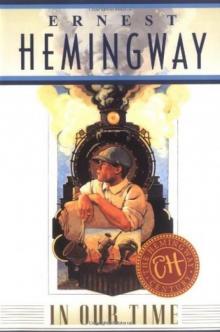
Ezra Pound, writing to console his friend, said that if the stories were at all good, then he could re-create them from memory, and probably better. However, Hemingway did not sit down again at his typewriter until Pound commissioned some pieces for The Little Review in February of 1923. The resulting vignettes were about war, bullfighting, and the execution of political prisoners. Then, after a fishing trip in Italy, Hemingway sat down and pounded out “Out of Season” in one marathon session. It was published, with “Up in Michigan” and “My Old Man,” in Three Stories and Ten Poems in the fall of 1923. The 31-page collection of 18 vignettes, in our time, followed shortly thereafter. Both were very small print runs; additionally, in our time was originally published with a hand-cranked press on hand-made paper, with plenty of white space to highlight the starkness of the text and the matter-of-fact descriptions of violence. In 1925, it would be expanded and republished as In Our Time by the New York firm of Boni and Liveright. The short stories contained therein introduce the character of Nick Adams, Hemingway’s alter ego for his younger self, and chronicle scenes of loss of innocence through a young man’s childhood, adolescence, war service, marriage, and, finally, fatherhood.