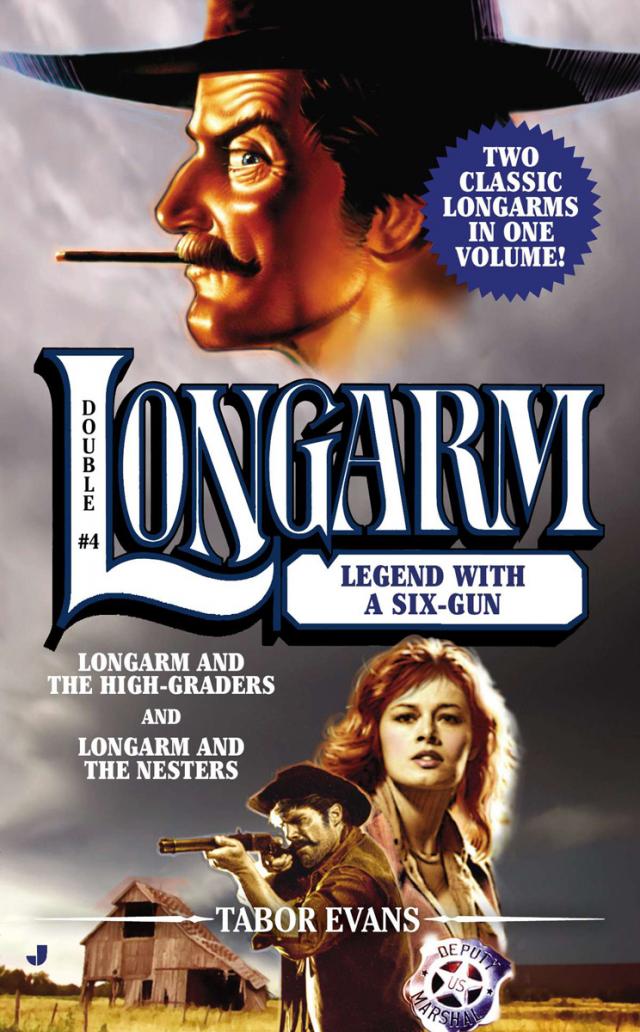
Legend with a six gun 97.., p.33
Legend With a Six-gun (9781101601839),
p.33


“Now, then,” Longarm went on. “If wheat goes up instead of down, you might have to pay fifteen cents a bushel to deliver the ten thousand bushels you sold short. But you know some farmers who need money real bad, so you tell them you’ll buy for spot cash, if they’ll take four cents a bushel. You make a little bit if wheat goes down, but you make a hell of a lot if it goes up. Is that called hedging?” While Longarm waited for Stone’s reply, he drained his glass.
“Mae!” Stone called, his tone peremptory. “Serve the marshal again.” Then he looked at Longarm, still smiling. “I make a profit either way, of course, because I was intelligent enough to hedge my position. In a totally legal way, I’ll remind you again.”
“Seems to me you get the poor farmer going and coming. He’s the one who loses on a deal like that. And the man who was betting against the market, of course.”
Mae brought the decanter over and refilled Longarm’s glass. Stone flicked a hand in her direction, as he’d flick away an annoying insect. She hurried out of the room.
Stone said, “The farmer got paid for his wheat. The speculator lost, but the chances are he could afford to. I don’t win every time, you know, when I speculate.”
“From the way you’re talking, Mr. Stone, I’m getting the idea that you’re going to hold these farmers here to the options you got them to sign last year.”
“Of course I am. They knew what they were signing. The fact that wheat’s a few cents above the price I offered them now, and probably will go higher because crop forecasts are bad, hasn’t anything to do with the validity of the options.” His eyes narrowed. “That’s what this is all about, is it? Those foreigners are stirring up trouble for me because they want to back out of a deal they made?”
“Well, they ain’t happy with it, that’s the truth. But I told them I’d have a talk with you, which is what I came here for.”
“I see. This isn’t an official call concerning a case you’re investigating, then?”
“No. I’m down here in Kansas to keep an eye on the election that’s coming up, and make sure there’re no vote frauds.”
“Odd that a federal marshal would be sent to such a small place, with so few votes, in a national election year. It seems to me there would be a lot of cities where your efforts would be needed, instead of an obscure village like Junction.”
“I don’t choose my cases, Mr. Stone. I just go where I’m sent.”
“Of course. Well, it’s of no importance to me. I’m not involved in it, of course.”
Longarm tugged pensively at a corner of his mustache. “That’s funny. I figured because you were visiting Clem Hawkins today, and he’s into the local election so deep—well, I thought you might be, too.”
“What in—” Stone began. He stopped short, started over. “I know Hawkins, of course. It was just a courtesy visit.”
“Sure. Well, I won’t take any more of your time right now, Mr. Stone. Appreciate you talking to me, and I sure enjoyed your whiskey.”
“I’m curious to know what you’re going to tell the wheat farmers about the options.”
The tall deputy rose from his chair and stretched laconically. “Not much I can tell ’em, beyond what you’ve told me. As far as the option agreements are concerned, they’re legal, all right.”
“I’m glad to find out you’re a reasonable man, Marshal Long. Drop in for a drink whenever you’re passing by.”
“Thanks. I might just do that.” Longarm picked up his hat and started for the door. “One thing I better say before I go, though. If I was to find out you and Mr. Hawkins were aiming to use those options to influence the wheat farmers to vote your way in the election, it’d be vote fraud, and I’d have to do something about it. Now I’ll bid you good day, Mr. Stone.”
Stone was still gaping at Longarm when the door closed behind him.
Smiling to himself, Longarm walked the short distance to the train shed and stepped inside. The agent recognized him at once.
“Did you get the answer to your wire, Marshal?” he asked.
“Not yet. You mean it came in?”
“About an hour ago. I looked for you where you said to, and when I didn’t find you around town, I delivered it to the sheriff to give to you.”
“Well, thanks. I’ll stop in there, it’s on my way.”
At the sheriffs office, the door was unlocked and Longarm went in without knocking. Grover was not at his desk. Longarm looked at the cells, intending to ask Prud Simmons where the sheriff had gone. The cells were both as empty as the office.
Chapter 9
For a moment, Longarm simply stared at the empty cells, unable to believe what he was seeing. He looked around the small, square office then, but there was no other door, no window, no closet, no place in which Prud Simmons could possibly be hiding.
Worry crept into Longarm’s mind. He knew Prud’s way with locks, and had warned Grover about the fugitive’s skill at picking them. There was, he thought, a chance that while Grover had had his attention focused elsewhere, Prud had somehow managed to open his cell and jump the sheriff. It would have been easy enough for the convict to have overpowered an unsuspecting man, and Prud was wily enough to choose his time carefully.
After that, with Grover’s guns as well as Prud’s own weapons, which Longarm had handed to Grover as evidence, the convict would be in full command. If he’d forced Grover to leave with him, nobody would have noticed; the office was too far from the few stores and houses on Junction’s street for anyone to have paid attention to a pair of riders leaving the place.
No damned way in the world to track ’em, either, Longarm thought. Prud’s been out on that Hawkins gather, and he’s learned every draw and gully inside of ten miles. . . .
“Where the hell have you been, Long?” The voice came from behind him.
Longarm drew as he turned. Sheriff Grover’s eyes popped when he saw the Colt’s muzzle menacing him. Longarm lowered the gun.
“Sorry, Grover. When I hear a strange voice at my back, I don’t feel comfortable about it.”
“Well, you pick a hell of a way to show how you feel.”
Longarm holstered the revolver. “Nothing to worry about. I always look before I pull the trigger.”
“Where have you been, Long?” Grover repeated. “I’ve been going all over town, trying to locate you.”
“I could ask you the same question, Grover, only I’ve got a better one. Where the hell is Prud Simmons?”
“I can’t say. I let him go when I got that wire your Denver office sent you.”
“Let him go!” Longarm exploded.
“I didn’t have much choice. Here, read it yourself.” The sheriff handed a Santa Fe telegram flimsy to Longarm.
NO ESCAPE FLYER ON PRUD SIMMONS STOP
NOT WANTED AS FAR AS KNOWN STOP
VAIL PER GLC
“How’d you get hold of this?” Longarm asked. “It’s addressed to me.”
“I supposed if it’d been something real private, it would’ve been sealed up in an envelope,” Grover replied. “And you oughta know how I got it. The station agent brought it, after he’d looked everywhere else you told him you’d be.”
“Oh, come on Grover. You know I don’t give a shit if you read the message. But you letting Prud go, that’s something else. Damn it, he was my prisoner!”
“Like hell. The minute you passed him over to me, he was my prisoner. Remember, you took him on a local charge in my jurisdiction.”
“Take your goddamned jurisdiction and shove it up your ass!” Longarm retorted angrily. “Here I bring you in a night-shooter who damn near killed a man, and give you enough to put him away, and you let him go the minute I turn my back!”
“What you call evidence wouldn’t hold up in court!” Grover retorted.
“That’s your opinion. I’ve seen men sent up for prison terms on a lot less!”
“Maybe. But not in Junction, Kansas, when a jury’s going to be made up of Clem Hawkins’s friends, and the prisoner works for Clem!”
Longarm shook his head pityingly. “Is that why you let Prud out?” His anger was still strong, but common sense was holding it submerged. “You figured you’d make Hawkins happy? Think again, Grover. Hawkins was right there when I took Prud prisoner. He told me to get him off his ranch, said he didn’t want trash like Prud smelling up his place.”
“Clem Hawkins said that? Ah, he was just putting on a show for you, Long. Clem never has cared much who he hires, as long as the man does his work.”
“You know him better than I do, I guess. It’ll be interesting to see if he takes Prud Simmons back on, though I doubt that Prud’s fool enough to stay around here very long. If I know him, he’s cutting a shuck right now to get someplace else.”
A new voice at the door interrupted them. The Santa Fe station agent stood there, another telegraph flimsy in his hand. He said, “This just came over the wire for you, Marshal Long. It’s marked ‘urgent,’ so I hurried out to find you.”
“Thanks.” Longarm took the message and read it. When he looked up at Grover, his eyes were cold. “It appears you’re not the only damned fool in this mess. Listen to what my office just sent. ‘Earlier message re Simmons in error. Simmons escaped prison Pembina, DT, five weeks ago. Notifying DT authorities subject held in Junction. They will send deputy to transfer.’”
“That—that’s impossible, Long! You federal people don’t make mistakes like that!”
“The hell we don’t. Not many, but we make ’em.”
“How’d they come to send the wrong information?” Grover sounded both beaten and bewildered.
“Too damn many people have got their fingers in things.” Longarm took the first message from the pocket where he’d thrust it, and looked at the signature. “I’ll tell you how this happened. Billy Vail, my chief, has got a prissy little secretary named George Linden Carver. Those are his initials, right on the bottom of this wire. Little Georgie took it on himself to send that wire while Billy was out, and he didn’t wire the Dakota people first, just looked through the wanted fliers in the files. Billy got back, and made him wire up to Dakota Territory.”
“But it’s not my fault!” Grover protested. “I thought that first wire was right!”
“Like hell it ain’t your fault! You turned my prisoner loose and didn’t wait to tell me you was going to. If you’d kept your prick in your pants, and not been so damn anxious to do Clem Hawkins a favor by letting his man go, you’d’ve been in the clear.”
“What are you going to do about it?” Grover asked.
“I don’t aim to do a thing. You made the mess; you clean it up. When the prison guards get here from Pembina, you can tell ’em why they don’t have a prisoner to take back. And any questions my chief asks me, I’ll tell him to look to you for answers.”
“Now, listen, Long—”
“No. You listen to me. That rifle slug Prud triggered the other night wasn’t meant for the man who took it. That bullet was aimed at me. I’m betting Prud ain’t run far. He might be hiding out close by, waiting for another chance to backshoot me. If he does, it won’t matter how bad I’m hurt, I’m coming after you and I’ll put a slug in you just where Prud got me. Now, chew on that with your supper!”
Pushing past Grover and the bewildered station agent, who’d stood riveted in frozen fascination while the argument went on, Longarm walked away.
* * *
Longarm didn’t enjoy his supper of steak and potatoes. The food tasted as sour as had the Maryland rye he’d sipped at the Ace High before going to the restaurant. Even his after-supper cheroot had a rank flavor. The night was still in its early half when he went to his room, and to bed. His last thought before dropping off to sleep was a hope that Ruthie wouldn’t knock on his door and rouse him.
It wasn’t Ruthie who knocked, however. Longarm didn’t know how long he’d been sleeping, but knew it hadn’t been long enough, when the insistent rapping of knuckles on the door panel brought him awake and to his feet. His Colt was in his hand before his feet touched the floor.
“Who is it?” he called through the door.
“Is me, Marshal Long. Nicolai Belivev.”
Longarm recognized the homesteader’s voice. He opened the door and Belivev came in.
“Is trouble, mister Marshal,” he panted without wasting time on greetings. “Mordka Danilov sent me to tell you, ask you if vill you help us again once more.”
“What kind of trouble are you talking about?”
“Same kind as before. Fence-cuttings and tramplings from vheat.” In his agitation, Belivev’s carefully learned English was deserting him. “Only now, this night, is vorse as before. Not is just one field, now. Is already three, and Mordka says maybe before daytime vill be more yet. Six, seven, riding horses, you understand? They go one place, cut fence, and ride horses over field, then fast ride mile or two avay and do again, field from somebody else.”
“You mean there’s a gang working your crops over?”
“If is six, seven men a gang, yes, Marshal Long. Shoot guns up in air to scare our vomen, keep us inside vhile they ruin vheat.”
“Damn fool cowhands from one of the ranches, maybe more than one,” Longarm muttered, more to himself than to Belivev. He went to the dresser and lifted the bottle of bonded rye, estimated that it held just enough for a wake-up swallow, and drained it. He went on, “Hands heard their bosses cussing you farmers, got the notion to chivvy you. Or maybe the bosses sent ’em to do it. Hard to know.”
“You vill vith me then come?” Belivev asked.
Longarm was already putting on his clothes. “Sure. Only, did you go by and rouse up the sheriff too? It’s his job to keep law and order around here.”
“Try to find sheriff, Mordka tell me, before I come ask you. Is no use. All over I go, no sheriff is. So to you I come,”
“All right.” Longarm stamped his feet into his stovepipe boots and belted on his Colt. He took his Winchester from the corner where it leaned and filled a coat pocket with extra shells from his saddlebag. He told Belivev, “I’ll ride double with you to the livery stable and get my horse. Then we’ll see what we can do about this damnfool night-riding caper.”
* * *
In the moonless night, they could see lights gleaming here and there amid the wheatfields soon after they’d left Junction. Where houses stood, windows and open doorways threw the glow of yellow lamplight through the blackness. Where there were soddies, the light rays hugged the ground, visible to a distant viewer only as a golden sheen. Occasionally the shadow of a man on patrol was silhouetted against one of the lighted areas. When they got closer and turned into the narrow lane that ran between the fenced fields, they could hear the faint ring of voices calling through the night.
Mordka Danilov was waiting in front of his house when they dismounted. He grasped Longarm’s hand in both of his and said, “I thank you greatly, Marshal Long, for coming to help us. Believe me, if it was not a serious matter, I wouldn’t have disturbed your sleep. But you seem to be the only one we can turn to right now.”
“I didn’t figure you’d send for me unless you were being pushed hard,” Longarm told him. “Besides, I promised you I’d do whatever I could to get you folks out of a scrape.”
“You know we’re grateful,” Mordka said. “This is something we haven’t had happen before.”
“These night-riders, they just pop up someplace and snip your Glidden wire, ride over your land, and move on? No rhyme or reason to where they hit?”
“There have been four wheatfields trampled so far. They came soon after dark and cut Basil Lednovotny’s fences, rode back and forth over his grain. Then they struck the fields of Sergei Tuscheva, two miles from Basil’s place. They had just done their wanton mischief at Anatoly Yanishev’s farm when I sent Nicolai to find you, if he couldn’t find the sheriff first. Anatoly’s land is about a mile from where Sergei lives. Since Nicolai has been gone, they struck at Pavel Sednov’s. So you see, they don’t seem to have a plan, just ride back and forth at random and stop to do their ugly work wherever they please. They are like the Cossacks of the Tsar!”
“Have your folks been fighting back? You’ve got a right to defend what’s yours, you know.”
“We were too stunned at first,” Mordka said. “But now we are aroused and ready. We want to live in peace, Marshal. We came here to America to find peace. Now, evil and violence is everywhere we look.”
“Belivev told me there’s been some shooting.”
“A few shots, yes,” Danilov replied. “Not aimed at anyone, I think. Just wild shots into the air, to frighten us.”
“Any of your people shoot to hit the riders?”
Mordka shook his head. “This I do not know. What I have told you has been passed along from one farm to the next until it reached me here. Everything, I do not know. But I do not think the Brethren have aimed their shots. Not yet.”
“High time they did, then. The best way to stop a thing like this is to hit back quick, before your people get hurt too bad.”
“Marshal Long, we do not wish to fight.” There was sadness in Danilov’s voice as he added, “But if you say we must . . .”
“Every man has to look after his own, right now,” Longarm reminded Danilov. “I can’t be everywhere at the same time. Now, I’ll pitch in and help you here, but you’ll have to help me too.”
“Tell me what you want us to do, and we will do it.”
While they’d been talking, Longarm’s mind had been busy with a plan. He told Danilov, “We’ll try to catch the riders at the next place they stop. Now, you said you’d got word about where they’ve been, passed along from one of your Brethren to the next. That’d work both ways, wouldn’t it? You can pass something along from here?”