The sun walks down, p.1
The Sun Walks Down,
p.1


Praise for Fiona McFarlane
THE SUN WALKS DOWN
‘The Sun Walks Down is the book I’m always longing to find: brilliant, fresh and compulsively readable. It is marvellous. I loved it from start to finish.’ Ann Patchett, author of These Precious Days
‘Gorgeous storytelling and superb characters are among the glories of The Sun Walks Down. Fiona McFarlane is an extraordinary writer, one of the best working today. Her magnificent reworking of the lost child story showcases the profound understanding she brings to people, places and the past. I lived in this wise, majestic novel for days and never wanted it to end.’ Michelle de Kretser, dual Miles Franklin–winning author of Scary Monsters
‘Accomplished, assured, elegant and insightful—this beautifully told novel took me on the most unexpected and compelling of journeys. I adored it.’ Sofie Laguna, Miles Franklin–winning author of Infinite Splendours
‘The Sun Walks Down is an extraordinary work of fiction that I have no doubt will become a classic of Australian literature. McFarlane’s writing is assured, masterful, nothing short of brilliant.’ Emily Bitto, Stella Prize–winning author of The Strays and Wild Abandon
‘Symphonic in composition, The Sun Walks Down assembles an entire world around the disappearance of a young boy into the South Australian dust. Patiently, subtly, and with great-hearted humanity, Fiona McFarlane gives full life to every character in this world, remaking colonial myths with a 21st-century novelist’s tools. As the parts come together towards a moving climax, you find yourself immersed in something vast, satisfying on every level, a triumph of literary construction. With The Night Guest, McFarlane emerged as a major Australian literary novelist; The Sun Walks Down confirms it.’ Malcolm Knox, author of Bluebird
‘McFarlane’s great gifts as a storyteller are on full display in this luminous and assured novel. Its extraordinary characters are at once revealed and shadowed by loss and by history, and by their fears for a child missing in a parched place few can read or know. All are infused—adults, children and the landscape they walk and search—with a complexity and dignity that is her hallmark. I closed the book and wanted immediately to read it again.’ Kristina Olsson, author of Boy, Lost
THE NIGHT GUEST
‘The Night Guest is such an accomplished and polished debut. A delicacy and poignancy to the writing is combined with almost unbearable suspense.’ Kate Atkinson, author of Life After Life
‘I will be haunted by its beauty and its truths for a long time to come … A rapturous, fearsome fable of grief and love.’ Susanna Moore, author of In the Cut
‘An extraordinary novel. At once a tender thriller and an exquisitely constructed meditation on time and memory, it is propelled by sentence after sentence of masterful prose. With The Night Guest, Fiona McFarlane announces herself as a writer to be read, admired, and read again.’ Kevin Powers, author of The Yellow Birds
‘The best Australian first novel I’ve read in years. I so much admire the intelligence that animates it, and her calm sentences that contain surprises.’ Michelle de Kretser, dual winner of the Miles Franklin Award
‘Astonishingly brilliant … Such a very rare voice.’ Evie Wyld, Stella Prize–winning author of The Bass Rock
‘Clear-sighted and compelling … you love Ruth as you travel with her to the book’s end.’ Ashley Hay, Weekend Australian
‘An utterly charming book. Ruth is mischievous, adventurous, and unconventional … McFarlane’s style is fresh and full of surprising delights.’ Australian Book Review
‘Sometimes a debut novel burns brighter than the rest, and offers up the promise of literary greatness. The Night Guest is one of these books.’ LA Review of Books
‘A debut of uncommon assurance … It seems to rise above the shiny trivia of the last decade’s novels … and do what serious fiction can: leave you more interested in the world, more conscious of its enigmas of love and memory, than you were before you read it.’ Chicago Tribune
‘A novel of uncanny emotional penetration … A low thrum of terror builds ever so gradually as The Night Guest proceeds, and its source is the slippery connection between the mind and the world … What makes The Night Guest especially unnerving is the way it immerses the reader in a mind that is slowly slipping its moorings. As McFarlane depicts it, in clean, sinuous prose, you begin to lose your self by burrowing deeper inside it.’ Laura Miller, Salon
‘An enrapturing debut novel … Startling and elegant.’ Kirkus Reviews (starred review)
‘Rich and suspenseful … [The Night Guest] is at once a beautifully imagined portrait of isolation and an unsettling psychological thriller.’ Publishers Weekly (starred review)
‘Gothic in sensibility, with a touch of magic realism, this novel feels at once like a classic and a fresh, original tale … Fans of psychologically oriented Scandinavian fiction should feel a familiar draw to this first novel, which is already creating significant buzz around the globe.’ Library Journal (starred review)
‘I have read the opening paragraph of Fiona McFarlane’s debut novel three times now—at first, slowly; but then with increasing, heart-pounding speed each time—and I am convinced it’s one of the most enticing openings to a novel I’ve read all year.’ David Abrams, The Quivering Pen
‘McFarlane exploits the vulnerably blurry boundaries of memory here to create a subtle and beguiling crescendo of suspense … A limpid, beautiful novel.’ Daily Mail
‘Horribly believable, The Night Guest is an impressive debut novel that sustains the tense unravelling of its mystery.’ The Sunday Times
‘Beautifully written and psychologically tense … extraordinarily accomplished.’ Sunday Express
‘This debut novel stands out among the year’s strongest so far, with its delicately told story of two women whose lives temporarily entwine: one an ageing widow, the other a larger-than-life carer who inveigles herself into the widow’s emotional life—and home. Its cool, controlled prose explores the intersections between dementia, unreliable narration, and elderly exploitation, regarding loss, ageing and racial tension, without a hint of cliché. And it’s a tension-filled psychological thriller to boot, all inspiring the use of that overused phrase “a must read”.’ The Independent on Sunday
THE HIGH PLACES
‘This felt like a writer who was pitch perfect and just hit it on the nail with this book. We were all really impressed by, bluntly, a genius.’ Dai Smith, Chair of Judges, Dylan Thomas Prize, won by The High Places
‘The High Places is superb … It’s not just that McFarlane’s descriptions are beautiful prose, though they are. The High Places is more deliberate than that, and more intelligent. McFarlane strikes an emotional note on every page, whether it be humour or nostalgia or discomfort or joy … Each story feels fresh and original … Nothing is forced and the reason I can’t pick my favourite is that every one of the thirteen stories is a winner.’ The Saturday Paper
‘Laden with wry wit and a deceptive simplicity … Moves boldly between place, perspective and voice, describing situations that manage to be both hysterically funny and quietly devastating at the same time … These singular images speak to the larger universal experience that is recognisable, discomfiting and always surprising.’ Books + Publishing
‘McFarlane’s people, or characters, because they exist in a liminal state unattached to reality, make ordinariness odd. It’s a vertiginous world, a Kirchner or Munch … McFarlane has an intelligent and distinctive voice and she’s a marvel at conjuring atmosphere.’ The Age
‘McFarlane has a gift for cutting into a story at precisely the right angle … Her writing is skilled; her point of view is unique.’ The Times
‘In her distinct and unusual voice—the disconcerting tone and dry humour are reminiscent of Margaret Atwood or Valerie Martin—McFarlane examines relationships with uncomfortable clarity and insight, observing the subtext of human behaviour while acknowledging a mysterious power behind the reality we think we know.’ Daily Mail
‘While lesser writers use similes to render descriptions more vivid, McFarlane’s heighten aspects of her characters and advance her plots.’ The New York Times Book Review
‘McFarlane has a knack for bringing out the macabre … and shows herself as an exceptionally fine writer of the ways coercion and care entangle us.’ Publishers Weekly
First published in 2022
Copyright © Fiona McFarlane 2022
All rights reserved. No part of this book may be reproduced or transmitted in any form or by any means, electronic or mechanical, including photocopying, recording or by any information storage and retrieval system, without prior permission in writing from the publisher. The Australian Copyright Act 1968 (the Act) allows a maximum of one chapter or 10 per cent of this book, whichever is the greater, to be photocopied by any educational institution for its educational purposes provided that the educational institution (or body that administers it) has given a remuneration notice to the Copyright Agency (Australia) under the Act.
Epigraph from ‘The Past’, My People, Oodgeroo, © 1970, Estate of Oodgeroo. Reproduced with permission of John Wiley & Sons, Inc.
Epigraph from William Carlos Williams, from Paterson, copyright ©1946 by William Carlos Williams. Reprinted by permission of Carcanet Press and New Directions Publishing Corp.
Allen & Unwin
Cammeraygal Country
83 Alexander Street
Crows Nest NSW 2065
Australia
Phone: (61 2) 8425 0100
Email: info@allenandunwin.com
Web:www.allenandunwin.com
Allen & Unwin acknowledges the Traditional Owners of the Country on which we live and work. We pay our respects to all Aboriginal and Torres Strait Islander Elders, past and present.
ISBN 978 1 76106 620 7
eISBN 978 176118 542 7
Set by Bookhouse, Sydney
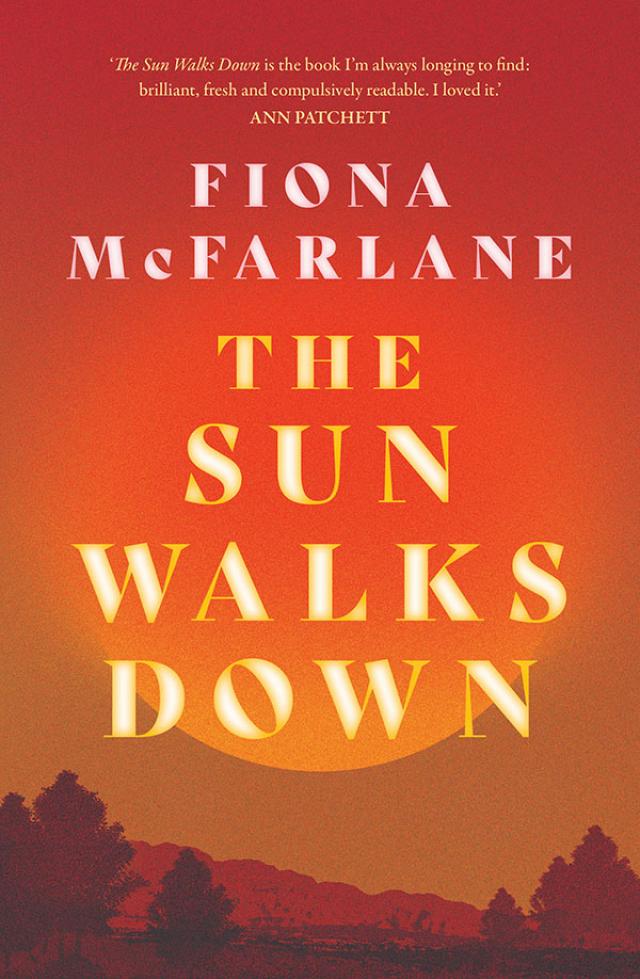
Cover design: Sandy Cull, www.sandycull.com
Cover images: Sandy Cull (Flinders Ranges); Khafi Kurnia / Alamy (trees)
For my sister, Katrina
Three hearty cheers for the flag, the emblem of civic and religious liberty, and may it be a sign to the natives that the dawn of liberty, civilisation, and Christianity is about to break upon them.
JOHN MCDOUALL STUART, PLANTING THE BRITISH FLAG IN THE CENTRE OF AUSTRALIA, 1860
Now is so small a part of time.
OODGEROO, ‘THE PAST’
The province of the poem is the world.
When the sun rises, it rises in the poem and when it sets darkness comes down and the poem is dark.
WILLIAM CARLOS WILLIAMS, PATERSON
AUTHOR’S NOTE
The Flinders Ranges and the Willochra Plain are real places, but Fairly, Undelcarra, Thalassa and the Axam Range are inventions. The locations in which this novel takes place would, if they existed, overlap with the Country of two Aboriginal nations: the Nukunu Nation and what is now known as the Adnyamathanha Nation. I respectfully acknowledge the land’s Traditional Owners and my novel’s debt to them. Sovereignty of this land has never been ceded, and never will be.
CONTENTS
AUTHOR’S NOTE
THE COLONY OF SOUTH AUSTRALIA, SEPTEMBER 1883
FIRST DAY
FIRST NIGHT
PRAYER OF THE GERMAN WIDOW
SECOND DAY
SECOND NIGHT
TALES OF THE YADLIAWARDA AND IRISH HOUSEMAIDS
THIRD DAY
THIRD NIGHT
VINDICATION OF THE RAMINDJERI TRACKER
FOURTH DAY
FOURTH NIGHT
DREAM OF THE PASHTUN CAMELEER
FIFTH DAY
FIFTH NIGHT
CONFESSION OF THE GERMAN PROSTITUTE
SIXTH DAY
SIXTH NIGHT
NOTES OF THE AUSTRALIAN WRITER
SIXTH NIGHT, STILL
STATEMENT OF THE ENGLISH ARTIST
SEVENTH DAY
SEVENTH NIGHT
THE STATE OF SOUTH AUSTRALIA, FEBRUARY 1901
ACKNOWLEDGEMENTS
ABOUT THE AUTHOR
THE COLONY OF SOUTH AUSTRALIA, SEPTEMBER 1883
The boy met a god by the hollow tree.
‘Go away,’ said the boy, and the god, formless, passed on in the direction of the red hill. Then the boy was free to hunt in the scrub for roosting hens. When he came upon the hens they flapped up as if they could fly, and he gathered their eggs in a basket. The boy was six years old and thin, with a vivid pointed face. He wasn’t pale, exactly—his skin browned in the sun—but the visible veins at his wrists and ears suggested a delicacy that the people he knew associated with pale children. There was so little of him. When his mother held him, his heart felt near. Light hair, lifting in the briefest wind. And not so delicate, in fact—a strong boy, a good runner. The name people called him was Denny, and he answered to it.
The boy was gentle as he settled the eggs in the basket. Then his mother wanted him close—he knew this, even though she hadn’t called his name. Nobody had ever told him about his mother’s deafness; she was simply his mother, which meant she heard little and spoke less. But the boy knew when she wanted him to go to her. She had finished hanging the sheets on the line behind the house, and the boy went to give her the basket of eggs; she took it, bent down to him, and pressed her face against his neck. Today she belonged to him entirely—all his sisters were at a wedding in town and his father was out planting parsnips.
The boy and his mam were alone and loving among the sheets. Then quick as a blink she straightened, turned her back and went into the house, which always ate her up. The boy, following, wanted to help her churn the butter, but she made him put his boots on, she laced them tight, and she sent him out with a sack to gather grass and bark and twigs. He liked to collect things for the fire, and he liked to please her. The black dog, Mopsy, woke from her nap in the sun and looked as if she might come with him; but she heard Mam start the butter churn and went to supervise that instead.
The boy walked away from the red hill, although it was from behind the hill that his sisters would come home from town. The country he walked into was red and brown—desert country—but there was a haze of green over the top of it, because it was spring. At this time of day, the surrounding hills were white and yellow and green. A shrub scratched the boy’s shin and he followed, for a while, the deep course of a dry creek. He kneeled on its stony bed and saw ants carrying a large dead fly. The word that came to him was ‘housebound’, maybe because he’d heard his mother use that word about Mrs Baumann, who had large eyes, like a fly, and clean, folded hands, and sat in a chair with wheels on it as if she had neat grey wings tucked behind her. But the boy didn’t think of Mrs Baumann exactly; the word ‘housebound’ just dropped into the boy and went away again.
He rounded a curve in the creek and surprised a kangaroo. He knew the story of the kangaroo: once upon a time, it argued about food with its cousin the wallaroo, so now it stayed here on the dry, flat plain while the wallaroo lived up in the hills. The boy’s heart was big with sorrow for the kangaroo, which crouched very still and looked at him. It seemed to be waiting for something to happen. Then it turned and flew from the creek bed and the boy climbed out to follow it for its dung, which also burned. Really, he followed it because it was fast, because the boy was also waiting for something to happen, because he was six years old.
Soon, things would happen. Men would call his name in the night; there would be blood on a handkerchief, and fire on the red hill.
The boy looked north and saw a high dark wall over the ranges. The wall was moving towards him. It was made of dust, and when the dust reached him it hid the sun. The sun was there, the boy could see it through his narrowed eyes, but it was brown now, and silly: only as bright as a lamp or the moon. The dust rolled down from the north in secret colours, very soft, until the wind came up behind it. Then it stung. The boy held the sack across his face, as his father had taught him to do when the dust storms came, and he turned around and began to walk, and that’s how he got lost: trying to walk home in the dust.
When the storm had passed, his mother went out into the yard and spat red onto the red ground. She looked for him in the direction he had gone and saw no sign.
FIRST DAY
The dust storm rose up in the central deserts. In order to reach the boy and his mother, it passed over the ridges, valleys and gorges of the northern Flinders Ranges. These ranges were laid down, long ago and slowly, in layers of rock: limestone, for example, sandstone, quartzite, also other types of rock that exist only here, in the arid middle of South Australia. They were laid down by time and water, folded into great peaks by the movement of the Earth, and in the aeons since then have been worn by time and water back to stumps. The European settlers, who came to the ranges in the 1840s, sometimes refer to them as hills, but this is too reasonable a word for the serrated ridges and startling inclines of this dusty, dry country. These are ancient mountains—so old that they’ve collapsed in on themselves, as stars do.
This particular storm contributed to the long, slow erosion of the Flinders Ranges by picking up more dust from the kicked surfaces of the sheep and cattle stations, then pouring over the jagged rim of Wilpena Pound. From there, it rolled down into the narrow northern neck of the broad tableland known as the Willochra Plain; it rolled on into the bristling wheat country, where it hid Denny and sent his mother running for the freshly washed sheets. That work done, the storm now continues south across the widening Willochra, which is surrounded by ranges on every side. The dust flows over the plain like a beery tide until it reaches the town of Fairly, where Denny’s sisters are attending a wedding.