

Tea and alchemy, p.1
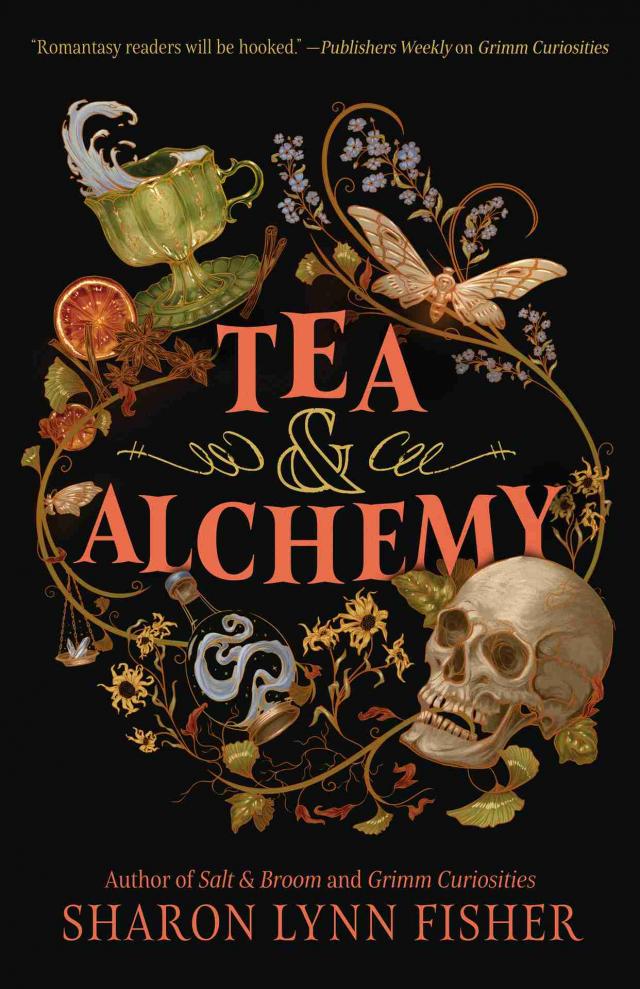
Tea & Alchemy,
p.1


Praise for Sharon Lynn Fisher
Grimm Curiosities
Recommended by The New York Times in “Holiday Romance Novels to Make Your December Merry and Bright”
“Fisher has penned a haunting, romantic tale.”
—Booklist
“Fisher allows the suspense to build slowly even as the romance burns quickly. Romantasy readers will be hooked.”
—Publishers Weekly
Other Books
“Fans of Jane Eyre will go feral for this mysterious, historical fantasy retelling of their favorite classic read.”
—The Everygirl on Salt & Broom
“Readers of Brontë’s original will appreciate this character-driven, romance-filled mystery.”
—Booklist on Salt & Broom
“Fisher’s loose retelling brings a gothic fairy tale vibe to the classic and adds some twists that will keep even those familiar with the original guessing.”
—Publishers Weekly on Salt & Broom
“A pleasant, atmospheric romp that fantasy or romance fans will enjoy. There’s no need to be familiar with Brontë’s novel to enjoy this one.”
—Library Journal on Salt & Broom
“Fisher has a fantastic voice—crisp, magical, and crystal clear.”
—Darynda Jones, New York Times and USA Today bestselling author
“Magical and brilliant! A fast-paced romp that expertly weaves two different worlds into an adventure not to be missed. Sharon Lynn Fisher crafts clever dialogue and creates characters to fall in love with.”
—Lorraine Heath, New York Times and USA Today bestselling author, on The Absinthe Earl
“The environment is lush and imaginative, with everyone appearing to hide their own seductive, dark secrets. It’s a world that comes alive with mysterious, foggy moors, dangerous peat bogs, and gorgeous green hills . . . Irish mythology and folklore are where Fisher’s writing shines.”
—Kirkus Reviews on The Absinthe Earl
“This is quite a wonderfully dizzying mash-up of a historical setting, time travel of a sort, and the fae. If you’re a reader drawn to historical fantasy and magical Regencies, definitely give this series a try.”
—Book Riot on the Faery Rehistory series
“This is a really fun sci-fi romance . . . Very cool setup and characters that I couldn’t put down . . . The twist at the beginning will really hook you in!”
—Felicia Day, actress and producer, on Ghost Planet
Other Titles by Sharon Lynn Fisher
47North
Salt & Broom
Grimm Curiosities
Faery Rehistory Series
The Absinthe Earl
The Raven Lady
The Warrior Poet
Science Fiction
Ghost Planet
The Ophelia Prophecy
Echo 8
Erotic Fantasy Shorts
Before She Wakes
This is a work of fiction. Names, characters, organizations, places, events, and incidents are either products of the author’s imagination or are used fictitiously. Otherwise, any resemblance to actual persons, living or dead, is purely coincidental.
Text copyright © 2026 by Sharon Lynn Fisher
All rights reserved.
No part of this book may be reproduced, or stored in a retrieval system, or transmitted in any form or by any means, electronic, mechanical, photocopying, recording, or otherwise, without express written permission of the publisher.
Published by 47North, Seattle
www.apub.com
Amazon, the Amazon logo, and 47North are trademarks of Amazon.com, Inc., or its affiliates.
EU product safety contact:
Amazon Media EU S. à r.l.
38, avenue John F. Kennedy, L-1855 Luxembourg
amazonpublishing-gpsr@amazon.com
ISBN-13: 9781662528699 (paperback)
ISBN-13: 9781662528682 (digital)
Cover design and illustration by Story Wrappers
For Selah, who knew I had a vampire novel in me.
For Talia, who’s always up for bingeing Twilight.
Contents
Epigraph
Author’s Note
Prologue: Harker Tregarrick
The Magpie
A Bad End
Chorus
“Poetic Justice”: Harker
Shapes
“Leave Her for Death”: Harker
Roche Rock
Stories
The Wolf’s Head
“Why Aren’t You Afraid?”: Harker
The Alchemist
Entranced
“Crawl If You Have To!”: Harker
Deadly Closeness
In the Leaves
St. Gomonda
“And Yet I Live”: Harker
Stones
Bait
“What Have You Done to Her?”: Harker
Goosevar
Options
Death
“The Other Way Round”: Harker
Tangled
Vow
“I Will End Myself”: Harker
Home
Pleasures of the Flesh
Messengers
“Fare Thee Well”: Harker
Hiding
“I Have Failed”: Harker/Goosevar
Sweetbriar
“Two for Joy”: Harker
Acknowledgments
About the Author
Her light step would appear wandering amidst the underwood, in quest of the modest violet; then suddenly turning round, would show, to his wild imagination, her pale face and wounded throat, with a meek smile upon her lips.
—John William Polidori, The Vampyre
Author’s Note
The setting for this story is based on a real village and very old chapel in Cornwall, England. Search “Roche Rock,” and you’ll easily find it. I visited on impulse—we’d unintentionally arrived in Cornwall during the first weekend of a spring school holiday, and I was looking for less-frequented attractions. The place made my jaw drop, and I knew immediately I had to put it in a book.
If you’d like some additional visuals to complement your reading experience, you can visit my Pinterest inspiration board (username “sharonlynfisher”).
And for music that inspired the story, you can find playlists for my books on Spotify. Click the “Profiles” button below the search bar and type “Sharon Lynn Fisher.”
Lastly, a note of caution—the alchemical medicine created in this story is fictional and sometimes contains toxic plants. Okay for supernatural creatures but not people.
Prologue
Harker Tregarrick
Roche Rock, Cornwall—September 27, 1854
Pushing open the casement, I bent close and breathed the moist air rolling in off Goss Moor. We’d seen the last of the long, sun-drenched days that had left me parched as harvest stubble.
Though the English Channel lay some seven miles to the south, my finely tuned senses sifted the seawater tang from the gentle movement of air. They also made me painfully aware of something much closer—a scent that had tormented me almost daily for the last two years.
A woman was walking along the road that divided the village of Roche from my family estate. A towering wall of granite and a thorn hedge screened her from me, but I could hear her shoes lightly striking the packed earth.
I knew neither her name nor her face. Neither her age nor her station in life. Only that she walked to town most days and occasionally took a footpath across the rocky, uneven heathland that sloped down from my stone fortress.
Roche was a small hive of activity that supported the surrounding farming and mining communities, and many people traveled that road. But this woman . . . she smelled of meadowsweet. No floral essence or apothecary-formulated scent, simply her own delectable smell.
Sweet almond and light musk.
The scent was strongest in the mornings. In the late afternoon, when she returned home, it had been muted by village smells—horseflesh, coal fires, pipe smoke, tea.
Yet behind this ever-evolving perfume, I could always smell her blood.
Everyone who passed along any boundary of my land smelled of it. But none of the others tempted me away from my “vital essence” as she did.
I swung the casement shut, for all the good it would do. Fitted to the fifteenth-century window opening, it sealed out drafts about as well as you might expect.
My fortress was a chapel, constructed from the same type of stone that it rested upon by my ancestor John Tregarrick (originally Tregarrek, Cornish for “homestead of the rock”). He had intended it for a gift to the church but then moved in with his family when a fire destroyed the manor.
So the place was a “chapel” in name only. The black quartz schorl walls, which looked like a natural outgrowth of the high outcrop on which they rooted, enclosed the unholy. They shielded Roche’s inhabitants from my ancient family, and vice versa.
Here I grew up, half orphaned from the day I emerged from my mother’s womb.
The strange tragedy of the place, and the secrecy of my family, had long generated lore in the parish. Some said religious zeal had caused John Tregarrick to withdraw here. Others, that he’d contracted leprosy. The idea of an old hermit in the chapel persisted, though a new heir took possession every century or two. Almost as if the villagers believed there had only ever been one master of the estate. They weren’t far wrong.
Other, darker tales of the place were still told, especially in the autumn and winte
r months, when the nights grew long. They warned of a “Wolf of Roche Rock,” mad and murderous. Fantastic tales in this bright new age of science and industry. Believed only by superstitious fools.
Yet some of the old things were best not forgotten.
I had made it my long life’s work to ensure the good folk of Roche village—including my anonymous tormentor—could rest safely in their forgetfulness. I had studied the condition passed down from father to son. My studies had led me to alchemy, which helped me to understand my physical body’s lack. The reason for my deadly thirst.
Alchemy, too, had provided a kind of treatment. My alchemical vital essence was a substitute for the natural vital essence that flowed through the veins of every living creature.
Though an aqua vitae (“water of life”) in more ways than one, my vital essence was no cure. Alchemy had not transmuted me into a normal man any more than it had transmuted base metals to gold or yielded the secret to eternal life.
I was grateful for what it had given me. A lessening of the fear that at any moment my true self could break free, reviving old terrors among my countrymen. Unleashing the ancient evil.
A lessening was all it could be.
The Magpie
Roche village, Cornwall—October 2, 1854
“Mina,” said my employer, ruddy cheeked, as she carried a tray of teacups into the kitchen, “could you clear that last table while I get started on the washing up?”
“Of course, Mrs. Moyle.” I emptied coins from my apron pockets onto the worktable before going back out to the tearoom.
Things were quieter now, thank heaven. Such a rush of workers came to Roche for the harvest that Mrs. Moyle and I could scarcely draw breath. Like the clay miners, the grain reapers were mostly the kind who preferred the frothy pints, hearty stews, and rough brown bread at The Wolf’s Head, but we caught the overflow and filled them with tea, scones, and pasties. (The strongest drink on offer at The Magpie was a dark cup of Assam.)
I made my way to one of the tables by the windows. I recalled a man had sat there alone, eating scones with Mrs. Moyle’s homemade strawberry jam and clotted cream while reading a newspaper. I hadn’t taken much notice of him; he’d been polite, quiet, and neatly dressed. I didn’t think he was from Roche, but we saw a lot of his sort. Probably a clerk working for one of the china clay companies or tin mines.
He’d left his newspaper behind, and I tucked it under my arm for Mrs. Moyle. “Being a woman is no excuse for being uninformed” was a favorite slogan of hers. More than a slogan, for my employer had taken it upon herself to teach me reading and writing (beyond what little I’d learned from my mother), saying I wouldn’t be of much use to her if I couldn’t read a list for market or write down a customer’s order.
While I supposed these were good reasons, I also thought she was lonely. We had that in common.
I carried the man’s dishes to the kitchen, brushing crumbs from the plate and emptying the tea strainer before setting them next to the washbasin. Upon opening the teapot to remove the leaves that had stuck inside, I froze.
The Magpie had been a welcome change for me in every way but one. Emptying all those pots, I had begun seeing shapes in the clumps of leaves. Everyday things like candles, or flowers, or crescent moons, but now and then a crown, or sword, or castle.
Sometimes after seeing a thing, I’d hear a bit of gossip that seemed related to it. Like the time I saw a ring in the teapot at a table of young ladies, and after a few days I heard one had become engaged. Another time, the sodden leaves formed a line across the bottom of a large teapot, and a month later we heard that the family was setting sail for America. But once I’d seen a sickle shape in old Lady Rundle’s cup—right before she suffered apoplexy.
I’d chided myself for paying heed to it, yet it kept happening. And try as I might, I could no more not see those shapes than I could not smell the gin on my brother, Jack, when he came home from the clay pits (and the tavern) in the evenings.
In this pot, I saw a magpie, plain as day—tea leaves forming the black feathers, the glazed clay of the pot forming the white. Magpies were news bearers, and Mum used to sing an old nursery rhyme about them:
One for sorrow,
Two for joy,
Three for a girl,
Four for a boy,
Five for silver,
Six for gold,
Seven for a secret never to be told
One for sorrow. Near the magpie was a narrow, pointy shape that I couldn’t see as anything but a knife. Or, by its handle, more like a dagger.
“That’s the last of it, then?” asked Mrs. Moyle, turning from the washbasin, the red in her cheeks deepened by the steamy water.
Blinking away the worrisome thoughts, I replied, “It is, ma’am.”
The skin pricked at the back of my neck as I stuck my hand in the pot and dug out the wet leaves before handing it to her. My fingers trembled as I picked up the towel to begin drying.
Let it go.
But I couldn’t.
“Mrs. Moyle,” I said, trying to keep a lightness in my tone, “did you know that fellow who sat alone by the window this afternoon?”
My employer didn’t miss much, and she looked up sharply. But she answered mildly enough. “I’ve never seen him before. I imagine he was just passing through. Seems we see more strangers in Roche every day.”
“That we do.” Roche had grown with the clay mining in the years since Mrs. Moyle had opened The Magpie using money from the sale of her late husband’s livery business. It was why I’d found work here.
She studied me as I dried a saucer patterned with dog roses. “I’m always dreading the day a young man will catch your eye and steal you away from me, but this one was old enough to be your father.”
I laughed, feeling the color in my cheeks. “Nothing like that, Mrs. Moyle.”
She handed me the clean teapot to dry. “What then? I can see you working something over in your mind.”
I rubbed the pot’s gleaming surface with the towel. “You’ll think me a fool. I think it myself.”
“I’ve met fools aplenty, Mina, and I’ve never counted you among them.”
Sighing, I set the pot on a shelf next to the window. Outside, mist gathered low along the ground in the garden, snaking slowly among the dried-up stalks. Most of Mrs. Moyle’s flowers had withered in the heat of the last couple of weeks, but the red roses still bloomed, and a few sweet, creamy woodbine blossoms dotted the vines growing along the hedgerow in back. The birds were at the haws, and we’d have to pick them soon if we were to have any for jelly.
“Sometimes,” I began slowly, “I see things in people’s teapots. Shapes, or likenesses. It often seems as if those shapes are trying to say something to me.”
“You’re a tasseographer,” said Mrs. Moyle in wonderment.
I raised my eyebrows. “Tassy . . . what?”
Her blue eyes were full of interest. “Tasseography! I’ve read about it but never knew anyone who could do it.”
“What is it, ma’am?” I asked, finding some comfort in the idea that the things I was seeing had a name.
“The reading of tea leaves. They form shapes that are symbols of certain outcomes—births, deaths, marriages, and the like. Did your mother read them, by any chance?”
I frowned. “Not so far as I know.”
“There are women who earn money by it; it’s a kind of fortune-telling. Once, a customer left a copy of The Times that had an article about it. There’s a school for young ladies on an estate in Yorkshire that teaches it.” She smiled. “My grandmother always said women with red hair could divine things, especially freckled ones like you, my dear.”
My mother’s hair had been dark, but now that I thought of it, we’d had strangers in the house sometimes for tea. Only when Da was at the mine. Mum sat with them, and she’d send Jack and me outside to hang laundry or peel potatoes. After they’d gone, Mum would tell us not to pester Da by talking about the guest, and she’d give us a bit of bread with jam. Once when I sat down to eat it, I saw her pluck a sixpence coin off the table.
“I think I might be wrong about my mother,” I said.


