The untaken path beyond.., p.18
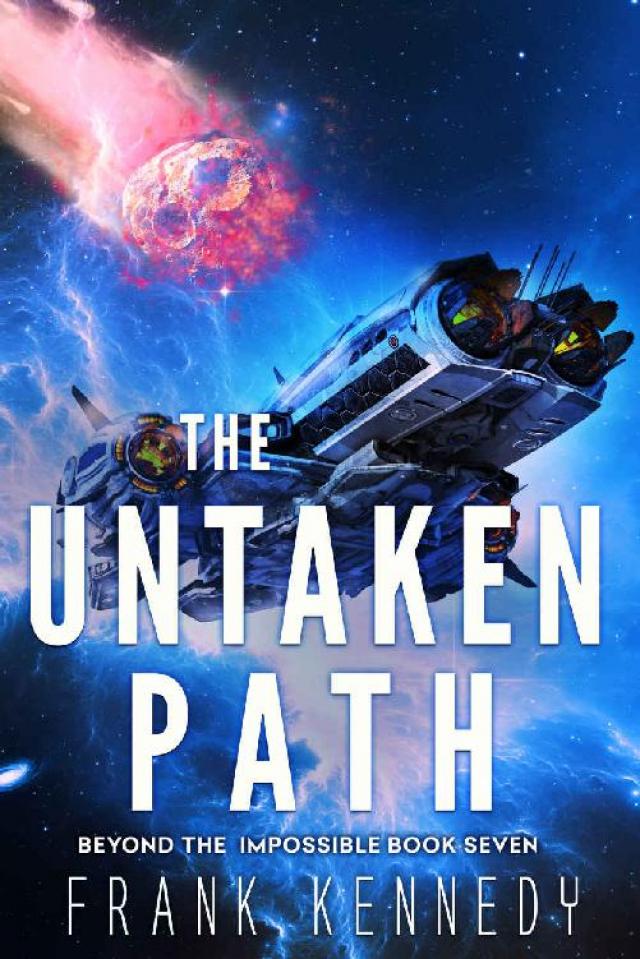
The Untaken Path (Beyond the Impossible Book 7),
p.18


She wiped away tears.
“There’s always one, Royal. But this time it was Corvaan Das.”
He thought of the huge man with the long hair and goatee who told Felina to shut up.
“What’s so special about him?”
“He was one of the first hundred in Bessios. He’s lived here more than ninety lifetimes.”
“I’m still fuzzy on this whole ‘lifetime’ business.”
“It’s not measured with calendars. Those don’t exist in Bessios.”
“No way to convert it to standard years?”
“Not with precision. But if you’re thinking in linear time, Corvaan’s lived here at least ten thousand standard years.”
Moon’s jaw dropped.
“No wonder he’s grumpy,” the Hokki said in a drumroll moment.
The well-timed one-liner surprised Royal and induced a laugh from the Gatekeeper.
“I shouldn’t have compared it to years. Ten thousand seems like forever, but it’s not. You’ll understand soon enough. Once you adapt to nonlinear time, age loses all meaning. A thousand cycles of daylight feels as recent as three.”
Royal understood the implications.
“Otherwise, you’d go insane.”
“Some have. Others are borderline.”
“What about this Corvaan Das?” Moon asked. “He’s old, but is there something else we ought to know?”
“He created the prophecy about the rise of immortals. He was preaching it long before I arrived. After today, he’ll be the most influential gae-h’loc in the city.”
“What’s a gae-h’loc?”
“It’s derived from the Creators’ language. It means messenger.”
Royal sighed. “Sounds like we’ll be seeing him soon.”
“You’ll see everyone. Listen, Mulkey was going to take you on a quick tour of the city later today. He’s barred. If you still want to venture out, I’ll show you myself.”
Royal heard ambivalence.
“If you ain’t feeling it, we can hang out here. I’m sure Moon hasn’t explored every cabinet in the pantry.”
Moon chimed in. “I got another whole row to go.”
“I appreciate it. Look, you two really ought to sleep. The bedrooms have blackout panels. There are sleeping pills in your privy. The more you sleep, the faster you’ll adapt to nonlinear time.”
“Sure,” Royal said. “We’ll have a sit-down and plan out the day. Sorry things didn’t go the way you wanted, Felina.”
“If you don’t mind, I’m going to change into something more comfortable and beat Mulkey upside the head with an iron pot. Make yourselves at home. It’s yours as long as you want it.”
They didn’t see her again during daylight.
Royal took stock of the moment while studying the view outside. The cobblestone street of the old town had emptied in a hurry. A few Bessians entered a shop below a stone arch, and a flurry of activity circled the location with the neon signs.
“Talk to me, Moon. What do you think?”
Moon dared to set loose a grin before he pulled on his pipe.
“I think we’re celebrities.”
“Damn right. How does that make you feel?”
“H-hard to say. But after everything we’ve been through, it’s kind of nice. I thought I’d feel frightened on the balcony. I wasn’t.”
Royal liked what he heard. Moon had been isolated from people for so many years, sheer terror would have been understandable.
“Did you feel a rush? Like a current running through you?”
“Huh. Yeah, Royal. I did.”
“Good. I been there a few times. When I led men into battle and I knew they were loyal to the death, I felt fucking invincible. When men stood at attention while I was yelling in their faces, and all they could do was shout, ‘Yes, General’ – that was something special.”
“I don’t think being a celebrity is the same as a General.”
“You’d be surprised how close they are, Moon. When Mulkey opened his mouth, half the crowd was jumping. We’re the most important men in this city. We haven’t done shit, and we already have an army.”
“We need one?”
“Better with than without. This place is gonna be home for a long cudfrucking time, Moon. Until we figure a way out, we need to take advantage.” He pulled on his cigar but realized it had burned out. “We exploit the fuck out of this deal. Feel me?”
“As long as we do it together, Royal.”
“Wouldn’t have it any other way.”
He patted his partner on the shoulder and looked around for the lighter he brought from the pantry. Where had he left it? It was a crystal square with a reserve of oil inside. He’d set it down …
Royal didn’t need to finish the search. Someone else held it.
The man from beneath the balcony filled the open doorway next to the kitchen. Tall and wide as a rhino, he stared at Royal with the relish of a man who knew too much.
“You look for this?”
“Sure enough,” Royal said. “You supposed to be here?”
“No. I violate this ground. Is only here for arrivals and caretakers. My name is Cor …”
“Corvaan Das. Yeah, yeah. Felina filled us in. By the way, I didn’t appreciate the way you shouted at my girl.”
He shrugged as if sorry, but Royal knew he wasn’t.
“Gatekeeper is always cold to me. Too bad.” He held out the lighter. “You want?”
“If you don’t mind. Then you can state your fucking business.”
Corvaan handed over the lighter and turned his eyes to Moon while Royal reignited his cigar.
“The quiet one.”
Royal laughed. “Who? Moon? Wait till you get to know him. He won’t shut up. Why are you here?”
Up close, Royal saw unexpected details. The man was ten thousand years old at best reckoning, but he didn’t look a day past sixty. His eyes did not blink but carried a hint of desperation. A scar ran along the full underside of Corvaan’s jawbone.
“I must know with certainty,” Corvaan said. “May I?”
He didn’t wait for a reply and planted a hand over Royal’s heart. Corvaan did not take his eyes off Moon.
“Looking for Rider?”
Corvaan nodded. “I wish to hear his word.”
“Good luck with that. I haven’t heard a peep.”
“You lack talent to hear. Training I will do for you.”
Corvaan removed his hand after a few seconds and said:
“G’hiz al-ti cum-zi for’as.”
“Sounds Creator-ish. We’ve heard it before.”
“I had to make sure of Rider’s goal. Is confirmed now.”
“And what would that be?”
“The superior goal.”
“Which is what?” Moon interjected, sounding impatient.
“A universe made for immortals.”
“But not the one Mulkey was talking about. He said all the mortals would be killed.”
“Cleansed. Yes.” Corvaan turned to Royal. “You will lead us through Prelude and Final Verdict.”
Royal didn’t believe the nonsense about wiping out all mortal life, but he did believe in playing along.
“Rider got a timetable?”
“Ah. Is funny. Timetable.” Corvaan did not laugh. “Plans must be prepared. Training you must have. You will die often until Rider says plan is prepared.”
“Rough estimate?”
“A lifetime.”
Fuck me.
“Hold on, Corvaan. You’re saying we don’t break out of here for another lifetime?”
Corvaan showed his first hint of a smile.
“Is not so long. I have lived ninety three. I will be personal trainer.”
“What am I training for? I’m already a soldier.”
“Yes. A killer of great renown. More is required.”
Moon came to Royal’s side.
“What about me?”
“You are Observant. Not important.”
“There you’re wrong, asshole,” Royal said. “We’re a package deal. Everything you teach me, he learns too.”
Moon wrapped his arm around Royal.
“We’re partners. I want to know everything.”
“Hmm? You will throw aside Observant to become Destroyer?”
“I’ll do whatever it takes.”
Royal liked this bold side of his best and only friend.
“He’s a fast learner, Corvaan. He’ll keep up.”
Corvaan seemed taken aback. He placed a hand over his own heart, as if to catch his breath.
“The prophecy says two Riders will become one.”
Royal hated the word prophecy, which he never heard spoken outside of fairytales. Still, he wasn’t about to shatter the moment. Corvaan Das was a raving lunatic, for all he knew. A personal trainer? That remained to be seen. But one thing was certain: The man carried weight in Bessios.
“Two for one? I like it. Tell you what, Corvaan. Why don’t you stick around? If you got nothing better to do.”
“You do not object?”
“No, not at all. Hey, Moon. Find an extra glass and pour Corvaan whatever you’re having. You like a good stiff drink?”
“I enjoy many pleasures.”
“Nice. Come on over to the couch. We’ll sit. We’ll drink. You can tell us about your ninety-three lifetimes.”
Corvaan studied the place where he must have spent his own transition so long ago. How much had it changed?
Royal didn’t give a shit about the answer. He did, however, say a silent thank-you to Mulkey for opening his big mouth.
When they were seated and comfortable, and Corvaan expressed his delight with the crimson liquor, Royal served the first question.
“So, how long before we run this city?”
18
The Aston James
Tranteum Conference
C ANDO COULDN’T SHAKE THE IMAGE of Ham Cortez lying dead at his feet, the skin a gray pallor and the eyes staring into an abyss. Worse, more than ten hours had passed and Cando heard nothing from Capt. Dunston or Dr. Harrold. Either the doctor couldn’t determine cause of death, or he did but worried about the implications of revealing it. The waiting game infuriated Cando, but he buried his frustration to present the strongest case before the military sub-committee.
“I find your suggestion puzzling.”
The speaker, Rear Admiral Johannes Nimes, responded to Cando’s analysis of Swarm interstellar combat abilities and proposals for an opposing force. Nimes proved to be Cando’s chief nuisance from the outset of today’s first session.
“Please, Admiral. Explain your confusion.”
The subcommittee of twelve sat at a round table with a projection plate in the center. A holo of the battle above Hokkaido was paused. Outside the table, more than fifty delegates ringed the room in silence. Per conference rules, delegates not assigned to committees rotated through the sessions. They submitted questions and comments using a handheld. Those remarks were then funneled to the session arbiter, who determined which might be entered into discussion at the appropriate time. So far, the outer ring had followed protocol and did not interrupt. Not that they had a chance: The committee’s eleven men and one woman never paused a beat.
“Your victory at Hokkaido demonstrates two strategies for obliterating Swarm vessels,” Nimes said. “A single capital ship defeated Ajax at close range, while transport-class vessels overwhelmed the Stilton with a simultaneous bombardment. Yet you insist these close-quarter strategies will fail against an invasion, even if we reach level strength. Explain the contradiction, Colonel.”
The Admiral’s point did not bother Cando as much as the way he stated it. This was the type of Chancellor Ham warned him about: Arrogant and condescending with a narrow vision. Nimes was the nomad fleet’s newest Admiral, appointed after his predecessor, Constantin Tramel, died mysteriously last year along with his crew inside the Fulcrum, close to the Euphrates system. Intel said Tramel was preparing to attack the Arakaat Shipyards to aid in stealing the warships Hermes and Charybdis. Nimes struck Cando as an administrator who’d never be seen near a battle.
“Admiral,” Cando said, “the element of surprise is a wonderful device every good General hopes will fall his way. But it is usually a product of luck or circumstance rather than military genius. Most war is fought within sight of the approaching enemy.”
“Yes,” Nimes said. “Of course, these principles are well known. However, we see here that Swarm capital ships are vulnerable to high-intensity bombardment from close range. This evidence cannot be denied. Yet you propose the new navy focus its construction on light vessels with limited firepower and minimize production of carrier class warships during the first phase.”
Play along, Cando told himself. He’s not the only one who has a problem with this plan.
“Admiral, I’d love to have full confidence we could jump warships out of worm on top of the enemy before they initiate countermeasures. Victory would require one or two particle missiles. But even the most advanced wormhole tech is not that precise.” He pointed to the holo and reversed it to seconds before the attack. “Scylla was within five thousand kilometers of a slow-moving target completely unaware of our presence. Even from that distance, we overshot. They were unprepared for combat. Still, we struggled to penetrate their defenses. A battle-ready Captain would have crippled us as we swung about to attack. In short, we were lucky.”
“I don’t doubt the assessment, Colonel. Nor do I doubt my eyes. Luck or not, you needed overwhelming force at close quarters to obliterate their warships. Yet your proposal minimizes this engagement in a manner that, quite frankly, I consider to be folly.”
Cando sat between allies: Yusef Matook to his left and Exeter Woolsey to his right. Though Exeter officially represented Aeterna, he intended to speak as a Talon when the discussion turned to ground combat. Cando expected his proposal to encounter early opposition; Yusef and Exeter, who liked the plan, agreed to hold their temper.
“My reasons are based on history, strategy, and industrial capacity. First, the Orzed Confederation has hundreds of carrier class warships but has never obliterated an entire Swarm battle group in more than a century. Second, the Orzed strategy leads to stalemate at best because the fleet lacks maneuverability. Its battle cruisers move too slowly on standard system engines. They are exposed just before and after wormhole travel. But Scramjets in this universe, running on Carbedyne nacelles, are ten times faster. Third, warship construction will take at least a standard year before the first vessels are space-worthy, assuming we begin tomorrow. I’m not sure we have that much time.”
Cando heard fearful murmurs but continued:
“However, there are more than seven thousand Scramjets, personal or corporate, on the former colonies. If we requisition these ships and enough factories, we can retrofit them with worm drives, spiral gun turrets, and a small package of particle missiles inside five months. We can establish defensive patrols in every system before the capital ships come online. Earth can play a role in this as well.” He turned to the two Earth representatives – officers who fought on opposite sides during the civil war. “Your Vice-Premier said you are decommissioning Ark Carriers. The materials on those city-ships would be invaluable.” He focused again on Nimes. “Admiral, have I mitigated your concern?”
Nimes tapped his fingers as if playing a melody.
“How precisely can Scramjets fight their carriers?”
“At first, they won’t try. Initially, they will act as diversions until our navigators and specialists are trained in more detailed combat techniques. If an enemy enters a system, the early-warning network will notify the warships. In most cases, help will arrive within thirty minutes. The longest possible jump is nine hundred and seventy light-years. That’s sixty-eight minutes. It gives us a fighting chance.”
“I see. And what are these detailed combat techniques?”
Cando smiled. Nimes had softened his tone.
“Have you ever encountered a nest of angry hornets, Admiral?”
“I wouldn’t know a hornet if it bit me.”
“One good reason to live off-world. My battle plan builds on that analogy, Admiral. It is new and yes, it is untested. But it’s also something the enemy has never encountered. Attacking the Swarm with a swarm.”
“Explain.”
Cando searched through his tablet and found the simulation, which he launched on the projector. The program showed a Swarm battle group – usually a carrier-class vessel flanked by two battle cruisers – on approach to a planet. Dozens of light craft buzzed the enemy in what appeared to be random swoops and waves but which Cando knew to be carefully designed.
“The soft armada, as I call them, would serve as a nuisance, flying just out of range of the enemy’s cannons. When they do maneuver inside the targeting field, they’ll move too fast for the cannons to achieve a lock. As you see here, they’ll fire particle missiles. By this point, each cruiser’s Crust will be active, and the nanodrones we call hunter bombs will disperse the energy. Our objective here is to poke the smallest holes in the Crust. Prolonged exposure to these attacks will put the cruisers at minimal risk, enough cause for the Captains to disperse fighters. By this point, the capital ships have entered the planet’s gravity well, rendering them less mobile.
“The Swarm will use dropships and mid-class transports to begin their planetary invasion. These vessels do not have effective countermeasures. Our soft armada, as you see, will be able to pursue and pick off many of these ships before they land. In the meantime, we will have delayed the ground invasion long enough to buy time for our warships to jump in and engage the battle group.”
Nimes studied the simulation with twiddling fingers.
“I see at least one in ten dropships reaching the ground, Colonel.”
“Yes. It’s possible the percentage will be higher. This plan focuses on our strategy in the first year, where blunting the invasion rather than outright victory will have to be the goal. Frankly, Admiral, I use conservative estimates in all my Year One plans.”
“I have never seen a battle plan not designed for total victory. This is disappointing.”