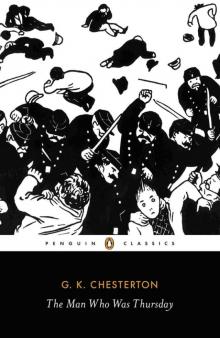
The man who was thursday, p.1
The Man Who Was Thursday,
p.1


G. K. CHESTERTON
Gilbert Keith Chesterton, the genial and prolific writer who presided over the world of English letters during the first decades of the twentieth century, was born in London on May 29, 1874, into a cultivated middle-class family. Chesterton, while at St. Paul’s School, was singled out as a student with distinct literary promise for his ability to recite long passages from Dickens, Scott, and Shakespeare. He later attended the Slade School of Art and University College, London, but abandoned his studies in 1895 to read manuscripts for a London publisher and eventually found work as a freelance journalist. Over the next decades Chesterton’s weekly articles in the Daily News, the Illustrated London News, the Daily Herald, and the New Witness established his reputation as a witty and provocative social critic who was a master of irreverent paradox. Long hailed as Fleet Street’s reincarnation of Dr. Samuel Johnson, he began publishing his own journal of public opinion, G.K.’s Weekly, in 1925. George Bernard Shaw deemed Chesterton “a man of colossal genius” and prompted him to write the play Magic, which was produced on the London stage in 1913. With What’s Wrong with the World (1910) he achieved recognition as a leading exponent of Distributism, a decentralized economic system in which private property would be divided into the smallest possible units. Chesterton’s conversion to Catholicism in 1922 occasioned his writing the biographies St. Francis of Assisi (1923) and St. Thomas Aquinas (1933), as well as The Everlasting Man (1925), perhaps the highest expression of his mysticism. Some of his earlier religious views were expressed in Heretics (1905) and Orthodoxy (1908). G. K. Chesterton completed his celebrated Autobiography (1936) less than two months before his death in Beaconsfield, near London, on June 14, 1936.
“To follow Chesterton’s mind and its expression is an introduction to the English soul,” remarked his friend, the writer Hilaire Belloc. “He is a mirror of England.” Chesterton initially gained prominence as a poet and literary biographer. His first published work, Greybeards at Play (1900), contains pure nonsense verse in the tradition of Lewis Carroll and W. S. Gilbert. “I cannot think of a single comic poem by Chesterton that is not a triumphant success,” said W. H. Auden. His next collection, The Wild Knight and Other Poems (1900), marked the real beginning of Chesterton’s career as a poet. The Ballad of the White Horse (1911), a long narrative poem that retells the story of King Alfred the Great’s fight to keep the pagan Norsemen from taking over Christian England, is generally regarded as his greatest serious verse. Chesterton showcased much of his so-called political poetry in Wine, Water, and Song (1915) and presented his poems of World War I in The Ballad of St. Barbara and Other Verses (1922). Charles Dickens, his acclaimed critical biography of the great Victorian novelist, was published in 1906. “It is conventional to say that Chesterton’s book on Dickens is the best thing he ever wrote,” reflected V. S. Pritchett. “It is not merely good; it is a masterpiece and contains, among other things, the most enlightening portrait of Dickens himself that I have ever read.” Likewise T. S. Eliot stated that “there is no better critic of Dickens living than Mr. Chesterton.” Chesterton produced several other masterful works that artfully meld literary criticism with biography: Robert Browning (1903), George Bernard Shaw (1909), William Blake (1910), Robert Louis Stevenson (1927), and Chaucer(1932). The Victorian Age in Literature, perhaps his most famous work of literary criticism, appeared in 1913.
“[Chesterton] had a genius simply for having original ideas,” noted Wilfrid Sheed in discussing his brilliance as an essayist. “It is hardly possible to read a page of Chesterton without finding an unexpected idea, at best wise, at worst fiendishly ingenious…. The spillover of his thinking leaves us a body of aphorisms universal enough to belong to literature.” During the course of his career Chesterton compiled hundreds of essays in a score of collections, including The Defendant (1901), Twelve Types (1902), All Things Considered (1908), Tremendous Trifles (1909), Alarms and Discursions (1910), A Miscellany of Men (1912), The Barbarism of Berlin (1914), The Uses of Diversity (1920), Fancies Versus Fads (1923), Come to Think of It (1930), All Is Grist (1931), All I Survey (1933), Avowals and Denials (1934), The Well and the Shallows (1935), and As I Was Saying (1936). “Chesterton inherited from the aesthetes of the 1880s and 1890s the conviction that a writer should be continuously ‘bright’ and epigrammatic,” observed W. H. Auden. “When he is really enthralled by a subject he is brilliant, without any doubt one of the finest aphorists in English literature.” In addition, several volumes of essays culled from his papers have appeared posthumously, namely The Common Man (1950), A Handful of Authors (1953), The Glass Walking-Stick (1955), Chesterton on Shakespeare (1971), and The Apostle and the Wild Ducks (1975).
Chesterton also enjoyed success as a novelist and short-story writer. “[It] is in his fiction that I find Chesterton’s genius best and most characteristically displayed,” said Kingsley Amis. “The novels and stories dramatize virtually the whole range of the themes and interests met in his other work.” He made his debut as a novelist with The Napoleon of Notting Hill (1904), a futuristic tale set in 1984. The Man Who Was Thursday (1908), his next novel, was hailed by C. S. Lewis as “a powerful picture of the loneliness and bewilderment which each of us encounters in his (apparently) single-handed struggle with the universe.” His subsequent fiction includes The Ball and the Cross (1910), Manalive (1912), The Flying Inn (1914), and The Return of Don Quixote (1927). As Anthony Burgess commented: “His best novels—The Napoleon of Notting Hill, The Man Who Was Thursday, and The Flying Inn—are as entertaining as when they were first written, and the substructure of the farce and fantasy—a concern with free will, Western civilization, and the ultimate mysteries of religion—is not less valid in the age of superstates and nuclear deterrents and brainwashing than it was in Chesterton’s more innocent heyday.”
Today Chesterton is perhaps best remembered for his detective stories featuring Father Brown, a seemingly absent-minded cleric who possesses a profound understanding of evil. Originally published in the Saturday Evening Post, the stories were collected in The Innocence of Father Brown (1911), The Wisdom of Father Brown (1914), The Incredulity of Father Brown (1926), The Secret of Father Brown (1927), and The Scandal of Father Brown (1935). “[Father Brown] is one of the greatest of all great detective figures,” said Kingsley Amis. “For many, he will always be the greatest…. His field of knowledge is human nature, and his skills are observation, reason and common sense.” Chesterton created several other amateur sleuths—notably Basil Grant, Horne Fisher, Gabriel Gale, and Mr. Pond—who appeared in The Club of Queer Trades (1905), The Man Who Knew Too Much (1922), The Poet and the Lunatics (1929), and The Paradoxes of Mr. Pond (1937). “A reading of Chesterton reinforces the truth that the best detective stories have been written by artists and not by artisans,” reflected critic Julian Symons.
“Chesterton belonged to an age when literary men could be public figures, just like politicians,” observed Anthony Burgess. “His immense range was essentially that of the professional writer who would be ashamed to reject any literary challenge. He could write biography belles lettres, literary criticism, history philosophy drama, as well as novels, detective fiction, and verse He was spontaneously witty, but he could also be care fully epigrammatic. He thought of words not as neutral rational counters, but as confetti, bonbons, artillery.” His friend and biographer Maisie Ward agreed: “Few writers have as much vitality as G.K.C., and one of its manifestations is the endless variety of his work…. The man is so exuberant, so disrespectful to the learned, so deadsure, so comic where he is most serious. This is the real paradox of Chesterton.” And Wilfrid Sheed concluded: “Chesterton was a brilliant philosophical journalist…. The range of [his] talent was almost alarming…. [He] was simply what the word ‘genius’ meant.”
CONTENTS
BIOGRAPHICAL NOTE
INTRODUCTION by Jonathan Lethem
THE MAN WHO WAS THURSDAY
CHAPTER 1. THE TWO POETS OF SAFFRON PARK
CHAPTER 2. THE SECRET OF GABRIEL SYME
CHAPTER 3. THE MAN WHO WAS THURSDAY
CHAPTER 4. THE TALE OF A DETECTIVE
CHAPTER 5. THE FEAST OF FEAR
CHAPTER 6. THE EXPOSURE
CHAPTER 7. THE UNACCOUNTABLE CONDUCT OF
PROFESSOR DE WORMS
CHAPTER 8. THE PROFESSOR EXPLAINS
CHAPTER 9. THE MAN IN SPECTACLES
CHAPTER 10. THE DUEL
CHAPTER 11. THE CRIMINALS CHASE THE POLICE
CHAPTER 12. THE EARTH IN ANARCHY
CHAPTER 13. THE PURSUIT OF THE PRESIDENT
CHAPTER 14. THE SIX PHILOSOPHERS
CHAPTER 15. THE ACCUSER
COMMENTARY
READING GROUP GUIDE
INTRODUCTION
Jonathan Lethem
How do you autopsy a somersault? G. K. Chesterton’s The Man Who Was Thursday is one of the great stunts ever performed in literary space, one still unfurling anytime you glance at it, as perfectly fresh and eloquent as a Buster Keaton pratfall. The book constructs its own absolute and preposterous terms in the manner found most often in certain children’s books, Alice in Wonderland, or Norton Juster’s The Phantom Tollbooth, or Russell Hoban’s The Mouse and His Child. Like those books, it offers the possibility of being about everything and nothing at once, and vanishes at the end with the air of a dream. Like them it begs to be reread.
Description is appropriately impossible, except by a series of exclusions. Kingsley Amis called Thursday:“… not quite a poli
tical bad dream, nor a metaphysical thriller, nor a cosmic joke in the form of a spy novel, but it has something of all three …” To that I’d add: not quite a roman noir, nor a simplistic religious allegory, nor—despite Chesterton’s subtitle—a nightmare. It’s much too complete and legible to be a nightmare, and, really, too happy—yet far too personal and strange to parse as an allegory of Chesterton’s Catholicism. For a while it does resemble a kind of Dickensian noir, but the stakes are all wrong A noir exalts sex and money and no two things could be further off Chesterton’s radar. Here, villain and MacGuffin are combined in one being in the monstrous and God-like figure of Sunday the President of the Central Anarchist Council. If Thursdays a version of The Maltese Falcon it’s one in which Sydney Greenstreet is encrusted head-to-toe in precious rubies and disguised with black enamel, to then steal away with the booty of himself.
Of course, there aren’t really characters in Thursday, not any more than there are characters in Lewis Carroll, or in a drawing by M. C. Escher, or in John Lennon’s “I Am the Walrus.” This is definitely an “I-am-you-and-you-are-me-and-we-are-all-together, joo joo ga joob” sort of world. But there are characterizations, and those are dashed off with a breezy, almost distracted assurance: Gabriel Syme, the insouciant and mild poet-policeman, feels wonderfully individual from his opposite number, the soapbox orator and sole true anarchist, the blazing and Blakean Lucian Gregory. Nevertheless, the reader understands instantly that the two are essentially Chesterton’s two natures, given form as philosophical sprites and pitted against one another. Chesterton loved argument, and his arguers are lovers, or at least twinned souls.
The real characters are the ideas. Chesterton’s nutty agenda is really quite simple: to expose moral relativism and parlor nihilism for the devils he believes them to be. This wouldn’t be interesting at all, though, if he didn’t also show such passion for giving the devil his due. He animates the forces of chaos and anarchy with every ounce of imaginative verve and rhetorical force in his body. You know he’s been tempted by these things; you feel it in how adoringly he loathes them. President Sunday, that huge gorgon of darkness, induces horror and desolation in Chesterton’s heroes, but they’re also drawn to him as towards a black sun.
The book begins with Syme and Gregory in an open-air debate in the London suburb of Saffron Park, bathed in a glow of sunset which establishes the surrealistically oversaturated descriptive atmosphere once and for all: “All the heaven seemed covered with a quite vivid and palpable plumage; you could only say that the sky was full of feathers, and of feathers that almost brushed the face.” Right at the start the book threatens to be all charming talk—and I do mean charming: Chesterton’s is sophistry you’d listen to forever. The two poets debate art and anarchy and the fate of the world and insult each other like a couple of affectionate spin doctors on cable television, working themselves up to the point where they’ve just got to hurry off together to a pub. Sort of like college. It’s then, though, that things get beautifully weird. The table they’ve seated themselves at slowly begins to rotate, until it corkscrews into an underground passage. There, Gregory explains, a secret anarchist cell will gather that very evening to elect a new Thursday to the Central Anarchist Council of all Europe, which has seven members, each named for a day of the week.
That kicks off the most spectacular sequence of bluff-calling in literature: Gregory calling Syme’s bluffs, Syme calling Gregory’s in return, and most of all Chesterton calling his own imaginative and ontological bluffs until he reaches the highest levels of straight-faced improbability. The invention is breathless, and so’s our man Syme, as he dodges and twists through ominous breakfasts, freak snowstorms, battles on beaches and in forests, shadowy pursuits by relentless, street-stalking figures, and a sword battle against an opponent who never bleeds conducted in a time-trial against an approaching locomotive. The garish cast of spies and policemen trade places with innocuous ease, and the conversation is always somehow droll and hysterically doomy at once. The trick to Chesterton is that he takes himself and his notions at face value, only every face is a mask with another mask underneath. It’s been pointed out again and again that Chesterton advances his arguments, as well as his stories, by the use of paradox. What’s less frequently noted is his furious use of velocity. The book has the compression of a three-minute Warner Brothers epic like Duck Amuck.
Because of his fondness for paradox, and for the stark and shuddering sense of aloneness in an indifferent universe which tends to come over Gabriel Syme every third page or so, Thursdays been much compared to the novels of Kafka. C. S. Lewis was the first to make this identification, and I can understand why it stuck, but the comparison’s only viable if taken as another Chestertonian inversion: Chesterton’s the anti-Kafka, really. He may tease you for a while with the possibility of never reaching the Castle, but his conclusion—not to give anything away, I hope—is that it’s impossible not to reach the Castle, because you’ve been inside it the entire time. The only question left is whether there is an outside to the Castle. Lucian Gregory would claim so, but I doubt Chesterton would be likely to agree with him. Kafka himself read Chesterton and detected the humming engine of optimism at the book’s core, saying, “He is so gay, one might almost believe he had found God.” Gays an excellent word. The books trills with Chesterton’s happiness. The miracle—assuming you believe in miracles—is that it’s never smug. Chesterton is so thrilled by his acrobatic stroll along the razor’s edge of nihilism that he earns his sunniness anew on every page.
Why not put The Man Who Was Thursday in its real context? The book was published in England in the same year as Kenneth Grahame’s The Wind in the Willows and Joseph Conrad’s The Secret Agent, and in some ways it describes a perfect midpoint between the two better-known books. The pre–Great War London full of revolutionaries with bombs in their coats and young men drunk on radical philosophies that Conrad and Chesterton describe is eerily identical, and confirms an element of realism in Thursday it would otherwise be easy to overlook. The Conrad feels more culturally prescient because he cast his book as a tragedy—and because his terrorists drew real blood—but it’s the same early whiff of twentieth-century horrors both writers have tasted in the air. Seen from the other perspective, Chesterton’s young men are seduced to anarchism much as Mr. Toad in The Wind in the Willows is seduced away from a quiet riverside life by the obnoxious craze for motorcars. That is to say in both Thursday and Willows the damage is reversible, the genie may be put back in the bottle. Motorcars might be renounced, and weasels and stoats driven from Toad Hall. Once the real weasels ran amok in Europe a bit later, it became hard to imagine anyone as serious as Chesterton writing such a reassuring book except as an act of nostalgia.
An antidote to Conrad, or The Wind in the Willows for grownups, have your pick. Either way, this really is one of the great books of reassurance and consolation—maybe one of the only great books of reassurance and consolation. As John Carey writes, “Usually we feel superior to innocence, associating it with stupidity. But in Chesterton’s case that will not work. If you think yourself cleverer than him, the odds are about ten million to one that you are wrong.” Chesterton subtitles Thursday “A Nightmare” and prefaces it with a poem to his friend Edmund Clerihew Bentley which suggests he feels he’s finally tackled a certain morbid part of himself, as if in writing Thursday he’d confronted a specter out of his mad, bad, dangerous, and gloomy youth: “This is a tale of those old fears / Even of those emptied hells, / And none but you shall understand / The true thing that it tells.” Yet the book is cheering because it feels, like the poem, retrospective: you sense Chesterton has long since put the possibilities of despair and suicide—even doubt—firmly out of reach by the time of writing. His giddy and paranoiac soufflé is evidence, finally, of a man making grotesque and hilarious faces in the mirror, freaking himself out completely, then turning to his desk and diligently, elaborately, and brilliantly explaining the faces away.
—
JONATHAN LETHEM is the author of five novels, including Motherless Brooklyn, which won the National Book Critics Circle Award. He lives in Brooklyn and Toronto.