Get up offa that thing, p.1
Get Up Offa That Thing,
p.1
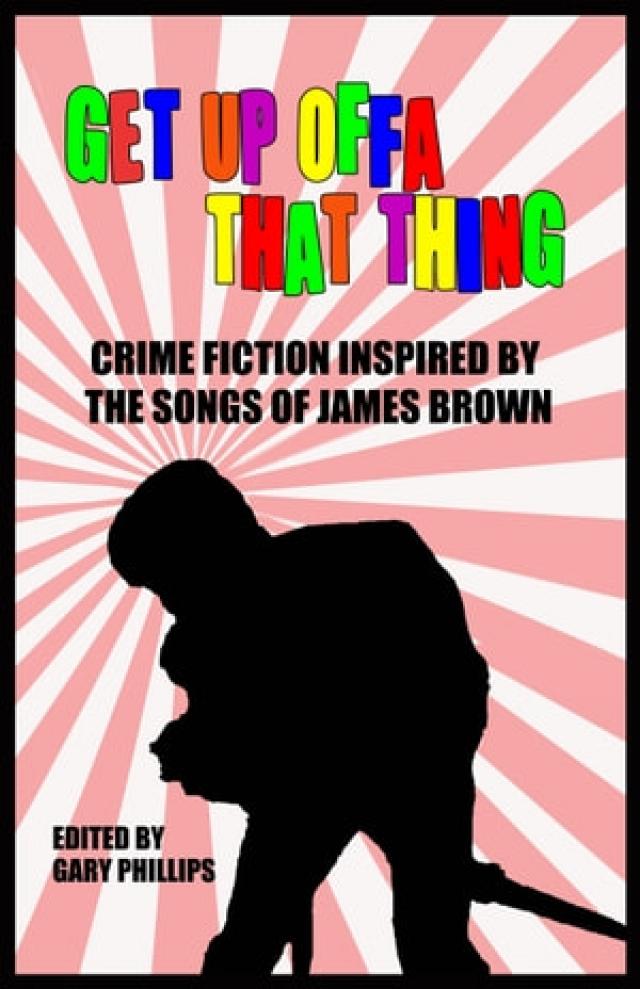


GET UP OFFA THAT THING
Crime Fiction Inspired by the Songs of James Brown
Gary Phillips, Editor
Collection Copyright © 2023 by Gary Phillips
Individual Story Copyrights © 2023 by Respective Authors
All rights reserved. No part of the book may be reproduced in any form or by any electronic or mechanical means, including information storage and retrieval systems, without permission in writing from the publisher, except by a reviewer who may quote brief passages in a review.
Down & Out Books
3959 Van Dyke Road, Suite 265
Lutz, FL 33558
DownAndOutBooks.com
The characters and events in this book are fictitious. Any similarity to real persons, living or dead, is coincidental and not intended by the author.
Cover design by Margo Nauert
Visit the Down & Out Books website to sign up for our monthly newsletter and we’ll deliver the latest news on our upcoming titles, sale books, Down & Out authors on the net, and more!
TABLE OF CONTENTS
Get Up Offa That Thing
Mama’s Dead
Ezra Claytan Daniels
Shadygrove
(inspired by the song “Try Me”)
John M. Floyd
Escape-ism
Michael A. Gonzales
The Money Party
(inspired by the song “Get on the Good Foot”)
Mysti Berry
Living in America
Fabrice Sapolsky
Money to Burn
(inspired by the song “The Boss”)
Lisa Morton
“It’s a Man’s, Man’s World”
Gar Anthony Haywood
In a Cold Sweat
Gary Phillips
Shootout at Mister Hip’s
(inspired by the song “Mister Hip”)
Jim Fusilli
The Funky Zombie President
A Madd Skillz Story
Jeff Carroll
The Day We Ate Pizza
(inspired by the song “Dancin’ Little Thing”)
Robert Ward
Prisoner of Love
James W. Ziskin
Hot Pants: No Way Back
Lise McClendon
Hit It and Quit It
(inspired by the song “Get Up Offa That Thing”)
Katy Munger
About the Editor
About the Contributors
Preview from Drums, Guns ’n’ Money by Jonathan J. Brown
Preview from Double Exposure by Colin Campbell
Preview from Redeeming Chase by Tom Schreck
To Magnificent Montague,
Burn, Baby! Burn!
Mama’s Dead
Ezra Claytan Daniels
It didn’t take long for Marent to start begging for his life. Falling to his knees, tears grasping at pant legs. Ze didn’t expect to find much of a backbone there, but even ze was surprised how quick the old man crumbled. Ze wondered if it would’ve been more satisfying if he’d stood up for himself. Ze wondered if it was a mistake to hit him right away. Getting hit in the face with a metal pipe does tend to escalate things.
Ze also wondered if the mask was too much. It was just a beige scrim stretched tight over zir face, but it reduced zir features to soft shadows that lit up the primordial fight-or-flight parts of the brain. Even ze was unsettled the first time ze saw it in a mirror. Ze wondered about these things because ze didn’t really feel much at the moment, and ze very much wanted to. The numbness had been setting in for a while, and that terrified zir. So many bodies burnt-up, floating in the reservoir, or just plain dead in the street. Alone. Children, too. Ze had hoped more than anything to still have some feeling left for this day; one last bump of endorphins before the end. Ze hit him again. Marent’s skull sent a sharp vibration through the pipe into zir forearm. But still, nothing. Ze was all used up.
And again. Ze didn’t mean to strike the exact same spot, but ze didn’t have a versatile swing. The pipe only felt right in zir right hand, and it only felt natural to swing it down, and to the left. This time, instead of the sharp crack of metal on bone, Marent’s skull gave. Ze shuddered as a childhood memory of biting into a soggy potato chip snapped into zir temporal lobe. Marent’s wailing went to a higher register.
He blubbered, “What did I do to you?”
Marent hadn’t actually done anything to zir, specifically, but it still felt very personal. Marent had made countless decisions over the course of many, many years, and before each one, he had to think to himself: “I don’t care who this will hurt.” It never even occurred to him he might someday be held accountable. It didn’t occur to any of them. We know this because they never hid their names. They did interviews on websites and television programs. They were hailed as great men and women. Bold leaders. That’s how they were all so easy to find.
Marent made a clumsy dive for his bulky satellite phone, which rested tantalizingly on the hood of his luxury SUV. Ze gave him a reflexive shove, sending him headlong into the vehicle’s absurd grill. Marent’s feeble body clattered to the floor. His pain still hadn’t really crossed zir mind. Ze only felt disappointment that this man, supposedly a brilliant, shrewd visionary, still thought someone could save him. Someone he could call and say, “Do you know who I am?” or “This is unacceptable!” and have people come running to make it right. Those days were gone. He should know better.
Marent lifted his wobbly head; his voice was barely there: “Take what you want. There’s food. Gold.”
Ze glanced through the heavily tinted window of the SUV. It was overstuffed with plastic tubs. Ze would take all of it, but even Marent must’ve known by now that’s not why ze was here.
Ze crouched down and leaned close to his blood-drenched face. “Nobody’s gonna make it to the island. Not the investors. Not your families.”
Marent wept, “Why?”
“You strangled Her to death. For what?” Ze shook zir head. “You don’t get to run away. You’re gonna die like the rest of us.”
Ze felt a sudden wetness on zir mask. Ze tore it off—hiding zir face was pointless now. Ze hoped desperately to find the fabric soaked through with tears. It was just Marent’s blood. Ze looked down at him—and he took in zir face. It was one both unremarkable, yet utterly alien to him. Marent had never been this close, this intimate, with a person like zir. Ze hit him once more, and as ze watched Marent’s body go still, ze held out hope for a final burst of satisfaction that zirs was the last face Marent ever saw. None came.
Ze opened Marent’s triple-wide garage door and felt a blast of hot air from the furious wildfire up the hill. It was another big one, but nobody made any effort to control them anymore. Ze wondered what would happen when there was nothing left to burn. Nothing left to grow. Nothing left to drink. She would finally be all used up. Ze wondered if there’d be anybody left who could feel anything about it.
Back to TOC
Shadygrove
(inspired by the song “Try Me”)
John M. Floyd
A hundred yards north of the stand of cottonwoods, Buck Clayton slowed his sweaty horse to a walk and shifted the reins to his left hand. His right rested on the grip of his holstered revolver. He could see her already, sitting alone on a flat rock in a pale yellow dress, staring down at the stream that wound through the sandy cluster of trees.
He was less than thirty feet away when Emily Johnson heard something—his horse’s hoofbeats, the creak of saddle leather, something—and turned to face him. For just a second, he felt the familiar ache in his heart.
“Buck?” she said, shading her eyes. “What are you doing here?”
He swung down off his horse and tied the reins to a willow branch. Two more horses—a big roan and a little bay with white socks—were tied to a stump nearby. He recognized the bay as Emily’s.
“I could ask you the same thing,” he said. “If I recall, this used to be a special spot for you and me. A lucky spot, you called it.” He could still remember her reaction when they’d stumbled upon it during one of their lovestruck outings. Always the romantic, she had seen the place as something from a fairytale, this quiet and beachlike clearing surrounded by gnarled and towering old trees.
She gave him a look that managed to be both sad and angry. “You might also recall that was a happier time, before you started riding off and staying gone for weeks at a stretch.”
“And before you took up with Deke Holland,” he said. “Behind my back.”
“Well, it’s not behind your back anymore.” She brushed a strand of golden hair out of her eyes and said, her face reddening, “I ain’t getting no younger, Buck. I need somebody I can depend on, somebody who might make something of hisself one day.”
“And you picked Deke Holland?” He started to say more, then shook his head. “Forget it.”
“I will. And I asked you what you’re doing here now. You gonna answer me or not?”
He pushed his hat back off his forehead and looked around the sun-dappled clearing for several seconds, memories of better days still flickering in his head as if teasing him. “I’m here for two reasons. One was to tell you goodbye.”
“What do you mean, goodbye? Where you going?”
“Montana,” he said. “Gonna buy me a little place up there, raise some cattle.”
“Montana?”
“Prettiest country you can imag
ine, so I hear.”
Emily was frowning now, the way he remembered she always did anytime she heard news that didn’t fit in with her view of the way things should be. Even though he was no longer hers, he figured she still wanted him close by.
“It’s cold there, ain’t it?”
“Cold weather don’t bother me,” he said. “I’m done with Texas.” And with Emily Johnson, he thought. “Besides, I never been to Montana.”
She stayed quiet awhile, studying his face from her perch on the flat rock. The wrinkles of her frown smoothed out a bit, and for a moment, she almost looked like her old lovely self. But he could tell she wasn’t pleased. “You’re a bounty hunter, Buck. What do you plan to use for money?”
“Honest wages, that’s what. I been lucky lately, in my finances.”
The frown returned. “Wait a minute. You said you came here to tell me goodbye—”
“I said that was one of the reasons I came.”
“—but how’d you even know I was here?”
“Because of Joe Talmadge.” Buck took off his hat and wiped his sweaty forehead. Even in the shade, it was hot as hell’s front door.
“Talmadge?” Her eyes widened. “Is that the one who’s been robbing all the banks?”
“Stages, too. But he ain’t robbing no more of ’em. I caught up with him this morning, out on the flats. You ever heard of the Lassiter Gang?”
“Everybody’s heard of them. But they’re west of here, right? El Paso?”
“Some of ’em are,” he said. “They’ve spread out a bit—Ned Lassiter and his brother are up north someplace, Hays City I think, or maybe Dodge, and four members of the bunch been doin’ business in these parts. Annie Bates is one of ’em, Luke Moon and Talmadge another two.”
“I’ve heard of Bates, too. Wild Annie, right?”
“She’d have to be, to run with that bunch. Anyhow, I caught up to Moon the other day and Talmadge this morning. I might go after Annie before headin’ to Montana. I ain’t decided yet.” He put his hat back on and absently smoothed the brim.
“And this Talmadge person—”
“He told me this is where I could find you.”
Emily’s eyes narrowed. “But—why’d he tell you that?”
“I ain’t sure. It’s the last thing he said to me.”
“Does that mean you shot him?”
“Sure did. After he’d shot at me.”
Emily slid down off the rock and stood facing him. She seemed taller than she used to be, and for the first time Buck realized she was wearing boots. Heavy boots, with a dress. Somehow, they made her look cute.
“That’s crazy,” she said.
“That I shot him?”
“No, that he told you I was here. I don’t even know Joe Talmadge. How could he tell you where I am or where I’m not?”
“’Cause he said a friend of his told him, that’s how. Talmadge said this friend was meeting you here, this afternoon.”
That stopped her cold. “Are you talking about Deke Holland?”
“That’s right. He’s the other reason I’m here. He’s gang member number four.”
She blinked. “You’re joshing me.”
“I’m dead serious, Em. You know yourself Holland don’t stay around much. He’s been with the Lassiters for years, and you just didn’t know it. And now he’s wanted from here to Tucson.”
She just stood there with her mouth hanging open. Her face was pale as a gravestone.
“We’re wasting time,” he said. “Where is he, hiding in the bushes like a little girl?” Buck looked again at the two horses. A gun belt with a holstered pistol was looped over the roan’s saddle horn.
“Emily? This is important. Answer me.”
She seemed to snap out of her trance. “Yes,” she said dully.
“Yes what?”
“Yes, he’s in them bushes, downstream. But he ain’t hiding. Just before you got here, he said he had to go answer nature’s call.”
“Hope that’s the only place he’s gone.” Raising his head, Buck called, “Come on out, Deke. I’m taking your ass in to the sheriff.”
No answer. On the bushy streambank beyond the cottonwoods, nothing moved. Somewhere to the east, a crow cawed.
Then a tall, stocky man with a black beard stepped into sight, pulled his suspender straps over his shoulders, and trudged toward them. Buck drew his Colt and held it at his side, pointed at the ground. Emily had moved over to stand beside him. He and Deke Holland kept their eyes on each other. After what seemed a long time, Holland stopped, five feet away.
Scowling, Holland spread his legs, bent his knees, and held his big hands open and ready at his sides. “You better get ready to shoot me, Clayton. I ain’t going to jail.”
Buck raised his gun. “I didn’t come here to shoot you, but I will if I have to. Just so you know, I turned your partner Luke Moon in to the U.S. Marshal last week, but Joe Talmadge made me kill him today. Didn’t much matter to me—bounty’s the same, either way.”
Holland hesitated. “You really would, wouldn’t you?”
“Shoot you? I damn sure will, if you force me to.”
“I ain’t sure I believe you would.”
“Try me,” Buck said.
Deke Holland stood there awhile longer, still crouched in his fighting stance and looking foolish. “How long you and me known each other, Clayton? Ten years?”
“Prob’ly. But that don’t matter now, does it?”
For a moment, no one spoke. The wind picked up a bit, riffling Emily’s hair and stirring the leaves of the trees overhead. The trunks threw long shadows across the clearing.
“Tell you what,” Holland said. “You want this gal here? Take her back. She ain’t nothing to me. Just let me go, and you two can live happily ever after.”
Emily squinted at him. “What did you say?”
“Let me go, Clayton. I’ll head back west right now. I swear you’ll never see me again.”
Buck made no reply.
“I’m nothing to you?” Emily said. “Is that what I heard you say?”
“That’s right,” Holland said, his eyes still locked on Buck’s. “Might actually be a relief, not having to listen to your yappin’.”
As it turned out, Buck Clayton wasn’t the one Holland should’ve been watching. In one smooth motion, Emily stepped forward, hiked her yellow dress up past her knees, and kicked Holland in the crotch, kicked him so hard it lifted him onto his tiptoes. He squeezed his eyes shut and—as Emily backed out of the way—fell facedown in the dirt. Which made things handy for Buck, who wasted no time securely tying the outlaw’s wrists behind his back.
Buck stood up, dusted off his hands, and looked at Emily. “You kicked him so hard his dog, back home, probably died,” he said. “Remind me never to make you mad.”
She was still glaring at Holland. “Can I kick him again?”
“I believe once was a plenty.” Raising his voice to be heard above Holland’s moans, Buck said to her, “You mind fetching his horse over here while I try to get him up off the ground?”
Five minutes later, Deke Holland was lying across his saddle as if already dead, his bound hands and feet roped together underneath his horse’s belly. It would be an uncomfortable way to make the journey into town to the marshal’s office, but at the moment Holland would’ve probably said it was preferable to having to sit in a saddle. His groans had mingled with curses, but Buck had managed to tune most of them out, and Emily didn’t seem to care one way or the other.
Buck adjusted his hat and said, “You gonna be okay getting home by yourself?”
She gave him a hard look. “I got here by myself, didn’t I? You don’t have to babysit me, Buck Clayton.”
He nodded. “All right, then.”
When he was mounted and had picked up the reins to Holland’s horse, Emily said, “Shadygrove.”
Buck turned in his saddle and looked at her. “What?”
She shrugged. “It’s what I used to call this place. Shadygrove. I thought it looked like something out of a storybook.”