One shot harry, p.4
One-Shot Harry,
p.4
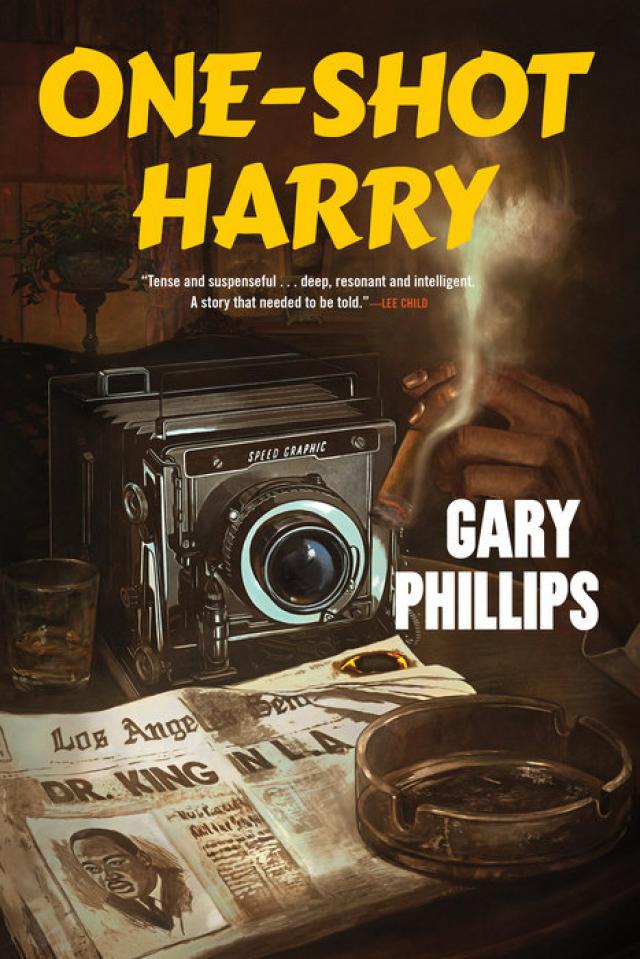


Ingram wanted to cuss the bastard out but knew he’d get a beating or worse. He’d brought that camera back from the war.
Staring at Ingram evenly, the cop said, “Now get the fuck out of here before I change my mind.”
Ingram picked up his broken camera, stuffing the pieces he could find in his pocket, as well as his press credentials.
“Hurry up.” Blondie rapped the end of his nightstick against his open palm. “We got important shit to attend to.”
Ingram worked his way back up the slope, getting a look at the fresh skid marks where Kinslow’s car had taken out the guardrail. He got in the Plymouth. He had half a mind to march back to those crackers swinging a tire iron like Josh Gibson. He could see the headline now in the Sentinel: “Crazed Photographer Shot Down Like a Mad Dog.”
Angry and sad simultaneously, Ingram wiped tears wetting his face. But he had to hold it together. He started his car and drove back to his place. There was one bit of satisfaction. When he’d had his back turned to the police, he’d switched out the film in his camera for a blank roll. The one with the shots was in his coat pocket. This wasn’t the first time Ingram had been braced by the cops over taking snaps where he wasn’t invited. Nor was it the first time his favorite camera had been banged around.
Back home, he put the Speed Graphic on the kitchen table, examining the damage with a practiced eye. The front standard was cracked, the lens was broken, a few knobs had been snapped off and the shutter release arm was bent. From a kitchen drawer he took out needle-nosed pliers, a steel screw extractor and several other tools. From the darkroom he came back with a medium-sized cardboard box containing various parts of cameras he’d salvaged over time. Putting on a Nat King Cole Trio album, he got busy repairing the camera. It took the length of playing the A side of a second record, but he got the Speed Graphic back together. To test it he took some shots of his bookshelf, a chair and out the window of passersby on the street below. He even set up the timer to take a couple of shots of himself. The camera was functioning again.
He regretted not getting a shot of one of the cops, especially the one with the billy club. Or, as he’d heard cops referring to it in the past, my “Nigger Be Good Stick.” What a great shot it would be, him aiming up from a low angle as a nightstick came thundering down on his face. Now that would get him on the front page of the Herald Ex for sure.
Afterward he developed those photos and the ones taken from Kinslow’s crash. By habit he made a brief notation on the back of each shot using a soft leaded pencil so as not to create markings in relief on the other side. Often when he made pictures he knew he was going to sell, he’d make two prints. The shots from the accident were for him, though he might try to get one in the Eagle.
Sitting at his kitchen table, he used a magnifying glass to look more closely at the shots he’d taken of the Mercury’s undercarriage. When they were in the service, Kinslow, who at one point had been the driver for a general, got the two of them out of an ambush. His friend had been behind the wheel of a jeep and he handled it like he and the vehicle were one. Bullets whistled by them, pinging off the vehicle, but Kinslow didn’t lose control as he ducked and dodged mortar holes and ruts in the road. Yeah, that was a decade ago, and maybe Ben had been drinking, but Ingram recalled how Kinslow had handled the Mercury the other night.
Ingram would find out if booze had been in his friend’s system. He knew an attendant who worked in the city morgue, prepping bodies for autopsies.
Peering through the magnifying glass, he zeroed in on the brake line where it originated from one of the rear wheel brake drums toward the front of the car and the master cylinder in the engine compartment. He looked closer at a break in the line. Was it severed, or had it pulled apart, causing the crash after the fluid was expelled? Ingram kept staring, unsure of what he was looking at. He needed an expert’s eye on this. He might be wanting to see foul play where there was none. He’d show this to his mechanic, Jed Monk.
Staring at Kinslow’s face, for the first time he saw the trickle of blood trailing from the corner of his slightly open mouth. It was dark against the stark black-and-white composition. He glared at this for some time, then went to his cupboard and took out a bottle of Jim Beam. It was past four, late enough in the day to have a blast, he reasoned. Hell, he’d earned it. He drank until the sun went down and decided he’d better get something to eat. He walked to a hamburger stand and got a cheeseburger with extra onions and fries. Rather than walk back with his dinner he sat and ate at one of the open-air tables.
At one point a police car rolled by, the white officer in it eyeing him and the other Black patrons. Ingram chewed away as the cop rolled on past. It was then Ingram made up his mind to find out if he was imagining things or if his friend had been purposely silenced. Maybe the police would do a thorough investigation but he owed Kinslow his life; he owed it to him to find out the truth. That time Kinslow had driven them away from certain death, he’d pointed out later, he’d been saving his own butt. That didn’t make any difference to Ingram. Because now he was the one left standing. He couldn’t bring Kinslow back, but he could find out what happened.
Balling up the paper his burger had been wrapped in, he tossed it away and started back to his apartment. He lit a cigar and puffed as he walked along. The evening was turning cool, but Ingram barely noticed. He paused at a campaign poster for Tom Bradley pasted on a wooden fence.
bradley, the only choice was in large red, white and blue letters, a semicircle of stars crowning the words.
“Yeah,” Ingram muttered, “the only choice.”
The next day Ingram went over to the Eagle’s offices on Central Avenue. The newspaper was across the street from the Elk’s Hall, where Ingram had enjoyed sets by jazz musicians over the years. He had a fond memory of being lubricated there before shipping out to the Army, listening to long tall Dexter Gordon coaxing bittersweet ballads out of his sax. Ingram had written up a brief piece to go with a few of the shots of the crash he showed to the managing editor, Wesley Crossman. The middle-aged bachelor worked at the newspaper and did freelance work for various publications such as Jet and a magazine called Dapper.
The latter publication was white-owned but intended for a Black male readership. The articles ranged from the lurid—“Mary Had to Pistol Whip Her Deaf Husband”—to ones about the appointment of a Black judge or a profile of the teacher of the year. Ingram had done words and pictures for Dapper as well. Though it was by no means as rugged as Stag or revealing as Playboy, Ingram had done a few cheesecake pictorials of pretty Black women for the magazine along with other work.
“I don’t know, Harry. It’s not like we don’t run pieces about white people, but you know it’s usually about our allies, like Governor Brown or Supervisor Hahn.”
The two sat at Crossman’s compact desk in his compact office off the equally modest newsroom. Several reporters clacked away on typewriters, the smell of stale cigarette smoke hanging in the air.
“I understand he was a friend of yours,” Crossman was saying. There was a well-used pipe in a worn pipe rack along with several piles of edited copy and file folders on the desk.
“I get it, Ben was unknown,” Ingram said flatly.
“Look, if we need some filler, maybe I can run this photo.” His finger tapped the shot Ingram had taken from above the tipped-on-its-side Mercury. “But I’m not promising anything.”
Ingram stood. “I appreciate it, Wes. Whatever you can do.”
He left, then set out to locate where his dead friend had been staying. He called the musician’s union pretending he wanted the horn player for a gig. But Kinslow hadn’t re-registered upon his return to town so that got Ingram nowhere. That also meant it was unlikely he’d be able to get a piece run on Kinslow in their newsletter.
Ingram then drove over to the Crystal Tea Room on Santa Barbara, where Kinslow had played a few times back when last he lived in L.A. That was about four years earlier. The club wasn’t open yet. Next he drove out to Mission Road, where the morgue was located on the same grounds as General Hospital. His contact, Somerset, was on duty, and for a five spot told Ingram that Kinslow’s body was there. He was an older, gray-haired white man with stooped shoulders.
“Any arrangements for which mortuary he’ll be sent to?” Ingram asked.
“So far, none that I know of.”
“Can I see what was in his pockets and glove box?”
“Christ, Harry, ask much, do you?”
Ingram produced another five.
“Make it quick. I ain’t losing my job over your amateur hour Dick Tracy foolishness.”
Somerset led Ingram past several corpses on gurneys lining the hallway to a plain room. Inside were file cabinets. They had index cards taped on each drawer in alphabetical order and he pulled open the appropriate one.
“Don’t try and leave with nothing. They’ll know.” With that Somerset walked out.
Ingram understood if he was caught, he was on his own. In a paper bag, neatly folded over like it held a lunch, Ingram looked through Kinslow’s effects: keys on a ring, an assortment of papers. There was a small key, like for a padlock, and Ingram slipped it off the ring and put it in his pocket. He found a rent receipt with someone’s name other than Kinslow’s on it. No address but it was better than nothing. He wrote down the name and considered taking the rest of the keys but sure enough those cops who rousted him would remember putting them in the bag. He closed the drawer just as an attendant in a blood-smeared smock entered.
“Hey, how you doing?” Ingram said off-handedly as he headed toward the door.
The attendant frowned at him as Ingram kept going.
CHAPTER FOUR
Ingram looked through the For Rent section of the L.A. Times going back a month, searching for the name signed on the receipt, Ernestine Morrison. Scanning the past issues on the library’s newly installed microfiche reader, he didn’t find the name related to a property. He then figured he might as well try the California Eagle and Sentinel, given his deceased friend’s open-mindedness. Kinslow might have wanted an apartment that was walking distance to a couple of the Black-oriented clubs where he could sit in on a jam session or two. Those archives couldn’t be found here but at the respective papers’ offices. Nor were they preserved on film but bound hard copies he had to leaf through. He headed back to the Sentinel.
“Find what you’re looking for, Harry?” Margaret Hutson asked him. She was a small-boned light-skinned Black woman with gray eyes who, Ingram knew from experience, could curse with the best of them if provoked. She ran the paper’s Want Ads department.
“Not yet, but . . . hold on, looks like you brought me luck.” He tapped a listing for a room for rent on Van Buren Place. The contact name was E. Morrison.
Hutson laughed good-naturedly. “Tell that to my two exes.”
Ingram wrote down the address and phone number and drove over to the house, a two-story clapboard affair that needed a paint job but looked comfortable and homey. Seems his friend had been rooming in a Black neighborhood. Now the question was how could he get in to look over Kinslow’s room? Had the police already been here? Would the lady of the house be on guard?
He walked up to the front door as a man was exiting.
“Is Miss Morrison around?” he asked.
“It’s Missus and she works until six or so. You want to rent a room?”
“I do,” he lied. “I guess I’ll come back later.”
“I can take your name and number if you like.”
“That’s okay, I’d like to see the room first.”
“They’re nice, plus Sunday dinner is included. She makes a mean fried catfish, friend.” The man adjusted his fedora and shut the door behind him, walking away.
Ingram also pretended to leave but circled back to try the front door. It was locked. He went down the driveway to the kitchen door on the side of the house. That was also locked. But behind the building, a window had been left cracked open. He used his penknife to carefully remove the screen and pushed the sash up. He climbed in, wondering who might be in the house at this time of day and what the hell he would tell them if he got caught.
Ingram had let himself into a bedroom, but a quick glance told him this was an older man’s room, what with small round tins of Doan’s Pills and bottles of Ben Gay on the dresser. He quit the room, entering a short hallway, several doors on either side. He tried one and it was locked. At another, he heard someone snoring on the other side. Instinct suggested he try upstairs. Here was what he was looking for.
There was a police padlock and hasp on the door, with a posted flyer warning not to enter. Just to make sure, he tried the padlock key he’d found on Kinslow’s ring, but it didn’t fit this lock. From his car, he got a screwdriver, and using the kitchen door he’d unlocked, re-entered the boarding house. He unscrewed the hasp enough to allow him entry. The door itself wasn’t locked.
Standing upright on the dresser was the horn case Ingram remembered seeing the other night. He eased the door shut and began looking around. He wondered, had the police gone through Kinslow’s digs? It seemed in addition to the horn, his other items had been left here. But then, if they’d already concluded it was an accident, what would they take? Ingram would check with Somerset about the possibility of liquor in his friend’s system.
On the dresser was an opened envelope with the name Shirley Kinslow and a return address in Kansas City. Ingram was pretty certain this was Kinslow’s mother. The police would have informed her of what happened. He wrote down her information, intending to call her. He went through the drawers, coming up blank. The closet contained only a few of Kinslow’s jackets. Inside one of the pockets he found two handwritten notes on index cards, contact information for the clubs the Totten Hot and the Crystal Tea Room.
He kept nosing around. At one point he opened the horn case, taking out the trumpet. He looked it over as if it might contain a vestige of his now-dead friend. If somehow he were capable of coaxing music out of the instrument, the melody might conjure up the spirit of Ben Kinslow.
Except for the door, there was nothing that had a padlock on it.
There on the nightstand was a photo of the squad from back in Korea. It was leaning in an inexpensive drugstore frame. Ingram picked it up, a rueful smile on his face as he looked at the dogfaces in the shot. Were they really that young then? Every battle, every push to take higher ground, had aged them years in weeks. Looking at the photo he realized it must have been taken by Milo Costas, the man from Look assigned to document various squads. But Costas didn’t make it to another detachment. He died right next to Ingram on a winter day, snow up to their calves and a blinding white sheet of an icy wind tormenting them along with enemy fire.
Sitting on the bed, Ingram was carried back, the only clear sounds the howl of the wind and ice tap-tapping against their helmets. That gale increased in his ears and Ingram got lost in grief and fury.
“Pardon me, but what are you doing here?”
He looked up to see a woman in a crisp linen outfit and a hat at a clever angle standing in the doorway. He must not have shut it properly. Shit. Be cool, baby, he told himself.
“I was a friend of Ben Kinslow.”
“Is that right?”
“It is. I’m trying to find out a few things about him.”
“You just said you were his friend.”
“We were in the service together. He lived out here for a while, then went away about four years ago. I saw him again in town just a few days ago.”
“Before the accident,” she said. “I overheard the policeman talking to Mrs. Morrison.”
Ingram didn’t respond. He rose, holding out the photo for her to take. She did. “That’s me, second from the left.”
She looked from the picture to Ingram then back again. “Yeah, that does look like you. And I recognize Ben too.”
“You were friends with him?” Ingram asked.
“He was a friendly guy.”
“Yes, he was.”
“Look, I’ve got to get to work and I probably shouldn’t leave you here.”
“Sure, I understand.” As he edged past her, he took the photo back.
“What did you say your name was?”
He told her who he was and what he did for a living.
“Would I have seen your work in the Sentinel?”
“I covered that incident on McKinley recently.”
Her eyes got wide. “Oh my, you’re that kind of photographer. Showing that man’s head caved in after his wife hit him with an iron.” She shook her head. “Don’t you want to take more, I don’t know, civilized sort of pictures? Like graduations and successful people being honored?”
He shrugged. “I don’t know, I guess I find that sort of stuff ordinary. Anybody can take those kinds of shots.”
“You seem like a nice fella, but have you considered that the kind of death and mayhem you shoot further brings our race down?”
“I don’t just take shots of colored folks cuttin’ up. Plenty of white people show up in my pictures too.”
By her expression it was clear that wasn’t a satisfactory response.
“I’m looking to cover Reverend King when he’s here,” he added.
“That’s a start.” She snorted. “May God guide you on the right path, Mr. Ingram.”
“Yes, ma’am.”
As he walked back to his car, it occurred to him he’d sold two publications those pictures he’d taken of the aftermath of the domestic squabble on McKinley. The Sentinel had run only one, the wife who’d brained her husband being led away in tears by the police. The more gruesome photos, including the laid-out husband after the iron had gone upside his head, those had run in Dapper. Ingram’s shots were included in their Crime Calendar section. Since the shot she referred to only ran in the magazine, could be she wasn’t as proper as she put on, he surmised.