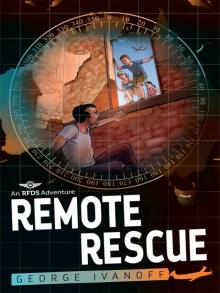
Remote rescue, p.7
Remote Rescue,
p.7


Until the 1960s, the RFDS rarely owned its own aircraft. Progressively, the RFDS began to purchase its own aircraft and employ dedicated pilots and engineers.
Today, the Royal Flying Doctor Service is one of the largest and most comprehensive aeromedical organisations in the world. Using the latest in aviation, medical and communications technology, it delivers extensive health care and 24-hour emergency service to those who live, work and travel throughout Australia. The RFDS has a fleet of 63 aircraft operating from 22 bases located across the nation and provides medical assistance to over 290,000 people every year.
Did you know? In 2015 the RFDS fleet flew the equivalent of 34 trips to the moon and back!
In order to modify an aircraft for its demanding role in the RFDS, it needs to be transformed into a flying intensive care unit. This is a two-stage process that can cost more than two million dollars!
The first stage involves readying the aircraft for emergency retrievals in difficult conditions. The landing gear is modified to allow for take-offs and landings on dirt airstrips. Half the aircraft is removed, reinforcements inserted and a cargo door wide enough to allow for easy loading and unloading of stretcher patients is created. A custom-built stretcher system with a hydraulic lifting device to raise and lower patients to and from the aircraft is then added.
The second stage involves furnishing the inside of the aircraft with a full range of medical equipment, including a defibrillator, ventilator, oxygen and suction system, medical cabinets, monitors and stretchers. A separate medical battery is installed to supply power to all on-board medical equipment. An integrated communication panel is added to allow medical staff to make emergency satellite phone calls while in flight.
The locations used in this book are real places. This includes the ghost town of Farina, situated along the Outback Highway in South Australia. But Farina wasn’t always a ghost town …
Farina was originally settled in 1878 as ‘Government Gums’ because of the River Red Gums growing in the area. It wasn’t long before the settling farmers changed the town’s name to Farina, which is Latin for wheat or flour. From 1882 Farina was used as a railhead – a station where other transport routes begin. Supplies would come by train and then go by road to other towns, including Port Augusta. Silver and copper mines were also dug in the surrounding area.
Farina was at its peak in the late 1800s, with a population of about 600, when good rainfalls meant that the farms flourished. The town included a railway station, two hotels, a general store, an underground bakery, a bank, a post office, a church, five blacksmiths and a school, as well as other buildings.
But the weather dried up, and the mines closed in 1927. By the 1940s people were leaving the town in droves. The school closed in 1957, the post office in 1960 and the general store in 1967. Finally, the railway line was shut down in the 1980s and the town was abandoned. It quickly fell into ruin and became the crumbling ghost town it now is.
To find out more about Farina and how it is slowly being restored, check out the Farina Restoration Project: http://www.farinarestoration.com
© Kerri Valkova
The Australian outback offers spectacular scenery and the chance for great adventure. But it is important to be ready for the risks of travelling in isolated areas. Unfortunately, up to a quarter of the emergency medical evacuations that the RFDS carries out each year are the result of city travellers who get into trouble on their outback adventure.
Preparation
Get good quality maps and plan your route
Bring matches or a lighter
Bring a compass and a whistle
Carry enough food for each person for two days
Do a first-aid course and pack a first-aid kit
Take a hat, sunscreen and insect repellent
Carry a high frequency (HF) radio compatible with the RFDS (mobile phones and CB radios will not work in remote areas); you can buy an HF radio from most two-way communication centres
Store water in small containers instead of one large tank; if you’re unused to the outback, you may need one litre of water every hour
Wear clothing suitable for the climate: wear good walking shoes; take warmer clothes for the evenings
Don’t travel during the hottest part of the year
During times of difficult communication the phonetic alphabet is of great use. ‘S’ and ‘F’ can sound the same, as can ‘D’ and ‘B’. Spelling of names is sometimes required. For example, ‘Smith’ is transmitted as Sierra Mike India Tango Hotel using the phonetic alphabet.
LETTER
PHONETIC
SPOKEN AS
A
ALPHA
AL FAH
B
BRAVO
BRAH VO
C
CHARLIE
CHAR LEE
D
DELTA
DELLTA
E
ECHO
ECK OH
F
FOXTROT
FOKS TROT
G
GOLF
GOLF
H
HOTEL
HOH TEL
I
INDIA
IN DEE AH
J
JULIET
JEW LEE ETT
K
KILO
KEY LOH
L
LIMA
LEE MAH
M
MIKE
MIKE
N
NOVEMBER
NO VEMBER
O
OSCAR
OSS CAH
P
PAPA
PAH PAH
Q
QUEBEC
KEH BECK
R
ROMEO
ROH ME OH
S
SIERRA
SEE AIR RAH
T
TANGO
TANG GO
U
UNIFORM
YOU NEE FORM
V
VICTOR
VICK TAH
W
WHISKEY
WISS KEY
X
X-RAY
ECKS RAY
Y
YANKEE
YANG KEY
Z
ZULU
ZOO LOO
OUT NOW!
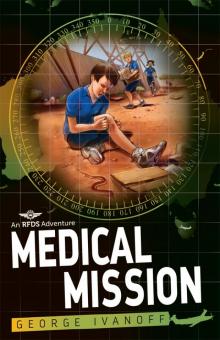
Medical Mission and Fast Flight
available May 2016
All rights reserved. No part of this book may be reproduced or transmitted by any person or entity, including internet search engines or retailers, in any form or by any means, electronic or mechanical, including printing, photocopying (except under the statutory exceptions provisions of the Australian Copyright Act 1968), recording, scanning or by any information storage and retrieval system without the prior written permission of Random House Australia. Any unauthorised distribution or use of this text may be a direct infringement of the author’s and publisher’s rights and those responsible may be liable in law accordingly.
Version 1.0
Royal Flying Doctor Service: Remote Rescue
9780857988775
Published by Random House Australia 2016
Copyright © George Ivanoff 2016
Illustrations copyright © Maria Pena 2016
The moral right of the author has been asserted.
A Random House Australia book
Published by Random House Australia Pty Ltd
Level 3, 100 Pacific Highway, North Sydney NSW, 2060
www.randomhouse.com.au
Random House Books is part of the Penguin Random House group of companies whose addresses can be found at global.penguinrandomhouse.com/offices
First published by Random House Australia in 2016
National Library of Australia
Cataloguing-in-Publication Entry
Author: Ivanoff, George
Title: Remote Rescue [electronic resource]
ISBN: 978 0 85798 877 5 (ebook)
Series: Royal Flying Doctor Service; 1
Target audience: For primary school age
Subjects: Royal Flying Doctor Service of Australia
Outdoor medical emergencies – Juvenile fiction
Airplane ambulances – Australia – Juvenile fiction
Dewey Number: A823.3
Cover and internal illustrations by Maria Pena
Cover design by Christabella Designs
George Ivanoff, Remote Rescue