Complete short fiction, p.74
Complete Short Fiction,
p.74


“You’re right,” Juan said. He relaxed a little, then wondered if his father was alive in this world. It would be that way, he realized, discovering differences of detail, but no changes in humankind.
Magnus stood up and walked over to the bar cart. Slowly, he dropped a cube of ice in a glass and poured some bourbon. He sipped and turned around. “I know you feel that you’ve lost your world. Worse, you doubt your identities. But, if you will forgive a more impersonal attitude, there’s still a lot left—everything essential, in fact.”
Relativity and quantum mechanics, Juan realized, might have profound psychological implications. Was there some observer effect that had drawn them into this world, where Magnus lived, and not another? Juan felt the darkness within himself. How many of him had stepped across the night sky? Perhaps the infinity of variants merged together to produce peak moments, a richness of reality, a texture of psychological contingency that could never be exhausted. Were dreams and multiple personalities the overlap between variants? Was the mystery he sometimes saw in the eyes of another a sign of possibility splitting at each firing of a synapse in the brain? Life seemed thin at times, with people moving in discrete orbits, circling some vast emptiness, yearning to touch, to quantum-leap into a more intense state, there to combine into greater wholes. The fearful masters of humankind’s world—this variant included—had set themselves to choke possibility, chain creativity to politics and economic interests, hold back the waves that yearned to break on kinder shores. New doors were opening, but others were closing behind him. Could he believe that the four people in this room could dispense the blessings of the web to humankind? They understood and cared, he told himself; but to succeed demanded more than moral ideals—it demanded their violation in the name of greater ideals. Perhaps Titus was necessary, after all.
“What now?” Lena asked Magnus, and Juan felt that a million years had passed. He hungered for the simple absence of disappointment, for naive hope; perhaps the cauldron of probability might give it to him.
Magnus looked down into his drink and said, “Unless you all feel otherwise. I won’t keep you here, and I won’t insist on what you should tell Titus. You can do what you wish with the disk in that recorder.”
Lena went up to him and said, “You are still one of us.”
He smiled. “How could I be otherwise, now that you’ve told me about myself. By the way, I would be very interested in reading my . . . namesake’s entries in his notebook.”
“I have it safe,” Lena said.
“What prevented you from going with us?” Juan asked, suddenly fearing for him again.
“Oh, a bit of illness.” He wandered over to the open balcony. “So I’m buried out there, under an alien tree.” He gazed dispassionately at the bright, starry sky, then took a long sip from his drink and said, “How poetic a way to end.”
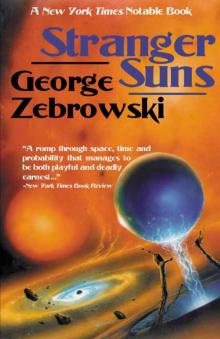
[This two-part serialization of “Stranger Suns” by George Zebrowski is the first third of a novel of the same title to be published by Bantam Spectra in 1991.]
The Number of the Sand
There are those who believe not only in the infinity of number but in actual infinity, and others who deny it, yet claim that the number of the sand cannot be said because it is too large.
—Archimedes
Hannibal dismounts and walks out into the center of the valley of Zama, followed only by his interpreter, a trusted veteran of the Italian campaign. Scipio also approaches with only an interpreter. At each general’s back, unseen armies wait in the hot Tunisian afternoon. The two leaders stop half a dozen steps apart and regard each other in silence.
Hannibal is the taller and older figure, with a sunburned face half-covered with a cloth that hides his graying hair. He turns his head slightly to benefit his good eye.
Scipio seems tense as he stands bareheaded, holding his helmet, but his expression is that of a proud, handsome man. There is gold inlay on his breastplate, but no other mark of Roman military rank.
“Do you prefer Latin or Greek?” Hannibal asks in Greek. “I know of your interest in the Hellenes.”
“It is one of your loves also,” Scipio replies. “I’ve heard that you write in Greek.”
Both men glance at their interpreters, then return their attention to each other.
“They will only witness our discussion,” Scipio says. “Neither of us needs the delay of having our words repeated.”
Hannibal nods at this sign of respect, then stands straighter and shifts his weight to his right leg. “Luck has been with you, Consul,” he says, “but we both know that good fortune cannot continue unbroken.”
Scipio draws a deep breath and says, “Fortune had little to do with the fact that you were compelled by obvious necessity, and your own honorable character, to leave Italy and come to the defense of your native city. All wars must aim at a truer peace.”
Hannibal smiles. “Why be modest? The necessity was of your making, and might have been otherwise.” He pauses and waits for a reply, but Scipio waits longer, and Hannibal at last says, “You and I seem to be the only ones who understand that war should be a way to a more lasting peace. Our peoples will only benefit if we end our conflict here and now.”
“What do you offer?” Scipio asks.
“The islands,” Hannibal says, “even the smaller ones, such as the Malta group, between Italy and Africa. Carthage will also give up Spain.”
“But this is less,” Scipio replies, “than the terms of the armistice already signed in Rome.”
“Which you drafted,” Hannibal says quickly, “whether signed by your government or not.”
“You offer us our own terms,” Scipio counters, “but without the surrender of war vessels or the return of deserters and fugitives in your ranks.” The Roman general raises a hand. “I know that they make up the majority of the army with which you fled Italy, and I realize that you will not betray your veterans, but I cannot accept less than Rome’s original terms.”
Hannibal sighs and nods. “I knew there was no possibility of peace between us, but I wished to meet you, and I do not regret it. We will have to attempt to destroy each other’s force. Neither of us can shirk that duty.”
The two men gaze at each other for a long, frozen moment, then make gestures of salute and turn away. . . .
A sea of simmering noise swallowed the scene at Zama. The historian ended his first observation of the meeting between Scipio and Hannibal in North Africa, near Carthage in the year 202 B.C., as the first step in his New Study of History. Any randomly selected coordinate of any linear history would have served as well.
As the Prolegomena to his study, he had sampled numerous studies of history, observing how oral narratives gave way to the art of writing down a connected chronicle from surviving documents. This crude form of history was constructed not from a continuous flow of events, but from available, discontinuous samples; from these moments, no one could reconstruct any one true past, and the result was always biased toward the concerns of the investigating present.
When the first linear history machines became operational, the interpretive art of the old historians collapsed, as the whole linear range of human time could now be observed at any desired speed. The old studies of history were replaced by a half-million-year literal record, which could be observed at any point along its meandering course.
After nearly a century, despite the efforts of interpretive observers, the past became the dead past, because nothing usable could be learned from it beyond curious fact. As the old problems of history were settled, the world rushed toward a future event horizon of incomprehensibility, on the other side of which waited a culture so changed in its biology and goals that little of history would have any meaning for it.
Even when the cliometricon uncovered quantum history, access to the infinity of historical variants only continued to lessen the importance of history in human affairs. Everything had happened and was going to happen; no lesson that could be extracted from the past had any meaning to an accelerating history. All previously false histories of the past became true in some world. Lessons could be applied, imperfectly, to restricted sequences of human experience, in which the time of one generation and the next was essentially unchanged; but to be led by the past in a quickening time would shackle the future, if it could even be done. The universe was not a closed, self-consistent system; it was open, unfinished, and infinite in all directions, including time. Its true nature was mirrored in the incompleteness of both natural and mathematical languages, and in the failure of human law to keep up with emergent circumstances.
The cliometricon’s ability to retrieve decaying, fading information from the cosmic background had extended the history machine’s capabilities, but without any clear advantage for humanity beyond the satisfaction of scholarly curiosity. Meanwhile, the history machine’s ability to show the past, even the immediate, fleeing past measured in seconds and minutes, made possible the emergence, after a stormy transition, of the first panoptic human culture. This transition included the so-called privacy wars, and led to the acceptance of peeping as the right of every human being. Since there was no way to blind the all-seeing eye, humankind had simply faced up to the fact of peeping with a new social stability based on informational nakedness, in which everyone was rewarded. The price of peeping was to be peeped. For the first time in its history, humankind revealed itself to itself in a systematic way, settling many questions of individuality and human nature. Past humanity had only glimpsed itself through its poetries, fictions, and visual dramas; but now all curiosities were satisfied, and the result was greater understanding and compassion for some, and boredom for others.
Cliometricians continued to pursue greater issues, even though they routinely used linear history machines to verify the priority of their colleagues’ areas of interest, personal as well as professional, and avoided poaching on all staked claims. But the profession always avoided facing up to the question of its legitimacy, which seemed irresolvable.
There could be no complete history of histories. Events ran to infinity in all directions, diverging at every moment, at every fraction of a moment, at every point in each variant of space-time. Yet this process always meant something to the interiors that were intelligent entities; even when it seemed to make no sense, meaning was felt. The cliometrician watched the embarrassment of the old historians as they were confronted with the living past—and their denials as they drowned in the ocean of truth, claiming that it was all a simulation constructed from massed data by imaging programs. They could not accept that human history was one of the masks of chaos, behind which there was nothing.
In the first hour of horizon light, a sleepless Hannibal watches from a hillock as the elephants stir and begin to advance. Behind them are Mago’s men—silent Ligurians, complaining Gauls, wild Moors, and a small group of Spaniards. Well drilled, heavily armed, and battle-wise, the men advance shoulder to shoulder. A second force of Carthaginian recruits, led by the aging Hanno, advances behind the elephants, followed by the third force, Hannibal’s veterans, the army of Bruttium, which deliberately lags behind, and is all but invisible to the Romans in the gray morning light.
Only Hannibal and his waiting messengers know why this is not his usual long battle line. If all goes according to plan, three separate battles will be fought at Zama.
But despite the starlit start of his first force, Hannibal sees that the Roman force is already moving across the valley, its standards a slow-moving fence, flanked by horsemen. Three ranks of machinelike infantry—front, spearmen, and supporting legions of triarii—come forward. There are puzzling breaks in the line, which are defended by only a few javelin throwers.
As the armies collide in the same place where Scipio and Hannibal had met, the Roman horns and trumpets cry out, startling Hannibal’s elephants. Many of the beasts panic and rush into the openings in the Roman lines, where they are greeted with swarms of missiles and herded through the lines to the rear. Confused, the remaining elephants turn and charge the Carthaginian cavalry. Scipio’s mounted force scatters Hannibal’s horsemen. They struggle to regroup and fight, but are too few for Laelius’s and Masinissa’s squadrons. The massed riders move off as a single storm, out of sight.
Hannibal watches as Mago’s Gauls and Ligurians lock man to man with the first Roman line and bring it to a stop; but the triarii slip through the openings, and the Roman line surges forward again. The second wave, Carthaginian recruits from the city itself, fails to relieve Mago’s force, because Hannibal has ordered his three forces to keep apart. The survivors of the first wave retreat and turn with rage on the Carthaginian recruits, who push them back as the Roman line drops its spears and javelins and advances with shields and swords, supported by second-rank spearmen.
Desperately, the Carthaginians hold back the legions, but by late morning the last of Hannibal’s two forces breaks to the sides of the valley, leaving the ground strewn with the dead and dying.
On his hillock, Hannibal knows that he must now send in his third force, the ten thousand veterans of Italy, who stand waiting for the moment when Scipio can no longer retreat, while on either side the survivors of the first two waves regroup.
Trumpets command the Romans to remove their wounded, recover weapons, and clear away debris. The standards still fly as the men drink water and rest.
Then, in response to swift new orders from Scipio, the three lines reform. Spearmen move off to one flank of the front line, the triarii take the other. The Roman line lengthens far beyond Hannibal’s, and closes in on the weak Carthaginian flanks. The armies are equally matched now, except that Hannibal’s veterans are fresh, and they have never known defeat at the hands of the Romans.
Suddenly the Roman cavalry returns—and charges into the rear of Hannibal’s veterans. There is no Carthaginian cavalry left to stop them. The army of Italy is caught between the infantry and horsemen. The Bruttians turn to defend their flanks and rear.
They fight and die across the afternoon, until nearly all are killed. Hannibal sends a message to Carthage, counseling acceptance of all surrender terms, and with a few survivors flees eastward.
The historian returned to the first meeting between Scipio and Hannibal, and listened again to their great-souled but hopeless words. Then he crossed the lines, watching the variations.
A servile Hannibal admitted his crimes against Rome to a pompous Scipio, mouthing the words of Livy’s history, which was true here and a lie elsewhen. The Tunisian landscape seemed frozen. Grains of sand hung suspended in the air at Zama. Hannibal’s headcloth disappeared. He wore a patch over one eye. He became stooped, then stood taller and lost an arm. Scipio appeared, now wearing his helmet. Insignias of rank appeared on his breastplate. The two leaders spoke only through their interpreters, who seemed changeless. The view-tank flashed as the historian paused. Scipio and Hannibal were conversing from horseback.
“They hate me back in Rome,” Scipio says in Greek, “and that hate will only increase if I defeat you here. There are those who fear my success.”
Hannibal smiles and says, “I, too, am disappointed with the city I left behind as a boy. The fat rich rule it for their sons and daughters. Honor is dead.”
“You might restore it,” Scipio answers, “if you became its just ruler.”
Hannibal laughs. “Your Senate will not tolerate a Carthage with me at its head!”
“But it might not fear a Carthage without you,” Scipio answers.
Hannibal considers, then says, “You and I will not fight, then. Will you give me your word that Carthage will not burn?”
Scipio nods. The two men clasp arms, then turn and ride away.
The historian cut across the variants and found Hannibal alone again, looking out across the empty valley of Zarna, where there had been no battle. Was Hannibal thinking of how he could have won? Was this aging soldier still in love with the craft of battle as he rode away, hoping for peace?
But in this variant Rome betrays Scipio, replaces him as commander of its forces in Africa, and burns Carthage to the ground. Scipio commits suicide. In Bithynia, far to the east, Hannibal receives the double news with sorrow, and drinks poison in the garden of his house as Roman soldiers approach. A servant flees north with Hannibal’s memoirs, forgetting the last piece of parchment, which lies on the table before the dead Carthaginian. In this variant, the writing reads: “The anxiety of the Romans is at an end. I am the old man for whose death you have waited so long. There will be only one Rome, but it might have been Rome or Carthage. . . .”
While at Zama, the three battles that became one defeat flare across infinity, and each of its three struggles is an infinity, changing through infinitesimal steps. The Roman horsemen do not return, having been ambushed by the sons of Syphax and their Numidian cavalry, leaving Hannibal to an honest test of his Bruttians against Scipio’s weary infantry. A few variants earlier, the Roman cavalry had arrived, but too late to save Scipio; and before that only at half strength; and before that . . .
The historian watched Carthage destroyed, then built up into a Roman city because the site was too good a center for commerce to be ignored. He watched Rome leveled and raised into a Carthaginian city, for the same reason. The variants ran through endless minor differences in these two outcomes, until he left these lines behind.
He could have of probability what he wanted—but what was it? An endless flickering structured out of nothing, differentiated into individual things by measurementlike interactions among components, copying itself endlessly, providing examples but no prescriptions. These could be studied definitively and forever, but to no end. There was no wall around past quantum-transitional time, so he could have of it what he wanted, even though he could not stand apart from its infinity and see it whole. Only the quantum future was forbidden, even to licensed historical observers, whose linear and quantum history machines were restricted by basic design. There had been a time when the study of history had called for a concern with the future, then with alternate futures, extending the study of the past toward the creation of desirable futures; but the quantum-transitional cliometricon had stifled that new history. Futurity’s informational influx into the past was feared and prevented; and yet there had to be variants in which it was embraced, where cultures of past and future mingled informationally without fear, because they understood that the stuff of being was blossoming into 100100+N directions, matter and living flesh metamorphosing toward distant, ever more tenuous and mysterious states, and that these conscious innards of time must huddle all their histories together. . . .