

Myth of the rain forest.., p.3
Myth of the Rain Forest Monster,
p.3


Dr. Iris nodded. “Good idea.”
Together, the group began moving boxes around. They put the things that were on Dr. Iris’s list on one side of the cabin and the things not on the list on the other side.
“This box has little cameras attached to straps,” Jessie said.
“Yes, those were Nigel’s idea. He wanted to film everything in case we saw the creature. The small cameras attach to vests, so we don’t have to carry around a big camera.”
Jessie placed the cameras in the pile of things that were on the list.
“Here’s one full of hats,” Violet said. “All different kinds.”
Dr. Iris shook her head, and Violet put the box in the other pile.
Benny held up a small box. “There’s a telephone here, but it looks a little like a walkie-talkie.”
“That’s a satellite phone,” Dr. Iris said. “It’s for camping in places where it’s hard to get a signal. I hope there is a box of boots. I gave him a list of all your sizes.”
“They’re here,” Jessie said, holding up a pair. “Does it rain so much we need rain boots?”
Dr. Iris checked another box. “No, but we’re all going to need to wear boots any time we aren’t sleeping to protect ourselves from snake bites and insect bites.”
“Really?” Violet asked. “Is the camp going to be that dangerous?”
Dr. Iris gave a gentle smile. “No, it’s just a precaution. It’s always better to be careful.”
They went through all the supplies, sorting and stacking them to make more room in the cabin. When they were done, there were two neat piles about the same size. “Everything is here,” said Henry. “And a lot of extra things too. Nigel brought lots of electronics, like cameras and computers.”
“I don’t understand why Nigel has included some of this equipment, but I suppose he must have his reasons,” said Dr. Iris. “He’s been doing this a long time.”
“Listen,” Violet said. “I hear the yipping noise again.”
The children were quiet for a moment. Sure enough, what sounded like the bark of a small puppy was coming from outside.
“We forgot to ask if the captain has a dog,” said Benny. “Can we go see?”
“Yes, go ahead,” Dr. Iris told them. “I want to make a phone call while I can still get a signal on my regular cell phone.”
It was getting dark when the Aldens climbed the stairs to the top deck.
“Over here,” Henry said. “I think that little room at the front of the boat is called the pilothouse. That’s where the captain steers the boat.”
Captain Souza was humming to himself when they walked in.
“We thought we heard a little dog,” Violet said.
The captain laughed. Without taking his eyes off the river, he pointed to the corner of the pilothouse. “You’re hearing my pal, Figly.”
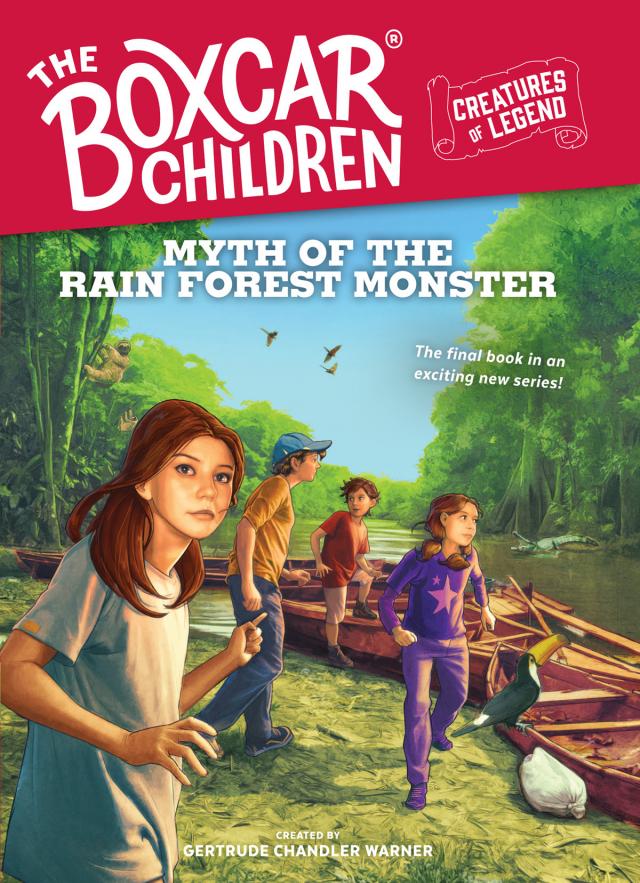
Instead of a dog, a large, black bird with a long, orange beak sat on a perch at the back of the pilothouse. Each of its eyes had a blue circle of tiny feathers around it.
“That’s a toucan, isn’t it?” Jessie asked.
“It certainly is,” the captain said.
“He’s so colorful,” said Violet. “And his call is so unique.”
“Yes, the toucan is very good at standing out,” said the captain. “And it needs to be.”
“Why?” asked Benny.
“With so many frogs and birds and insects making noise in the Amazon, and with so much land, toucans need to be able to find each other. They do that through their colors and with their calls.”
Jessie thought back to their visit to the zoo. “It reminds me of how the sloth has changed over time to fit in. Except the toucan seems to have adapted to stand out.”
The bird turned to the children and gave a dog-like yip. Violet noticed one of its wings looked different from the other. “Did something happen to him?” she asked.
“Yes, his wing was injured when he was a chick. That’s why I have him. He couldn’t take care of himself. You can feed him a treat if you want.” The captain pointed to a little bowl of treats. “Take one and hold it out for him. He likes figs. That’s why I named him Figly.”
Benny grabbed a treat and held it out. In a flash, the toucan’s long beak grabbed the treat and gobbled it up, flinging bits everywhere. Benny laughed.
“They’re messy eaters,” Captain Souza chuckled. “I get used to having bits of fruit in my hair.”
The bird gave one more yip and then hopped to the floor. “Better move back so he can get out. Toucans don’t sit still for very long. He likes to roam around the decks.”
The Aldens made a path for the bird. He hopped between them and then out the door, making his yipping call as he went.
When they turned back, the captain was pointing to the shore. “Take a look over there.”
It had gotten so dark that they could just make out the shapes of some large creatures sliding into the water.
“Those are caiman, aren’t they?” Jessie said.
“Yes, the particular species you see along here are black caiman. They are very hard to see once they’re in the water, even in daylight. They blend right in.”
“We heard they can be dangerous,” Violet said.
“Yes, a man we met said Nigel had been bitten by one,” Benny added. “I don’t see them anymore. Are they following us?”
“No, no,” the captain said. “Caiman usually don’t bother people unless people bother them. The river is their world. We are just visitors. I hadn’t heard that about Nigel though.”
Jessie thought it was strange that Nigel hadn’t told Captain Souza about his caiman attack. It seemed like it had been a big deal for him. But before she could ask anything more about it, a noise came from up ahead. It sounded like the hum of an engine.
Captain Souza’s expression turned serious. He turned on a bright spotlight. “This, however, might be trouble.”
INTO THE WILD
The riverboat’s light shone down on a speedboat with one man in it. The man waved as he turned his boat to go around the Toucan.
Captain Souza waved back and let out a big sigh. “That’s a relief,” he said. “I was afraid it would be a river-pirate boat. We don’t usually get river pirates on this part of the river, but I don’t like hearing the sound of a small boat at night. Most people don’t travel in those sorts of boats after dark, except for pirates.”
“There are really pirates here?” Henry asked.
“I thought they were just in stories about the olden days,” Violet said.
“Sadly, there are still pirates,” the captain said. “They don’t wear eye patches or have peg legs, but they can be dangerous. In such a remote area, pirates think they can take what they want from anyone.”
“It reminds me of the loggers who cut down trees illegally,” said Jessie.
Captain Souza nodded. “That’s right. Sometimes it’s not the animals who pose the most danger in the Amazon; it’s the humans.”
“I think I hear something rumbling,” Benny said. “Is there another boat coming?”
The captain laughed. He checked his watch. “That was my stomach! It’s almost time for dinner. I’ll join you in the main room on the lower deck in a few minutes. Once we lower the table down, we can eat.”
“What do you mean?” Henry asked.
The captain smiled. “Go look.”
The children went downstairs to the main room. It did not look like a dining room. “Are we sure this is the right place?”
Then Jessie pointed to the ceiling. “The table is up there!”
Sure enough, there was a chain holding the table near the ceiling.
“I’ve never seen a table on a ceiling before,” Violet said. “Why would it be up there?”
“We make use of all the space we can on riverboats,” the captain explained as he came into the room. “If we have a lot of passengers, we lift the table up at night so we can string hammocks in this room for people to sleep.” He pointed at some hooks in the walls. “See, we can fit a dozen hammocks in here if we need to. You should be glad you have cabins though. It can get loud at night if one person is snoring.”
Jessie, Violet, and Benny looked at Henry.
“Hey, I don’t snore!” he said.
“Oh, yes you do,” Dr. Iris said as she walked into the room. The children laughed.
Once the table was down and the folding chairs were in place, everyone sat down. Dinner was a fish and vegetable stew served over rice. For dessert, they had Brazilian treats that the captain called brigadeiros.
“It’s a bit like a truffle,” the captain said, passing the tray around. “I don’t know exactly how it’s made; I’m not much of a cook. I just know I like them!”
Benny ate one. “I don’t care how they are made. These are delicious!”
The tray went around the table until the treats were all gone. After everyone was done eating, the Aldens helped clear the table and raise it back to the ceiling. Once that was finished, Henry looked at a map on the wall. “Which way are we going?” he asked.
The captain came over and traced his finger along a blue line. “We’re going north. There aren’t as many towns along this stretch.” He pointed at a black dot. “I’m taking you here.”
“Are all those blue lines rivers?” Violet asked. “I thought the Amazon was just one big river.”
“Big rivers are often big because smaller rivers flow into them,” the captain explained. “The Amazon River has more than one thousand rivers and streams feeding into it. It’s the largest river system in the world. In fact, we aren’t even on the Amazon River right now. We are going up a river called the Rio Negro, which means ‘black river.’”
“I saw that the water was very dark,” said Violet. “Why is that?” Something about floating on a river with such murky water made her nervous.
“During the rainy season, much of this area floods,” the captain explained. “Huge areas of plant life suddenly go underwater. As the plants break down, they give off the black color. Some people say the water looks like black tea.”
After dinner, everyone went to the top deck, where the night pilot was steering the boat. Besides the lights on the Toucan, the only other light came from the moon shining on the water. Violet liked imagining they were floating on a river of tea. But the huge wilderness and the stories of the mapinguary still worried her.
“It feels like we are all alone out here,” she said. “It’s like you said, Captain Souza; we are visitors here.”
Captain Souza smiled. “We may be visitors,” he said. “But I’ve learned that as long as we are good guests, everything will be fine.”
That made Violet feel better. The Alden children knew how to be good guests. Before long, Violet was yawning along with Benny, and it was time to go to sleep.
“It feels early, even though the sun is already up,” Benny said the next morning as they went to eat breakfast.
“It is early,” Dr. Iris said. “The sun rises around six a.m. year-round along the equator. And that means daylight lasts almost exactly twelve hours. The sun sets at six p.m.”
Jessie fanned herself. “It’s already hot too.”
“The equator is the part of Earth closest to the sun, so there are no cold winters here,” Dr. Iris said. “It only gets slightly cooler during the rainy season.”
“I like it when it’s hot,” Benny said. He rubbed his stomach. “But I like cold breakfast. I wonder what we’re having.”
In the main room, breakfast was already waiting for them. There was granola and yogurt with bananas and berries.
“What kind of berries are these?” Jessie asked. “They look like blueberries, except they’re a darker purple.”
“Those are acai berries,” Captain Souza said. “The Amazon has several different kinds of fruit you’ve probably never seen before.”
“On the plane, I was reading the guidebook Professor Cardoso gave me about plants,” Jessie said. “The book says there are more than eighty thousand different kinds of plants in the Amazon.”
Dr. Iris nodded. “That’s one reason why I said the Amazon was a treasure for the whole world.”
Benny swallowed a big bite of yogurt and berries. “How can plants be treasure?” he asked.
“There are a couple ways,” Dr. Iris explained. “First, plants make oxygen, which is what us humans breathe. The Amazon has so many plants, people call it the lungs of the world. Also, many medicines we use today were first discovered from the plants that grow here.”
“Not to mention plants are food for lots of animals,” said Benny.
Dr. Iris chuckled. “That is true. I can always count on you to think of the most important thing, Benny—food!”
The trip up the river took all day. Every once in a while, the boat would pass a small village. At one village, a bright-yellow boat was parked at the dock.
“It looks like a school bus,” Violet said.
“It is a school bus,” Dr. Iris said. “Or I should say, a school boat. Many of the villages here are too small to have their own schools, so a school boat picks up the children to take them to a bigger village that does have a school.”
Soon, there were no more villages, just forest on both sides of the river. The Aldens spent most of the time sitting on the deck, watching the shore and reading their guidebooks.
“I haven’t seen many animals,” Violet said. “It’s too hard to see through the trees.”
Jessie turned to her sister. “Look behind us.”
“Dolphins!” said Violet. In the boat’s wake, a pod of dolphins was swimming along and leaping out of the water.
“I thought dolphins lived in the ocean,” said Benny. “Turn around, Mr. and Mrs. Dolphin!” he called. “You’re going the wrong way!”
“Those are river dolphins, Benny.” Henry held up his guidebook. “According to this, they’re called botos. I hope they get close. The book says that some of them, the older ones, look pink.”
The animals swam closer to the boat, like they wanted to follow it. Violet pointed. “There’s a pink one—that big one!”
The smaller ones around it were mostly gray. The children watched as the dolphins swam around the Toucan curiously then swam off ahead.
It was late afternoon when the riverboat slowed and pulled up to a wooden pier. At the other end of the pier, a man with curly blond hair was jiggling a plastic object in front of him.
“What is that man doing?” Benny asked.
“It looks like he’s holding a coffee maker,” Jessie said. “But I don’t know why he would be doing that.”
“Hello! I’m Iris Perez,” Dr. Iris called out. “We’re looking for Nigel Livingstone. Have you seen him?”
The man stopped jiggling the object and stood up straight. “Nigel Livingstone, at your service.”
“I thought he was supposed to have a shaved head,” Violet said to her siblings.
Jessie shrugged. “I guess he decided to let his hair grow.”
Captain Souza tied up the boat to the dock, and the man came out to meet them. Dr. Iris stepped off the boat. “You’re Nigel Livingstone?” She sounded puzzled.
“Yes,” the man said, looking over her shoulder at the boat. “Who else would I be?”
BASE CAMP
The man held up his wallet, which contained a driver’s license with a photo of the man smiling. Next to the photo was the man’s name, Nigel Livingstone.
“Right,” Dr. Iris said. “I’m sorry for my confusion. I didn’t realize you were so young. You’ve accomplished quite a bit in your career.”
Nigel shrugged. “I graduated from college early and jumped right in. Come on, I’ll show you the camp.” He looked down at the coffee maker. “I think it’s got enough charge to work now.”
“Is that a solar panel on top of the coffee maker?” Henry asked.
“Yes, it’s the latest thing,” Nigel said. “I like a good cup of coffee every morning, so I thought this would be perfect. Except the camp is too shady for it to get a good charge. I didn’t think about that.”
Two long boats that looked like canoes with motors attached were tied up to the dock. Benny knelt down to get a better look at them. “Are these boats made out of logs?” he asked.
“Yes,” Nigel said. “Some of the small boats that people use to get up and down the river are still made the traditional way. Aren’t they terrific? They look great on film too. Follow me, and I’ll show you the camp.”
Henry and Jessie looked at each other. Nigel did not seem like the person they had imagined.
He led the way up the riverbank. Ahead, a post stood with a board nailed to it. The words Camp Macaw had been painted on it, but the paint was chipped and fading.
“I hope that means there are macaws here,” Violet said. “We saw one kind at the zoo. But I read in my bird guidebook that there are many kinds.”
“I suppose so.” Nigel shrugged. He turned and led them past the sign to a clearing. Three open-air buildings, each with just one back wall, stood around a fire pit. The buildings had roofs made of dried plants, but there were some gaps where it looked like the plants had blown away. Log benches surrounded the fire pit. A young man was stirring something in a pot over the fire. He had straight black hair under a cap with a circular brim.
“Hello,” Henry said to the young man. “I’m Henry, and these are my sisters and brother.”
The young man stood up and greeted them. His name was Kwini Macedo.
“Kwini is one of the best guides around,” said Nigel. “And a great cook too.”
After everyone was introduced, they went to look at the shelters.
“It doesn’t look like anyone has been here for some time,” Dr. Iris said. “Nigel, I thought you said this was a research camp. It’s in very poor shape.”
“It was a research camp, but they aren’t using it this year,” Nigel said. “I assumed someone would have kept it fixed up.”
Dr. Iris shook her head. “At least we can sleep on the boat.”


