

Land of dreams a novel, p.1
Land of Dreams: A Novel,
p.1


Other Titles by Gian Sardar
When the World Goes Quiet
Take What You Can Carry
You Were Here
This is a work of fiction. Names, characters, organizations, places, events, and incidents are either products of the author’s imagination or are used fictitiously.
Text copyright © 2026 by Gian Schwehr
All rights reserved.
No part of this book may be reproduced, or stored in a retrieval system, or transmitted in any form or by any means, electronic, mechanical, photocopying, recording, or otherwise, without express written permission of the publisher.
Published by Lake Union Publishing, Seattle
www.apub.com
Amazon, the Amazon logo, and Lake Union Publishing are trademarks of Amazon.com, Inc., or its affiliates.
EU product safety contact:
Amazon Media EU S. à r.l.
38, avenue John F. Kennedy, L-1855 Luxembourg
amazonpublishing-gpsr@amazon.com
ISBN-13: 9781662526800 (paperback)
ISBN-13: 9781662526817 (digital)
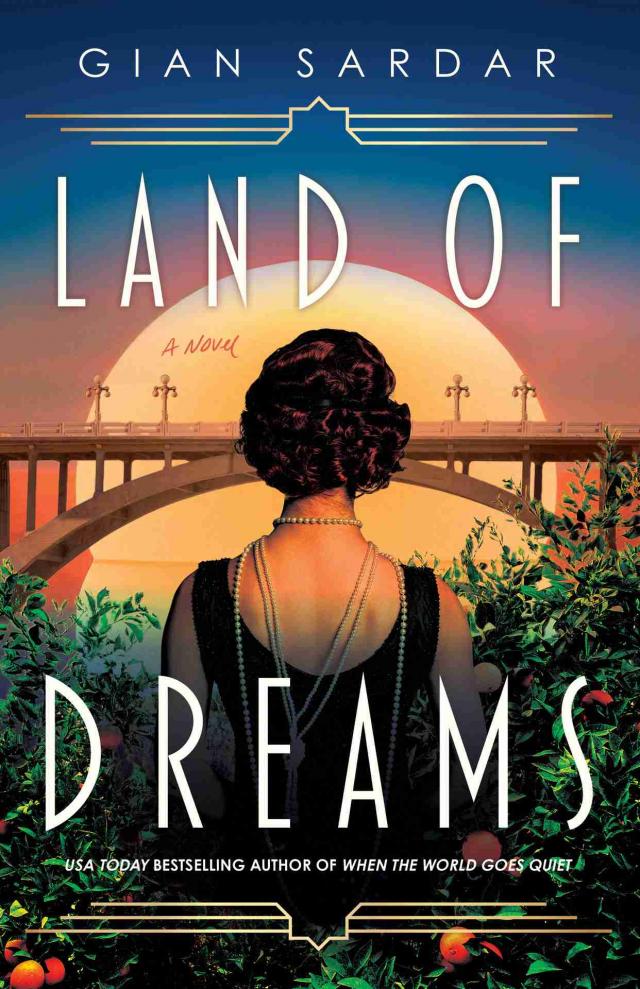
Cover design by Faceout Studio, Addie Lutzo
Cover image: © Sudha Peravali / ArcAngel Images; © juanma hache, © Jiojio, © Jose A. Bernat Bacete / Getty; © Angel DiBilio, © Brocreative, © Twins Design Studio, © Ava Peattie / Shutterstock
For Joe, who made the dreams possible
Contents
Chapter 1: Do What You Gotta Do
Chapter 2: Everyone Holds the Cards to Their Downfall
Chapter 3: One Lucky, Lucky Man
Chapter 4: Justice and a Happy Ending
Chapter 5: People Can Surprise You
Chapter 6: A Coil Wound Too Tight
Chapter 7: Don’t Yell at a Swarm of Bees
Chapter 8: Some Things Can’t Be Faked
Chapter 9: The Beast We Work For
Chapter 10: Admission to the Battle
Chapter 11: She Didn’t Say Goodbye
Chapter 12: A Wordless Code for I Love You
Chapter 13: The Lie Is Smooth
Chapter 14: Perception Takes More Casualties
Chapter 15: However I Have To
Chapter 16: Toss Him to the Wolves
Chapter 17: This Is What It’s Come To
Chapter 18: Mountains Made of Clouds
Chapter 19: Words Don’t Pull the Trigger
Chapter 20: Luck Has Nothing to Do with It
Chapter 21: It Doesn’t Get Better than This
Chapter 22: Par for the Course
Chapter 23: Loud Enough to Wake the Dead
Chapter 24: People in the Know
Chapter 25: A World That Won’t Stand Still
Chapter 26: Something Nice About a Disaster
Chapter 27: Everything to Do with You
Chapter 28: When, Not If
Chapter 29: Undoing This Is Not an Option
Chapter 30: Strategy Relies on Information
Chapter 31: Get Ahead of It
Chapter 32: You Can’t Win if You Don’t Play the Game
Chapter 33: The Big Picture
Chapter 34: The Last Lie
Chapter 35: This Golden Age
Acknowledgments
About the Author
Chapter 1
Do What You Gotta Do
December 1930
New York City
A city full of people with no place to go. They walk just to walk, move to not stand still; they do anything they can to not feel where they are or, worse, who they are. Up and down Mott Street, cars crawl and horns make almost comic protests while signs blink on and off, on and off. At the corner, a newsie, a boy no older than ten, stands on a crate and waves a newspaper, bundles tied with twine at his feet, and a movie palace’s marquee is missing half its bulbs, the entire a in theatre dark. But it doesn’t matter; the line to the box office stretches the length of the building, everyone shifting and restless. Though no one should be spending the thirty-five cents for a movie, all are desperate for the warmth and the escape. Sit back, look up, and leave your life behind. Though nobody has enough money, all have plenty to forget.
Frankie’s the only one not moving, struck still by the racing of her heart. A block over, there’s a job interview taking place, but the line was around the corner when she went to drop off her application, and if she doesn’t make it uptown within the hour, she’ll miss the only other opening she knows about. Yesterday she found the man she’s been working for hanging from a rafter. Today she is unemployed. She told herself to not feel or think, to not even consider her situation, but instead to jump right in and find something new, but the line threw her, sapping her resolve.
She’s twenty-three years old and worn thin. She knows the exact shade the ceiling gets during every hour of every night, because she’s there, studying the cracks. Her mother died just months ago, and even though Frankie has worked almost her whole life, she has done so mostly at the whims of others. The laundress who broke a wrist: I’ll need help this week, and maybe next. The dressmaker who was fighting with her cousin: Until she says sorry, the work is all yours. Nothing steady. Nothing under her control. The one thing she’s done for years is cook for the landlord’s frail wife, but without Frankie’s mother’s income, it’s not enough.
“Only a penny!” the newsboy shouts, slicing the air with the paper, back and forth. “Special deal for a special day!”
She catches the date on the page. The kid’s hawking last night’s edition, hoping no one notices. Most likely he took whatever the New York Times tossed into an alley this morning. Most likely he’s got a mother who always claims she ate just before dinner. Honestly, I’m full. You have that.
“Only a penny?” Frankie manages to say as a man turns the corner. “That’s a deal.” Without looking, the man hands over a penny and grabs a paper and keeps moving. Frankie winks at the kid, who gives her a grateful smile.
Still, her heart hammers. So fast, it’s made its way into her ears, the sound relentless, and she realizes she might be having a heart attack.
It’s actually this thought that calms her. If she died now, struck down by her grieving and worn-out heart, there would be no blame, no failure. Never give up, her mother, Fiona, used to say. Essentially, endure. Bend but don’t break. It is better to be strong than to be loved, Fiona also used to say, but only after years and years of falling in love with men who lifted her high into cloudy adoration, who made promises and assurances that proved to be nothing more than mist.
But Frankie is tired and doesn’t want to be strong. She doesn’t want to keep going. In this moment, she only wants to stop; she wants to disappear and somehow leave her life, if only for a break or a chance to start over.
Suddenly, the kid hawking papers looks above her head. And it’s the expression on his face that makes her turn.
Above her, the sky has broken open.
A crack. A beam of light has somehow pierced the gray and white, sifting into something like a rainbow. A slice of color. A wonder, a romantic might think. Frankie, however, is not a romantic. All the faith she had in miracles died with her mother, because when Fiona was gone, there were no signs, no messages, no chills on her shoulder from a ghostly touch. And while some might see this beautiful rift as a sign or a miracle, Frankie jumps to suspicion, wondering how someone managed to pull this prank. But then she sees that everyone has stopped, and is looking up. Whatever it is, it’s real, and the whole depressed world is caught up in its strange beauty.
And that’s when Frankie looks down and sees that the line for the job interview has scattered, all the women stepping beyond the restaurant’s green awning and into the street, raising their hands to shield their eyes as they look and point at the sky.
Life, Frankie’s mother always said, is a web of choices. Every decision, every moment, branches off and leads to the next. Sometimes you actually feel the moment of change, the exact instant your path turns, but more often than not, the real shift was earlier, unannounced and overlooked. Something small that’s only apparent in hindsight. Identifying those moments became a game Frankie and Fiona used to play. If your shoelace hadn’t come untied, you’d have been right there when the dog came loose, or if my stomach didn’t start hurting, I never would have stopped and seen that job sign. The idea that something little could be essential to something big was comforting to people who lived in a small corner of a small apartment, who were lost in the haze and shuffle of a big city, and who worried that when push came to shove they would slip from the earth unnoticed.
Now it feels as though an entire city is looking up at the sky, and Frankie understands that this is one of those moments. A shift she can feel while it’s happening.
Within seconds she’s there, and while the manager’s pressed against the window, Frankie slips her application on top of the pile. Nearby, a man in a double-breasted pinstripe suit sees this and sits back, lowering his paper as if he understands a better entertainment is about to commence. On the plate before him are four dark-purple figs and a scoop of ricotta, and the sight of the fruit—during winter—throws her.
There’s talk among the customers—a sundog, someone calls the occurrence, which hooks into one of the few memories Frankie has of her birth family, whom she last saw when she was five. Her memories of them are threadbare, worn thin over the years, but one that’s clear was of their dog, who was black and liked to sit on the bricks behind the house and soak up the sun. Heat radiated off him when he went inside, and Frankie remembers r
esting her head on his rib cage when he lay down. Hot, like something left inches from a flame. Dusty, like dry earth.
By the time the manager’s returned, Frankie’s standing near the bathroom, casual, as he picks up the top application. Beside her, the wall is covered with postcards from Italy and newspaper clippings and a map of the boot with hearts drawn around certain cities and villages. She’s often assumed to be Italian, someone from the north with olive skin and dark hair but blue eyes, and that, along with the name she was born with, Francesca, could be enough if the man doesn’t fixate on her adoptive mother’s last name.
“Francesca Donnelly,” the manager calls, looking expectantly at the first woman in line.
Frankie steps forward, wiping her hands on her skirt as if she’s just been in the restroom, and tells him to call her Frankie. Out of the corner of her eye, she sees the man in the pinstripe suit smiling as he cuts a fig in half and smothers it with a dollop of ricotta.
“Whoa,” the first woman in line says, a blonde with finger-waved hair, smooth and sculpted like something straight out of a film. “I didn’t see you here.”
“There’s a line,” someone else says.
All the women turn. Disapproving, annoyed, but waiting for Frankie to speak, because, despite the fact that they clearly need jobs as well, part of them must still hope there’d be a reason someone would cut in front of them. That in the face of everything, kindness and order have not been forgotten. And this thought breaks Frankie’s heart—or it would, if she had time to let it. But a glance at the clock on the wall tells her she needs to start the journey uptown in ten minutes if she’s to make it.
She smiles at the first woman. “Honestly, you’re why I left the line.”
At this, the man in the pinstripe suit lowers his paper, abandoning all pretense of not listening in.
“Your hair,” Frankie continues. The woman touches the crown of her own head. “It’s flawless. My mother used to help with mine, but she’s gone and I’m hopeless. Seeing yours made me want to try.”
The woman’s eyes cut to Frankie’s hair, which is chin length and waved naturally and, she’s heard, energetically. “Well—” the woman starts to say, but the manager cuts her off.
“Come on, now. You see what we got here. You think it’s time to talk about hair?”
Down the line, someone says, “And I was just at the restroom, and I did not see her.”
The blonde glances over her shoulder. “Edith, you were outside with the rest of us.”
“Not before that, I wasn’t.”
“I was in the alley,” Frankie says. “The restroom was occupied. I figured it would be a while, and I have a mirror in my compact.” To the manager, she says, “I know this is wasting your time. I’m sorry. I just wanted to do what I could.”
He softens, then shakes the page in his hand. “This you?”
“It is. But I can get back in line. I don’t want to upset anyone.”
Frankie thinks she hears a laugh from Pinstripe, but won’t look his way.
“No,” the blonde says. “You’ll be fast, I’m sure. You go.”
And though all Frankie intends to do is tell the woman thank you, instead she hugs her. A full hug, with her arms wrapped around the woman’s shoulders. The embrace catches even Frankie off guard, and she feels the woman stiffen and then relax. At last, she whispers into Frankie’s ear, “You just need a good brilliantine. And a brush.”
Before the protests get too loud, Frankie follows the manager to a corner, where he takes a seat. When he flips over her application, she quickly starts to explain. “The charges were—”
“You got an arrest on your record?”
“You see, my mother—”
“That lady was right, this is gonna be fast.” He turns in his seat, yelling to a man near the kitchen, “I thought you got the bad ones out!”
Frankie stays seated. “You want someone like me to work for you. Someone not afraid to get their hands dirty. Someone who will do what it takes to get the job done.”
There’s a second when he pauses, when she knows he’s actually considering her words. But then there’s a smirk. “The job’s waiting tables. I’d prefer hands that are clean.”
“I know how to cook every Italian dish. Ribollita, puttanesca, crostata, I can make a Bolognese that will make your heart sing—”
“Don’t need it, don’t need it, don’t need it. And what makes my heart sing is someone without a record. Please. Do what you gotta do in life, but you can’t do it here.”
Tall buildings hunker over the street, casting shadows. Frankie stands in a wedge of cold outside the restaurant, watching three feathers flutter slowly to the ground, before she looks up, tracing the fire escape all the way to the top, where a group of kids hang their arms over the railing, watching the plumage drift. She closes her eyes. Just barely, existing somewhere behind the noise of everything, she thinks she hears a chicken scream. Then silence.
She’s tired. Though a wood partition separates her from the family who shares her small apartment, in one spot they ran out of wood, and so the wall is improvised with a hanging sheet. Late at night, when the man’s wife and child are sleeping, he cries. And though he retreats to the corner farthest from them, he forgets, or doesn’t have the luxury to care, that Frankie’s right there, just beyond the tattered cotton, sleepless and living both his sorrow and her own. If she traded sides with them, she could tuck herself into an alcove and spare herself some sound, but many of her best memories with her mother took place at the window on her side. It was there they carved hearts in the wood, there her mother taught her a wordless code for I love you—three taps in the center of her palm, a silent promise in the night—and there her mother strung up a plastic morning glory vine, the purple petals now dusty but beautiful if Frankie squints.
“Never lead with the word honestly,” someone says. “It’s like a megaphone announcing you’re about to lie.”
The man in the pinstripe suit. Italian, forties. Pants with the perfect pleat. A side part and slicked-back hair. He has the appearance of something polished to a dangerous shine, and yet the laugh lines at his eyes and the set of his mouth convey a sense of humor, a slight undoing to his composure. “But you got one thing right: Pay someone a compliment, and you win ’em over. That was fun.”
“Was it, now?” she asks, peering back up at a sky that’s mended. Seam of light sewn shut, the colors gone.
“More fun for me than you. I get that. But listen, I didn’t come out here to proposition you. Or maybe I did.” Now she looks at him sharply, and he laughs, a laugh that seems to gather momentum. “Here’s what I’m saying. I could use someone like you. For work. Someone who thinks on their feet.” He smiles. “Someone not afraid to get their hands dirty.”
She stands straight. Can almost feel the ruler along her spine, the sisters’ way of making sure she didn’t slouch. “Done. I’m your girl. When do I start?”
Again, a laugh that gets bigger as if he’s retelling a joke in his mind. “You probably shouldn’t ask when but where.”
She stays silent, waiting.
“Fine. The answer’s five days and two trains away from here. But you get yourself there, show me you want it, and the job’s yours.”
In a little over two years, on a mockingly clear and beautiful March afternoon, she will think of this day while attending a funeral at Hollywood Memorial Park. As knives of sunlight glint on the pond near the mausoleum and fans push against barricades, ripples of grief overtaking them now and then, Frankie will hide in the corner, guilt tugging at her heart as her mind traces the breadcrumbs of events back to this day in New York, this afternoon when the sky broke open.
What would’ve happened if she never looked up? Or if that boy didn’t decide to sell newspapers on that specific corner, that corner where her heart started beating and her mind went loud and the world stopped, just for a bit, to peer at a crack in the sky? If that moment didn’t occur, would the gun have gone off, years later?
The link in the chain. The breath before the sentence. That’s how she will think of this moment, right here, when the man hands her his business card.
Nico Marconi. Head of Publicity. RCO Studios. Hollywood, California.


