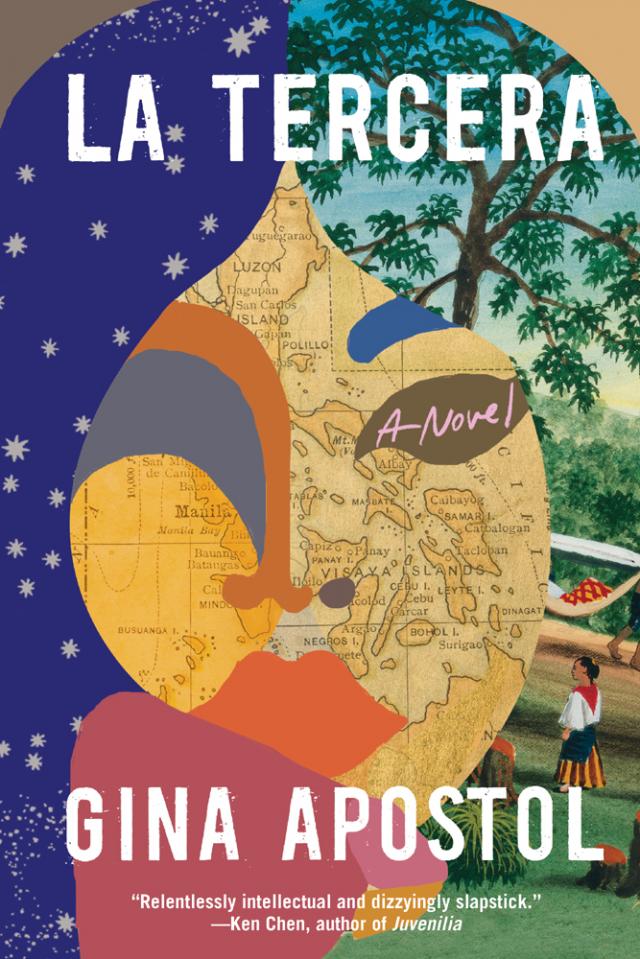
La tercera, p.1
La Tercera,
p.1


Also by Gina Apostol
Bibliolepsy
The Revolution According to Raymundo Mata
Gun Dealers’ Daughter
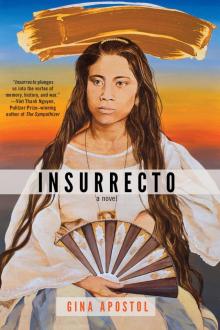
Insurrecto
Copyright © 2023 by Gina Apostol.
All rights reserved.
“Early Poems” from Doveglion: Collected Poems by José Garcia Villa, edited by John Edwin Cowen, copyright © 2008 by John Edwin Cowen, Literary Trustee, Estate of José Garcia Villa. Used by permission of Penguin Books, an imprint of Penguin Publishing Group, a division of Penguin Random House LLC. All rights reserved.
This edition first published in 2023 by
Soho Press, Inc.
227 W 17th Street
New York, NY 10011
Library of Congress Cataloging-in-Publication Data is available upon request.
ISBN 978-1-64129-390-7
eISBN 978-1-64129-391-4
Interior design by Janine Agro, Soho Press, Inc.
Printed in the United States of America
10 9 8 7 6 5 4 3 2 1
For my mother
Virginia
“Despedida kan Kirikay”
(Goodbye to Kirikay)
Lakat na la, lakat na la kun malakat ka.
Saho ko man, saho ko man bis’ ka ngain.
Lakat na la, di ak’ ha im’ mababaraka,
Ngan di ha imo magbibiling.
An budo ayaw pagdad-a,
An bahaw ngan luwag,
Layas na kun malayas ka,
Diri matangis an ak’ kalag.
Kapara na, kapara na ha ak’ paniplat.
Pahirayo, di ak’ ha im’ mag-aawil,
Pakadto na, gikan na ngan lurop ha dagat,
Bis’ bugkoton ka hin bukawil.
Diri gad ha im’ mahawid,
Paturon han paglakat—
Ibilin kalayo, tubig,
Di ak’ ha im’ maglalanat.
(Go, go, if that’s what you want! / I don’t care, don’t care where. / Just go, go, I don’t care! / I won’t be looking for you!
You can’t bring the salted fish, / The leftover rice, the ladle. /
Go, go if you must, / I won’t be grieving about it, for sure.
Get out, out of my sight. / Go away, I’m not going to miss you. /
Leave now, leave, jump in the sea if you will. / If a conch gobbles you up, that’s fine too.
Well, I’m not stopping you, / Go on, get going, / Just leave the fire behind, the water, / I’m not chasing after you, never.)
—Eduardo Makabenta; trans. Merlie Alunan
Inday, inday, nakain ka
Han kasunog han munyika
Pito ka tuig an paglaga
An asô waray kita-a.
(Inday, inday where were you / When the doll burned / Flaming for seven years / No one saw the smoke.)
—Waray folk song
Effects
Of the visible works left behind by Francisco “Paco” Delgado y Blumfeld and Jorge “Jote” Delgado y Blumfeld, what persists does not console. The long-dead brothers possessed the following effects:
1. a weird-looking guitar;
2. the rusted remains of chicken coops along the river Himanglos in Salogó;
3. a seawall, a.k.a. AWOL;
4. a digest of operatic libretti (in which a parasite has erased an etching of Lucia di Lammermoor and the ghost shape of a moth enshrouds the buried bride);
5. the name of a dog, Moret;
6. three volumes bound in leather, with a title in gold lettering, William McKinley’s World, resting in a domed sepulcher;
7. a wooden box, 9 x 18 x 3, inlaid with capiz, and on its lid the initials F.B.;
8. the journals of a boy already at war but not yet in his teens, 1899-1901;
9. maps of the area called San Jose in Tacloban and of a gleam of land, now called Greenhills, in metropolitan Manila.
They were hidden in plain view around the Delgado family home, a forsaken place in the wilds of Leyte, and the question of which brother owned what was moot. We called them both Lolo—their identities interchangeable because it seemed they had none: their world was incomprehensible.
For a long time, I mixed the brothers up.
No one in the house touched their effects except the worms.
The Delgados are a fretful clan, prone to delusions of pathos rather than grandeur. We linger on the abstract, such as despair and pride. I speak of the Delgados I know—my mother’s family—madmen and collaborators, so I’m told. By the time I had come across my mother’s inheritance, the banality of objects in the material world inhabited by her grandfathers had lost, for my mother, even the sense of the ridiculous—she had ceased to see them.
Instead, the memory of La Tercera, a place she had never known, drove her mad.
I grew up under the shadow of La Tercera. It was a legacy not quite tangible but not improbable. And this ambiguity has led members of my family, through generations, to acts that have ended in a sense of loss that burdens too many in the place I am from.
Top of the World
The voicemail was from my uncle, Tio Nemorino, the honorable mayor as they called him years after his regime.
I’d been calling my mother the entire month. She had no use for Messenger. Skype was dead to her. She owned no computers. She was the last woman in that selfie-happy archipelago to have only a rotary phone.
All I had was her voice.
During the years I’ve lived in New York, I admit I never called her much. I hate the phone. I mislay it, I pretend I’m not home, I hate the need to call people. The rest of the family knows. They know they will expect no birthday greetings, they will hear nothing from me when my books come out, they will learn about my readings on Facebook, where all the Filipinos are. I’m on Facebook for my books. I have a phone for my mom.
Her voice was girlish, high-pitched, the voice of one, I thought, who believed too easily in illusion. My mom lived in the future, and the present was a dislocation. She had the trick of making you think it was your existence that gave her joy—partly because of her childish voice, her intakes of breath as she spoke to you, as if her diaphragm and lungs were not formed enough for her thrill.
“Inday!” she said when it was first detected, “I’m so healthy. I just had my tests!”
She always called me inday, sounding like she had so many children she had forgotten my name, though I’m her only daughter.
“But Mom, Tio Nemor said—”
“My heart is good, my cholesterol is great, my lungs are perrrrfect! All I have is cancer! Without cancer I’m on top of the world!”
And she began to hum that song from my childhood.
I could see her doing the cha-cha with the cord of the rotary phone, shaking her hips, dressed in satin and silk, lithe and unconquerable in her feline way, like the stray cats that perched on the unfinished cement wall in Mana Marga’s dirty-kitchen, purring in the security of having so many lives.
When she was first told she should have surgery to take out her cancerous breast, she refused.
“How can you dance the tango if you have only one breast!”
I imagined her, Adina an guapa, pearled and perfumed, dancing the cha-cha to Karen Carpenter, in her high heels. I keep seeing her in her seventies bouffant—though in her last pictures, uploaded on Facebook by Putt-putt who never tags me but still I follow him, her hair has thinned. Her reflexive mode of existence was to go ballroom dancing. She wore high heels to water her orchids in the garden, and when I was a kid watching her use a brown eyebrow pencil to line her lips, she laughed as I stared—“Inday!” she said, humming as she did the weirdest things to her face, her deft fingers etching herself into shape—“does it look good, inday?” she asked.
“Yes,” I’d say, and it was true.
I grew up with the daring invention of my mom’s daily routines.
My mom wore her beauty in a way that was not a drag to others: we were just proud witnesses. Nothing marred her grace. People in Tacloban called her Adina an guapa, that was her nickname. Adina the beautiful. She emerged from her rituals looking somehow like Gina Lollobrigida, who was famous in Tacloban because she once posed by our fantastical bridge.
Adina an guapa was a silk-and-organza spectacle from the time of that first dictator, the locus of my memory of my mom.
“Top of the World” was her brother Nemorino’s campaign song, the one the band struck when Tio Nemorino ran for mayor in the seventies.
“You know that’s not a good allusion, Mom,” I said. “Karen Carpenter did not come to a good end.”
She told me not to return home.
She told me what mattered was that I was an artist—how could I leave New York, she said, when I had my career, I was a hysterical novelist, as she called with pride my vocation, my work on events so forgotten neither victors nor losers give a damn.
“It’s your dream, inday. You stay where you are. In Green Witch. To do your art.”
“Greenwich Village, Mom.”
“It says here on the postcard. Green Witch. Stay in Green Witch.”
So I did.
My mother’s gift to me was that she believed in all of my dreams, including the stupid ones.
She kept up a perfect face no matter how ordinary or significant the moment, so that neither her illness nor her love sent me home.
It was Tio Nemorino’s voice in my mailbox that told me she was gone.
The Court Case
It’s no surprise that in a country that exists on the argument of conquest, laws about the possession of land are murky. On All Sou
ls’ Day, how many families, bourgeois or not, but mostly bourgeois, burn candles on the plots of the dead only to rant on and on about some long-lost, stolen piece of land?
The evidence of the existence of La Tercera is tenuous but not mythical.
Of my mom’s lawsuit over her intestate Lolo Paco’s lands, I remember the outlines like vague crisscross shades produced by the nighttime gauze of mosquito nets, that shadow-roof of my childhood—though all my life my mother kept italicizing the facts.
Lolo Paco had no will, he had no child, when he died who should inherit his properties but us—the children of his blood, of his only brother, Jorge Delgado y Blumfeld, my Papá’s papá: your Lolo Jote!
I grew up with the incoherent details of Lolo Paco’s life and times while I scraped out burnt rice at the bottom of the kaldero or slapped at bugs that got through the moskitero’s gauze no matter how firmly my mom tucked me into bed. Minor acts or objects would set her off. Such as food. Once, the particular luster that day of her favorite—fresh hipon—the smelliest stuff on the table, I thought, though I was too polite and in awe of my mom’s appetite to mention it—reminded her how much her Lolo Paco had loved the hipon of Leyte, which he called bagoong, and among the bundles that her father, Mister Honorable Mayor Francisco Delgado III, would take on his annual pilgrimage to her Lolo Paco at Greenhills were those jars of purple sheen, Salogó’s hipon, wrapped in multiple layers of banig, so that if they spilled, the gusts of hipon would not ruin her father’s clothes. Lolo Paco also loved danggit, dried squid, and all the most awful kinds of budo-bulad—basically, he had a taste for smelly things—and I see my grandfather, the Honorable Mayor, also the town’s old music teacher, lugging the weight of his bounty from Salogó’s dust to Tacloban’s gangplanks to Manila’s piers. I kept imagining, with a sense of my own humiliation, this proud man, my mom’s Papá, arriving at his rich uncle the senator’s doorstep—stooped, sweating, and reeking of pusit—to deliver his homage of fermented shrimp fry and salted fish, the province’s bounty offered to Manila’s gods.
Every year, when she had to pay the school bills to the Divine Word Missionary School for my dumb education, my mom mentioned how she could have gone to high school in Manila, you know—and not just college at Far Eastern University in Sampaloc! Anyway, she never graduated from FEU because she refused to wear sneakers during PE, but that’s another story. If only her Papá had allowed her to live with childless Lolo Paco and his mean wife, Lola Chedeng, when he asked to take her—he wanted to adopt her when she was just a baby! Ah, instead, who got to be the child growing up at the senator’s dinner table?
Oh, that cripple, that orphan—that Madam Charity Breton!
That poliomyelitic!
“Oh my goodness, inday, how could she call herself a Delgado—she could not even walk! Agi nga poliomyelitic! An American with no name, left behind by a GI, a ward of the orphanage, a no-name saved by the Gotas de Leche! Ay leche, that Gotas de Leche!”
And at that last word, that unholy leche!, my mom started laughing.
I can see my mom, lifting her head up from her usual occupations, pasting weeds on cloth canvasses or gluing baubles on homemade lampshades, her veined finger sticky with her pastes, raised to her lips.
“Oh, inday, do not say that word leche, it is bad!”
And then she crossed herself because she had said the word again.
Listening to the way her holiness mixed with her prejudice, a troubling jumble of ethics that as a child I could not pinpoint as a portion of my malady, only that I felt it, I felt my mind skip over my unease the way I always moved the fish’s eye, prominent in my mom’s beloved tinola, to make it look away from me.
“Ah, inday, what would my life have been, if not for that orphan who took all of Lolo Paco’s lands, that greedy woman, your Auntie Charity Breton!”
“Well, Ma,” I said, “if you had grown up at Lolo Paco’s table, I think you would still be eating too much hipon and budo-bulad!”
It was the woman in the wheelchair, the cripple of Gotas de Leche, Auntie Charity Breton, who in my mom’s telling of the famous court case won La Tercera. The wonders of Lolo Paco’s money and the marvels of his generosity toward his poor relations in Salogó were equal parts torment and trophy for my mother. I once went with her to a musty government office in Manila—these were the times of her furious traveling, her flights from Tacloban, to become an “artist-businesswoman, an inventor!” She used to abandon us to the mercies of Mana Marga, her all-around servant and loyal clone, but at the time I was already in college, and she arrived at my dorm with her frames.
To my shame I called them that—her frames—canvases of stretched katsa or velvet on which she arranged wildflowers and vagrant grasses into intricate spirals of ineffable symmetry, using her own made-up paste to stick them into place (the glue, another invention, was called Adina EVERLASTING!™). She was disheveled but glamorous, wearing fuchsia high heels that almost matched her lipstick and eyeshade. On any other woman, that pink coordination would be fatal. Instead, my mom’s boldness persuaded people her choices were correct. Even Salome, the malevolent night guard of Kamia Residence Hall, looked at the apparition of Adina an guapa, dressed in blue georgette, with the tact one offers movie stars or madwomen. Salome used to scare me with her dagger eyes if I arrived two minutes after curfew. But with her gun in her holster and pudgy in her tight uniform, Salome helped my mom carry her frames down to the basement, to Room B-12, where my two roommates, an accounting major from Dagupan whose name I’ve forgotten, and Aurora, an anorexic neat-freak Ilongga studying for the bar in between getting beaten up by her law-school boyfriend, were fortunately away. It was a few weeks before exams. Adina an guapa slept that night in my dorm. I did not. I was cramming Part II of Don Quixote for my finals in Medieval and Renaissance Lit, groggy from inertia and from resentment at my mom’s sudden intrusion and from guilt that is the squire, the Sancho Panza, of my resentment.
I sat up on the edge of Aurora’s empty, well-made bed, listening to my mom snore, wondering where she had been, when she had arrived in the city, what she had been doing away from home, away from my brother Adino who was still in school, a child in Tacloban. She snored with a profound rattling, a heaving sound that made the cheap, metallic bed tremble, as if her entire body, her bones and her blood, her perfect heart and her healthy lungs, were unloading a misplaced weight, who knows who laid it, which in turn she was off-loading onto me, onto my bed, onto my dorm room at midnight, onto the haunted, postwar spaces of Kamia Residence Hall and my placid reading life with Sir Gawain and the Green Knight, with Proust, with the Tale of Genji, a life of books by which I had escaped Tacloban, though I now knew the sounds of my mother would never leave me, no matter how far I fled.
I woke up to my mother in my arms, her moist smell of armpit and Pond’s Cold Cream, the uncomfortable fabric of humid, filmy georgette, a cloth I hate because it does not breathe, stuck to my sweating palms. My face was wet, as if I had been crying, but it was only the sensation from the hollow of my mother’s neck, phantom tears from her clavicle soaking her dress, the cloth soaking up the sweat.
At the movement of my hand across her shoulder, she bolted straight up, and she said—“Is it Monday, inday, is it Monday?”
And it was on that Monday, a time in late February or early March (I measured time then by exams), that she took me to see her.
Auntie Charity Breton.
She needed me to help carry her frames. One was three feet by four, a gleaming glass object with what looked like gold filigree at its center, and I held it up on the four jeepney rides as if it were my doppelganger, the length of my seated body, held arm’s length, tipped toward my knees. I could see my face in its dark, obscure mirror, veined by the grasses of my mother’s gathering, with gold bunched at my chin like a stain or a puddle. How many hours had I spent in childhood watching my mother among weeds by the road, bent over and intent above wild grass, a high-heeled, hair-sprayed hunter-gatherer? From Diliman through Quezon Avenue, past Sampaloc where my mother did not go to high school, through the rotting, capiz-shelled homes of Malate toward Roxas Boulevard, I stared at the black canvas of my mother’s labor. It never occurred to me then to call it what it was. Our destination, a low warren of buildings backing into Manila Bay, turned out to be an outpost of the Department of Foreign Affairs.