

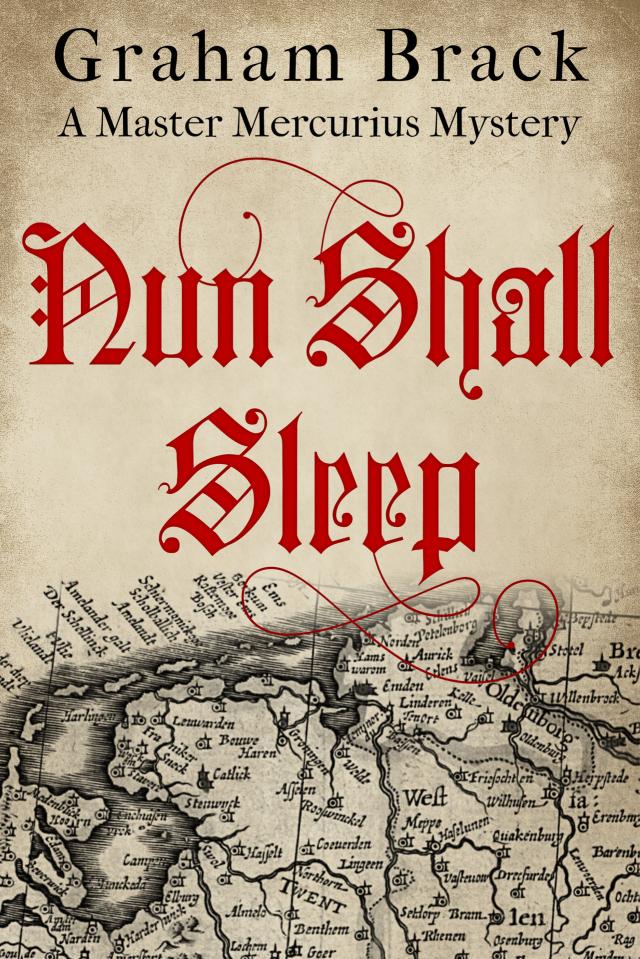
Nun shall sleep, p.5
Nun Shall Sleep,
p.5


His maid showed Liese to a room, and to my delight the minister then showed me his room and suggested that if I found it comfortable I could have the bed, and he would sleep on a mattress on the floor. Frans, needless to say, would be accommodated over the stable. I accepted at once, enjoyed a simple but tasty meal, and settled by the fire with a glass of excellent beer to enjoy some sensible conversation that did not revolve around the relative merits of satin and silk, whether rouge was injurious to the skin, or if it was vain to dress one’s hair high to give the impression of added height. Liese had retired immediately after we ate, the minister having suggested that his maid would prepare a hot bath for her if she so wished.
It was such a splendid diversion that I may have drunk more beer than usual, which is the only way I can account for the dream I had, possibly the oddest of my life. I recount it here primarily because of its strangeness, which left me puzzling over the message it was intended to convey to me.
Briefly, I entered a tavern. It was very busy, and I had never been there before. After a moment or two I heard my name called, turned towards the speaker, and found myself looking at my illustrious predecessor at Leiden, Adriaan Heereboord.
‘Mercurius! You’ll take a glass with me, won’t you? You look well!’ he said.
‘So do you, Heereboord,’ I replied, which was true, since he had been dead for nearly twenty-eight years by this time.
Now that my attention had been drawn to this remarkable fact, I could see several others there who had, to my certain knowledge, passed on to their reward. Unnerved by this, I tried to grasp Heereboord by the arm, but my hand passed straight through it.
‘Ah, that happens,’ he announced sadly. ‘The time to worry is when it doesn’t.’
‘What is this place?’ I hissed.
‘This? This is the Inn Between the Worlds. The dead can come in through the back door, and the living come in through the front. If your time was come you’d leave with me, but as it is, you’ll go back to your life to wait for another day.’
‘But what about Heaven? Or Hell? Or Purgatory?’
‘They come later. But once you see them there’s no going back. The Inn Between the Worlds is as far as mortals can go.’
He laughed and clapped me on the back. I realised in horror that I could feel it, which shocked me so much that I ran out of the door before Heereboord could seize hold of me. Even then I could feel hands grabbing me and pulling me down, down, down…
‘Master!’ said the minister. ‘I fear you were having a nightmare. Shall I bring you a beaker of beer?’
‘No, thank you,’ I said. ‘I’d better not.’
The next portion of the carriage ride was a sombre one. Liese respectfully held her peace, assuming that I had a hangover. In fact, I was mulling over that awful dream, which had left me discomfited. Was it a portent of my impending death? Had Heereboord come back to tell me to prepare myself? If I could feel his hand on my back that could only be because I had become spirit, as he was. I would like to say that I was too young to die, but Heereboord died at forty-seven, and I was then over fifty years old.
The astute reader will have noted that despite this anguish, I am now dictating this thirty-three years later and therefore I did not die. That is undoubtedly true, but it does not diminish the terrible effect that dream had on me. I still feel a little clammy when I think of it now. At the time it caused me a lot of soul-searching. Just because I wanted to go to Heaven does not mean that I wanted it to happen right at that moment. Actually, I am still a little ambivalent about it now. Heaven is a great ambition for people a little older than me. [Yes, Van der Meer, there are people older than me. At least I think there are. The last time I checked there was a nun in Utrecht who was ninety-four. And don’t say “If you say so” in that tone of voice.]
We had to make another unscheduled stop. Why do young women drink so much tea if they cannot keep it in? Frans and I stood by the carriage as she descended into a small ditch, there being no substantial vegetation nearby.
‘I never got the taste for tea,’ Frans said. ‘Foreign muck.’
‘I’ve only tried it once or twice.’
‘Have you ever seen an elephant, Master?’
What brought this on? There is an interesting thesis to be written describing how the brain of a coachman works. ‘No, I can’t say I have.’
‘I have. I saw an elephant from Ceylon when I was a small boy. Someone brought her here for his mingerie.’
‘I think you mean a menagerie.’
‘Do I? What’s a mingerie then?’
‘A place where you keep minges, I suppose. Whatever one of those is.’
‘Do you know, Master, elephants have long noses?’
‘So I believe.’
‘They don’t have fingers like us, so they pick up their food with their nose and push it in their mouths.’
That would be very handy when I am reading a book, I thought.
Liese returned so we re-entered the carriage. ‘I wondered how long it would be before you got the elephant story,’ she said.
CHAPTER FIVE
Let us advance a few days in the interests of the readers’ sanity and pick up our journey again at the last stage. We stopped in Melle as directed by the Abbess and found a man called Karl, who was verger of a church there. Karl, she had said, would give us directions for the remainder of the journey.
He must have done this many times before. He invited us to ascend a tower to the highest point of the church, where there was a window facing north.
‘You will see, gentlemen, a road leading slightly to the west of north. As you follow that road, there comes a point where the river on your left follows the road closely, then passes under a bridge. Turn right there, and follow the river as closely as you can. After about ten or fifteen minutes the river turns sharply north again. Instead, you will turn south along another path and very soon you’ll find a track into the forest on your left. That will lead you to the convent.’
I thanked him and offered him a small donation for the church, which he gratefully accepted.
‘You would do well not to stop on that track,’ he cautioned. ‘From time to time wolves have been seen there.’
‘In that case,’ Liese replied, ‘is there somewhere I can…?’
‘Out the back, miss. You might want to hold your skirts up. The apprentices from the printers’ workshop use it and they aren’t too fussy. Wedge the door shut with the short plank you’ll find there.’
By common consent we forewent any liquid refreshment in Melle and pressed on. Karl’s directions were very good and we soon found the track. Having followed it for the best part of an hour, I was beginning to wonder whether we had been the victims of a particularly cruel practical joke when suddenly the trees parted and we came across a kitchen garden, and then a fine building in cream stone.
One of the sisters came out to greet us.
‘I am Sister Dorothea,’ she said. ‘Do you have business here?’
‘My name is Mercurius. I have come at the invitation of Abbess Mathilde to work on your library and escort this young lady, Liese den Uyl, who is thinking of joining you.’
‘Oh, no!’ said Liese. ‘I’m not thinking of it. My mind is quite made up.’
‘I will tell Abbess Mathilde of your arrival,’ said Sister Dorothea. ‘She has been looking forward to it so much.’
Liese dropped to her knees and kissed the ground as we entered through the gate. Frans remained with the carriage.
‘Nuns or no, I’m not leaving chests unattended,’ he growled. ‘I suppose they won’t have a man to help me take them inside.’
‘I’ll ask,’ I said.
The beautiful building we had seen turned out to be the guest house and public rooms into which pilgrims could pass. Like many religious houses, the convent welcomed visitors who would swell their coffers, but unlike monasteries, the convent needed to protect the reputation of the nuns, so there had to be a clear demarcation between the areas the guests could use and those which were private to the sisters. In this case a short wing extended back from the public building with a narrow door that could be bolted, cutting it off. During the day this was where Sister Dorothea sat to keep an eye on arrivals.
She showed us a bench just inside the convent proper, where we were invited to wait while she fetched Abbess Mathilde. The Abbess presently appeared, as majestic and unhurried as ever, and greeted us warmly.
‘I am so happy that you have been able to conduct our new postulant to us,’ she said, ‘and to help us improve our library. I hope that it will not disappoint you, but there is always room for improvement. You remember Sister Hildegard?’
She indicated a young nun who stepped from the shadows. I had met her before when she accompanied Abbess Mathilde to Maastricht for our debate against the University of Leuven; but whereas Abbess Mathilde seemed not to have aged one day in the succeeding three years, Hildegard had grown from the shy young girl I remembered into a confident but demure woman.
‘Of course,’ I said.
‘She will show you to your rooms, and Hildegard will be Liese’s mentor here as our most recently professed nun. I am sure that you will want to refresh yourselves after your journey. Sister Dorothea, are there any men among our visitors who might help with our new guests’ trunks?’
‘I will ask, Abbess.’
‘If you would. Master, is your coachman returning at once?’
‘He hoped to rest overnight and leave tomorrow, if that is convenient.’
‘Then we must make him comfortable. There is an anteroom to your chamber where we can make up a bed, and Hildegard will ask Sister Angela to see your horses are stabled and cared for.’
The arrangements having been made, we retired to our quarters to have a wash and change our clothes. In my view, I had now completed the first of my tasks. Liese was safely delivered to her new home, so I was free to give all my attention to the matter of Abbess Mathilde’s library, and I was itching to start.
The custom of the convent was to celebrate matins, lauds and vespers communally, but for the other canonical hours the sisters merely paused in their work at the tolling of a bell to say their prayers. The bell now tolled for sext, indicating that it was midday, so all stopped to pray the Angelus. Since I was supposed to be a Reformed minister I was tempted to pretend that I did not know it. But since nobody was watching me, I said it, and suddenly felt a great sense of joy at not having to conceal my faith.
After a good wash and a change of clothes I presented myself in the hallway once more. Frans had declared his intention of doing all the sleeping he could before his return journey, so I left him to it and promised to let him know when meals were served. Liese, I was told, was being measured for her postulant’s habit. She would remain a postulant for around six months before beginning her formal novitiate, and although she was keen to start at once, a period of discernment was in the interests of both sides.
Abbess Mathilde pounced on me within seconds. How she knew I was there, I cannot tell. Perhaps nuns have some special sense.
‘I’m sure you are keen to see the library,’ she said.
“Keen” did not do justice to my feelings. I had not been so excited since my first visit from St Nicholas when I was a small boy (after a short tantrum because I had learned that he left presents for children in their clogs and my older brother Laurentius took a bigger size than me).
Mathilde led me along a corridor into the convent proper.
‘As our special guest you will of course have full access to the convent during daylight hours,’ she said, ‘though you will understand that after vespers we will ask you to return to your rooms and we will bolt the gate between the visitors’ and sisters’ areas. If you are in urgent need of anything during the hours of darkness there is a bell-rope just outside your room that will alert Sister Dorothea, who will come to stand just under your window to see how she can help.’
If only we had such an arrangement in Leiden connecting me to the kitchen so I could obtain refreshments without leaving my desk.
‘I need hardly say that there is no objection in the circumstances to your taking a book you happen to be reading back to your room.’
I was almost in Heaven, and without having to brave the Inn Between the Worlds to get there. I just hoped that they might have some books that I would like to read.
When I was a boy my grandmother used to refer to me from time to time as the flycatcher, owing to my habit of standing with my mouth open when surprised. ‘Do close it, dear, before people think you’re simple,’ she used to say. I fear that if she had been beside me when I entered the library she might well have said it again.
I do not know exactly how many books there are in the library at Leiden. There has not been a proper catalogue made since 1674, and relatively few books had been acquired that were published after 1660. Even the university’s own printers often overlooked their duty to lodge a copy of each new book in the library when published. Compton, the Bishop of London, had shown me his library, which was reputed to hold two thousand volumes. While the convent’s holdings were less extensive, there were a number of books that I had never seen, some antique but many of recent date.
‘I believe we have six hundred and two books,’ Mathilde said. ‘The sisters have been making a catalogue but none of them would claim to be a librarian and the catalogue lacks a sound system.’
I realise that I have been rather scathing in my memoirs about Friedrich Spanheim the Younger, and while I stand by many of my comments it is only fair to the man to record that he had worked tirelessly to produce the 1674 library catalogue and had devised an excellent system of shelf markers. In anticipation of my coming to the convent I had toured the shelves at Leiden making notes about his system so that I would not appear a complete idiot if questioned on the matter.
‘Sister Brigitte acts as our part-time librarian and will assist you in any way she can, Master. She is currently in the kitchen preparing supper but I can summon her if you wish.’
‘Thank you, but there is no need. Perhaps you could introduce me at supper?’
‘It will have to be just before supper. We prefer to eat in silence save for the reading of God’s word.’
‘Of course,’ I said, suitably chastened. At Leiden when the students are in the refectory you can hardly hear yourself think. At least the nuns would not throw hunks of bread at one another. ‘Maybe I might be permitted to browse a while, to familiarise myself with the contents of your magnificent library?’
‘You are very kind,’ said Mathilde, ‘but it is not yet magnificent. It will approach it under your guidance, I am sure.’
‘May I ask how large the bequest is that you wish to spend?’
‘Of course. We have just over five hundred silver reichsthalers.’
I grabbed the edge of a shelf for support. That was equivalent to around twelve hundred and fifty guilders. Even in a good year the librarian at Leiden had to get special permission from the Curators to spend more than three hundred guilders on books. I did not know where I would even find that quantity of books for sale; not in nearby Osnabrück, that was certain.
The reader will understand that at this point I was desperate to dive into the shelves to see what I could find, like a child who has been left alone with the household honey pot, but Abbess Mathilde wanted me to see something else.
‘There is a small chapel available to pilgrims at the end of the guest house,’ she explained. ‘You will find it very convenient for your chamber. But I hope you will accept our full hospitality and join us in our chapel whenever you are able.’
This was a rare honour. With the exception of the priests who come in to say Mass, men are not generally permitted within the convent chapel.
‘Perhaps you would also do us the honour of saying Mass for us?’
I had been thoroughly rumbled. The secret I had kept perfectly well for twenty-five years — well, obviously not perfectly, because I had been found out, but very carefully — was no secret at all to this remarkable woman. She had made an oblique remark in Maastricht that led me to think that she might have divined where my religion really lay, though how she did that I could not say. I realised that the palms of my hands had turned sweaty and I felt that I ought to say something, but what?
There were two considerations for me. First, how did she know? There is no better way of finding out than by asking the question. ‘May I know how you discovered my secret?’
She smiled, such a sweet enigmatic smile, then wagged her finger gently at me. ‘If you don’t want to look like a Catholic, don’t mouth the words as others say their prayers!’
‘Did I?’
‘At Maastricht. Then, when you said grace to yourself before we ate, I heard your prayer. It didn’t sound very Reformed to me.’
‘I’m not masquerading because I want to,’ I insisted.
‘I know. You’d lose your job if people knew. But you must be a fine priest, so one reason for inviting you was to give you the chance to be yourself for a short while. Nobody here knows you except Liese and me, and we don’t get out much. If she notices, I will solemnly tell her that she is never to share your secret under pain of ignominious dismissal from the convent.’
That dealt with my second consideration, that others would come to know; and suddenly I felt a great weight lifted from me. ‘Then I would be proud to say Mass for you,’ I said. ‘But I must caution you that I am rather rusty. I may not be very fluent.’
‘Our normal priests do it somewhere every day and they aren’t very fluent either,’ she said. ‘Now, let me show you our treasury. We have some splendid relics there.’
How right she was! I am normally quite unimpressed by relics. So many of them are palpably bogus. St Peter, for example, apparently had at least three arms. If you added together all the pieces of the True Cross around Europe then it is no surprise that Jesus stumbled under its weight, for it must be three times the height of a man. There are even several places that claim to have Jesus’ foreskin. I am not an expert in such matters, but I think that only one of them could possibly be telling the truth about that, and I am not clear why anyone would have kept it in the first place.


